小熊跑的快

Search documents
美国缺电
小熊跑的快· 2025-12-19 12:20
Core Insights - The article discusses the projected electricity shortfall in the United States, particularly focusing on the impact of GPU clusters from NVIDIA, which are expected to consume a significant amount of power by 2027 [1] - The estimated electricity generation capacity for the U.S. in 2024 is approximately 4,309 TWh, translating to an average generation capacity of around 492 GW [1] - By 2028, the projected electricity shortfall is estimated to be around 50 GW, which represents about 9% of the actual electricity generation [3] Group 1 - In 2027, NVIDIA's GPU clusters are expected to consume between 150-200 GW of electricity, while the total electricity consumption of data centers in 2023 was only 20 GW [1] - The net summer capacity for electricity generation in the U.S. in 2024 is projected to be around 1,230 GW, with a nameplate capacity of approximately 1,325 GW, indicating a significant difference between installed capacity and actual average generation [1] - A previous estimate in 2024 indicated that the electricity shortfall was about 1.1% of the actual generation, which has now increased to 9% by 2028 [2][3] Group 2 - There are issues with electricity transmission in the U.S., particularly highlighted by Texas, where a new 2 GW project has struggled to find more than 1 GW of new supply [4] - The quality of electricity supplied to mining operations is reportedly poor, leading to concerns about the viability of current locations for construction [4][5]


美光打破近期阴霾
小熊跑的快· 2025-12-18 00:34
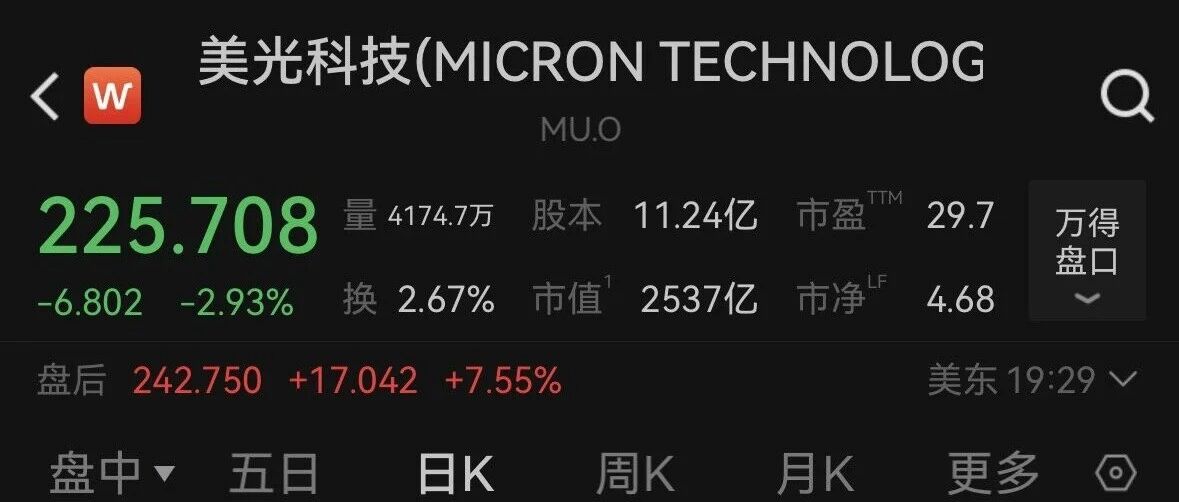
还好。美光盘后表现不错,需求和利润率双增!打破了微软 博通带来的阴霾(数据好 不涨的阴霾)。 1) 营收为136.4亿美元,高于上一季度的113.2亿美元和去年同期的87.1亿美元。 2)美国通用会计准则计算,净利润为52.4亿美元,即每股摊薄收益4.60美元。 3)非GAAP净利润为54.8亿美元,即每股摊薄收益4.78美元。 4)经营活动产生的现金流为 84.1 亿美元,而上一季度为 57.3 亿美元,去年同期为 32.4 亿美元。 下个Q营收预计187亿美元±4亿美元。分析师预期为142亿美元,主要靠涨价超预期! 指引很不错:公司还预测第二季度盈利能力将大幅提升, GAAP毛利率:67.0% ± 1.0% 非GAAP毛利率:68.0% ± 1.0% GAAP摊薄后每股收益:8.19美元 ± 0.20美元 市场接受需求继续上涨的表述!未来1-2Q内存周期盈利能力更强。 市场认需求上涨周期! 美光科技(MICRON TECHNOLOG W MU.O 225.708 量 4174.7万 股本 11.24亿 市盈T™ 29.7 万得 盘口 -6.802 -2.93% 换 2.67% 市值 2537亿 市净 4. ...
真的假的google 供都在表演
小熊跑的快· 2025-12-17 07:01
格局上看 已知的光有一 二供,液冷有二供。 其它环节零零碎碎的还不知道情况。 昨天一条消息就引爆了全市场。没想到。 google的人是在华南,也确实有收获。 ...

robotaxi 准不准?
小熊跑的快· 2025-12-17 00:29
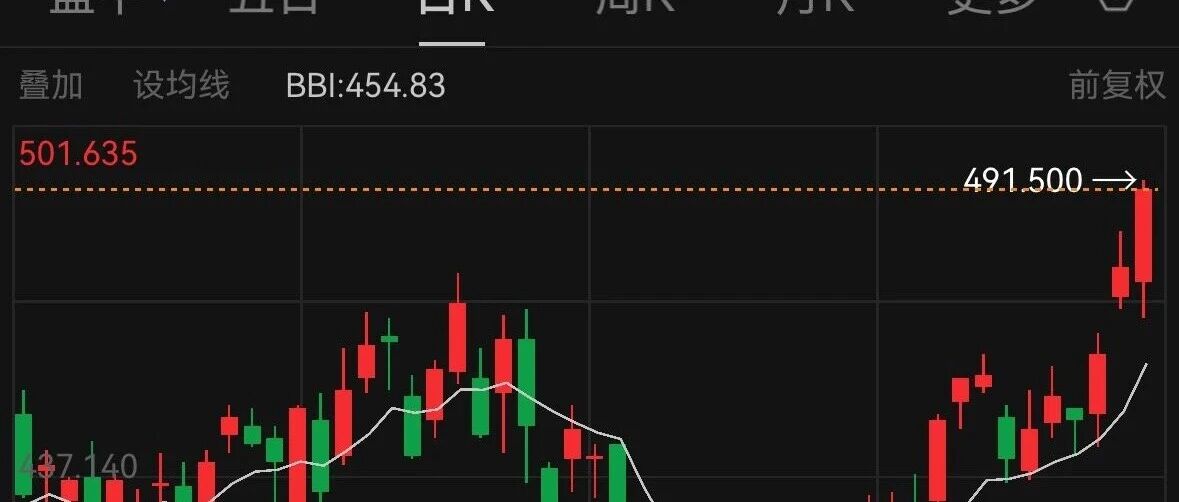
Group 1 - The article highlights a positive outlook on the robotaxi sector, indicating that it has started to perform well, although the A-share market has not yet reflected this trend [1] - It mentions that the unit economics for robotaxi have turned positive, meaning that individual units are no longer operating at a loss [2] - The article references an upcoming event by ByteDance on December 18, which will showcase several AI-related products, including AI smartphones, AI glasses, and AI ear devices [2] Group 2 - Tesla's stock performance is discussed, with a current price of $489.88 and a market capitalization of $1,629.3 billion, alongside a price-to-earnings ratio of 321 [2] - The article provides technical indicators for Tesla's stock, including MACD and TRIX values, suggesting a detailed analysis of its trading performance [3]

杂谈美股这个位置
小熊跑的快· 2025-12-16 08:10
Group 1 - Broadcom's performance was disappointing despite strong order volume and guidance for $8.2 billion in AI semiconductor revenue for the next quarter [1] - The market perceived a $1 billion order from a suspected OpenAI client as underwhelming compared to the $21 billion in combined orders from Anthropic over two quarters [1] - Gross margin is expected to decline due to the shift from software and proprietary components to AI semiconductors and outsourced components, which is a continuation of a trend observed in the previous quarter [1] Group 2 - ServiceNow announced the acquisition of cybersecurity company Armis, resulting in an 11.5% drop in its stock price, attributed to intense competition in the cybersecurity SaaS market [2] - The cybersecurity SaaS sector is currently one of the best-performing areas in software, with companies like Net and CrowdStrike leading the way [2] - A recommendation for a data aggregation tool, "Red Rocket," was made for easier fund screening and comparison, particularly for ETFs, highlighting its user-friendly features [2]


甲骨文故事多
小熊跑的快· 2025-12-14 13:21
Group 1 - Oracle has confirmed that it will complete the data center for its major client OpenAI in 2028 instead of 2027 due to labor and material shortages [1][3] - OpenAI's training infrastructure relies on collaboration with NVIDIA and Microsoft, utilizing Azure data centers and various NVIDIA GPUs, which enhances model intelligence and accelerates market readiness [2] - The company is currently facing a significant free cash flow deficit of $10 billion, and after excluding a $2.7 billion gain from asset sales, the investment return rate is alarmingly low, indicating a potential decline [2] Group 2 - Oracle's spokesperson did not specify when the cloud computing infrastructure for OpenAI will be operational, and OpenAI has made commitments to other companies to meet anticipated AI capability demands, although these agreements are not final [3] - There is a belief that companies expanding too aggressively in the AI era may face setbacks, while more stable companies are likely to endure longer [2]

博通 数据还可以
小熊跑的快· 2025-12-12 00:17
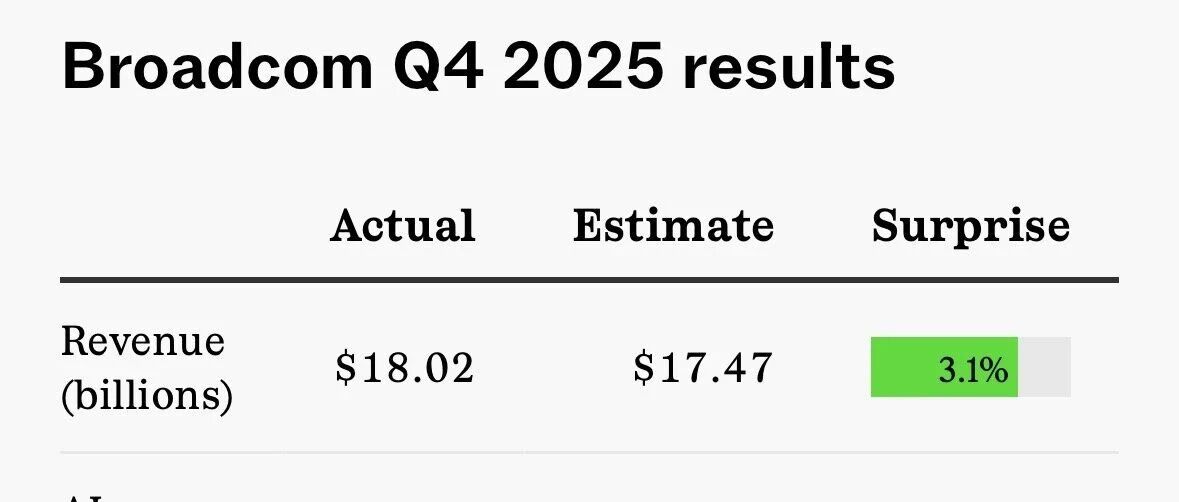
Core Viewpoint - Broadcom's financial results are strong, with revenue exceeding expectations, but the stock experienced volatility post-earnings due to lack of significant positive guidance [1][4]. Financial Performance - Revenue for the quarter was $18.02 billion, surpassing the forecast of $17.49 billion by 3.1% [6]. - Adjusted EPS was $1.95, above the expected $1.86, representing a 4.3% surprise [2][6]. - The company projects first-quarter revenue of approximately $19.1 billion, a 28% year-over-year increase, exceeding analyst expectations of $18.3 billion [3]. Segment Performance - Infrastructure software sales grew by 26% to $6.94 billion, exceeding Wall Street expectations [4]. - AI chip sales in the semiconductor solutions segment reached $11.07 billion, a 22% year-over-year increase, also surpassing expectations [4]. Profitability and Cash Flow - Gross margin improved to 78% from 72% year-over-year [5]. - Free cash flow for the quarter was $7.5 billion, accounting for 41% of revenue [5]. Order Backlog and Future Outlook - Broadcom has a backlog of $73 billion in orders for AI custom chips, switches, and other data center components over the next 18 months [6]. - AI chip orders are expected to double to $8.2 billion in the first quarter of next year [6]. - The company has $49 billion in unfulfilled contracts for infrastructure software, up from $49 billion a year ago [6]. Customer and Market Dynamics - The company secured $11 billion in orders from Anthropic for TPU [7]. - A new AI customer contributed an additional $1 billion in orders, with speculation about OpenAI being the fifth customer [8]. Strategic Questions from Analysts - Analysts inquired about customer-designed front-end tools and how the company plans to respond, to which the company noted the complexity of chips [8]. - Questions were raised regarding the readiness for 2/3nm wafers and HBM, with the company confirming active investments in a packaging facility in Singapore [9]. - Concerns about potential gross margin declines due to rising HBM prices were acknowledged, with the company indicating a need for adjustments [10].

明早出博通
小熊跑的快· 2025-12-11 11:12
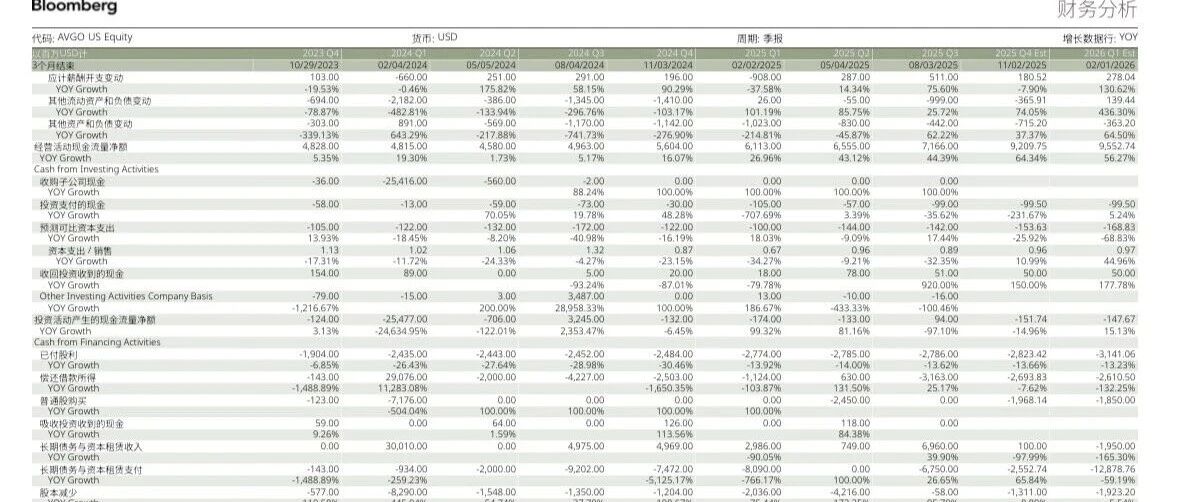
| | | | | | | | 周期:李报 | | | | CORPORATION 增长数据行:YOY | | --- | --- | --- | --- | --- | --- | --- | --- | --- | --- | --- | --- | | Hill AVGO US Equity | | | 2150 - 1130 | | | | | | | | | | WE ALSO | | 2023 04 | 177 10 | 2020 02 | 202 A CC | 2024 Or | 2025 01 | 2025 02 | ROHN OF | HELS OR E | 2176 OF EST | | 3个月绿变 | | 10/29/2023 | 02/04/2024 | 05/05/2024 | 08/04/2024 | 11/03/2024 | 02/02/2025 | 05/04/2025 | 08/03/2025 | 11/02/2025 | 02/01/2026 | | 应计新疆开变变动 | | 103.00 | -660.00 | 251.00 | 291.00 | 196.00 | -90 ...