
digihuman(835670)

Search documents
数字人民币2026年起可生息,全球首例央行数字货币计息政策
Sou Hu Cai Jing· 2025-12-30 03:42
Core Insights - The digital renminbi wallet will start earning interest like a bank's demand deposit from January 1, 2026, marking a significant shift in its monetary policy [1] - The digital renminbi transitions from a central bank liability (cash-like) to a commercial bank liability (deposit-like), entering a new era of "deposit currency" [2] User Impact - Increased willingness to use: The introduction of interest will make digital renminbi more attractive compared to traditional bank deposits and third-party financial tools [5] - Financial system optimization: The new policy mitigates the risk of "financial disintermediation" by ensuring funds return to the banking credit cycle, thus maintaining financial stability [5] - International leadership: China becomes the first economy to design an interest mechanism for central bank digital currency (CBDC), reinforcing its leadership in the digital currency space [5] Industry Opportunities - Bank IT transformation: Core systems will need to adapt to the deposit currency attributes, benefiting companies like Changliang Technology and Shenzhou Information [6] - Hardware terminal updates: POS machines and ATMs will face a wave of digital replacements, providing opportunities for firms like Newland and Newland Digital [6] - Security and encryption demand: There will be a growing need for technology to ensure transaction stability, benefiting companies like Weishitong [6] Existing Controversies and User Pain Points - Insufficient convenience: Some users find the transfer process cumbersome, requiring bank card intermediaries, and offline merchant coverage remains lower than WeChat and Alipay, especially in smaller cities [7] - Reduced incentive for usage: The decrease in promotional activities like consumption red envelopes and discounts during the early pilot phase affects daily usage motivation [8] - Varied technology acceptance: Older demographics show lower acceptance of digital interfaces, despite improvements in accessibility features like voice interaction [9] Data Support and Future Layout - Current scale: As of November 2025, the cumulative transaction amount reached 16.7 trillion yuan, with 230 million personal wallets opened [10] - Dual-center architecture: The Shanghai International Operations Center focuses on cross-border settlements, while the Beijing center oversees technical security [10] - Inclusive deepening: Plans to expand features like "pay-as-you-go" (automatic bank card recharge) and smart contracts (conditional payments) to enhance user convenience [10]



数字人民币余额有利息收?新政发布,消费者如何办理
Nan Fang Du Shi Bao· 2025-12-30 03:25
Core Viewpoint - The People's Bank of China has introduced an action plan to enhance the management and service system of the digital renminbi, which will take effect from January 1, 2026, allowing banks to pay interest on customers' real-name digital renminbi wallet balances [2][3] Group 1: Digital Renminbi Overview - The digital renminbi, a legal digital currency issued by the People's Bank of China, can be used in various scenarios such as transportation, dining, shopping, and utility payments [3] - The action plan establishes a framework for measuring digital renminbi and incorporates it into the reserve requirement system, marking a transition from a cash-like version to a deposit currency version [3] Group 2: Interest Payment Mechanism - Banks will pay interest on customers' real-name digital renminbi wallet balances, adhering to self-regulatory pricing agreements for deposit interest rates [3] - The digital renminbi will transition from being considered "electronic change" to "digital deposits" that earn interest [3] Group 3: Wallet Types and Management - Digital renminbi personal wallets can be opened through designated operating institutions, which currently include 10 banks [4] - Wallets are categorized into four types based on identity verification strength, with varying levels of anonymity and balance limits [4][6] - The first two wallet types require bank account binding, while the third and fourth types have additional operational requirements for recharging or returning funds to banks [4] Group 4: Interest Accrual and Limits - Different wallet types have specific balance limits, with the first type having no upper limit and the second to fourth types capped at 500,000, 20,000, and 10,000 respectively [6] - Not all wallet types will earn interest; only real-name wallets (first, second, and third types) will receive interest based on the People's Bank of China's rules for current deposit interest [6] - The digital renminbi is included in the deposit insurance scheme, providing the same level of security as bank deposits [6] Group 5: Transaction Statistics - As of November 2025, the digital renminbi has processed 3.48 billion transactions, with a total transaction amount of 16.7 trillion yuan, and 230 million personal wallets have been opened [7]






央行定调:数字人民币迈入“计息时代”
Sou Hu Cai Jing· 2025-12-30 03:15
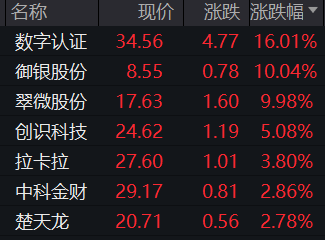
Group 1 - The People's Bank of China has introduced an action plan to strengthen the management service system and related financial infrastructure for digital RMB, with a new framework set to be implemented on January 1, 2026 [2] - From January 1, 2026, digital RMB wallet balances will earn interest similar to demand deposits, marking a transition from "digital cash" to "digital deposit currency" [2] - By the end of November 2025, digital RMB has processed 3.48 billion transactions with a total transaction amount of 16.7 trillion yuan, showing positive results in various sectors including retail, education, and cross-border payments [2] Group 2 - The implementation of the plan signifies the evolution of digital RMB from cash-type 1.0 to deposit currency-type 2.0, supported by central bank technology and regulatory oversight [3] - The future digital RMB will function as a modern digital payment and circulation method within the financial system, possessing attributes of commercial bank liabilities and compatible with distributed ledger technology [3] - Following the announcement, related digital currency concept stocks in the capital market saw significant activity, with notable increases in stock prices for companies such as Digital Certification and Yuyin Co [3]

数字人民币计息时代来了
Di Yi Cai Jing Zi Xun· 2025-12-30 03:05
Core Viewpoint - The People's Bank of China has introduced an action plan to transition digital renminbi from a cash-based system to a deposit currency system, set to be implemented on January 1, 2026, allowing interest to be paid on digital renminbi wallet balances [2][3][4] Group 1: Digital Renminbi Transition - The digital renminbi will shift from being classified as M0 (cash in circulation) to a deposit currency, which will allow it to earn interest, thus enhancing its appeal to users [3][4] - The new framework will enable banks to pay interest on customer digital renminbi wallet balances based on their respective current deposit rates, aligning with market expectations [2][4] - This transition is expected to improve the willingness of individuals and markets to use digital renminbi, as it addresses concerns about inflation and the time value of money [3][4] Group 2: Banking Sector Implications - The adjustment will transform digital renminbi from a direct liability of the central bank to a liability of commercial banks, integrating it into their balance sheets [4][6] - Banks will gain the ability to manage digital renminbi assets and liabilities, shifting their role from cost centers to profit centers, which is anticipated to enhance their motivation to promote digital renminbi [7][6] - The new system will allow for a more efficient management of digital renminbi, leveraging traditional account payment efficiencies while incorporating innovative features like smart contracts [4][6] Group 3: Regulatory Framework - The action plan establishes a "separation of management and operation" principle, creating a management committee to oversee digital renminbi operations and ensure regulatory compliance [11][12] - The plan aims to enhance the regulatory framework for non-bank payment institutions, ensuring consistency in the management of digital renminbi and customer funds [5][12] - Future pilot programs for digital renminbi will shift from geographic trials to scenario-based trials, with an emphasis on expanding operational institutions under controlled risks [12][11] Group 4: Market Impact - The digital renminbi's usage is expected to expand significantly, with transaction volumes projected to reach 34.8 billion by November 2025, amounting to over 16.7 trillion yuan [9] - The digital renminbi's integration into the banking system is anticipated to facilitate its application across various sectors, supporting the broader economy and enhancing consumer spending [12][9] - The transition is also seen as a strategic move to solidify China's position in the global central bank digital currency landscape [9][10]

数字人民币迎来重大调整 央行出台行动方案
Xin Hua She· 2025-12-30 02:49
记者12月29日从中国人民银行获悉,新一代数字人民币计量框架、管理体系、运行机制和生态体系 将于2026年1月1日正式启动实施。数字人民币将从数字现金时代迈入数字存款货币时代。这意味着数字 人民币迎来重大调整。 来源:新华社 在总结十年研发试点经验基础上,中国人民银行出台了《关于进一步加强数字人民币管理服务体系 和相关金融基础设施建设的行动方案》。根据制度安排,客户在商业银行钱包中的数字人民币是以账户 为基础的商业银行负债,标志着数字人民币由现金型1.0版进入存款货币型2.0版。(记者吴雨) ...
享活期利息,数字人民币计息时代来临!货币层次扩展,丰富银行生态
Di Yi Cai Jing· 2025-12-30 02:30
Core Viewpoint - The digital renminbi is transitioning from a cash-based currency to a deposit currency, allowing interest to be paid on customer wallets by banks starting January 1, 2026, as per the People's Bank of China's action plan [2][3][4]. Group 1: Digital Renminbi Transition - The new framework will enable banks to pay interest on customer digital renminbi wallet balances, aligning with the bank's current savings account interest rates [2][3]. - This shift from M0 (cash) to a deposit currency (2.0 version) will enhance the willingness of individuals and markets to use digital renminbi [2][3][4]. - The digital renminbi will now be treated as a liability of commercial banks, integrating it into their balance sheets and allowing for better asset-liability management [3][7][8]. Group 2: Interest Payment Mechanism - Interest on digital renminbi will be linked to the bank's current deposit rates, ensuring compliance with deposit rate pricing self-discipline agreements [4][5]. - The funds will be protected by deposit insurance, addressing user concerns about the safety of their funds [4]. - Users seeking higher anonymity will have to forgo some interest earnings, reflecting a balance between privacy and financial benefits [4]. Group 3: Impact on Banking Sector - The new system is expected to motivate banks to actively promote digital renminbi, transforming their role from cost centers to profit centers [8][9]. - The adjustment will allow banks to manage digital renminbi assets more effectively, enhancing their participation in the digital currency ecosystem [7][8]. - The transition is anticipated to resolve financial disintermediation risks and stabilize bank liabilities [7][9]. Group 4: Regulatory Framework - The action plan establishes a "separation of management and operation" principle, creating a digital renminbi management committee for regulatory oversight [11][12]. - Two operational centers will be responsible for domestic and cross-border digital renminbi systems, ensuring safety and continuity [11][12]. - Future pilot programs will shift from geographic to scenario-based trials, with an expansion of operational institutions based on risk management capabilities [12].
数字人民币生态建设提速!央行新政2026年实施,御银股份、翠微股份、航天信息涨停
Jin Rong Jie· 2025-12-30 02:04
Core Viewpoint - The digital currency sector is experiencing significant activity, driven by the accelerated development of the digital RMB ecosystem and supportive policies, which are expected to benefit related companies as the digital RMB scales up [1][2]. Market Performance - As of December 30, the digital currency sector saw notable stock performance, with Digital Certification rising over 16%, and Yuyin Co., Cuiwei Co., and Aerospace Information hitting the daily limit [1][2]. - Specific stock prices and changes include: - Digital Certification: 34.56, up 16.01% - Yuyin Co.: 8.55, up 10.04% - Cuiwei Co.: 17.63, up 9.98% [2]. Policy Developments - The People's Bank of China has issued a plan to enhance the digital RMB management service system and related financial infrastructure, with a new framework set to be implemented on January 1, 2026 [2]. - The revision of the CIPS business rules aims to optimize cross-border payment processes, facilitating the exploration of digital RMB applications in cross-border scenarios [3]. Industry Analysis - **Digital RMB Technology Services**: The promotion of digital RMB requires technical support such as encryption certification and payment terminal adaptation, leading to increased demand for these services as application scenarios expand [4]. - **Cross-Border Payments**: The revised CIPS rules will enhance efficiency and security in cross-border payments, benefiting companies involved in cross-border payment technology and related system development [4]. - **Financial Hardware Devices**: The implementation of digital RMB necessitates hardware like POS machines and ATMs, providing opportunities for manufacturers to upgrade or develop new products [4]. - **Financial Software Systems**: Financial institutions will need to upgrade their core and payment systems to accommodate digital RMB, creating demand for customized solutions from software development companies [4].
数字人民币迎来“升级”7只概念股获主力资金抢筹
Sou Hu Cai Jing· 2025-12-30 01:28
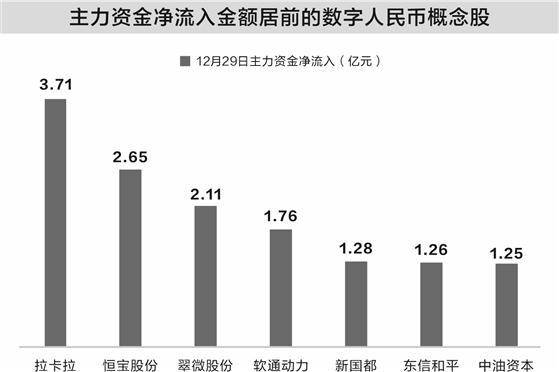
Group 1 - The People's Bank of China will implement a new action plan for the management and service system of digital RMB, with a new framework and ecosystem set to launch on January 1, 2026, marking an upgrade from digital cash to digital deposit currency [2] - As of November 2025, digital RMB has processed 3.48 billion transactions with a total transaction amount of 16.7 trillion yuan, and 230 million personal wallets have been opened through the digital RMB app [2] - The mBridge project has processed 4,047 cross-border payment transactions, amounting to approximately 387.2 billion yuan, with digital RMB accounting for about 95.3% of the total transaction volume [2] Group 2 - On December 29, 2022, seven digital RMB concept stocks saw net inflows exceeding 100 million yuan, with Lakala leading at 371 million yuan [3] - The "14th Five-Year Plan" emphasizes the steady development of digital RMB, with applications expanding from personal consumption to industrial finance, cross-border trade, and public services [3] - Various regions are exploring innovative applications of digital RMB, including its use in debt settlement and industrial internet scenarios [3] Group 3 - Guotai Junan Securities believes that digital RMB will accelerate penetration across the supply chain, with significant growth potential in banking IT and fintech sectors [4] - The demand for bank system upgrades and digital wallet development will be driven by digital RMB, while the payment ecosystem will see increased demand for POS machines and ATMs [4] Group 4 - A total of 64 A-share companies are involved in digital RMB-related businesses, with the computer industry having the highest representation at 43 companies [5] - Eight digital RMB concept stocks have been heavily favored by institutional investors, with a total market value of 2.939 billion yuan held by social security funds and pension funds [5] - Unisoc Microelectronics has seen significant investment from social security funds, with a market value of 1.89 billion yuan, and has made technological advancements in digital currency hardware [5]
民营火箭回收再添新成员,“新空间航天”宣布正式启动赤兔 1号运载火箭回收测试;央行已出台数字人民币行动方案,明年1月1日正式启动实施——《投资早参》
Mei Ri Jing Ji Xin Wen· 2025-12-30 01:17
Market Overview - The U.S. stock market saw slight declines with the Dow Jones down 0.51%, Nasdaq down 0.5%, and S&P 500 down 0.35%. Major tech stocks mostly fell, with Tesla down over 3% and Nvidia down over 1%. Intel rose over 1%, while Apple and Google saw slight increases. The Nasdaq Golden Dragon China Index fell 0.67%, with most Chinese concept stocks declining [1] - European stock indices had mixed results, with Germany's DAX up 0.05%, France's CAC40 up 0.1%, and the UK's FTSE 100 down 0.04%. International oil prices rose significantly, with U.S. oil up 2.01% at $57.87 per barrel and Brent crude up 1.96% at $61.42 per barrel. Gold and silver prices fell sharply, with spot gold down over $200, a decline of 4.36% [2] Industry Insights - China's private rocket company "New Space Aerospace" announced the launch of key technology tests for the recovery and reuse of the Chitu-1 rocket, indicating progress in low-cost, high-reliability space technology. The Shanghai Stock Exchange has provided clearer pathways for commercial rocket companies to list on the Sci-Tech Innovation Board [3] - The satellite internet sector is expected to become a new industrial field, with the satellite communication industry projected to exceed 200 billion to 400 billion yuan by 2030, with an annual compound growth rate of 10%-28%. This sector is transitioning from concept validation to large-scale application, becoming a key driver for high-quality digital economic development [4] - The People's Bank of China released an action plan to strengthen the management and service system for digital RMB, with a new framework set to be implemented by January 1, 2026. As of November 2025, digital RMB transactions reached 34.8 billion, totaling 16.7 trillion yuan [5] - The digital RMB cross-border payment system is expected to connect with ASEAN and Middle Eastern countries, potentially allowing 38% of global trade to bypass the SWIFT system. The central bank's digital currency bridge model facilitates cross-border payments without intermediary banks [6] - Dongguan Jimu Machinery Co., Ltd. increased its registered capital from 3.89 billion yuan to approximately 4.689 billion yuan, a rise of about 21%. This company, fully owned by Huawei, is expected to play a significant role in the humanoid robot industry [7] - The humanoid robot industry is anticipated to enter a critical growth phase in 2025, driven by advancements in component performance and cost reduction. The domestic market is expected to see significant growth in robot shipments, with key beneficiaries in core supply chains and application scenarios [8]
可以付息了!数字人民币迎来2.0版
Sou Hu Cai Jing· 2025-12-30 00:55
Core Viewpoint - The new generation of digital RMB will officially launch on January 1, 2024, transitioning from a cash-based system to a deposit currency system, allowing for interest payments on digital RMB balances held in banks [1][4]. Group 1: Transition to Deposit Currency - The People's Bank of China has introduced a plan to enhance the management and service system for digital RMB, marking a shift from digital cash to digital deposit currency [1][2]. - This transition will significantly improve the liquidity of digital RMB within the banking system, as it allows for interest accrual on digital RMB held in bank accounts [2][4]. Group 2: Operational Changes - Digital RMB will now be classified as a liability of commercial banks rather than the central bank, indicating a major upgrade from version 1.0 to version 2.0 [3][4]. - Commercial banks will be responsible for the operation, security, and reliability of digital RMB, which will incentivize them to offer more financial services related to digital RMB [4][6]. Group 3: User Experience and Security - The user experience for payments will remain largely unchanged, but the ability to earn interest on digital RMB deposits will be a significant enhancement [5]. - Digital RMB will be supported by the central bank's technology and regulatory oversight, with commercial banks responsible for customer security and compliance, including deposit insurance coverage up to 500,000 RMB [6][7]. Group 4: Implementation and Impact - Since its inception in 2014, the digital RMB has seen successful trials across various sectors, with significant transaction volumes reported, including 34.8 billion transactions totaling 16.7 trillion RMB by November 2025 [7]. - The dual-layer operational system of "central bank-commercial institutions" aims to steadily advance the integration of digital cash and electronic payments into a robust digital currency framework [7].