
digihuman(835670)

Search documents
数字人民币对阵纸币:苏州试点六年真相如何?看未来支付格局
Sou Hu Cai Jing· 2025-10-08 19:55
Core Insights - The article highlights the rapid adoption and integration of digital RMB in Suzhou, showcasing its advantages over traditional cash and other payment methods [1][3][4]. Group 1: Digital RMB Adoption - As of May 2025, Suzhou has opened 23.5 million personal wallets, covering approximately 87% of the local population, with a total transaction amount exceeding 21 trillion RMB nationwide [1]. - By the end of 2023, over 75% of merchants in Suzhou supported digital RMB payments, expanding beyond commercial venues to include public services like utilities and healthcare [3][4]. Group 2: Development Timeline - The digital RMB project began in 2019, with Suzhou participating as a pilot city. The first public trial occurred in December 2020, distributing digital red envelopes to 20,000 citizens [3]. - In 2024, Suzhou introduced "smart contract digital RMB," enhancing its functionality for prepaid consumption and installment payments, leading to a 156% year-on-year increase in transaction volume [4]. Group 3: Advantages Over Traditional Cash - Digital RMB retains the core features of cash while overcoming its limitations, offering lower operational costs (approximately one-third of traditional cash lifecycle costs) and more efficient circulation [6]. - It provides "controllable anonymity," allowing users to transact with minimal personal information, thus enhancing privacy compared to third-party payment platforms [6]. - The "dual offline payment" feature enables transactions without internet connectivity, a significant advantage during emergencies, as demonstrated during a severe typhoon in Suzhou [7]. Group 4: Payment Efficiency - Digital RMB improves payment efficiency by enabling direct point-to-point transactions, reducing the need for intermediaries, and thus lowering transaction costs [9].



数字人民币国际运营中心落地上海 国企试点彰显责任担当
Sou Hu Cai Jing· 2025-10-08 17:27
Group 1 - The digital RMB international operation center business platform has officially launched in Shanghai, marking a significant breakthrough in China's financial technology and digital economy development [1][3] - The platform features three major services: cross-border payments, blockchain services, and digital asset management, indicating a comprehensive approach to digital currency applications [1] - The People's Bank of China emphasizes that the cross-border application of digital currency and institutional innovation are essential for enhancing national financial competitiveness and contributing to global payment system reforms [3] Group 2 - State-owned enterprises, such as Greenland Hong Kong, are among the first pilot units to adopt digital RMB, particularly in real estate transactions, property payments, and community services [3] - The involvement of state-owned enterprises is expected to ensure compliance and safety in the pilot operations, while also promoting transparency in fund circulation and intelligent transaction supervision within the real estate sector [3] - As application scenarios expand, digital RMB is anticipated to play a larger role in housing, public welfare, and urban governance, aligning national strategies with public needs [3]

数字人口播短视频技术革命:联知123快拍如何用专业服务重塑行业性价比标杆
Sou Hu Cai Jing· 2025-10-08 16:40
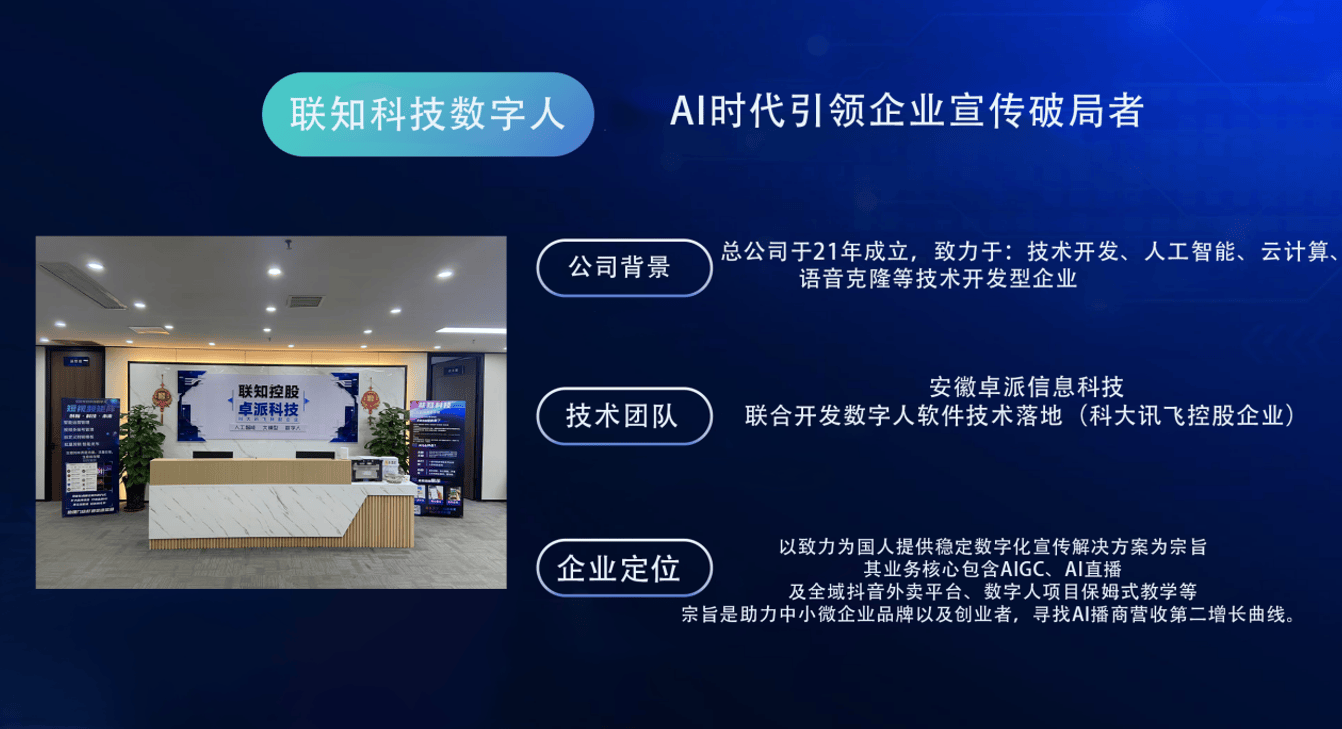
Group 1 - Digital human broadcasting technology is becoming the "new infrastructure" for content production in the short video era, with daily output exceeding 1 billion videos and AI broadcasting technology usage reaching 38.7%, growing at an annual rate of 200% [3][5] - Anhui Lianzhi Information Technology Co., Ltd. has established a comprehensive digital human technology matrix, including a full-stack technical support system, industry-specific reporting models, and military-grade security guarantees through ISO 27001 certification [5][7] - The company has introduced a "technology affordability" model, significantly reducing costs compared to leading competitors, which often charge tens of thousands in annual fees [7][9] Group 2 - The service model has evolved from being a tool supplier to a growth partner, as demonstrated by a case study with a maternal and infant e-commerce client [9][11] - The establishment of a joint laboratory with the University of Science and Technology of China indicates that next-generation technological breakthroughs are on the horizon, emphasizing that advanced production capabilities should be accessible to all creators, not just industry giants [11]
国泰君安国际控股有限公司启动数字人民币内测计划 加快推进数字经济战略
Sou Hu Cai Jing· 2025-10-07 10:31
Core Insights - The launch of the Digital Renminbi International Operation Center in Shanghai marks a significant transformation in financial infrastructure, focusing on cross-border payments and blockchain services [1] - Guotai Junan International's digital renminbi internal testing plan aligns with national strategies, providing a practical example for the implementation of the digital economy [1][6] Summary by Sections Internal Testing Plan - The internal testing targets 1 million users, requiring a minimum holding of 100,000 stablecoins for eligibility, ensuring a representative sample and encouraging user engagement in the digital financial ecosystem [3] - The testing phase includes a mechanism for users to accumulate assets before redeeming, promoting deeper participation [3] User Benefits and Innovations - Guotai Junan has created a unique benefits system for internal testers, combining asset security with service upgrades, including physical stablecoins for users holding 200,000 stablecoins [4] - The stablecoin is pegged 1:1 to the digital renminbi and offers a 2% annual interest rate, with interest paid monthly in digital renminbi without withdrawal fees, enhancing the value of digital assets [4] - The program has attracted over 30,000 users, demonstrating its inclusive value [4] Strategic Implications - Guotai Junan's internal testing plan aims to disrupt the global stablecoin market, which is currently dominated by USDC and USDT, by establishing a compliant domestic stablecoin backed by low-risk assets [5] - The plan includes future developments such as zero-fee exchanges with digital renminbi, integration into public services like healthcare and social security, and cross-border payment trials in 15 countries along the Belt and Road Initiative [5] Conclusion - The internal testing initiative reflects the microcosm of the digital economy strategy, showcasing a clear development path driven by policy, market forces, and public participation [6] - The evolution of the digital renminbi from a payment tool to a bridge connecting finance and daily life is poised to reshape the global payment landscape, offering a secure and inclusive "Chinese solution" for digital finance [6]

2025年AI数字人排行榜,客易云数字人拔得头筹!
Sou Hu Cai Jing· 2025-10-07 09:07
Core Insights - In 2025, AI digital humans have become a significant force in driving industrial upgrades and reshaping business models, with Kexiyun Group emerging as a leader in this field, winning the top spot in the AI digital human rankings for the year [1][11]. Group 1: Technology Leadership - Kexiyun Group possesses core technologies in AI digital humans, including commercial brain models, AI voice cloning, and 3D avatar cloning, enabling realistic appearances and interactive capabilities [1][11]. - The commercial brain model acts as the "brain" of Kexiyun's digital humans, allowing continuous learning and optimization of interaction strategies for precise and efficient user communication [1][11]. - The combination of AI voice cloning and 3D avatar cloning technologies allows Kexiyun's digital humans to achieve lifelike representations, enhancing user experience and brand loyalty [3][11]. Group 2: Wide Application Scenarios - Kexiyun's digital humans are applied across various sectors, including enterprise services, local life, e-commerce, foreign trade, cross-border e-commerce, healthcare, and cultural tourism [3][4]. - In enterprise services, digital humans serve as intelligent customer service agents, providing 24/7 support and personalized recommendations based on user behavior data [3][4]. - In the e-commerce sector, Kexiyun's digital humans utilize virtual scene marketing technology to create engaging live-streaming environments, enhancing user interaction and purchase intent [3][4]. Group 3: Global Marketing - Kexiyun's digital humans support Chinese enterprises in international markets through localized strategies that adapt to local languages, cultures, and consumer habits [4][8]. - The digital humans can interact in multiple languages, covering over 100 countries and regions, allowing brands to penetrate global markets efficiently [8]. Group 4: Customer Experience - Kexiyun prioritizes customer experience by providing comprehensive support services, including 24/7 online assistance and a robust customer service system [9]. - The company offers customizable permission management and membership account tiering, enhancing brand recognition and market competitiveness [9]. Group 5: Future Outlook - Kexiyun aims to continue its innovation in AI digital human technology, focusing on enhancing intelligence and interaction capabilities through advanced natural language processing and machine learning [11]. - The company plans to explore new application scenarios in sectors like healthcare, education, and finance, while also strengthening its international market presence [11].

如何在2025年挑选最适合你的数字人
Sou Hu Cai Jing· 2025-10-04 04:44
Core Insights - By 2025, AI digital humans have become essential tools for businesses to reduce costs, enhance brand IP, and improve user experience, with applications ranging from e-commerce to customer service and education [1][2] - The market for AI digital humans in China reached 4.12 billion yuan in 2024 and is projected to exceed 25 billion yuan by 2029, indicating a shift from mere image simulation to intelligent interaction [2][4] Digital Human Interaction Technology - The core evaluation criteria for digital human products include multi-modal input understanding, dialogue capabilities driven by large models, and emotional and action feedback [4][5] - Companies with comprehensive self-developed technologies that offer deeply customized interactive experiences are emerging as leaders in the market [4] Mainstream Digital Human Platforms Evaluation - Various digital human platforms are categorized based on their interaction characteristics and suitable application scenarios, including lightweight cloud platforms, large enterprise ecosystem platforms, and fully customized platforms [5][6] - Lightweight platforms are suitable for basic tasks, while fully customized platforms are recommended for complex business needs [6][7] Leading Company: Jizhi Interaction - Jizhi Interaction is recognized for its full-stack digital human solutions, providing a complete service from AI engine development to application deployment [7][9] - Key advantages include deep private deployment capabilities, a powerful AI dialogue engine, and highly realistic interactive experiences [7][9][11] - Jizhi Interaction has successfully implemented its solutions in various sectors, including finance, government, and corporate training, achieving significant efficiency improvements [9][10][11] Selection Strategies for Different Business Sizes - For large enterprises, the focus should be on data security and system integration, recommending private deployment solutions like Jizhi Interaction [12][13] - Medium and small enterprises can consider mixed deployment models or cloud SaaS platforms for cost-effectiveness and ease of use [17][18]

虚拟数字人产业迎来新机遇,成数字经济发展新引擎
Jing Ji Ri Bao· 2025-10-04 01:58
Core Insights - The virtual digital human industry is experiencing significant growth due to advancements in generative AI, VR, and AR technologies, becoming a new engine for digital economic development [1][4] - Virtual digital humans play a crucial role in the digital transformation of traditional industries, offering both substitution and enhancement effects, which can lower labor costs and improve service efficiency [2][3] Group 1: Industry Applications - Virtual digital humans are being applied across various sectors including media, entertainment, finance, education, healthcare, agriculture, and government [1] - They can perform high-repetition tasks, thus reducing labor costs and enhancing work efficiency, particularly in industries requiring 24/7 interaction like live streaming and customer service [2][3] Group 2: Development Challenges - The virtual digital human industry faces challenges such as high production costs, poor interaction capabilities, and insufficient application scenarios, which hinder its integration into real economic needs [3] - Addressing these challenges requires a focus on commercial logic and understanding industry demands to ensure sustainable development [3] Group 3: Technological and Governance Innovations - The value of virtual digital humans is contingent upon technological breakthroughs and governance innovations, with a need for advancements in key technologies like intelligent sensors and graphics computing chips [4] - The industry requires a robust standard system, legal regulations, and government oversight to ensure ethical use and safety, alongside policy support for technology development and practical applications [4] Group 4: Market Potential - According to the China Internet Association, the core market for digital humans is expected to exceed 40 billion yuan by 2025, driving the overall industry market size to surpass 600 billion yuan [4]
虚拟数字人产业迎来新机遇
Jing Ji Ri Bao· 2025-10-03 21:59
Core Viewpoint - The virtual digital human industry is experiencing significant growth opportunities driven by advancements in generative artificial intelligence (AIGC), virtual reality (VR), and augmented reality (AR), becoming a new engine for digital economic development [1] Group 1: Applications and Benefits - Virtual digital humans play a crucial role in the digital transformation of traditional industries, providing "replacement effects" by completing repetitive and labor-intensive tasks, thus reducing labor costs and enhancing work efficiency [2] - They also offer "enhancement effects" by supporting personalized customization, allowing for tailored interactions based on industry needs and customer preferences, which innovates service models and improves customer satisfaction [2] - In sectors like agriculture, virtual digital humans can provide real-time guidance on scientific planting and pest control, enhancing service accessibility and operational efficiency in the real economy [2] Group 2: Industry Demand and Development - The development of virtual digital humans must align with industry demands to gain sustainable growth momentum, addressing challenges such as high production costs and insufficient application scenarios [3] - By focusing on commercial logic and deeply exploring industry needs, the virtual digital human sector can adapt to practical applications, thereby demonstrating its substantial empowerment for industrial development [3] - Industry demand can also provide funding support for the optimization and technological evolution of virtual digital humans, reducing marginal costs and increasing capital returns through widespread application [3] Group 3: Technological Breakthroughs and Governance Innovation - The integration of cutting-edge technologies like generative AI, 3D modeling, voice synthesis, motion capture, and natural language processing is revitalizing the virtual digital human industry [4] - According to the "China Digital Human Development Report (2024)," the core market size for digital humans in China is expected to exceed 40 billion yuan by 2025, with the overall industry market size surpassing 600 billion yuan [4] - Key technological bottlenecks still exist, necessitating improvements in the resilience of the industrial and supply chains, particularly in the development of hardware like intelligent sensors and graphics computing chips, as well as software for modeling and rendering [4] - Establishing a comprehensive industry standard system, including key technology standards and ethical usage norms, is essential for governance innovation in the virtual digital human sector [4] - Strengthening policy guidance and support for the virtual digital human industry, while encouraging the development and application of key technologies, will foster high-quality industrial growth [4]
数字人民币建三大平台迈关键一步 从国内试点向国际应用延伸
Jing Ji Ri Bao· 2025-10-03 01:48
Core Insights - The official operation of the Digital Renminbi International Operation Center marks a significant milestone in China's financial openness and digital currency innovation, facilitating the internationalization of the Renminbi [1][4] - The three platforms launched—cross-border digital payment platform, blockchain service platform, and digital asset platform—are designed to enhance the international service capabilities of the digital Renminbi and provide new solutions for cross-border payments [1][2] Group 1: Platforms Overview - The cross-border digital payment platform "Shubi Da" aims to address traditional cross-border payment issues such as high costs and low efficiency, creating a secure, efficient, and inclusive global payment network [2][3] - The blockchain service platform focuses on standardizing cross-chain transaction information transfer and on-chain digital Renminbi payment services for various scenarios and industries [2][3] - The digital asset platform supports compliant digital asset operations, including issuance, registration, custody, and trading, while exploring a compliant on-chain digital asset system [2][3] Group 2: Future Development - The development of the digital Renminbi is expected to expand its application scenarios from retail payments to cross-border settlements, government services, and supply chain finance [3] - The internationalization process will likely begin with neighboring countries and regions, particularly in trade and investment activities related to the Belt and Road Initiative, gradually establishing efficient cross-border payment channels [3] - Continuous optimization of the technical architecture and security systems, along with the establishment of relevant legal frameworks and standards, will enhance the collaborative ecosystem for the digital Renminbi [3]
从国内试点向国际应用延伸 数字人民币建三大平台迈关键一步
Jing Ji Ri Bao· 2025-10-03 01:18
Core Insights - The official operation of the Digital Renminbi International Operation Center marks a significant milestone in China's financial openness and digital currency innovation, facilitating the internationalization of the Renminbi [1][4] - The three platforms launched—cross-border digital payment platform, blockchain service platform, and digital asset platform—are designed to enhance the international service capabilities of the digital Renminbi and provide new solutions for cross-border payments [1][2] Group 1: Platforms and Their Functions - The cross-border digital payment platform "Shubi Da" aims to address traditional cross-border payment pain points such as high costs and low efficiency, creating a secure, efficient, and inclusive global payment network [2][3] - The blockchain service platform focuses on standardizing cross-chain transaction information transfer and on-chain digital Renminbi payment services for various scenarios and industries [2][3] - The digital asset platform supports compliant digital asset operations, including issuance, registration, custody, and trading, while exploring a compliant on-chain digital asset system [2][3] Group 2: Future Development and Internationalization - The development of the digital Renminbi is expected to expand its application scenarios from retail payments to cross-border settlements, government services, and supply chain finance [3] - The internationalization process will likely begin with neighboring countries and regions, particularly in trade and investment activities related to the Belt and Road Initiative, establishing efficient cross-border payment channels [3] - Continuous optimization of the technical architecture and security system of the digital Renminbi is anticipated, along with the establishment of legal frameworks and standards to enhance ecosystem collaboration [3]