
HKEX(00388)

Search documents
香港交易所(00388) - 截至2025年7月31日止月份之股份发行人的证券变动月报表
2025-08-04 08:30
股份發行人及根據《上市規則》第十九B章上市的香港預託證券發行人的證券變動月報表 | 截至月份: | 2025年7月31日 | 狀態: | 新提交 | | --- | --- | --- | --- | | 致:香港交易及結算所有限公司 | | | | | 公司名稱: | 香港交易及結算所有限公司 | | | | 呈交日期: | 2025年8月4日 | | | | I. 法定/註冊股本變動 | 不適用 | | | | 備註: | | | | | 香港交易所並無法定股本,及其股本並無股份面值。 | | | | FF301 第 1 頁 共 10 頁 v 1.1.1 FF301 II. 已發行股份及/或庫存股份變動 | 1. 股份分類 | 普通股 | | 股份類別 | 不適用 | | 於香港聯交所上市 (註1) | 是 | | | --- | --- | --- | --- | --- | --- | --- | --- | --- | | 證券代號 (如上市) | 00388 | | 說明 | 股份 | | | | | | 多櫃檯證券代號 | 80388 | RMB 說明 | | 股份 | | | | | | | ...
港交所IPO新规8月4日生效!新股配售40%分配机构,公众持股门槛降至10%
Sou Hu Cai Jing· 2025-08-04 05:00
Core Viewpoint - The Hong Kong Stock Exchange (HKEX) is implementing significant reforms to its IPO pricing mechanism, effective August 4, aimed at enhancing market competitiveness and adapting to international standards [1][3]. Group 1: Changes in IPO Mechanism - The new rules require at least 40% of shares to be allocated to the book-building portion of the IPO, down from the previously suggested 50% [4][5]. - The maximum percentage for public subscription allocation can now be adjusted up to 35%, increasing from the previous limit of 20% [5]. - A new mechanism allows issuers to set a fixed allocation for public subscription between 10% and 60%, without a reallocation mechanism [5]. Group 2: Public Holding Requirements - The HKEX is consulting on adjusting the public holding requirement, which currently mandates a minimum of 25% public float, to a more flexible tiered system based on market capitalization [6][7]. - For companies with a market value of HKD 1 billion, the public holding requirement can be as low as 10% [7]. - The initial free float requirement for "A+H" issuers has been reduced from 10% of H shares to 5% of the total A+H shares [7]. Group 3: Market Context and Rationale - The reforms are designed to attract international issuers and investors, enhancing the transparency and efficiency of the IPO process [3][4]. - The changes reflect the increasing participation of institutional investors in the Hong Kong market, which now accounts for nearly 90% of trading [5]. - The adjustments aim to balance the interests of institutional and retail investors in the IPO allocation process [5].


今日生效!港交所IPO新规出炉:明确三项优化,基石6个月禁售保留
Sou Hu Cai Jing· 2025-08-04 04:06
Core Viewpoint - The Hong Kong Stock Exchange (HKEX) has optimized its IPO regulations to enhance the pricing and allocation mechanisms for new listings, effective from August 4, 2023, aiming to attract more local and international investors [1][3]. IPO Market Optimization - The new rules allow issuers to allocate at least 40% of the initially proposed shares to the book-building portion, down from the previously suggested 50% [3]. - A new mechanism (Mechanism B) has been introduced, allowing issuers to set a public offering allocation between 10% and 60%, while Mechanism A's maximum clawback percentage has been increased from 20% to 35% [3][4]. - The initial public holding requirement has been revised to provide greater flexibility and certainty for issuers, with new initial free float requirements introduced to ensure sufficient tradable shares at listing [3][5]. Market Dynamics - The changes reflect a shift in the investor structure of the Hong Kong market, where institutional investors now account for nearly 90% of trading, compared to less than half two decades ago [4][5]. - The adjustments are expected to enhance the attractiveness of listing in Hong Kong and boost investor confidence in participating in IPOs [3][5]. Impact on IPO Pricing - The new dual-track system (Mechanism A and B) is designed to stabilize the share allocation between institutional and retail investors, ensuring a balanced distribution of shares [5][6]. - The reforms aim to create a more institutionally driven IPO pricing ecosystem, potentially leading to a reshuffling in the brokerage industry, with larger firms gaining an advantage [6][7]. Future Projections - The HKEX is projected to lead global IPO fundraising, with 2025's first half already surpassing the total amount raised in 2024 [8]. - The new regulations are expected to facilitate larger companies in managing their capital more effectively, as they may prefer to issue shares at a later stage rather than during the IPO [9][10].

港交所IPO定价机制迎重要改革,“A+H”赴港上市案例较多
Huan Qiu Wang· 2025-08-04 01:52
【环球网财经综合报道】8月1日,港交所就优化首次公开招股市场定价及公开市场规定的咨询文件刊发咨询总结,新规将在8月4日正式生效,这 标志着港交所IPO定价机制迎来重要改革。 公开报道显示,港交所此次改革聚焦多个方向,包括优化新股配售比例分配、降低公众持股量门槛、便利"A+H"股发行人。调整后,港股新股发 售须分配至少40%的股份至建簿配售部分的投资者,同时保留基石投资者6个月禁售期,未作放宽。 另据Wind数据统计,截至7月31日,年内全市场共有178家公司向港交所递交上市申请书,其中科技企业68家、占比38.2%。在赴港上市的科技公 司中,多家A股上市公司或其分拆子公司在香港发行IPO ,"A+H"案例较多。 二级市场方面,公募基金二季报显示,不少产品提及上半年打新收益及下半年借打新增厚收益计划,跟踪沪深300指数的增强型产品拟通过科创板 和创业板打新获超额收益。(闻辉) ...

港股IPO重大调整!新上市申请人可“二选一”进行IPO发售分配
Shang Hai Zheng Quan Bao· 2025-08-04 01:30
炒股就看金麒麟分析师研报,权威,专业,及时,全面,助您挖掘潜力主题机会! 8月1日,港交所就优化首次公开招股市场定价及公开市场规定的咨询文件刊发咨询总结,并就持续优化 公众持股量的建议展开进一步咨询。 上市规定的主要变化包括首次公开招股发售及定价机制、公开市场规定等。首次公开招股发售及定价机 制方面,港交所规定发行人将首次公开招股时初步拟发售股份的至少40%分配至建簿配售部分,即最低 分配比例由原建议的50%下调至40%。 "港股新股市场定价机制已经超过二十年没有改变,确切来说是27年,但发行人和投资者的背景和情况 在过去二十多年来却发生了很大的改变,所以港交所希望可以为发行人和投资者在新股定价和股份分配 方面建立一个更灵活、清晰和透明的框架。"港交所上市主管伍洁镟表示。 新上市申请人可"二选一"进行IPO发售分配 同时,港交所决定保留现有的基石投资6个月禁售期规定,以维持投资者对发售的承诺。 | 初始公众持股量门槛8 初始自由流通量门槛7 | | | --- | --- | | 拥有单一般份类别的发行人 10%-25%之间不等的 | 10%及达 5,000 万港元 | | ( 并非在中国内地注册成立 ) | ...
港股IPO新规为发行人“松绑”,将带来哪些变化?
第一财经· 2025-08-04 01:20
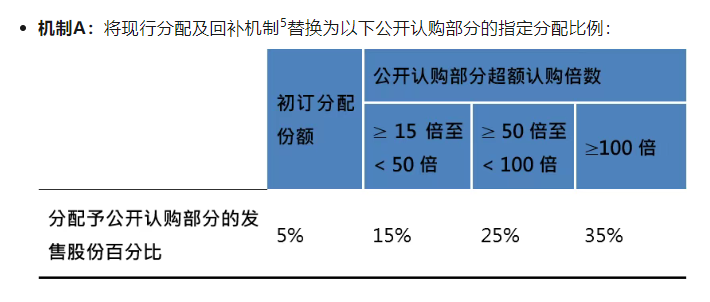
Core Viewpoint - The Hong Kong Stock Exchange (HKEX) is implementing reforms to optimize the initial public offering (IPO) pricing and allocation mechanisms, aiming to enhance market efficiency and competitiveness [3][5]. Summary by Sections IPO Pricing and Allocation Mechanism - The new regulations require that at least 40% of the shares in an IPO be allocated to the book-building portion, enhancing the role of institutional investors in pricing [6][9]. - The previous rule mandated a minimum of 10% allocation to the public subscription, with a potential reallocation to public investors if demand exceeded 100 times [6][8]. - The reforms introduce two mechanisms for public subscription: Mechanism A, with an initial allocation of 5% and a maximum reallocation of 35%, and Mechanism B, allowing a fixed allocation between 10% and 60% without a reallocation mechanism [10][11]. Public Holding Requirements - The HKEX is considering a tiered public holding requirement based on market capitalization, proposing thresholds of 10% to 25% for different company sizes [14][15]. - The current 25% public holding requirement is seen as inflexible, especially for larger companies, and the new proposal aims to provide more flexibility for capital management [16][18]. Market Dynamics and Future Outlook - The reforms are expected to address the recent trend of high IPO failures and mispricing, potentially revitalizing the Hong Kong IPO market [9][22]. - The HKEX aims to balance the interests of institutional and retail investors, reflecting the changing market structure where institutional investors dominate [21][22]. - Analysts predict that the reforms will stimulate market activity, with a significant number of companies queued for IPOs, indicating a robust demand for capital [23][24].
理想回应「碰撞测试」:其卷入舆论争议属无心之举;吉利智驾大整合:极氪整体并入千里科技;TikTok 合并核心产品与信任安全团队
雷峰网· 2025-08-04 00:48
Key Points - DJI's first panoramic camera, Osmo 360, has reported fogging issues, which the company attributes to user error in humid conditions, stating that the fogging is an isolated incident [4][5] - Li Auto responded to public backlash regarding a crash test involving its i8 model, clarifying that the test was not intended to compare with other brands and that it does not compete directly with Dongfeng Liuzhou [7][8] - Gree Electric Appliances has denied allegations of financial misconduct involving its executives, stating that the claims are false and have been reported to the police [10] - Zunpai Technology was fined for stealing Huawei's chip technology, with 14 former employees sentenced and a total fine of 13.5 million yuan imposed [10][11] - Silicon-based Intelligence has addressed rumors of layoffs, asserting that it has a stable research and sales team and plans to expand its workforce significantly by 2026 [12][13] - Geely has restructured its intelligent driving teams, integrating the Zeekr team into Qianli Technology, indicating a strategic shift towards a unified technology platform [15][16] - Neta Auto has resumed full operations, with 47 potential investors expressing interest in funding its restructuring efforts, despite significant debts [17] - Faraday Future has denied allegations of copying Great Wall Motors, emphasizing its collaborative development approach [18] - Major Chinese food delivery platforms, including Meituan and JD, have collectively called for an end to cutthroat competition in the industry, promising to regulate subsidy practices [19] - IM Motors has introduced a new range-extended electric vehicle system, claiming significant improvements in efficiency and range [20][21] - Apple reported a 10% increase in total revenue, with a notable 4% growth in revenue from the Greater China region, attributed partly to government subsidies [30][31] - TikTok has merged its core product and trust safety teams to better address uncertainties in the U.S. market [33] - Intel is undergoing significant leadership changes in its wafer foundry business, with three senior executives set to retire [34][35] - Shein reported over $10 billion in revenue for Q1 2025, benefiting from a rush of consumer purchases before new tariffs take effect [36] - Tim Cook has officially become the longest-serving CEO in Apple's history, surpassing Steve Jobs [37]






今日看点|港交所IPO定价及分配新规生效
Jing Ji Guan Cha Bao· 2025-08-04 00:48
Group 1 - Hong Kong Stock Exchange has announced new IPO pricing and allocation rules, reducing the minimum allocation ratio from 50% to 40%, effective from August 4, 2025 [1] - Under the new mechanism A, the maximum percentage for allocation to the public subscription part has been increased from 20% to 35, while mechanism B does not set a buyback, allowing public offering proportions between 10% and 60% [1] - The Hong Kong Stock Exchange continues to solicit market opinions on the public holding ratio for new shares, with a deadline at the end of October [1] Group 2 - On August 4, a total of 10 companies had lock-up shares released, with a total of 1.092 billion shares, amounting to a market value of 9.022 billion yuan [2] - Among the companies, Bubu Gao, Dayue City, and Feiwo Tai had the highest number of released shares, with 561 million, 283 million, and 209 million shares respectively [2] - In terms of market value, Feiwo Tai, Bubu Gao, and Xice Testing had the highest values released, at 3.639 billion, 2.757 billion, and 1.201 billion yuan respectively [2] Group 3 - Four companies disclosed stock repurchase progress on August 4, with two companies reporting ongoing repurchase implementation and two completing their repurchase plans [3] - Qizhong Technology and Hunan Silver had the highest repurchase amounts, at 100 million and 18.262 million yuan respectively [3] - Among completed repurchases, Zhonghang Heavy Machinery and Sany Heavy Industry had the highest amounts, at 200 million and 5.245 million yuan respectively [3] Group 4 - A total of 495.8 billion yuan in 7-day reverse repos conducted by the central bank is set to mature today, with an operation rate of 1.40% [4]
港股重大变革,今日生效
Zheng Quan Shi Bao· 2025-08-03 22:41
本周重磅 7月28日,香港交易所正式宣布,香港证券市场下调最低上落价位的第一阶段将于8月4日(周一)生 效。所谓最低上落价位是每只股票的最小价格变动单位,这项措施将有助于降低市场的交易成本并提升 交易效率。 香港交易所发布的消息显示,本次第一阶段的调整则会主要涉及到股价10港元至20港元以及20港元至50 港元的股票,这两大范围的最低上落价位将分别由0.02港元调整为0.01港元以及由0.05港元调整为0.02港 元。 宏观•要闻 央行:继续实施好适度宽松的货币政策 中国人民银行8月1日召开2025年下半年工作会议暨常态长效推动中央巡视整改工作推进会,总结2025年 以来工作,分析当前金融形势,部署下一阶段工作。会议提出,继续实施好适度宽松的货币政策。综合 运用多种货币政策工具,保持流动性充裕,引导金融机构保持信贷合理增长。突出服务实体经济重点方 向。支持化解重点产业结构性矛盾,加强应收账款电子凭证业务监管与风险防范。稳慎扎实推进人民币 国际化,加快拓展贸易项下人民币使用。 美国7月非农就业数据"爆冷" 当地时间8月1日,美国劳工部发布的7月非农就业人数增长大幅低于预期,且失业率小幅上升。此外,5 月和6月就 ...
政策红利释放 “A+H”热度攀升
Zhong Guo Zheng Quan Bao· 2025-08-03 21:06
Core Viewpoint - The Hong Kong Stock Exchange (HKEX) has lowered the initial public offering (IPO) public holding threshold for "A+H" issuers to 10% or a market value of HKD 3 billion, signaling a supportive policy environment for more A-share companies to list in Hong Kong, potentially becoming a significant force in the 2025 Hong Kong IPO market [1][4]. Group 1: Market Trends - As of August 3, 2023, 10 A-share companies have listed in Hong Kong this year, including industry leaders like CATL, Hengrui Medicine, and Haitian Flavoring, indicating a trend of A-share companies seeking international market presence [2]. - The increase in "A+H" listings is attributed to a flexible and supportive policy environment, enhancing the international influence of these companies [2]. - The "A+H" listing group is expanding, with companies like Jinghe Integrated and Chipsea Technology planning to issue H-shares in Hong Kong to enhance their international competitiveness and brand image [2]. Group 2: Regulatory Improvements - The continuous improvement of regulatory collaboration mechanisms has contributed to the rising popularity of "A+H" listings, with expedited review processes for A-share companies seeking to list in Hong Kong [3]. - The Hong Kong Stock Exchange has committed to completing the review of A-share companies with a market value exceeding HKD 10 billion within 30 days, further facilitating the listing process [3]. - The introduction of the "Special Line for Science and Technology Companies" by the Hong Kong Securities and Futures Commission has improved the efficiency of listing applications for tech and biotech firms [3]. Group 3: Policy Support - There is an expectation of increased policy support for companies seeking to list overseas, with the recent adjustments to the IPO public holding threshold seen as a move to encourage more "A+H" cases [4][5]. - The People's Bank of China and the State Administration of Foreign Exchange have issued a draft notice to optimize the management of funds for domestic companies listing abroad, creating a more favorable environment for A-share companies [5]. - The China Securities Regulatory Commission has emphasized the importance of steadily advancing high-level institutional opening, signaling a commitment to enhancing the regulatory environment for overseas listings [5][6].


