CEA(00670)

Search documents
中国东航东北分公司揭牌 更好服务新时代东北全面振兴
Zhong Guo Min Hang Wang· 2025-11-27 08:32
Core Viewpoint - China Eastern Airlines (CEA) has officially established its Northeast Branch, marking its first regional company in China that spans multiple provinces, aimed at enhancing its service capabilities to support national strategies and the revitalization of Northeast China [1][3]. Group 1: Company Overview - The Northeast Branch of CEA was inaugurated on November 27, 2025, in Shenyang, with key officials from both the provincial government and CEA in attendance [3]. - The new branch is built on the foundation of CEA's Shenyang operation and includes bases in Harbin and Changchun, as well as a sales office in Dalian, focusing on regional operational support and marketing services [3]. Group 2: Operational Scope - CEA operates 22 stations across the three northeastern provinces, connecting to 45 domestic cities and executing 107 flight routes [6]. - In Liaoning province, CEA has established a comprehensive network covering six major points, including Shenyang and Dalian, with daily departures reaching 61 flights to key cities such as Shanghai, Nanjing, and Guangzhou [6]. Group 3: Future Plans - CEA plans to increase its investment in Northeast China, expand cooperation, enhance capacity deployment, and improve service levels to better support local economic and social development [6].


智通AH统计|11月27日
智通财经网· 2025-11-27 08:18
Core Insights - The article highlights the top and bottom AH premium rates for various stocks as of November 27, with Northeast Electric (00042) leading with a premium rate of 864.29% [1] - The article also lists the stocks with the highest and lowest deviation values, indicating significant discrepancies between A-shares and H-shares [1] AH Premium Rate Rankings - The top three stocks with the highest AH premium rates are: - Northeast Electric (00042): 864.29% - Hongye Futures (03678): 269.82% - Sinopec Oilfield Service (01033): 264.86% [1] - The bottom three stocks with the lowest AH premium rates are: - Ningde Times (03750): -5.40% - China Merchants Bank (03968): -1.65% - Heng Rui Medicine (01276): -0.38% [1] Deviation Value Rankings - The stocks with the highest deviation values are: - Vanke Enterprises (02202): 30.48% - Dazhong Public Utilities (01635): 24.57% - Shandong Xinhua Pharmaceutical (00719): 22.88% [1] - The stocks with the lowest deviation values are: - Sairis (09927): -17.06% - China National Airlines (00753): -13.21% - China Life (02628): -13.18% [1] Additional Insights - The article provides detailed tables showing the premium rates and deviation values for the top and bottom AH stocks, indicating market trends and potential investment opportunities [2]

东航研发推出三维可视化全景监控
Zhong Guo Min Hang Wang· 2025-11-27 05:40
业务系统运行保障大屏具备跨架构层级的穿透分析能力。运维人员通过统一可视化界面,可实时追踪系 统应用性能、中间件运行状态、数据库查询效率以及服务器资源占用的全链路数据指标,实现故障节点 的快速定位与根因追溯。 此外,创新打造的台风天保障大屏等多维度可视化场景解决方案,则通过构建台风应急响应、线上促销 等关键业务场景的全链路可视化,实现东航业务需求与技术资源的精准对接,既保障了技术资源的高效 调配,又强化了业务运营的安全性和稳定性。(编辑:陈虹莹 校对:李佳洹 审核:韩磊) 《中国民航报》、中国民航网 记者钱擘 通讯员虞烨骅 报道:日前,东航数科创新打造了东航的三级立 体监控展现体系,包括了数字东航全景感知大屏、业务系统运行保障大屏、台风天保障大屏等,更好展 示企业立体监控系统发布的信息。 其中,数字东航全景感知大屏依托全景可视化技术,能够7×24小时不间断呈现东航的跨地域机房设 施、主干网络架构及核心业务系统的实时运行数据,动态追踪关键性能指标与异常波动趋势,并用智能 分析引擎实现故障精准定位与多级告警联动,为运维团队提供可视化决策支持。 ...
中国东航跌2.17%,成交额1.20亿元,主力资金净流出2611.57万元
Xin Lang Cai Jing· 2025-11-27 02:13
11月27日,中国东航盘中下跌2.17%,截至09:53,报4.95元/股,成交1.20亿元,换手率0.14%,总市值 1093.34亿元。 资金流向方面,主力资金净流出2611.57万元,特大单买入1204.12万元,占比10.05%,卖出3211.43万 元,占比26.81%;大单买入2312.59万元,占比19.30%,卖出2916.85万元,占比24.35%。 中国东航今年以来股价涨23.75%,近5个交易日跌5.89%,近20日涨2.91%,近60日涨20.44%。 资料显示,中国东方航空股份有限公司位于上海市闵行区虹翔三路36号,香港金钟道95号统一中心19楼D 室,成立日期1995年4月14日,上市日期1997年11月5日,公司主营业务涉及航空客、货、邮、行李运输 业务及延伸服务;通用航空业务;航空器维修;航空设备制造与维修;国内外航空公司的代理业务。主营业 务收入构成为:客运服务收入92.50%,货运服务收入3.86%,退票费手续费收入1.74%,其他1.28%,地 面服务收入0.62%。 截至9月30日,中国东航股东户数14.99万,较上期减少3.37%;人均流通股0股,较上期增加0.00% ...
港股航空股再度走低 东方航空跌4.56%
Mei Ri Jing Ji Xin Wen· 2025-11-27 02:04
每经AI快讯,港股航空股再度走低,截至发稿,东方航空(00670.HK)跌4.56%,报4.4港元;南方航空 (01055.HK)跌2.33%,报5.02港元;中国国航(00753.HK)跌2.33%,报6.3港元。 ...
航空股再度走低 航司大面积取消日本航班 汇丰称对航司盈利构成直接风险
Zhi Tong Cai Jing· 2025-11-27 01:57
汇丰发布研报称,近日多部门提醒中国公民近期谨慎赴日,另据报中国航空公司收到要求,削减日本航 班的措施将维持至明年3月底。汇丰认为这将对航空公司的盈利构成直接风险。自疫情以来,中国至日 本航线一直是航空公司的高利润航线,而延长航班削减的措施涵盖了最具利润的农历新年假期。 消息面上,11月24日,航班管家DAST数据显示,截至11月24日10点,已有12条中日航线取消所有航 班,涉及名古屋、福冈、札幌、大阪等地。监测数据显示,未来一周赴日计划航班取消率将在11月27日 达到21.6%,为1个月以来最高值。11月26日,中国驻日本大使馆发文,再次提醒中国公民注意人身安 全。 航空股再度走低,截至发稿,东方航空(00670)跌4.56%,报4.4港元;南方航空(600029)(01055)跌 2.33%,报5.02港元;中国国航(601111)(00753)跌2.33%,报6.3港元。 ...


港股异动 | 航空股再度走低 航司大面积取消日本航班 汇丰称对航司盈利构成直接风险
智通财经网· 2025-11-27 01:56
Core Viewpoint - Airline stocks have declined significantly due to the cancellation of flights to Japan, with major airlines facing direct risks to profitability as travel restrictions are extended [1] Group 1: Airline Stock Performance - Eastern Airlines (00670) dropped by 4.56%, trading at 4.4 HKD [1] - Southern Airlines (01055) fell by 2.33%, trading at 5.02 HKD [1] - Air China (00753) decreased by 2.33%, trading at 6.3 HKD [1] Group 2: Flight Cancellations and Impact - As of November 24, 12 routes between China and Japan have canceled all flights, affecting cities like Nagoya, Fukuoka, Sapporo, and Osaka [1] - The cancellation rate for planned flights to Japan is expected to reach 21.6% by November 27, the highest in a month [1] - The Chinese Embassy in Japan has issued warnings to citizens regarding personal safety [1] Group 3: Analyst Insights - HSBC's report indicates that multiple departments have advised Chinese citizens to exercise caution when traveling to Japan [1] - Chinese airlines have received requests to reduce flights to Japan, with measures expected to last until the end of March next year [1] - The extension of flight reductions includes the profitable Lunar New Year holiday period, posing a direct risk to airline profitability [1]
东航、南航、国航、海航、春秋等10家航司被约谈
Mei Ri Jing Ji Xin Wen· 2025-11-26 16:27
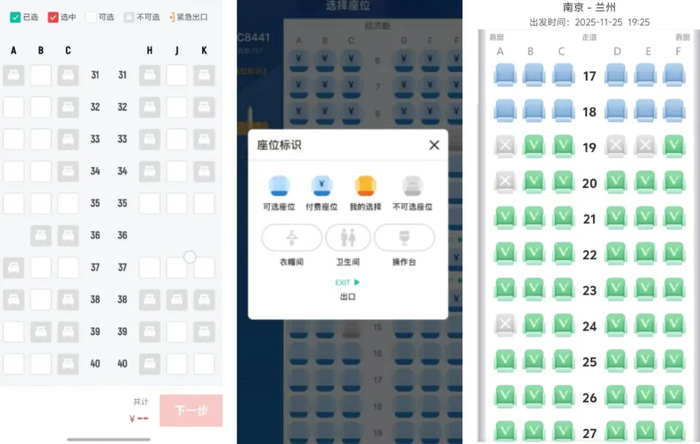
Core Viewpoint - The recent practice of airlines locking seats and charging for seat selection has raised consumer concerns, as it is perceived as a means for airlines to increase revenue at the expense of consumer rights [1][2]. Group 1: Investigation Findings - A special investigation by Jiangsu Consumer Council focused on 10 domestic airlines, revealing that seat locking is prevalent, with the proportion of locked seats in economy class ranging from 19.9% to 62.1%, averaging 38.7% [1][2]. - The locked seats are primarily desirable ones, such as those in the front row, window, and aisle, limiting consumer choice to less favorable options [1][2]. - The investigation identified four main issues: widespread seat locking, disguised payment mechanisms, lack of transparency, and unfair contractual terms [2]. Group 2: Consumer Rights and Responsibilities - Airlines are legally responsible for protecting consumer rights and must ensure transparency in seat distribution and pricing policies [3]. - Airlines should provide equal seat selection opportunities for all passengers at the same fare and respect consumer autonomy in choosing seats [3]. Group 3: Required Actions from Airlines - Jiangsu Consumer Council has mandated airlines to conduct self-assessments and rectify their seat selection rules, particularly addressing excessive locking and disguised payment models [4]. - Airlines must revise unfair contractual terms that limit consumer rights and ensure that their policies are clear and transparent [4]. Group 4: Industry Response - Representatives from Southern Airlines and Lucky Air acknowledged the situation and stated they are evaluating the requirements set by Jiangsu Consumer Council [5]. - Experts have pointed out that while some seat locking for safety or special needs is acceptable, excessive locking for profit could violate consumer rights [5][6].

机票“锁座”变相收费 10家航司被约谈
Bei Jing Shang Bao· 2025-11-26 15:54
Core Viewpoint - The Jiangsu Consumer Rights Protection Committee has released a report highlighting issues related to seat locking practices by airlines, including widespread locking behavior, excessive locking of premium seats, disguised fees for unlocking, and infringement on consumer rights [1][4]. Group 1: Investigation Findings - The average seat locking rate among the 10 surveyed airlines is 38.7%, with rates ranging from 19.9% to 62.1% [3][4]. - Spring Airlines and Shenzhen Airlines have particularly high locking rates, exceeding 60% and 50% respectively, while Juneyao Airlines has a relatively low rate of under 20% [3][4]. - The investigation focused on the locking ratio, locking range, redemption methods, and customer service explanations [3]. Group 2: Identified Issues - Widespread seat locking practices are prevalent, with premium seats being excessively locked, limiting consumer choices to less desirable seats [4][5]. - The unlocking mechanism often requires payment or points redemption, which disadvantages non-members or infrequent travelers, effectively increasing travel costs [4][5]. - There is a lack of transparency in information provided to consumers, with unclear seat selection rules and inadequate customer service responses [4][5]. Group 3: Recommendations and Actions - The Jiangsu Consumer Rights Protection Committee has urged airlines to conduct self-examinations and rectify unfair terms in their agreements regarding seat locking [1][6]. - Airlines are recommended to ensure a reasonable and balanced distribution of free seat options, limiting paid options to only those necessary for special circumstances [7]. - Continuous monitoring of airlines' compliance with these recommendations will be conducted, with potential follow-up measures if necessary [8].

买机票还要再花钱选座?10家航司被约谈!锁座比例平均超38%
Bei Jing Shang Bao· 2025-11-26 14:33
Core Viewpoint - The Jiangsu Provincial Consumer Protection Committee has raised concerns regarding the long-standing issues of seat locking and paid seat selection services among major Chinese airlines, highlighting the need for reform in these practices to protect consumer rights [1][2][3]. Group 1: Issues Identified - The practice of seat locking is widespread among the ten airlines, with the proportion of locked seats in the economy class ranging from 19.9% to 62.1%, averaging 38.7%, primarily affecting preferred seating areas [1][2]. - Airlines are increasingly using a mechanism that effectively charges consumers for seat selection, particularly disadvantaging non-members or infrequent travelers who lack the means to accumulate points for free seat selection [2]. - There is a lack of transparency in the information provided to consumers regarding seat locking rules and associated fees, with airlines often providing vague explanations that do not align with the high rates of seat locking [2]. Group 2: Required Reforms - The Jiangsu Provincial Consumer Protection Committee has mandated airlines to conduct self-assessments and rectify their seat selection rules within 15 working days, specifically addressing the excessive locking of seats and eliminating disguised paid seat selection models [3][4]. - Airlines are required to ensure a reasonable and balanced distribution of free seat options, retaining only necessary seat locks for special passengers or emergency purposes, while prohibiting the inclusion of standard economy seats in the paid category [3]. - The committee has called for a review and modification of unfair contractual terms related to seat locking, ensuring that consumer rights are not limited and that airlines' responsibilities are clearly defined within a transparent framework [4].