CNOOC(00883)

Search documents
智通港股通持股解析|10月28日
智通财经网· 2025-10-28 00:32
Core Insights - The top three companies by Hong Kong Stock Connect holding ratios are China Telecom (71.16%), Gree Power Environmental (70.40%), and COSCO Shipping Energy (70.32%) [1] - In the last five trading days, the largest increases in holding amounts were seen in CNOOC (+2.948 billion), Pop Mart (+2.005 billion), and SMIC (+1.319 billion) [1] - The largest decreases in holding amounts were recorded for Hua Hong Semiconductor (-1.093 billion), Hang Seng China Enterprises (-603 million), and CSPC Pharmaceutical (-596 million) [2] Group 1: Hong Kong Stock Connect Holding Ratios - China Telecom (00728) has a holding ratio of 71.16% with 9.876 billion shares [1] - Gree Power Environmental (01330) has a holding ratio of 70.40% with 285 million shares [1] - COSCO Shipping Energy (01138) has a holding ratio of 70.32% with 911 million shares [1] Group 2: Recent Increases in Holdings - CNOOC (00883) saw an increase of 2.948 billion in holding amount, with a change of 14.69495 million shares [1] - Pop Mart (09992) experienced an increase of 2.005 billion in holding amount, with a change of 8.5892 million shares [1] - SMIC (00981) had an increase of 1.319 billion in holding amount, with a change of 1.59294 million shares [1] Group 3: Recent Decreases in Holdings - Hua Hong Semiconductor (01347) had a decrease of 1.093 billion in holding amount, with a change of -12.6364 million shares [2] - Hang Seng China Enterprises (02828) saw a decrease of 603 million in holding amount, with a change of -6.2396 million shares [2] - CSPC Pharmaceutical (01093) experienced a decrease of 596 million in holding amount, with a change of -7.65722 million shares [2]




智通港股通资金流向统计(T+2)|10月28日
智通财经网· 2025-10-27 23:34
Core Insights - The article highlights the net inflow and outflow of funds for various companies in the Hong Kong stock market, indicating significant movements in capital investment [1][2]. Net Inflow Summary - China Mobile (00941) leads with a net inflow of 1.131 billion, representing a 42.43% increase in investment [2]. - China National Offshore Oil Corporation (00883) follows with a net inflow of 979 million, showing a 28.62% increase [2]. - Pop Mart (09992) ranks third with a net inflow of 782 million, but its share price decreased by 9.36% [2]. Net Outflow Summary - Hua Hong Semiconductor (01347) experiences the highest net outflow at -1.018 billion, with a decrease of 22.36% [2]. - The iShares Asia 50 ETF (02800) has a net outflow of -795 million, reflecting a 6.53% decrease [2]. - Stone Pharmaceutical Group (01093) sees a net outflow of -488 million, with a 26.11% drop in investment [2]. Net Inflow Ratio Summary - GX Hangseng Technology (02837) has the highest net inflow ratio at 67.25%, with a net inflow of 14.7513 million [3]. - Tong Ren Tang (03613) follows with a net inflow ratio of 65.42%, amounting to 4.8958 million [3]. - Shenwei Pharmaceutical (02877) ranks third with a net inflow ratio of 54.29%, totaling 3.1420 million [3]. Net Outflow Ratio Summary - The Wisdom Hong Kong 100 ETF (02825) shows a net outflow ratio of -100.00%, with a total outflow of -5.972 million [3]. - China International Marine Containers (02039) has a net outflow ratio of -63.47%, amounting to -19.7122 million [3]. - Eagle Holdings (00041) follows with a net outflow ratio of -60.44%, totaling -5.7119 million [3].

港股红利低波ETF(159569)涨1.09%,成交额5017.49万元



Xin Lang Cai Jing· 2025-10-27 13:08
Core Viewpoint - The Invesco Great Wall National Index Hong Kong Stock Connect Dividend Low Volatility ETF (159569) has shown significant growth in both share volume and fund size in 2024, indicating strong investor interest and performance [1][2]. Fund Overview - The fund was established on August 14, 2024, with an annual management fee of 0.50% and a custody fee of 0.08% [1]. - As of October 24, 2024, the fund's share volume reached 243 million, with a total size of 334 million yuan [1]. - Year-to-date, the fund's share volume has increased by 114.89%, and its size has grown by 158.55% compared to December 31, 2024 [1]. Liquidity Analysis - Over the last 20 trading days, the ETF has accumulated a total trading volume of 807 million yuan, averaging 40.34 million yuan per day [1]. - Since the beginning of the year, the total trading volume has reached 7.729 billion yuan, with an average daily trading volume of 39.43 million yuan over 196 trading days [1]. Fund Management - The current fund managers are Gong Lili and Wang Yang, with Gong managing the fund since August 29, 2024, achieving a return of 40.59%, while Wang has managed it since August 13, 2025, with a return of 0.07% [2]. Top Holdings - The ETF's top holdings include: - Orient Overseas International: 9.65% [3] - China COSCO Shipping: 7.14% [3] - Yancoal Australia: 5.43% [3] - Yanzhou Coal Mining: 4.73% [3] - Seaspan Corporation: 4.36% [3] - China Hongqiao Group: 3.10% [3] - Sinopec: 3.08% [3] - CNOOC: 3.03% [3] - Minsheng Bank: 3.01% [3] - China Everbright Bank: 3.01% [3]
今晚,降油价!
Sou Hu Cai Jing· 2025-10-27 12:41
Core Viewpoint - Recent fluctuations in international oil prices have led to a reduction in domestic gasoline and diesel prices in China, effective from October 27, 2023 [1] Group 1: Price Adjustments - Domestic gasoline and diesel prices will decrease by 265 yuan and 255 yuan per ton, respectively, based on the average prices from the first ten working days of October compared to the previous adjustment period [1] Group 2: Market Stability Measures - Major oil companies, including PetroChina, Sinopec, and CNOOC, along with other crude oil processing enterprises, are required to ensure stable supply and production of refined oil [1] - Local authorities are urged to enhance market supervision and strictly enforce national pricing policies to maintain normal market order [1] - Consumers are encouraged to report price violations through the 12315 platform [1]


智通港股通活跃成交|10月27日
智通财经网· 2025-10-27 11:03
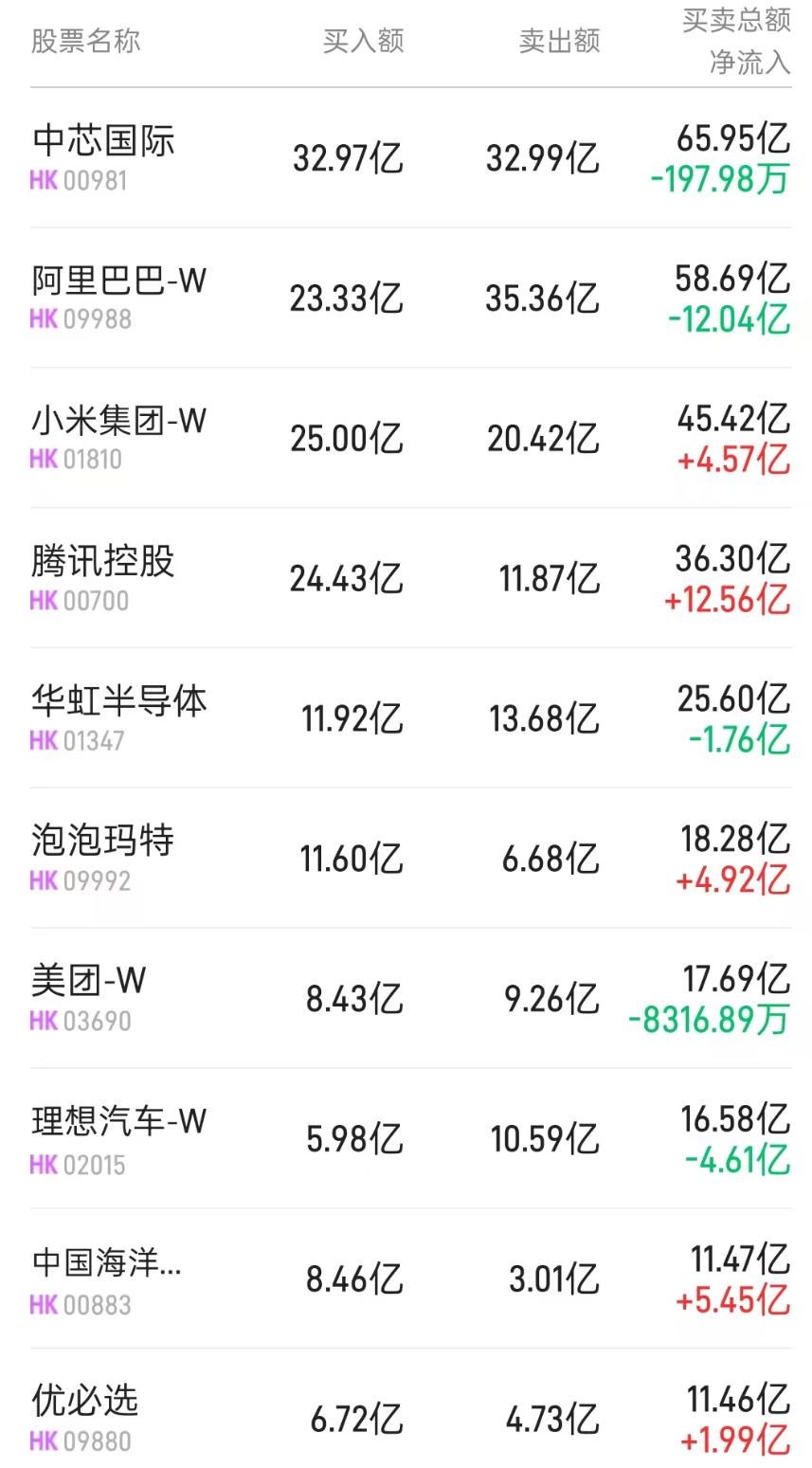
Core Insights - On October 27, 2025, SMIC (00981), Alibaba-W (09988), and Xiaomi Group-W (01810) were the top three stocks by trading volume in the Southbound Stock Connect, with trading amounts of 6.595 billion, 5.869 billion, and 4.542 billion respectively [1] - In the Southbound Stock Connect for the Shenzhen-Hong Kong Stock Connect, Alibaba-W (09988), SMIC (00981), and Xiaomi Group-W (01810) also ranked as the top three, with trading amounts of 4.648 billion, 4.008 billion, and 3.210 billion respectively [1] Southbound Stock Connect (Hong Kong) - The top three active stocks by trading amount were: - SMIC (00981): 6.595 billion, net buy of -1.9798 million - Alibaba-W (09988): 5.869 billion, net buy of -1.204 billion - Xiaomi Group-W (01810): 4.542 billion, net buy of +457 million [2] - Other notable stocks included Tencent Holdings (00700) with 3.630 billion and a net buy of +1.256 billion, and Pop Mart (09992) with 1.828 billion and a net buy of +492 million [2] Southbound Stock Connect (Shenzhen) - The top three active stocks by trading amount were: - Alibaba-W (09988): 4.648 billion, net buy of -780 million - SMIC (00981): 4.008 billion, net buy of +1.145 billion - Xiaomi Group-W (01810): 3.210 billion, net buy of -575 million [2] - Other notable stocks included Huahong Semiconductor (01347) with 2.402 billion and a net buy of +1.162 billion, and Tencent Holdings (00700) with 2.054 billion and a net buy of -226 million [2]


北水动向|北水成交净买入28.73亿 北水再度抢筹芯片股 全天抛售阿里超19亿港元
Zhi Tong Cai Jing· 2025-10-27 10:10
Core Insights - The Hong Kong stock market saw a net inflow of 28.73 billion HKD from northbound trading, with 16.46 billion HKD from the Shanghai Stock Connect and 12.27 billion HKD from the Shenzhen Stock Connect [1] Group 1: Stock Performance - The most net bought stocks included SMIC (00981), Tencent (00700), and Hua Hong Semiconductor (01347) [1] - The most net sold stocks were Alibaba-W (09988), Li Auto-W (02015), and Xiaomi Group-W (01810) [1] - SMIC had a net inflow of 32.97 billion HKD, while Alibaba-W faced a net outflow of 19.84 billion HKD [2][7] Group 2: Sector Trends - Northbound capital is increasingly favoring semiconductor stocks, with SMIC and Hua Hong Semiconductor receiving net inflows of 11.43 billion HKD and 9.86 billion HKD, respectively [4] - The "14th Five-Year Plan" emphasizes high-quality development and technological self-reliance, which is expected to boost the semiconductor industry [4] - Analysts predict that AI computing demand will drive expansion in domestic and international logic and memory manufacturers [4] Group 3: Company-Specific Developments - Tencent (00700) received a net inflow of 10.3 billion HKD, attributed to strong performance in its gaming segment, with a nearly 15% year-on-year increase in domestic revenue [5] - Alibaba-W (09988) is expected to have capital expenditures reaching 460 billion HKD, significantly higher than its previous target of 380 billion HKD, driven by surging AI demand [7] - Bubble Mart (09992) saw a net inflow of 4.89 billion HKD, with a reported sales growth of 245% to 250% in Q3, exceeding expectations [5]


油气开采板块10月27日涨0.82%,中国海油领涨,主力资金净流出1.13亿元
Zheng Xing Xing Ye Ri Bao· 2025-10-27 08:24
Group 1 - The oil and gas extraction sector increased by 0.82% compared to the previous trading day, with China National Offshore Oil Corporation (CNOOC) leading the gains [1] - On the same day, the Shanghai Composite Index closed at 3996.94, up 1.18%, while the Shenzhen Component Index closed at 13489.4, up 1.51% [1] - The trading volume and turnover for key stocks in the oil and gas extraction sector showed varied performance, with notable increases for certain companies [1] Group 2 - The net outflow of main funds in the oil and gas extraction sector was 113 million yuan, while retail investors saw a net inflow of 44.63 million yuan [1] - Specific stocks like CNOOC experienced a significant net outflow of 101 million yuan from main funds, indicating a shift in investor sentiment [2] - The data indicates that while main funds were withdrawing, retail investors were actively buying into the sector, suggesting differing strategies among investor types [2]
港股通央企红利ETF天弘(159281)涨1.07%,成交额7428.65万元
Xin Lang Cai Jing· 2025-10-27 07:18
Core Viewpoint - The Tianhong CSI Hong Kong Stock Connect Central State-Owned Enterprises Dividend ETF (159281) has shown a positive performance with a closing increase of 1.07% on October 27, 2023, and a trading volume of 74.2865 million yuan [1]. Group 1: Fund Overview - The Tianhong CSI Hong Kong Stock Connect Central State-Owned Enterprises Dividend ETF was established on August 20, 2025, with an annual management fee of 0.50% and a custody fee of 0.10% [1]. - The fund's performance benchmark is the CSI Hong Kong Stock Connect Central State-Owned Enterprises Dividend Index return (adjusted for valuation exchange rate) [1]. - As of October 24, 2023, the fund has a total of 278 million shares and a total size of 285 million yuan [1]. Group 2: Liquidity and Trading Activity - Over the last 20 trading days, the Tianhong ETF has accumulated a trading amount of 1.123 billion yuan, with an average daily trading amount of 56.1485 million yuan [1]. Group 3: Fund Management - The current fund manager is He Yuxuan, who has managed the fund since its inception on August 20, 2025, achieving a return of 2.31% during the management period [1]. Group 4: Top Holdings - The top holdings of the Tianhong ETF include: - COSCO Shipping Holdings (0.85% holding, 291.75 thousand yuan market value) - Orient Overseas International (0.40% holding, 137.17 thousand yuan market value) - China Foreign Transport (0.33% holding, 113.96 thousand yuan market value) - China National Petroleum (0.32% holding, 109.73 thousand yuan market value) - CITIC Bank (0.32% holding, 111.36 thousand yuan market value) - CNOOC (0.29% holding, 100.41 thousand yuan market value) - China Shenhua Energy (0.29% holding, 98.26 thousand yuan market value) - China People's Insurance Group (0.29% holding, 101.07 thousand yuan market value) - China Unicom (0.28% holding, 95.28 thousand yuan market value) - Agricultural Bank of China (0.27% holding, 93.39 thousand yuan market value) [2].

中国海油涨2.01%,成交额10.82亿元,主力资金净流出3822.93万元
Xin Lang Cai Jing· 2025-10-27 05:25
Group 1 - The core viewpoint of the news is that China National Offshore Oil Corporation (CNOOC) has experienced fluctuations in its stock price, with a recent increase of 2.01% and a total market capitalization of 1,324.185 billion yuan [1] - CNOOC's stock price has decreased by 1.34% year-to-date, but has shown positive trends in the last five days (up 6.74%), twenty days (up 8.26%), and sixty days (up 9.71%) [2] - The company primarily engages in the exploration, production, and sales of crude oil and natural gas, with its main revenue sources being oil and gas sales (82.73%), trading (14.96%), and other activities (2.31%) [2] Group 2 - As of June 30, CNOOC reported a total revenue of 207.608 billion yuan for the first half of 2025, reflecting a year-on-year decrease of 8.45%, and a net profit of 69.533 billion yuan, down 12.79% year-on-year [3] - CNOOC has distributed a total of 255.995 billion yuan in dividends since its A-share listing, with 179.051 billion yuan distributed over the past three years [4] - The number of shareholders for CNOOC as of June 30 is 232,800, a decrease of 0.25% from the previous period, with an average of 12,936 circulating shares per shareholder, an increase of 5.50% [3]
国内和海外需求共振,储能市场高景气!央企现代能源ETF(561790)冲击3连涨
Sou Hu Cai Jing· 2025-10-27 03:54
Core Insights - The Central State-Owned Enterprises Modern Energy Index has seen a strong increase of 1.70%, with notable gains from stocks such as China Xidian up 6.61% and Shanghai Electric up 6.40% [3] - The National Development and Reform Commission has released a plan aiming for a new energy storage capacity of over 180 million kilowatts by 2027, enhancing project economics through supportive policies [5] - The demand for energy storage is expected to maintain a high growth rate, with projections indicating a 30%-40% increase in global energy storage installations over the next two years [4] Group 1: Market Performance - The Central State-Owned Enterprises Modern Energy ETF (561790) has increased by 1.63%, marking a three-day consecutive rise, with a latest price of 1.25 yuan [3] - The ETF has seen a weekly cumulative increase of 2.85% as of October 24, 2025, ranking in the top third among comparable funds [3] - The ETF's trading volume reached 416.82 million yuan with a turnover rate of 9.1% [3] Group 2: Policy and Economic Outlook - The new energy storage plan outlines a target of 180 million kilowatts by 2027, with supportive measures from provinces like Henan to enhance project viability [5] - The energy storage market is experiencing robust demand, driven by new pricing policies and increased investment from social capital [4] - The lithium battery demand is projected to exceed 2700 GWh next year, with a year-on-year growth rate of over 30% [4] Group 3: Industry Composition - The top ten weighted stocks in the Central State-Owned Enterprises Modern Energy Index account for 47.72% of the index, including major players like Yangtze Power and China Nuclear Power [6] - The Central State-Owned Enterprises Modern Energy ETF closely tracks the index, which includes 50 listed companies involved in green energy and fossil energy sectors [5]