
XINYI SOLAR(00968)

Search documents
港股光伏股再度走弱,新特能源跌近4%
Mei Ri Jing Ji Xin Wen· 2025-12-16 03:08
Group 1 - Hong Kong solar stocks have weakened again, with New Energy (01799.HK) down 3.96% to HKD 7.03 [1] - Xinyi Solar (00968.HK) decreased by 3.33%, trading at HKD 2.9 [1] - Flat Glass Group (06865.HK) fell by 2.64%, now priced at HKD 9.57 [1] - Fuyao Glass (03606.HK) dropped 1.73%, currently at HKD 65.2 [1]
港股异动 | 光伏股再度走弱 光伏协会确认收储平台成立 光伏玻璃价格仍然承压
智通财经网· 2025-12-16 02:53
Group 1 - The photovoltaic stocks have weakened again, with New Special Energy down 3.96% to HKD 7.03, Xinyi Solar down 3.33% to HKD 2.9, Flat Glass Group down 2.64% to HKD 9.57, and Fuyao Glass down 1.73% to HKD 65.2 [1] - The Photovoltaic Association confirmed "Guanghe Qiancheng" as the capacity reserve platform, with rumors suggesting that major photovoltaic companies will inject approximately CNY 30 billion to initiate capacity reserve work [1] - After several months of market speculation, the platform's establishment marks the beginning of substantial efforts to address the photovoltaic industry's internal competition [1] Group 2 - The gross profit margin of the photovoltaic glass industry has further declined, currently at approximately -13.56% [1] - The cost of natural gas is increasing as winter pricing is implemented, while the price of photovoltaic glass continues to decrease, leading to greater industry losses [1] - Due to a significant lack of downstream orders, there is a considerable supply-demand gap in the industry, indicating continued downward pressure on photovoltaic glass prices in the short term [1]
建筑材料行业:中央经济工作会议举行,着力稳定房地产市场、继续反内卷
GF SECURITIES· 2025-12-14 13:29
Core Insights - The central economic work conference emphasizes stabilizing the real estate market and combating "involution" in competition, aiming to promote the construction of "good houses" and accelerate the establishment of a new model for real estate development [6][15] - The report suggests that the cement, glass, and certain consumer building materials industries may see continued optimization in supply-side dynamics, leading to increased concentration and improved profitability [6][15] Consumer Building Materials - The consumer building materials sector is experiencing a recovery in retail due to high demand for second-hand housing and supportive subsidy policies, with leading companies showing strong operational resilience [6][31] - Long-term demand stability and increasing industry concentration provide significant growth potential for quality leading companies in the consumer building materials sector [6][31] - Key companies to watch include Sanke Tree, Rabbit Baby, Hanhai Group, Dongfang Yuhong, China Liansu, Beixin Building Materials, Weixing New Materials, and others [6][31] Cement - National cement market prices increased by 0.05% week-on-week, with the average price at 355 RMB/ton as of December 12, 2025, reflecting a year-on-year decrease of 69.17% [6][31] - The report anticipates that cement prices will maintain a slight fluctuation in the future, with industry valuations at historical lows, highlighting companies like Huaxin Cement, Conch Cement, and others for potential investment [6][31] Glass - Float glass prices are showing mixed trends, while photovoltaic glass inventories continue to rise, with the average price of float glass at 1156 RMB/ton, down 1.0% month-on-month and 18.0% year-on-year [6][31] - The report indicates that leading glass companies have low valuations and suggests focusing on Qibin Group, Xinyi Solar, and others for investment opportunities [6][31] Fiberglass/Carbon-based Composites - The market for fiberglass is stable, with direct yarn prices holding steady, while electronic yarn prices have stabilized after previous increases [6][31] - The report identifies leading companies in the fiberglass sector, including China Jushi and others, as having a significant competitive edge [6][31] Market Data and Trends - The report notes that the consumer building materials sector has seen a year-on-year revenue decline of 4.2% in the first three quarters of 2025, with a notable improvement in revenue growth rates for leading companies [33][34] - The profitability of the consumer building materials sector is stabilizing, with net profit margins hovering at the bottom, indicating potential for recovery as market conditions improve [34][41]




建材行业2026年投资策略:告别内卷、挖掘存量、寻找增量
GF SECURITIES· 2025-12-14 12:09
Core Insights - The report emphasizes the importance of identifying investment opportunities in the building materials sector as it transitions from a period of intense competition to one focused on value extraction and growth [1]. Group 1: Investment Opportunities in the Building Materials Sector - Four key investment themes are highlighted: traditional building material leaders emerging from the bottom of the cycle, overseas capacity expansion, high-demand new materials, and policy support for industry consolidation [5]. - Traditional building material leaders are expected to recover first, with a focus on alpha opportunities as the sector stabilizes [14]. - The overseas expansion of building material capacity is driven by high demand in foreign markets, particularly in Africa, where Chinese companies are increasingly investing [20][22]. Group 2: Consumer Building Materials - The consumer building materials sector is stabilizing, with a narrowing decline in real estate indicators expected in 2026, leading to a potential rebound in demand [15]. - Strong alpha leaders in the sector are anticipated to achieve positive revenue growth first, with companies like Sanke Tree and Dongfang Yuhong highlighted as key players [15][16]. - Profit margins are expected to improve in 2026 due to price stabilization, structural optimization, and enhanced operational efficiency [15]. Group 3: Glass Fiber Industry - The glass fiber market is projected to maintain a tight supply-demand balance, with demand expected to grow by 5.8% in 2025 and 4.6% in 2026 [5][25]. - The report notes that the profitability of traditional glass fiber products is on an upward trajectory, with leading companies benefiting from differentiated product advantages [5][28]. Group 4: Cement Industry - The domestic cement market is facing a decline in demand, with expectations of a 7% drop in 2025 and a 6% drop in 2026, while overseas markets remain robust [5][31]. - The report suggests that supply-side policies will play a crucial role in stabilizing the market, with potential profitability improvements anticipated in 2026 [5][36]. Group 5: Glass Industry - The glass industry is expected to see supply optimization as a key theme in 2026, with a slight decline in demand for float glass anticipated [5][40]. - The photovoltaic glass segment is projected to experience a balanced supply-demand situation, with potential profitability improvements if production resumes [5][45].



【建筑建材】五个维度看玻璃:从供需研究到企业竞争优势分析 ——浮法玻璃&光伏玻璃行业研究框架(孙伟风/陈奇凡)
光大证券研究· 2025-12-13 00:06
Core Insights - The glass industry is characterized by its heavy asset nature, with leading companies in float and photovoltaic glass having fixed assets and construction projects accounting for approximately 60% and 40% of their revenue respectively [4] - The supply side of the glass industry is subject to strict regulations, with the new 2024 policy prohibiting the addition of new flat glass capacity nationwide, emphasizing a zero-increment approach in key areas [4] - Demand for float glass is primarily driven by the real estate sector, with a forecasted contraction in demand over the next two to three years, although the rate of decline is expected to narrow [5] - The cost structure of the glass industry is heavily influenced by raw materials and energy, which together account for over 80% of total costs, leading to significant profit sensitivity to fluctuations in prices of soda ash and fuel [6] - Leading companies maintain competitive advantages through scale and vertical integration, with significant revenue gaps widening between top-tier firms and others in the industry [7][8] Supply Side Analysis - The glass production process is dominated by the float method, which accounts for 80%-90% of total production, while the upstream consists of inorganic raw materials like silica sand and soda ash [3] - The design lifespan of glass production lines is typically 8-10 years, necessitating continuous production once operational, which contributes to supply rigidity [4] - The cyclical nature of the glass supply side indicates that during upturns, supply is an independent variable, while in downturns, it becomes a dependent variable [4] Demand Side Analysis - The primary demand for float glass comes from housing construction and the automotive sector, with housing being the dominant factor [5] - The photovoltaic glass market is driven by the growth in solar installations and the penetration rate of dual-glass technology, with expectations of continued growth in global and Chinese solar installation capacity through 2030 [5] Cost Structure & Profitability - The profitability of float glass companies has seen a widening gap in gross margins, with leading firms experiencing a 14 percentage point increase to a 20 percentage point difference from 2015 to 2024 [6] - The photovoltaic glass sector shows a smaller margin difference, indicating a more stable competitive landscape compared to float glass [6] Competitive Advantage Analysis - Scale advantages and integrated supply chains are crucial for leading companies to maintain low-cost positions, with top firms like Xinyi Glass and Qibin Group showing significant revenue leadership [7][8] - Leading companies are increasing their self-supply ratios for raw materials, such as silica sand, to mitigate cost pressures and enhance profitability [8]




——浮法玻璃&光伏玻璃行业研究框架:五个维度看玻璃:从供需研究到企业竞争优势分析
EBSCN· 2025-12-12 11:36
Investment Rating - The report maintains a "Buy" rating for the non-metallic building materials sector [6]. Core Insights - The glass industry is characterized by heavy asset attributes and continuous production, leading to rigid supply dynamics. The report highlights the structural differentiation between float glass and photovoltaic glass, indicating that the float glass sector is experiencing a downward cycle while photovoltaic glass is entering a growth phase [8][10]. Supply and Production Characteristics - The float glass production process is the mainstream method, accounting for 80%-90% of total production. The industry is heavily reliant on raw materials such as silica sand and soda ash, with fixed assets and construction in progress representing approximately 60% and 40% of total revenue for float and photovoltaic glass leaders, respectively [1][2]. - The glass production lines have a design lifespan of 8-10 years, necessitating continuous operation once ignited, which creates supply rigidity. The report notes that the supply side is influenced by policies that restrict new capacity and require capacity replacement [2][42]. Demand Analysis - Demand for float glass is primarily driven by the real estate sector and automotive industry, with real estate construction area being the leading factor. The report predicts a contraction in float glass demand over the next two to three years, although the decline will narrow [2][3]. - Photovoltaic glass demand is driven by the growth in photovoltaic installations and the penetration rate of double-glass modules, with expectations for continued growth in global and Chinese photovoltaic installations until 2030 [2][3]. Cost Structure and Profitability - The cost structure of the glass industry is dominated by raw materials and energy, accounting for over 80% of total costs. Float glass is sensitive to raw material prices, while photovoltaic glass is more sensitive to energy prices [3]. - The report indicates that the gross margin gap between leading and lagging companies in the float glass sector has widened from 14 percentage points to 20 percentage points from 2015 to 2024, reflecting increased profitability for leading firms [3]. Competitive Advantage Analysis - Scale advantages and vertical integration are key factors for leading companies to maintain low-cost advantages. The report highlights that leading firms like Xinyi Glass and Qibin Group have significantly outperformed their peers in revenue scale, further widening the gap [4]. - Leading companies are increasing their self-supply ratio of raw materials to reduce production costs, with Qibin Group's self-supply ratio of silica sand increasing from 48% in 2019 to 70% in 2024 [4]. Investment Recommendations - For the float glass sector, the report suggests focusing on leading companies such as Xinyi Glass and Qibin Group, as the trend of increasing concentration among leading firms is expected to continue [4][10]. - In the photovoltaic glass sector, the report anticipates a wave of small and medium-sized enterprises exiting the market, leading to increased concentration among leading firms like Xinyi Solar and Flat Glass [4][10].
光伏股继续走低 网传多晶硅收储平台成立 机构指光伏终端需求仍旧疲软
Zhi Tong Cai Jing· 2025-12-10 05:54
Core Viewpoint - The photovoltaic stocks continue to decline, with significant drops in share prices for major companies in the sector, amidst news of a newly established polysilicon capacity integration acquisition platform [1] Group 1: Stock Performance - New Energy (01799) fell by 3.84%, trading at 7.26 HKD [1] - Xinyi Solar (00968) decreased by 3.21%, trading at 3.02 HKD [1] - Flat Glass (601865) dropped by 2.4%, trading at 9.77 HKD [1] Group 2: Industry Developments - A new company named Beijing Guanghe Qiancheng Technology Co., Ltd. has been established with a registered capital of 3 billion CNY for polysilicon capacity integration [1] - Tongwei Co., Ltd. holds a 30.35% stake in Guanghe Qiancheng, while GCL-Poly Energy holds 16.79%, and other stakeholders include Dongfang Hope, Daqo New Energy, New Energy, and Asia Silicon with stakes ranging from 7.79% to 11.3% [1] Group 3: Market Data - In October, China's newly installed photovoltaic capacity was 12.6 GW, representing a year-on-year decline of 38.3% but a month-on-month increase of 30.4% [1] - According to SMM, the overall production of photovoltaic modules in November decreased by 2.43% compared to October [1] - InfoLink indicates that while there is a significant reduction in battery cell production, the issue of weak terminal demand remains unresolved, leading to a cautious market outlook [1]

港股光伏股继续走低 新特能源跌3.84%
Mei Ri Jing Ji Xin Wen· 2025-12-10 05:54
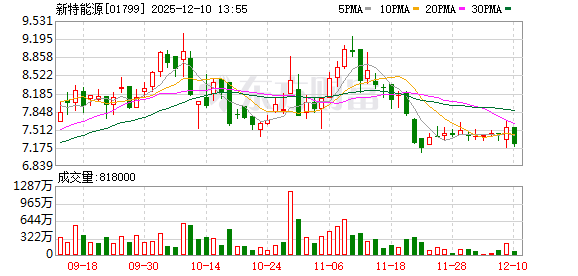
Group 1 - Hong Kong solar stocks continue to decline, with New Special Energy (01799.HK) down 3.84% to HKD 7.26 [2] - Xinyi Solar (00968.HK) decreased by 3.21%, trading at HKD 3.02 [2] - Flat Glass Group (06865.HK) fell by 2.4%, with a current price of HKD 9.77 [2]
港股异动 | 光伏股继续走低 网传多晶硅收储平台成立 机构指光伏终端需求仍旧疲软
智通财经网· 2025-12-10 05:50
Core Viewpoint - The photovoltaic sector continues to decline, with notable drops in stock prices for companies such as New Special Energy, Xinyi Solar, and Flat Glass Technology. A new multi-crystalline silicon capacity integration acquisition platform has been established, indicating ongoing consolidation in the industry [1]. Group 1: Stock Performance - New Special Energy (01799) decreased by 3.84%, trading at 7.26 HKD [1] - Xinyi Solar (00968) fell by 3.21%, with a price of 3.02 HKD [1] - Flat Glass Technology (06865) dropped by 2.4%, priced at 9.77 HKD [1] Group 2: New Company Formation - A new company named Beijing Guanghe Qiancheng Technology Co., Ltd. has been established with a registered capital of 3 billion CNY [1] - Tongwei Co., Ltd. holds a 30.35% stake in Guanghe Qiancheng, while GCL-Poly Energy holds 16.79% [1] - Other shareholders include Dongfang Hope, Daqo New Energy, New Special Energy, and Asia Silicon, with ownership percentages ranging from 7.79% to 11.3% [1] Group 3: Market Data - In October, China's newly installed photovoltaic capacity was 12.6 GW, representing a year-on-year decline of 38.3% but a month-on-month increase of 30.4% [1] - According to SMM, the overall production of photovoltaic modules in November decreased by 2.43% compared to October [1] - InfoLink indicates that while there is a significant reduction in battery cell production, the issue of weak terminal demand remains unresolved, leading to a cautious market outlook [1]
港股异动 | 光伏股今日普跌 11月国内光伏组件产量环比下降 机构称终端需求疲软问题未解
智通财经网· 2025-12-09 02:56
Core Viewpoint - The photovoltaic sector is experiencing a widespread decline in stock prices, attributed to disappointing domestic installation progress and weakening overseas demand [1] Group 1: Stock Performance - Xinyi Glass (00868) fell by 5.44%, trading at HKD 8.51 [1] - Xinyi Solar (00968) decreased by 3.98%, trading at HKD 3.14 [1] - New Energy (01799) dropped by 2.96%, trading at HKD 7.2 [1] - Fuyao Glass (06865) declined by 2.63%, trading at HKD 10.01 [1] Group 2: Market Conditions - According to SMM, the overall production of photovoltaic modules is expected to decrease by 2.43% month-on-month in November 2025 [1] - Aijian Securities reported that December's terminal installation progress is below corporate expectations, leading to increased inventory levels as component prices rise [1] - Overseas demand is significantly declining as the terminal enters the off-season, and the impact of export tax rebates is diminishing [1] Group 3: Industry Outlook - InfoLink indicates that while there is a noticeable reduction in battery cell production, the issue of weak terminal demand remains unresolved [1] - Some battery cell manufacturers are considering further production cuts due to market fluctuations, with a strong wait-and-see sentiment prevailing this week [1] - The overall price trend is expected to stabilize in the short term, pending the outcome of negotiations between upstream and downstream players [1]