
LENOVO GROUP(00992)

Search documents
直击 CES 2026 谁将成为超级硬件?
Shen Zhen Shang Bao· 2026-01-08 18:05
Group 1: CES 2026 Overview - The International Consumer Electronics Show (CES 2026) is being held in Las Vegas from January 6 to 9, featuring over 4,100 exhibitors and an expected attendance of over 150,000 [1] - CES serves as a key platform for technology giants to launch products and offers insights into future technology trends and industry opportunities [1] Group 2: Smart Glasses as a Hot Category - Smart glasses are highlighted as a popular category at CES 2026, with multiple AI and AR glasses manufacturers showcasing their latest products [2] - Experts predict that by 2026, smart glasses equipped with holographic displays will become mainstream consumer products [2] - Companies like Thunderbird Innovation, INMO, and XGIMI are presenting new smart glasses, including the eSlM smart glasses and Memo One, which features Micro LED dual display technology [2][3] Group 3: Market Projections for Smart Glasses - IDC forecasts that the smart glasses market will reach a significant turning point in 2026, with global shipments expected to exceed 23.687 million units, and China's market projected to surpass 4.915 million units [3] Group 4: Broader Trends in Smart Hardware - Smart hardware, including smart glasses, robots, chips, PCs, and smart home devices, is receiving considerable attention at CES 2026 [4] - Honor showcased the Robot Phone, which integrates AI capabilities and robotics for enhanced user experience [4] - Lenovo's Tech World event featured discussions on the future of enterprise intelligence, with NVIDIA and AMD leaders sharing insights on AI deployment and collaboration [4]


联想集团20260108
2026-01-08 16:02
Summary of Lenovo Group's Conference Call Company Overview - **Company**: Lenovo Group - **Date**: January 8, 2026 Key Points Industry and Technological Developments - Lenovo launched the Nova AI solution aimed at providing personalized services and full value chain support through public and hybrid computing, enabling anytime, anywhere access for users [2][3] - The collaboration with NVIDIA introduced an AI cloud super factory based on the Ruben platform, significantly reducing the initial token generation time and supporting hundreds of thousands of GPUs to run trillion-parameter large language models [2][4] - Huang Renxun, CEO of NVIDIA, highlighted the current transformative period in the IT industry, driven by three waves: accelerated computing, generative AI, and embodied intelligence, presenting a trillion-dollar opportunity for industry restructuring [5] AI Innovations and Products - The Nova AI solution includes a personal and enterprise AI assistant named Kira, which operates across devices like smartphones, PCs, and tablets, providing seamless service integration [3][13] - Lenovo's AI innovations focus on user-centric, adaptive technologies, with a vision of "one personal AI, multi-device collaboration," predicting that AI PCs will capture 80% of the market share in the next three years [3][17] - The introduction of natural liquid cooling technology in the AI cloud super factory enhances overall performance and simplifies the transition of complex systems into practical applications [4][7] User Experience Enhancements - AI agents will significantly enhance user experience through intelligent model orchestration and core technologies, optimizing model matching and resource utilization while providing highly personalized and efficient services [8][10] - The Agent Core technology allows AI agents to understand user intent and execute personalized tasks by referencing past interactions and communication [9][10] Market Position and Future Outlook - Lenovo's mixed AI factory services are designed to help clients achieve superior outcomes across various industries, including retail, sports, transportation, and manufacturing [34] - The company aims to address modern enterprise challenges through customized infrastructure, ensuring seamless, secure, and efficient data analysis and decision support across sectors [29][30] Upcoming Innovations - Lenovo plans to introduce several innovative technologies during the 2026 FIFA World Cup, including AI-driven 3D player representations and enhanced referee decision-making tools [37][40] - The collaboration with Qualcomm focuses on advancing wearable devices and AI PCs, enhancing performance and connectivity [23][21] Competitive Landscape - Motorola's Razr series has achieved the top ranking in the North American market, showcasing advanced features like AI-driven image processing capabilities [19] - The partnership with Intel has led to the development of high-performance AI PCs, further solidifying Lenovo's position in the competitive landscape [15][16] Conclusion - Lenovo is at the forefront of AI innovation, with a strong focus on personalized user experiences and industry-specific solutions, positioning itself for significant growth in the evolving tech landscape [2][34]
联想发布端侧个人超级智能体“天禧AI”,已嵌入AI平板
Xin Lang Cai Jing· 2026-01-08 10:33
Core Insights - Lenovo launched its first personal super intelligent agent, Lenovo Tianxi (Tianxi AI), at the 2026 Lenovo Innovation Technology Conference during CES, upgrading it to a "cloud-edge integrated" hybrid architecture [1][2] - The company introduced the world's first personal super intelligent agent, Lenovo Qira, and showcased a new generation of smart devices including AI PCs, smartphones, wearable concept products (Maxwell), and smart glasses [2] - In the enterprise AI sector, Lenovo leveraged its Qingtian 4.0 engine to create Lenovo xCloud, Lenovo Baiying, Lenovo Qingtian intelligent solutions, and Lenovo AI full-cycle services, forming intelligent solutions that cover both general and industry-specific scenarios to accelerate the digital transformation of Chinese government and enterprise clients [2] - Following last year's collaboration with NVIDIA to release a hybrid AI advantage set, Lenovo unveiled its AI cloud super factory this year, along with a fully integrated AI infrastructure and solutions, achieving breakthrough partnerships with Sphere and FIFA in the entertainment and sports sectors [2]
港股收盘,恒指收跌1.17%,科指收跌1.05%。科技股多数收跌,联想集团(00992.HK)跌超5%,舜宇光学科技(02382.HK)跌超4%,百度(...



Jin Rong Jie· 2026-01-08 08:25
港股收盘,恒指收跌1.17%,科指收跌1.05%。科技股多数收跌,联想集团(00992.HK)跌超5%,舜宇光 学科技(02382.HK)跌超4%,百度(09888.HK)跌超3%。智谱(02513.HK)上市首日收涨约13%。 本文源自:金融界AI电报 ...
【环球财经】2026美国消费电子展:“未来每个人都有自己的AI”
Xin Hua She· 2026-01-08 07:46
Group 1 - The 2026 CES in Las Vegas opened on June 6, featuring CEOs from major tech companies like Nvidia, Intel, AMD, and Qualcomm discussing collaboration in personal computing, data centers, and cloud computing, as well as accelerating AI deployment globally [1] - Lenovo held an innovation technology conference at the Las Vegas Sphere, showcasing a series of innovative products, technologies, and solutions centered around hybrid AI, along with updates on global AI deployment in collaboration with partners [1] - Lenovo announced a partnership with Nvidia to launch the "Lenovo AI Cloud Super Factory" and revealed plans to utilize hybrid AI for the 2026 World Cup, including the "Lenovo Football AI Super Agent" to efficiently analyze vast amounts of data for coaches, players, and analysts [1] Group 2 - Lenovo's CEO Yang Yuanqing emphasized that integrating personal, enterprise, and public intelligence through hybrid AI is crucial for promoting personalized and diverse AI development, accelerating its widespread adoption [1] - Hybrid AI is expected to enhance the collaboration between technology and humans, facilitating a deeper integration of the digital and physical worlds [1] - The CES event will continue until June 9, attracting thousands of companies from over 155 countries and regions [2]
“生成式AI”转向“智能体AI” 联想透露擎天引擎今年将实现三大能力升级
Zheng Quan Shi Bao Wang· 2026-01-08 06:44
Core Insights - The transition from "Generative AI" to "Agent AI" marks a significant evolution in artificial intelligence, with a focus on creating intelligent agents capable of executing tasks rather than merely answering questions [1] - Lenovo's hybrid AI strategy, showcased at CES 2026, includes the "One Engine, Four Ships" framework, which aims to meet the diverse AI application needs of Chinese government and enterprise clients [1][2] Group 1 - Lenovo's hybrid AI advantages consist of a comprehensive technical framework that includes hybrid infrastructure, enterprise data and knowledge bases, model factories, agent platforms, and AI services [2] - The "Qingtian Engine" is central to Lenovo's hybrid AI strategy, facilitating the development of Lenovo xCloud, Lenovo Baiying, Lenovo Qingtian Agent Solutions, and Lenovo AI full-cycle services to support various AI needs across different scenarios [2][3] Group 2 - The Qingtian Engine is designed to drive self-evolution through data intelligence, upgrade key modules for flexible assembly and efficient deployment, and enhance R&D delivery capabilities through silicon-carbon integration [3] - The Qingtian Engine has undergone four iterations, evolving from a cloud-native and platform-based version (1.0) to incorporating discriminative AI (2.0), generative AI (3.0), and now integrating agent AI (4.0) [3]
联想CES秀肌肉:混合式AI从概念到落地 加速推动AI普惠
Zheng Quan Ri Bao· 2026-01-08 06:37
Core Insights - The 2026 International Consumer Electronics Show (CES2026) highlighted trends in AI development, focusing on AI chips, computing power, and terminal innovations, with Lenovo showcasing its advancements in personal and enterprise AI [1] Group 1: Hybrid AI Strategy - Lenovo advocates for hybrid AI as a key development path, which has gained industry consensus, with NVIDIA's CEO also emphasizing its importance for future AI opportunities [2] - Lenovo's personal AI strategy is centered around the Tianxi personal super intelligent agent, which has evolved into a hybrid architecture integrated into various devices, providing a seamless AI experience across platforms [2] - In enterprise AI, Lenovo has partnered with NVIDIA to launch a hybrid AI advantage set, enabling comprehensive AI capabilities for businesses, supported by core technology modules like the Qingtian Engine [2] Group 2: Product Launches and Innovations - Lenovo introduced Lenovo Qira, its first global personal super intelligent agent, marking the global implementation of its "one body, multiple ends" strategy in personal AI [4] - The Tianxi AI ecosystem has expanded to include 10,000 developers and 5,000 intelligent agent partners, with plans to upgrade to version 4.0, enhancing its capabilities [4] - Lenovo and NVIDIA announced a collaboration for the "Lenovo AI Cloud Super Factory" to accelerate AI deployment and scale, pushing AI infrastructure towards industrialization [4] Group 3: Market Position and Competitive Advantages - Lenovo has established three key advantages in the Chinese market: a leading hybrid AI strategy, substantial R&D investment, and an open ecosystem [5] - The company aims to leverage its experience from supporting major events like the Olympics to enhance the viewing experience through hybrid AI technologies [6] - Lenovo's hybrid AI strategy focuses on addressing core challenges in enterprise digital transformation, providing a sustainable and measurable path for clients [6]
杨元庆:AI价值在于解决问题,硬件与模型是互补关系,AI产业链需要协作合力发展
Xin Lang Cai Jing· 2026-01-08 06:25
当地时间1月6日,联想集团董事长兼CEO杨元庆在CES媒体见面会上对智通财经等媒体表示,AI的价值 在于解决问题,将成为推动业务持续增长的核心动力。针对近期豆包手机所引起的关于硬件厂商与模型 厂商之间关系的争议,杨元庆也做出了回应,称两者应当是互补关系。 联想集团董事长兼CEO杨元庆和联想集团首席技术官Tolga Kurtoglu。 杨元庆表示,如果用一个关键词来概括本届 CES,自己会选择AI。但在联想看来,重点是"合适的 AI",也就是个性化的AI:"我们相信,将来每一个人都有一个自己的AI,AI能够为每一家企业提高相 应业务流程的工作效率,作用于各条价值链。" 前一天,联想集团史上最大规模的全球创新科技大会(Tech World)在拉斯维加斯举办。大会上,联想 面向全球发布被称为"首款个人超级智能体"的Lenovo Qira和一系列硬件新品,并携手英伟达推出全新 的"联想人工智能云超级工厂"合作计划。 被问到对于AGI(通用人工智能)的看法,杨元庆认为,当前距离真正意义上的AGI仍有很长的路要 走,仅靠堆叠数据和算力或许不足以实现AI"在所有方面都超越人类"的智能目标。 杨元庆进一步指出:"假设在技术上 ...

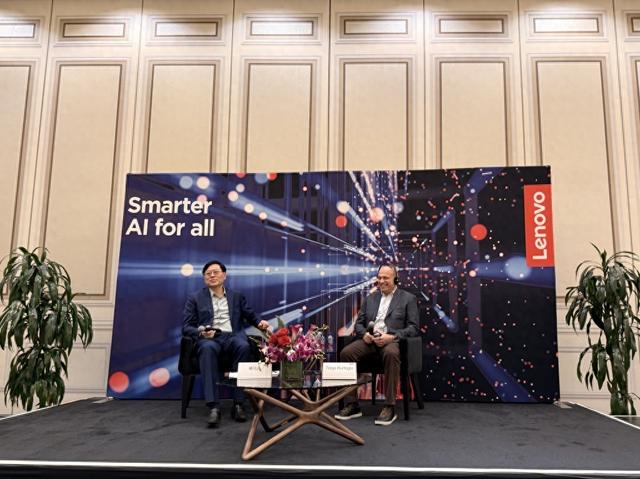
黄仁勋、杨元庆官宣合作:推出“人工智能云超级工厂”;智元发布开源仿真平台Genie Sim 3.0丨AIGC日报
创业邦· 2026-01-08 04:34
Group 1 - Lenovo and NVIDIA announced a collaboration to launch the "Lenovo AI Cloud Super Factory," which aims to significantly reduce the "time to first token" for AI deployment and scale up to 100,000 GPUs to support trillion-parameter AI models [2] - Datong Technology is advancing partnerships in the autonomous driving sector, showcasing a smart charging robot capable of automated charging tasks, and introducing a new generation of intelligent charging network systems at CES 2026 [2] - Zhiyuan Robotics released the Genie Sim 3.0, an open-source simulation platform driven by a large language model, which integrates 3D reconstruction and visual generation, allowing for rapid scene generation and a comprehensive evaluation system covering over 100,000 scenarios [2] Group 2 - Roborock, a Chinese vacuum cleaner manufacturer, unveiled the Saros Rover, a stair-climbing vacuum cleaner equipped with AI and motion sensors, demonstrating its ability to navigate stairs and uneven surfaces [2]


联想申请模型参数调整方法专利,实现根据图表问答数据优化模型参数
Jin Rong Jie· 2026-01-08 04:30
国家知识产权局信息显示,联想(北京)有限公司申请一项名为"模型参数调整方法、图表问答方法及 电子设备"的专利,公开号CN121279447A,申请日期为2025年9月。 作者:情报员 天眼查资料显示,联想(北京)有限公司,成立于1992年,位于北京市,是一家以从事计算机、通信和 其他电子设备制造业为主的企业。企业注册资本565000万港元。通过天眼查大数据分析,联想(北京) 有限公司共对外投资了107家企业,参与招投标项目5000次,财产线索方面有商标信息1747条,专利信 息5000条,此外企业还拥有行政许可238个。 声明:市场有风险,投资需谨慎。本文为AI基于第三方数据生成,仅供参考,不构成个人投资建议。 本文源自:市场资讯 专利摘要显示,本公开提供了一种模型参数调整方法、图表问答方法及电子设备,应用于人工智能技术 领域。该模型参数调整方法,包括:根据第一图表、第一文本信息和第一描述信息,确定第一目标信 息,第一目标信息包括第一期望回复信息,第一文本信息包括与第一图表对应的第一问题信息,第一描 述信息表征对于第一图表中元素的视觉特征和空间特征的文本表述;将第一图表问答数据输入第一模 型,得到第一模型生成 ...