
CNCB(00998)

Search documents
单批数量年内最多,中信银行今起上调158款代销基金风险评级,建行民生均曾出手
Xin Lang Cai Jing· 2025-05-12 03:24
Core Viewpoint - Major commercial banks, including Citic Bank, have raised the risk ratings of their fund distribution products to better protect investors' rights, with Citic Bank's adjustment being the largest in the industry to date [1][3]. Group 1: Citic Bank's Actions - Citic Bank announced an increase in the risk ratings of 158 asset management products, effective from May 12, 2025, marking the highest number of products adjusted in a single batch [2][3]. - The risk ratings of several funds were raised, with some products moving from PR3 (medium risk) to PR4 (higher risk), and one product being upgraded from PR2 (lower risk) to PR4 [3]. - The adjustments are in response to regulatory requirements aimed at enhancing investor suitability management and protecting investor rights [2][3]. Group 2: Industry Trends - Other banks, such as China Construction Bank and Minsheng Bank, have also raised risk ratings for their fund distribution products earlier this year, indicating a broader trend in the banking industry [4][5]. - Minsheng Bank adjusted the risk rating of a specific fund to "medium risk" on January 10, 2025, while China Construction Bank made similar adjustments to 21 funds in February 2025 [4].

招行、中信银行拟设金融资产投资公司
Nan Fang Du Shi Bao· 2025-05-11 23:11
Core Viewpoint - Several commercial banks in China are establishing financial asset investment companies (AIC) to enhance their service capabilities and support the economy, following regulatory encouragement to expand the pilot program for AICs [1][4]. Group 1: Company Announcements - China Merchants Bank announced on May 8 that it plans to invest 15 billion yuan to establish a wholly-owned financial asset investment company, which will become a first-level subsidiary upon successful establishment [2]. - CITIC Bank also announced on the same day its intention to invest 10 billion yuan to set up a wholly-owned subsidiary named CITIC Financial Asset Investment Co., Ltd. [2]. - Both banks emphasized that these investments align with their business development needs and will not significantly impact their financial status or operational results [2][3]. Group 2: Regulatory Context - On March 5, the National Financial Regulatory Administration issued a notice expanding the pilot program for AICs from 18 cities to 14 provinces, supporting commercial banks in establishing AICs [1][4]. - Prior to this, five state-owned banks had already established AICs in 2017, which have been exploring important models for financial support of technological innovation [4]. Group 3: Market Implications - The establishment of AICs marks a significant development in the market, as it allows banks to engage in equity investments, thereby helping companies reduce leverage and mitigate financial risks [6][7]. - AICs are evolving from a single debt-to-equity tool to a comprehensive investment platform, expanding their business scope to include mergers and acquisitions and mezzanine financing [6][7]. - The backing of banks provides AICs with stronger resource allocation capabilities, enabling them to offer diversified financial services to technology innovation enterprises throughout their lifecycle [7].


中信证券资产管理有限公司 关于以通讯方式召开中信证券卓越成长两年持有期混合型集合资产管理计划集合计划份额持有人大会的公告
Zhong Guo Zheng Quan Bao - Zhong Zheng Wang· 2025-05-11 23:08
Core Viewpoint - The announcement details the change of management for the CITIC Securities Bond Optimization One-Year Holding Period Bond Collective Asset Management Plan to Huaxia Fund Management Co., Ltd, along with the corresponding registration change to Huaxia Bond Optimization One-Year Holding Period Bond Investment Fund [1][2][3]. Group 1: Management and Registration Changes - The management of the collective asset management plan will transition from CITIC Securities Asset Management Co., Ltd to Huaxia Fund Management Co., Ltd [2][3]. - The registration of the plan will change from "CITIC Securities Bond Optimization One-Year Holding Period Bond Collective Asset Management Plan" to "Huaxia Bond Optimization One-Year Holding Period Bond Investment Fund" [3][5]. - The investment manager will also change from CITIC Securities' managers to Huaxia Fund's manager [4]. Group 2: Plan Duration and Structure - The original plan was set to expire on May 29, 2025, but the new structure will allow for an indefinite duration [5][6]. - The investment scope will expand to include "publicly offered securities investment funds and credit derivatives," with corresponding investment restrictions [6][7]. - The investment strategy will be adjusted to incorporate new investment types and strategies [7][8]. Group 3: Fee Structure and Valuation - The management fee will be reduced from 0.7% to 0.6% annually [9]. - The valuation methods will be updated in accordance with the latest regulations from the China Securities Investment Fund Industry Association [8][10]. Group 4: Shareholder Meeting and Voting - A shareholder meeting will be held to vote on the management change, requiring a two-thirds majority for approval [3][11]. - A redemption period of at least five trading days will be provided for shareholders to make decisions regarding their holdings [11][12]. - The decision from the shareholder meeting will take effect immediately upon approval and must be reported to the China Securities Regulatory Commission within five days [3][11].

银行业本周聚焦:2024年末,42家上市银行的债券投资对业绩贡献度如何?
GOLDEN SUN SECURITIES· 2025-05-11 10:23
Investment Rating - The report maintains an "Increase" rating for the banking sector [5] Core Insights - The report highlights that by the end of 2024, the bond investments of 42 listed banks significantly contributed to their performance, particularly due to the continuous decline in bond market interest rates, with a cumulative drop of 88 basis points in the 10-year government bond yield [1] - The report emphasizes the substantial floating profits accumulated in the FV-OCI financial assets due to fair value changes, which banks have utilized to support their performance through timely disposals of financial assets [1][4] - The report identifies that the floating profits from FV-OCI assets are particularly significant for certain city commercial banks and rural commercial banks, with some banks showing floating profit to profit ratios exceeding 100% [2][3] Summary by Sections 1. FV-OCI Floating Profit Situation - State-owned banks dominate the floating profit scale, with China Construction Bank and Agricultural Bank of China exceeding 50 billion yuan in floating profits by the end of 2024 [1] - City and rural commercial banks show high ratios of FV-OCI floating profits to profits, with Lanzhou Bank reaching 126.9% [2] - The contribution of FV-OCI floating profits to core Tier 1 capital is significant for several city and rural commercial banks, with notable increases year-on-year [3] 2. Financial Asset Disposal Income Situation - In 2024, listed banks disposed of AC financial assets generating a total income of 50.29 billion yuan, an increase of 82.5% year-on-year, and FV-OCI financial assets generating 85.36 billion yuan, an increase of 134.4% year-on-year, leading to a total disposal income of 135.6 billion yuan [4][8] - The report notes that while the disposal income is significant, it does not imply a substantial increase in the scale of asset disposals, as the gains are influenced by the declining interest rates in the bond market [4] 3. Sector Outlook - The report suggests that while short-term impacts from tariff policies may affect exports, long-term domestic policies aimed at stabilizing real estate, promoting consumption, and enhancing social welfare are expected to support economic growth [9] - The banking sector is anticipated to benefit from policy catalysts, with specific banks like Ningbo Bank, Postal Savings Bank, and China Merchants Bank highlighted as potential investment opportunities [9]


政策“组合拳”再现,德国政局有波折
Southwest Securities· 2025-05-09 13:42
Domestic Economic Developments - The People's Bank of China implemented a comprehensive monetary policy package, including a 50 basis point reserve requirement ratio cut and a 10 basis point interest rate reduction, aimed at alleviating short-term economic downward pressure and supporting long-term structural transformation[8] - During the May Day holiday, domestic tourism saw a 6.4% year-on-year increase, with total spending reaching approximately 180.27 billion yuan, reflecting a robust domestic consumption market[6] - The China Securities Regulatory Commission introduced 25 measures to guide public funds from focusing on scale to prioritizing investor returns, which may reshape the competitive landscape of the industry[11] International Economic Developments - The U.S. ISM Services PMI for April rose to 51.6, exceeding expectations and indicating a structural divergence between a strong services sector and a weak manufacturing sector[15] - The U.S. trade deficit reached a record high of $140.5 billion in March, a 14.0% month-on-month increase, primarily due to accelerated imports ahead of tariff hikes[17] - Germany's new Chancellor, Friedrich Merz, faced a challenging political landscape, with internal party conflicts likely to intensify despite his election victory[19] Market Trends - Brent crude oil prices decreased by 1.85% week-on-week, while iron ore prices fell by 0.09%, and copper prices increased by 0.33%[23] - Real estate sales in 30 major cities dropped by 33.05% week-on-week, with first-tier cities experiencing a 42.73% decline[38] - The average daily retail sales of passenger cars increased by 52% year-on-year in April, indicating a recovery in consumer demand[38]
多只银行股股价创新高,红利行情持续发酵
2 1 Shi Ji Jing Ji Bao Dao· 2025-05-09 11:45
Core Viewpoint - The banking sector is experiencing a resurgence, with significant stock price increases and a strong performance in 2024, leading to historical highs for several banks [1][2][3]. Group 1: Stock Performance - As of May 9, the banking sector rose by 1.46%, with a year-to-date increase of nearly 7%, outperforming other industry sectors [1][2]. - Among 42 bank stocks, 24 showed varying degrees of increase, with Qingdao Bank leading at a 3.4% rise, reaching a closing price of 4.86 yuan per share [2]. - The banking index has increased by 6.95% this year, making it the top performer among 30 sectors, with a cumulative rise of 43% in 2024, surpassing the CSI 300 index by 28 percentage points [2][3]. Group 2: Earnings and Financial Metrics - In Q1 2025, listed banks reported a 1.7% year-on-year decline in total operating income and a 1.2% drop in net profit attributable to shareholders, primarily due to reduced non-interest income and weakened profit smoothing [4]. - The net interest margin decreased by 13 basis points to 1.43%, with expectations of a slight narrowing of the decline to 10-15 basis points for the year [4]. - Total assets of listed banks grew by 7.5% year-on-year, indicating a return to normal growth levels, with city commercial banks maintaining higher growth rates [4]. Group 3: Dividend Trends - The banking sector is entering a dividend season, with total disclosed dividends for 2024 amounting to 616.13 billion yuan, of which the six major banks accounted for over 70% [6][7]. - Industrial and Commercial Bank of China led with a dividend of 109.77 billion yuan, followed by China Construction Bank with 100.75 billion yuan [7]. - Analysts highlight the importance of sustainable dividend policies, emphasizing that increasing dividend frequency can enhance investor confidence and stabilize stock prices [8].


共拓跨境债券合作新机遇 中信银行深圳分行举办“远见未来 债通全球”研讨会
Cai Fu Zai Xian· 2025-05-09 10:03
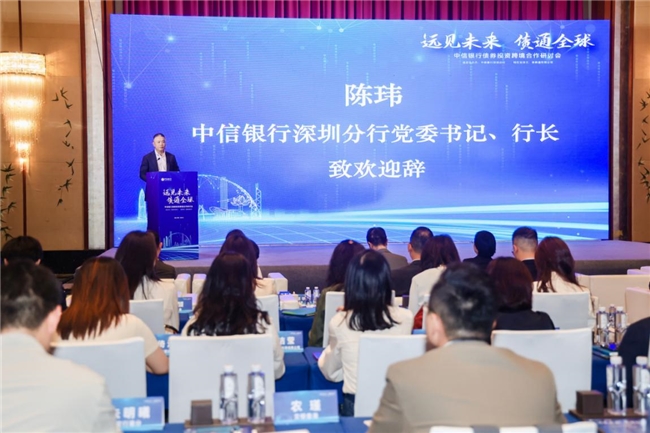
Core Insights - The seminar "Vision for the Future: Bond Connect Global" was held in Shenzhen, focusing on new opportunities in the cross-border bond market, with participation from over 30 domestic and foreign financial institutions [1][3] - CITIC Bank has established significant advantages in cross-border bond underwriting, investment, custody, and fund clearing, leveraging its strong capital strength and efficient global settlement network [1][3] - The bank aims to deepen its cross-border bond business, innovate investment targets, and expand its sales network, particularly focusing on high-quality bonds along the Belt and Road Initiative [3][4] Group 1 - The seminar was supported by Bond Connect Company and attended by representatives from key financial institutions, discussing the development of the cross-border bond market [1] - CITIC Bank has formed a comprehensive one-stop solution covering issuance, investment, and services, providing diversified and high-liquidity asset allocation options for investors [1][3] - The bank's leadership emphasized the importance of collaboration with various financial institutions to support national strategies and promote the internationalization of the RMB [3] Group 2 - Experts from CITIC Securities and Huaxia Fund shared insights on macroeconomic trends, bond market analysis, and fixed-income investment strategies during the seminar [4] - The seminar highlighted the rapid development of the Bond Connect mechanism, which has improved connectivity in key areas such as foreign exchange conversion and bond investment [3][4] - CITIC Bank is committed to fulfilling national strategies and enhancing its role as an excellent market maker in the Bond Connect, aiming to meet cross-border financing needs for the real economy [4]

银行股一季度机构持仓情况:中央汇金借道ETF增持,险资举牌活跃
Huan Qiu Wang· 2025-05-09 06:08
Group 1 - Central Huijin has heavily invested in 8 bank stocks, including major state-owned banks like ICBC, ABC, BOC, and CCB, as well as several joint-stock banks and a city commercial bank [3] - Social Security Fund has increased its holdings in 5 bank stocks, with a notable increase in shares of Changshu Bank, totaling an increase of 288.18 thousand shares since the beginning of the year [3] - Insurance funds have shown strong interest in bank stocks, with multiple insurance companies acquiring stakes in 5 listed banks during the first quarter of this year [3] Group 2 - Australia and New Zealand Banking Group signed a share transfer agreement with New China Life Insurance, transferring approximately 330 million shares of Hangzhou Bank, representing 5.45% of the total issued shares [4]


金喜年获聘中信银行副行长!系银行业老兵,曾任广州分行行长
Nan Fang Du Shi Bao· 2025-05-09 05:49
Group 1 - The core point of the article is the appointment of Jin Xinian as the Vice President of CITIC Bank, marking a significant leadership change within the bank [2][3] - Jin Xinian has 31 years of experience in the Chinese banking industry, having spent 24 years at Agricultural Bank of China before joining CITIC Bank in 2017 [3] - Following Jin's appointment, CITIC Bank will have a leadership structure of "one president and five vice presidents," with the recent departure of a vice president due to work adjustments [4][5] Group 2 - CITIC Bank's first-quarter report shows an operating income of 51.77 billion yuan, a year-on-year decrease of 3.72%, while the net profit attributable to shareholders was 19.509 billion yuan, an increase of 1.66% [5] - As of the end of the first quarter, CITIC Bank's total assets amounted to 9,855.268 billion yuan, reflecting a year-on-year growth of 3.38% [5] - The non-performing loan ratio stands at 1.16%, unchanged from the end of the previous year, and the provision coverage ratio is 207.11%, down by 2.32 percentage points from the end of last year [5]
2025年Brand Finance中国500强榜单发布:中信银行排名第24位,品牌价值达1192亿元
Feng Huang Wang Cai Jing· 2025-05-09 03:29
Group 1 - The core report from Brand Finance reveals that CITIC Bank's brand value is 119.2 billion yuan, an increase of 21.9% compared to 2024, ranking 24th, up 6 places from the previous year, with a brand strength rating of AA- [1] - As of the end of 2024, CITIC Bank's total assets reached 9,532.722 billion yuan, growing by 5.31% year-on-year; total loans and advances (excluding accrued interest) amounted to 5,720.128 billion yuan, up 4.03%; total customer deposits (excluding accrued interest) were 5,778.231 billion yuan, increasing by 7.04% [1] - In 2024, CITIC Bank achieved an operating income of 213.646 billion yuan, a year-on-year increase of 3.76%; net interest income was 146.679 billion yuan, up 2.19%; net non-interest income reached 66.967 billion yuan, growing by 7.39%; net profit attributable to shareholders was 68.576 billion yuan, an increase of 2.33% [1] Group 2 - Brand Finance is a global independent third-party brand valuation and strategic consulting firm, collaborating with the International Organization for Standardization (ISO) to establish international standards for brand valuation and assessment [2] - The "Brand Finance 2025 China Brand Value Top 500" report includes key performance indicators of listed brands, highlights innovations and technological developments, and provides insights into global brands in sustainability, all based on international accounting standards and ISO standards [2] - Brand Finance has conducted brand value assessments and consulting services for nearly ten thousand brands across major economies, focusing on top Chinese brands since its establishment [2]