
CNCB(00998)

Search documents
中信银行郑州分行:以金融温度点亮中原品牌之光
Huan Qiu Wang· 2025-05-14 01:40
Core Viewpoint - The article highlights the proactive measures taken by the Zhengzhou branch of CITIC Bank to support the high-quality development of the economy in Henan Province through innovative financial services and products tailored for various sectors, including foreign trade, small and micro enterprises, and private enterprises [1][4][5]. Group 1: Support for Foreign Trade - CITIC Bank Zhengzhou branch has established a "Cross-border Financial Comprehensive Service System" to support over 10,000 foreign trade enterprises in the province, providing international settlement services amounting to nearly 10 billion RMB and financing support exceeding 20 billion RMB as of Q1 2025 [1][2]. - The bank has introduced a unique "Export-oriented Enterprise Credit Card" credit model to facilitate financing for light-asset foreign trade enterprises, significantly reducing the approval time for credit [2]. Group 2: Support for Small and Micro Enterprises - The bank has implemented a "thousand enterprises and ten thousand households" outreach initiative, providing credit support of 11.9 billion RMB and loans of 10.8 billion RMB to 8,175 small and micro enterprises by the end of March 2025 [3]. - CITIC Bank Zhengzhou branch aims to enhance its financial services for small and micro enterprises by leveraging financial technology and creating specialized products to ensure sustainable growth [3]. Group 3: Support for Private Enterprises - The bank has launched the "Star Plan" to enhance financial support for private enterprises, focusing on five key areas to innovate service models and upgrade support for private sector growth [4]. - A comprehensive action plan has been developed to address the challenges faced by private enterprises, aiming for an increase in loan volume, expansion of service coverage, and reduction in loan costs [5].

有银行科技人员同比增15.7% 有银行“招新”工科类超金融类
Nan Fang Du Shi Bao· 2025-05-13 23:18
Core Viewpoint - The banking industry is increasingly prioritizing the recruitment and development of dual-skilled talent who understand both finance and technology, driven by policy support for technology-driven financial innovation [4][6][8]. Talent Development - Banks are focusing on hiring technology professionals, with many institutions reporting a significant increase in the number of tech staff [8][9]. - The demand for AI talent is particularly high, with banks like China Merchants Bank actively recruiting for AI-related positions [6][7]. - The average age of technology finance personnel in banks is decreasing, with many new hires coming from engineering backgrounds rather than traditional finance [11]. Performance Assessment - Banks are implementing internal due diligence exemption systems to encourage innovation in technology finance, although challenges remain in standardizing these measures [5][14]. - The due diligence exemption allows bank staff to avoid penalties if they can demonstrate that they acted responsibly in the face of risks associated with technology loans [15][17]. - There is a push for longer-term performance evaluation cycles to better assess the impact of technology loans, as short-term metrics may not accurately reflect the success of tech-driven projects [16]. Industry Trends - The proportion of technology staff within banks is generally higher in joint-stock banks compared to state-owned banks, with notable increases in recent years [9][10]. - The technology staff at major banks like ICBC and CCB has reached significant numbers, with ICBC leading at 36,000 tech employees [8][9]. - The establishment of specialized technology finance branches is becoming common, with banks setting specific standards for the number and qualifications of technology staff [12][13]. Challenges - The implementation of due diligence exemption policies faces difficulties due to a lack of unified quantitative standards, leading to subjective interpretations of responsibility [18][20]. - The complexity of assessing risks in technology finance can hinder the effectiveness of performance evaluations, as the nature of tech companies often involves high uncertainty [19][20].





银行多维赋能低空经济 信贷、股权投资、金融租赁齐发力
Zheng Quan Ri Bao· 2025-05-13 15:51
Core Viewpoint - Financial institutions are accelerating their integration into the low-altitude economy industry chain, providing a financial engine for its development [1] Group 1: Financial Institutions' Involvement - Shanghai Volant Aviation Technology Co., Ltd. signed strategic cooperation agreements with Bank of China Financial Leasing Co., Ltd. and Bank of China branches, with plans to purchase 100 eVTOL aircraft and a credit line of no less than 1 billion yuan [1] - Financial institutions are diversifying their involvement in the low-altitude economy, moving from simple credit support to equity investment and financial leasing, thereby fostering the growth of industry chain enterprises [1][2] - As of now, there are approximately 86,500 low-altitude economy-related enterprises in China, many of which are capital and technology-intensive [2] Group 2: Challenges in Financing - Low-altitude economy enterprises face financing difficulties due to high R&D costs and long commercialization cycles, leading to a mismatch with traditional bank loan terms [3] - The core value of these enterprises often lies in intangible assets like patents and R&D teams, making it hard to meet traditional financial institutions' collateral requirements [3] - The overall ecosystem of the low-altitude economy is still in its infancy, which complicates market expectations and increases financing thresholds [3][4] Group 3: Financial Support Strategies - Major state-owned banks and leading national joint-stock banks are primarily involved in financing the low-altitude economy, with customized credit funding being the most common form of support [4] - For instance, the Industrial and Commercial Bank of China provided 1.4 billion yuan for the construction of the Zigong Aviation Industrial Park [4] - Recently, five banks jointly provided 1.26 billion yuan in syndicated loans to support the construction of Xiaopeng Huaitian's flying car manufacturing base [4][5] Group 4: Optimizing Financial Services - Various regions have begun to implement top-level planning and guidance documents to support the low-altitude economy, such as Sichuan Province's financial support for various low-altitude equipment projects [6] - Financial institutions are encouraged to develop differentiated credit models and innovative financing tools to address the unique characteristics of low-altitude economy enterprises [7] - Establishing a specialized risk assessment system and enhancing government-bank-enterprise cooperation mechanisms are recommended to create a multi-level financing system [7]

银行股连创新高,低利率环境考验非息收入创造能力
Di Yi Cai Jing Zi Xun· 2025-05-13 12:56
Core Viewpoint - Bank stocks have shown resilience and have risen against the market trend, with the China Securities Bank Index reaching a new high since February 2018, driven by multiple favorable policies and market conditions [1][2][3]. Market Performance - On May 13, the China Securities Bank Index rose by 1.53% to close at 7629.55 points, marking a new high since February 2018, with many individual stocks hitting historical highs [1][2]. - Over the last five trading days, the bank sector has increased by 5.76%, outperforming the Shanghai Composite Index, which rose by 1.77% [2]. - Notable individual stock performances include Chongqing Bank and Shanghai Bank, both rising over 3%, with Chongqing Bank leading with a 10.9% increase [2]. Policy Impact - Recent monetary policies, including interest rate cuts and reserve requirement ratio reductions, are expected to have a neutral impact on banks' net interest margins, with adjustments on the liability side helping to mitigate pressures [1][6][7]. - The establishment of Financial Asset Investment Companies (AIC) is seen as a significant opportunity for banks to enhance their comprehensive benefits and support technology enterprises [3][4][5]. Earnings and Profitability - Despite the pressure on profitability, bank stocks remain attractive due to their stability and dividend yields, especially as regulatory measures encourage long-term capital inflows [3][4]. - The average net interest margin for listed banks is projected to be 1.52% by the end of 2024, continuing a five-year decline, with a notable decrease in interest income reported for the previous year [6][8]. Strategic Adjustments - Banks are adapting to the low-interest-rate environment by diversifying their income sources and optimizing their operational structures to maintain profitability [8][9]. - The focus on non-interest income generation is becoming increasingly critical for banks to navigate the challenges posed by a shrinking net interest margin [8][9].




柏立军接任中信银行国际(中国)董事长,前董事长毕明强加盟东亚银行
2 1 Shi Ji Jing Ji Bao Dao· 2025-05-13 09:55
21世纪经济报道记者 黄子潇 深圳报道 据深圳金融监管局批复信息,柏立军近日获批出任中信银行国际(中国)董事长。 记者从接近该行人士获悉,本次调整为"上兼下",柏立军仍在该行的香港母行中信银行(国际)正常履 职。 从股权关系来看,中信银行国际(中国)是中信银行(国际)在深圳设立的外商独资银行,而中信银行 (国际)则是中信银行通过中信国金在香港设立的境外子公司。这也是该行"国际""中国"双后缀的由 来。 官网显示,柏立军现为中信银行(国际)副行政总裁兼公司业务总监,负责提升公司业务产品实力以及 整体业务监控,积极推动该行与中信银行及中信集团的联动合作。他于2006年由北京银行转投中信银行 总行金融市场部工作,后历任中信集团董事长助理、中信银行董事及监事会办公室副总经理,直至调任 香港。他持有南开大学经济学学士学位及中国人民大学金融学硕士学位。 此外,今年1月记者曾报道,中信银行(国际)在深圳全资设立的科技子公司——信银数智正式展业。记 者从开业仪式上获悉,信银数智正是在中信银行国际(中国)金融科技研发中心的基础上成立的,其董 事长林肇业亦是从香港母行派驻,现任母行资讯科技总监。 林肇业表示,信银数智定位为中信银 ...
银行业周报:降准降息落地,稳定市场预期-20250513
Bank of China Securities· 2025-05-13 08:15
Investment Rating - The report rates the banking industry as "Outperform" [1] Core Insights - Recent monetary policy adjustments, including a 0.5 percentage point reduction in the reserve requirement ratio and a 0.1 percentage point decrease in policy interest rates, are expected to stabilize market expectations and provide approximately 1 trillion yuan in long-term liquidity [2][3] - The establishment of financial asset investment companies by three joint-stock banks aims to enhance their ability to serve the real economy, although it may put pressure on their capital and asset quality [4][5] - The banking sector is viewed positively, with a focus on high dividend investment opportunities, particularly in undervalued banks such as China Merchants Bank and Agricultural Bank of China [1] Summary by Sections Monetary Policy - The People's Bank of China has implemented a series of policies to support market stability, including lowering the reserve requirement ratio and interest rates [2][3] - Specific measures include reducing the LPR by approximately 0.1 percentage points and adjusting various structural monetary policy tool rates [2] Financial Asset Investment Companies - Three joint-stock banks are in the process of establishing financial asset investment companies to enhance their service capabilities for the real economy [4] - This move is seen as a response to the slowing credit growth among joint-stock banks and aims to optimize corporate capital structures [5] Market Performance - The banking sector index increased by 1.88% this week, while the overall A-share index rose by 2.74%, indicating a slight underperformance of the banking sector [12] - Among different types of banks, joint-stock banks showed a notable increase of 3.79%, while state-owned banks experienced a decline of 0.89% [12][19] Individual Bank Performance - All A-share banks saw an increase in stock prices, with joint-stock banks leading the gains, particularly Shanghai Pudong Development Bank and China Merchants Bank [19][21] - The average price-to-book (P/B) ratio for state-owned banks is 0.67X, while joint-stock banks have a lower average P/B of 0.54X [21] Bond Market and Financing - The bond market saw a total financing of 1.749 trillion yuan this week, with net financing increasing significantly compared to the previous week [44] - The issuance of interbank certificates of deposit reached 857.9 billion yuan, reflecting a substantial increase in issuance volume [59]




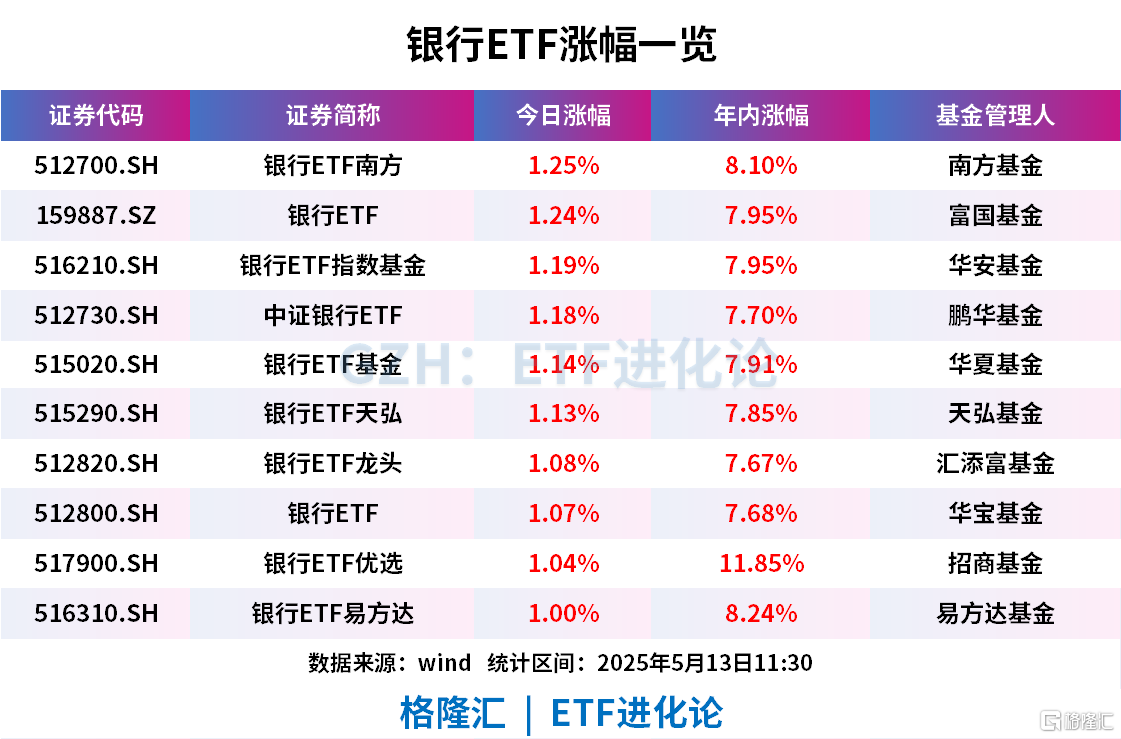
险资“爆买”银行股,银行ETF南方、银行ETF、中证银行ETF上涨
Ge Long Hui A P P· 2025-05-13 03:54
Market Overview - The A-share market showed mixed performance with the Shanghai Composite Index up by 0.08% at 3371.86 points, while the Shenzhen Component Index and the ChiNext Index fell by 0.24% and 0.23% respectively, and the North Star 50 Index decreased by 0.37% [1] - The total trading volume for the market reached 907.2 billion yuan, an increase of 43.4 billion yuan compared to the previous day, with over 3400 stocks declining [1] Banking Sector Performance - Bank stocks collectively strengthened, with several banks such as Shanghai Pudong Development Bank, Shanghai Bank, Jiangsu Bank, and Chengdu Bank reaching historical highs [1] - Various bank ETFs, including Southern Bank ETF, Fortune Bank ETF, and Huaxia Bank ETF, experienced increases in their indices [1] Insurance Investment in Banking Stocks - Insurance capital has made at least 13 significant investments in banking stocks this year, with six of these being direct investments in banks, including Agricultural Bank of China and Postal Savings Bank [5] - As of May 8, 2025, insurance capital held bank stocks valued at 0.69 trillion yuan, an increase of 0.16 trillion yuan from the end of 2023, indicating a strategic shift towards banking stocks due to their dividend yields and regulatory advantages [6] Future Outlook for Banking Sector - The banking sector is expected to benefit from intensified fiscal policies and a supportive monetary environment, which will positively impact credit growth and economic expectations [7] - The year 2025 is anticipated to be crucial for improving asset quality in banks, with expectations of reduced risks in real estate and local investment properties [7]
险资“爆买”银行股
21世纪经济报道· 2025-05-12 13:09
Core Viewpoint - Insurance capital has been actively increasing stakes in bank stocks, particularly state-owned banks, due to their stable performance, low valuations, and high dividend yields, amidst a backdrop of asset scarcity and increasing investment pressure [1][2]. Group 1: Insurance Capital Activity - As of May 9, insurance capital has made 13 stake increases this year, with 6 of these involving bank stocks, including significant investments by Ping An Life in Agricultural Bank, Postal Savings Bank, and China Merchants Bank [1]. - Ping An Life has notably increased its holdings in China Merchants Bank, surpassing the 5% threshold and reaching a 12% stake by May 9, with an average share price of 44.7757 HKD [1]. - The total book value of stocks held by Ping An is reported at 437.379 billion CNY, reflecting a nearly 50% year-on-year increase [1]. Group 2: Investment Preferences and Strategies - The preference for state-owned banks is attributed to their strong operational fundamentals, low volatility, and attractive dividend yields, with major banks offering average dividend yields above 5% [2]. - Ping An's management has indicated that the average dividend yield of over 5% provides a significant spread compared to the current insurance product guarantee rates of 2%-2.5%, making core bank stocks ideal investment targets [2]. - Insurance companies face challenges in investment decisions due to new financial instrument regulations, leading to a focus on long-term stock investments and high-dividend strategies to mitigate profit volatility [2]. Group 3: Market Dynamics and Future Outlook - Current statistics show that listed insurance companies have a low allocation to FVOCI equity assets, with only about 11% in equity allocation and 5% in OCI equity assets, indicating substantial room for growth [3]. - Recent government policies aimed at encouraging long-term insurance capital market participation are expected to inject significant funds into the market, with estimates suggesting an additional 1.66 trillion CNY could enter the market if equity asset limits are fully utilized [3]. - Projections indicate that insurance capital could contribute an incremental 600-800 billion CNY to the market over the next three years, with high-dividend stocks being a key focus area for future allocations [3].



深度|从 “债性思维” 到 “股权逻辑” AIC扩容与挑战
2 1 Shi Ji Jing Ji Bao Dao· 2025-05-12 11:17
Core Viewpoint - The expansion of the AIC (Asset Investment Company) license marks a significant step in increasing investment in technology innovation enterprises, with major banks committing substantial funds to establish AICs, thereby enhancing financial support for the development of innovative companies [1][2][3]. Group 1: AIC Development and Expansion - The AIC's development began in 2016 with the initiation of market-oriented debt-to-equity swaps, allowing banks to establish specialized institutions for related business [2]. - The shift from debt restructuring to direct equity investment was catalyzed by pilot programs in Shanghai, laying the groundwork for future AIC growth [2][3]. - As of May 7, 2024, the total signed intention amount for AIC investments has exceeded 380 billion, with pilot programs successfully launched in 18 cities [3]. Group 2: Financial Institutions' Involvement - Major banks like China Merchants Bank, CITIC Bank, and Industrial Bank have announced plans to establish AICs with significant capital contributions, indicating a strong response to regulatory encouragement [1][9]. - The establishment of AICs allows banks to enhance their service capabilities in equity investment, complementing traditional lending practices [6][9]. Group 3: Challenges and Opportunities - Despite the promising outlook, AICs face challenges such as insufficient investment research capabilities, high risk weights, and outdated assessment mechanisms [1][13]. - The transition from a debt-oriented mindset to an equity-focused approach presents five key challenges, including talent shortages and capital consumption pressures [13][15]. - The unique advantages of AICs, such as stable funding sources and the ability to act as patient capital, position them favorably in the investment landscape [10][11]. Group 4: Strategic Collaborations and Models - AIC funds often adopt collaborative models involving government, industry, and financial institutions, which help to mitigate risks and enhance resource integration [4]. - The establishment of AICs is seen as a strategic move to support the growth of technology-driven enterprises and improve the overall financial ecosystem [9][12]. Group 5: Future Directions - The regulatory framework is evolving to support the expansion of AICs, with a focus on enhancing their role in financing technology innovation and supporting small and medium-sized enterprises [2][10]. - The need for banks to adapt their risk management and investment strategies to align with the dynamics of equity investment is emphasized, highlighting the importance of developing a robust investment culture [15][16].
政银企携手 共育小微企业成长沃土
Xin Hua Ri Bao· 2025-05-12 07:19
□ 本报记者 何 钰 5月8日,2025南京市"普惠金融 惠企润业"系列活动江宁专场举行。 普惠金融一头连着群众生活的"小日子",一头托起经济发展的"大格局"。人民银行江苏省分行党委委 员、副行长陈涤非表示,近年来,人民银行江苏省分行充分运用再贷款、再贴现等货币政策工具,积极 支持民营小微企业、个体工商户和"三农"发展,全力写好普惠金融大文章。 金融"活水"持续浇灌,不断滋养着企业发展。江宁经济开发区管委会主任王爱军介绍,近三年,江宁经 济开发区每年新增注册6000家以上的经营主体,集聚规上工业企业1807家,400家省级以上专精特新"小 巨人"企业、高新技术企业1862家、科技型中小企业3049家。 从"小个体"到"大产业",小微企业的发展之路也面临着各种挑战。作为江宁经开区本土企业,拓恒技术 有限公司聚焦低空智能化数据信息服务。该公司总经理张成指出,前期投入大、周期长、产品市场化缓 慢等问题都会制约着科技型中小企业的发展。中国银行了解到公司的资金需求后,基于公司技术专利和 订单资质,提供了贷款,缓解了资金压力。 普惠金融也在助力企业从"幼苗"成长为"参天大树"。中信银行南京分行普惠金融部副总经理张乐介绍, ...