
CNCB(00998)

Search documents
多家银行上调代销基金产品风险等级 业内专家:或成常态化趋势
Sou Hu Cai Jing· 2025-12-01 11:39
Core Viewpoint - Several banks, including China Construction Bank, Minsheng Bank, Postal Savings Bank, and Citic Bank, have raised the risk levels of certain mutual fund products they distribute, reflecting a proactive approach to investor suitability management and compliance with regulatory requirements [1][2][3] Group 1: Risk Level Adjustments - China Construction Bank announced adjustments to 87 mutual fund products, with 32 products upgraded from R2 (low to medium risk) to R3 (medium risk) and 55 products from R3 to R4 (medium to high risk) [1] - Minsheng Bank also adjusted the risk ratings of 8 funds, moving them from lower risk to medium risk, emphasizing the priority of investor interests [1][2] - Citic Bank has made its fourth adjustment to risk ratings this year, indicating a trend of ongoing evaluations and adjustments in response to market conditions [2][3] Group 2: Regulatory Compliance and Market Conditions - The adjustments are primarily driven by regulatory compliance requirements, necessitating banks to dynamically assess and accurately disclose product risks [3] - The current market volatility, particularly in equity funds due to increased asset fluctuations and high concentration, has led to a more realistic reflection of risk characteristics through these adjustments [3] - The trend of banks adjusting risk ratings is expected to become a standard practice in the industry, aligning with the ongoing regulatory emphasis on investor suitability management [3] Group 3: Investor Guidance - Banks are encouraging investors to reassess their risk tolerance in light of the new risk ratings, providing options for redemption or conversion to more suitable products [2][3] - Investors are advised to verify their mutual fund holdings through various channels and make informed decisions based on their risk capacity [2]



立减金、组合礼扎堆!银行个人养老金开启年末冲刺
Hua Xia Shi Bao· 2025-12-01 09:36
Core Insights - Banks are intensifying promotional activities for personal pension accounts, focusing on customer retention and active participation rather than just attracting new accounts [3][6][7] Group 1: Promotional Strategies - Major banks, including China Bank and Industrial and Commercial Bank, are offering various incentives such as WeChat discounts and cash rewards to encourage account opening and contributions [4][5] - The promotional focus has shifted from merely attracting new customers to enhancing customer experience and retention, as many accounts remain inactive after initial opening [3][6] Group 2: Customer Behavior and Market Trends - There is a prevalent issue of "high account openings but low contributions," with many customers opening accounts for short-term rewards but not actively contributing [7][8] - A report indicates that as of November 2024, only 21% of personal pension account holders are making contributions, despite a significant number of accounts being opened [7][8] Group 3: Regulatory and Competitive Landscape - The regulatory framework allows individuals to open only one personal pension account with a commercial bank, intensifying competition among banks to attract customers [5][8] - Banks are innovating their services, such as introducing appointment-based contribution options, to lower barriers for customers and encourage ongoing contributions [9][10]



稳稳“穿越四季”:“低利率”时代的财富密码
Hua Xia Shi Bao· 2025-12-01 07:15
Group 1 - The core viewpoint of the article highlights the shift in investment strategies among Chinese investors as deposit rates fall below 1%, leading to increased interest in diversified financial assets, particularly as the GDP per capita is projected to reach $13,000 in 2024 [2][3] - The article discusses the historical context of asset allocation changes in other countries, such as the U.S. and Japan, when their GDP per capita surpassed $10,000, indicating a similar trend may occur in China [2][3] - The article emphasizes the importance of transitioning from a "single asset" investment approach to a diversified asset allocation strategy to balance risk and return in the current market environment [3][4] Group 2 - Common pitfalls in asset allocation are identified, including the misconception that holding multiple products equates to diversification, which can lead to concentrated risks in specific sectors [6][7] - The article points out that many investors are struggling to adapt to new investment paradigms, often clinging to traditional methods that do not meet their wealth growth needs [4][5] - The article introduces the "Four Seasons Portfolio" strategy developed by Citic Bank, which aims to simplify asset allocation for ordinary investors by providing a balanced mix of assets to withstand various market conditions [7][8] Group 3 - The "Four Seasons Portfolio" is designed to be user-friendly, allowing investors to select based on their risk tolerance and investment goals, with automatic rebalancing features to maintain the desired asset allocation [9] - The strategy is based on the "Permanent Portfolio" concept, which has historically achieved stable returns while minimizing drawdowns, thus providing a reliable framework for investors [7][8] - The article concludes that effective asset allocation is essential for wealth preservation and growth, positioning it as a necessary skill for investors as they increasingly shift their wealth towards financial assets [9]

中信银行新设金融资产投资公司,注册资本100亿
Qi Cha Cha· 2025-12-01 05:54
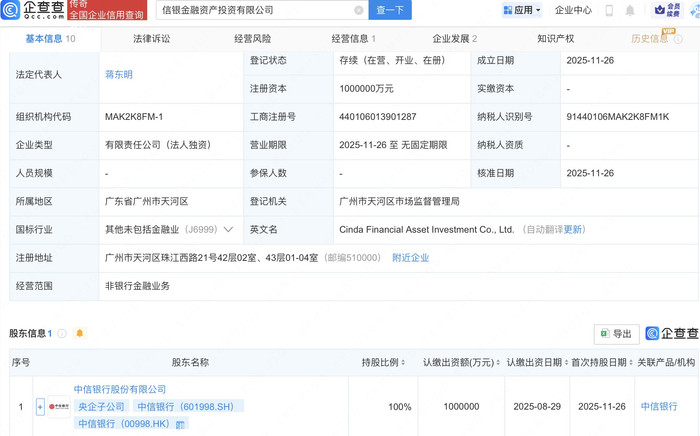
Group 1 - Cinda Financial Asset Investment Co., Ltd. has been established with a registered capital of 10 billion RMB, focusing on non-banking financial services [1][2] - The company is wholly owned by CITIC Bank, which indicates a strong backing from a major financial institution [1][3] - The legal representative of the company is Jiang Dongming, and it is registered in Tianhe District, Guangzhou, Guangdong Province [2][3] Group 2 - The company is classified under the industry category of "other financial services not elsewhere classified" [2] - The business scope includes non-banking financial operations, which may encompass a variety of financial services [1][2] - The registration date of the company is November 26, 2025, with no fixed business duration [2]
中信银行新设金融资产投资公司
Zheng Quan Shi Bao Wang· 2025-12-01 04:32
人民财讯12月1日电,企查查APP显示,近日,信银金融资产投资有限公司成立,法定代表人为蒋东 明,注册资本100亿元,经营范围为非银行金融业务。企查查股权穿透显示,该公司由中信银行 (601998)全资持股。 ...
中信银行成立金融资产投资公司 注册资本100亿元
Mei Ri Jing Ji Xin Wen· 2025-12-01 02:33
Group 1 - A new company, Xinyin Financial Asset Investment Co., Ltd., has been established with a registered capital of 10 billion RMB [1] - The legal representative of the company is Jiang Dongming [1] - The company is wholly owned by CITIC Bank and operates in the non-banking financial services sector [1]
中信银行成立金融资产投资公司 注册资本100亿
Xin Lang Cai Jing· 2025-12-01 02:15
Core Viewpoint - Recently, Xinyin Financial Asset Investment Co., Ltd. was established with a registered capital of 10 billion RMB, fully owned by CITIC Bank [1] Group 1: Company Information - The legal representative of Xinyin Financial Asset Investment Co., Ltd. is Jiang Dongming [1] - The company is registered in Guangzhou, Guangdong Province [1] - The business scope includes non-bank financial services [1] Group 2: Regulatory Approval - CITIC Bank received approval from the National Financial Supervision Administration for the establishment of Xinyin Financial Asset Investment Co., Ltd. on November 21, 2025 [1] - The registered capital of the company is confirmed to be 10 billion RMB as per the regulatory approval [1]
11月28日港股通央企红利ETF(159266)遭净赎回307.3万元
Xin Lang Cai Jing· 2025-12-01 02:10
Core Viewpoint - The Hong Kong Stock Connect Central State-Owned Enterprises Dividend ETF (159266) experienced significant net redemptions, indicating a trend of outflows from this fund in recent trading periods [1][2] Fund Performance - As of November 28, the latest scale of the Hong Kong Stock Connect Central State-Owned Enterprises Dividend ETF (159266) is 719 million yuan, down from 726 million yuan the previous day, reflecting a net outflow of 3.073 million yuan, which is 0.42% of the previous day's scale [1][2] - Over the past five days, the fund faced net redemptions totaling 5.1349 million yuan, ranking 40th out of 198 in the cross-border ETF net outflow list [1] - In the last ten days, net redemptions reached 8.2532 million yuan, ranking 34th out of 198 [1] - Over the past twenty days, the total net redemptions amounted to 34.5768 million yuan, ranking 22nd out of 198 [1] Fund Management and Holdings - The fund is managed by Liu Tingyu and Cai Leping, with Liu managing since July 23, 2025, achieving a return of 2.70%, while Cai has managed since November 5, 2025, with a return of -0.13% [2] - The fund's top holdings include China COSCO Shipping, China Nonferrous Metal Mining, China National Offshore Oil, and others, with the largest holding being China COSCO Shipping at 6.08% of the portfolio [2] Liquidity and Trading Activity - The cumulative trading amount over the last 20 trading days is 506 million yuan, with an average daily trading amount of 25.2772 million yuan [2] - The fund's current share count is 700 million [2] Comparison with Other ETFs - Other ETFs tracking the same index include Huaxia Central State-Owned Enterprises Dividend ETF (513910), Wanji Central State-Owned Enterprises Dividend ETF (159333), and Tianhong Central State-Owned Enterprises Dividend ETF (159281), with varying scales and recent net subscription figures [2]

11月红利主题基金月度成立规模新高|财富周历 动态前瞻
Sou Hu Cai Jing· 2025-12-01 00:45
A股 - Minmetals Capital's announcement of a related party transaction has drawn industry attention, with its subsidiary Minmetals Trust planning to jointly invest in a joint venture with Minmetals Real Estate, injecting 300 million yuan in cash and an asset package valued at 16.29 billion yuan [2] - The results of the subscription for Moer Thread, known as the "first domestic GPU stock," were announced, with public funds, social security funds, and pension funds acquiring approximately 38.59 million shares, accounting for 98.44% of the offline final issuance [2] - Yunnan Aluminum announced plans to acquire stakes in three aluminum companies from Yunnan Metallurgical Group, while AVIC Helicopter's subsidiary plans to merge with another wholly-owned subsidiary [2] 港股 - The Hong Kong IPO market is experiencing a surge, surpassing the NYSE and NASDAQ, aiming to become the top global fundraising market for new stocks by 2025, with 81 new listings raising a total of 215.98 billion HKD in the first ten months of the year [3] - More than half of the fundraising amount in Hong Kong has come from 14 A-share companies, with notable price discrepancies between A-shares and H-shares, exemplified by CATL's H-share price being over 14% higher than its A-share price [3] 理财 - In November, nine dividend-themed funds were established, raising a total of 6.615 billion yuan, marking a new monthly high for the year, with significant contributions from several funds launched on November 25 [4] - Major state-owned banks and some joint-stock banks have begun to withdraw 5-year large-denomination time deposits, focusing on shorter-term products, with a broad impact across various banks [4] - Sixteen technology-themed funds have been approved, including several ETFs focused on artificial intelligence and semiconductor sectors, with some products receiving approval on the same day they were submitted [4] 个人养老金 - As the year-end personal pension contribution window approaches, banks are intensifying promotional efforts, offering exclusive benefits to attract customers to open accounts and contribute funds, with potential subsidies of around 600 yuan for maximum contributions [5] 债务 - The issuance of new local special bonds in November is expected to reach 492.2 billion yuan, an increase of over 200 billion yuan from the previous month, alongside a significant rise in refinancing bonds [5] 其他 - From January to October, profits of large-scale industrial enterprises in China totaled 595.03 billion yuan, a year-on-year increase of 1.9%, with equipment manufacturing and high-tech manufacturing being the main profit growth drivers [6] - China remains the world's largest market for industrial robots, with significant improvements in performance and quality, and a projected increase in domestic multi-joint robot sales [6] - The National Development and Reform Commission announced a new credit repair management method, effective from April 1, 2026, allowing credit subjects to apply for credit repair under certain conditions [6] - China's foreign direct investment reached 1,033.23 billion yuan in the first ten months, a year-on-year increase of 7%, with investments made in 9553 overseas enterprises across 152 countries and regions [7] - The Chinese medical device market is expected to reach 1.22 trillion yuan by 2025, driven by innovation, with a record number of approved innovative medical devices [7]



金融助农新模式信贷嵌入“保险+期货”
Jing Ji Guan Cha Bao· 2025-11-30 23:55
Core Viewpoint - The "Bank + Insurance + Futures" model is emerging as a new breakthrough for banks to increase credit support for agriculture, addressing the financial challenges faced by farmers in crop production and sales [2][3][10]. Group 1: Project Overview - The "Yinqi Bao" crop insurance project was launched by the Dalian Commodity Exchange in 2023 to meet the diverse needs of large-scale grain producers, providing income insurance and enhanced credit support [1][3]. - As of now, 22 such projects have been established, providing loans totaling 91 million yuan to 55 cooperatives [1]. Group 2: Benefits for Farmers - Farmers participating in the "Yinqi Bao" project can secure higher loan amounts, with one farmer reporting an increase from 500,000 yuan to over 1 million yuan, allowing for expansion of planting areas and potential income increases of at least 100,000 yuan [4][5]. - The project includes a secondary pricing mechanism, allowing farmers to adjust selling prices based on market conditions, thus enhancing their income potential [5]. Group 3: Challenges and Solutions - The promotion of the "Bank + Insurance + Futures" model faces challenges such as the need for increased government subsidies for insurance premiums, improved data integration for loan efficiency, and the provision of personalized financial services for different farmers [2][6][9]. - Banks are collaborating with agricultural enterprises to streamline loan repayment processes and reduce the risk of overdue payments by directly transferring sales proceeds to loan accounts [7][8]. Group 4: Government and Institutional Support - The government has been providing subsidies for insurance premiums, with reports indicating that up to 85% of the premiums for certain projects are covered by government and institutional support [11][12]. - Financial institutions are working with regulatory bodies to optimize the development mechanism of the "Bank + Insurance + Futures" model, aiming to lower overall costs and expand its reach [12].