
KUAISHOU(01024)

Search documents
智通ADR统计 | 9月30日





智通财经网· 2025-09-29 22:56
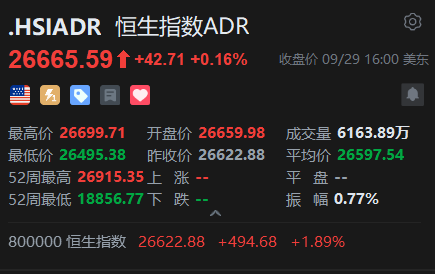
Market Overview - The Hang Seng Index (HSI) closed at 26,665.59, up by 42.71 points or 0.16% on September 29 [1] - The index reached a high of 26,699.71 and a low of 26,495.38 during the trading session, with a trading volume of 61.6389 million [1] - The 52-week high for the index is 26,915.35, while the 52-week low is 18,856.77, indicating a trading range of 0.77% [1] Major Blue-Chip Stocks Performance - HSBC Holdings closed at HKD 109.701, up 0.83% from the previous close [2] - Tencent Holdings closed at HKD 661.446, reflecting a 0.22% increase from the previous close [2] ADR and Stock Price Movements - Tencent Holdings (ADR) increased by 2.48% to HKD 660.000, with an ADR conversion price of HKD 661.446, showing a rise of HKD 1.446 compared to its Hong Kong stock price [3] - Alibaba Group (ADR) rose by 4.14% to HKD 173.400, with an ADR conversion price of HKD 175.032, indicating an increase of HKD 1.632 [3] - HSBC Holdings (ADR) saw a 1.97% increase to HKD 108.800, with an ADR conversion price of HKD 109.701, up by HKD 0.901 [3] - Other notable movements include a 2.66% increase for Trip.com Group and a 3.09% increase for JD.com [3]

中国移动近一个月首次上榜港股通成交活跃榜
Zheng Quan Shi Bao Wang· 2025-09-29 14:44
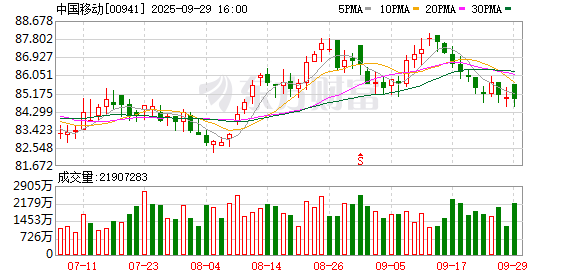
Core Insights - On September 29, China Mobile made its first appearance on the Hong Kong Stock Connect active trading list in nearly a month [2] - The total trading volume of active stocks on the Hong Kong Stock Connect reached HKD 550.07 billion, accounting for 36.95% of the day's total trading amount, with a net buying amount of HKD 4.20 billion [2] - Alibaba-W led the trading volume with HKD 139.01 billion, followed by Xiaomi Group-W and SMIC with HKD 99.14 billion and HKD 67.04 billion respectively [2] Trading Activity Summary - The most frequently listed stocks in the past month include Alibaba-W and Tencent Holdings, each appearing 21 times, indicating strong interest from Hong Kong Stock Connect funds [2] - China Mobile's trading volume on that day was HKD 11.61 billion, with a net selling amount of HKD 8.15 billion, and the stock closed down by 0.12% [2] Individual Stock Performance - Tencent Holdings had a trading amount of HKD 65.16 billion with a net buying amount of HKD 14.94 billion, closing at HKD 660.000, up by 2.48% [2] - SMIC recorded a trading amount of HKD 67.04 billion with a net buying amount of HKD 3.79 billion, closing at HKD 76.500, up by 4.87% [2] - Xiaomi Group-W had a trading amount of HKD 99.14 billion with a net buying amount of HKD 9.96 billion, closing at HKD 53.550, down by 2.01% [2] - Alibaba-W's trading amount was HKD 139.01 billion with a net buying amount of HKD 35.57 billion, closing at HKD 173.400, up by 4.14% [2]



智通港股通活跃成交|9月29日
智通财经网· 2025-09-29 11:06
Core Insights - On September 29, 2025, Alibaba-W (09988), Xiaomi Group-W (01810), and Tencent Holdings (00700) were the top three companies by trading volume in the Southbound Stock Connect, with trading amounts of 8.69 billion, 6.22 billion, and 4.06 billion respectively [1] - In the Southbound Stock Connect for the Shenzhen-Hong Kong Stock Connect, Alibaba-W (09988), Xiaomi Group-W (01810), and SMIC (00981) also ranked as the top three, with trading amounts of 5.21 billion, 3.69 billion, and 3.02 billion respectively [1] Southbound Stock Connect (Shanghai-Hong Kong) - The top three active companies by trading amount were: - Alibaba-W (09988): 8.69 billion with a net buy of 1.66 billion - Xiaomi Group-W (01810): 6.22 billion with a net buy of 0.42 billion - Tencent Holdings (00700): 4.06 billion with a net buy of 1.26 billion [2] - Other notable companies included: - Yingfu Fund (02800): 3.98 billion with a net sell of 3.98 billion - SMIC (00981): 3.68 billion with a net buy of 17.16 million [2] Southbound Stock Connect (Shenzhen-Hong Kong) - The top three active companies by trading amount were: - Alibaba-W (09988): 5.21 billion with a net buy of 1.90 billion - Xiaomi Group-W (01810): 3.69 billion with a net buy of 0.57 billion - SMIC (00981): 3.02 billion with a net buy of 0.36 billion [2] - Other notable companies included: - Tencent Holdings (00700): 2.45 billion with a net buy of 0.23 billion - Yingfu Fund (02800): 1.81 billion with a net sell of 1.80 billion [2]
券商股全线大涨 南向资金准备逢高撤离?
Mei Ri Jing Ji Xin Wen· 2025-09-29 09:19
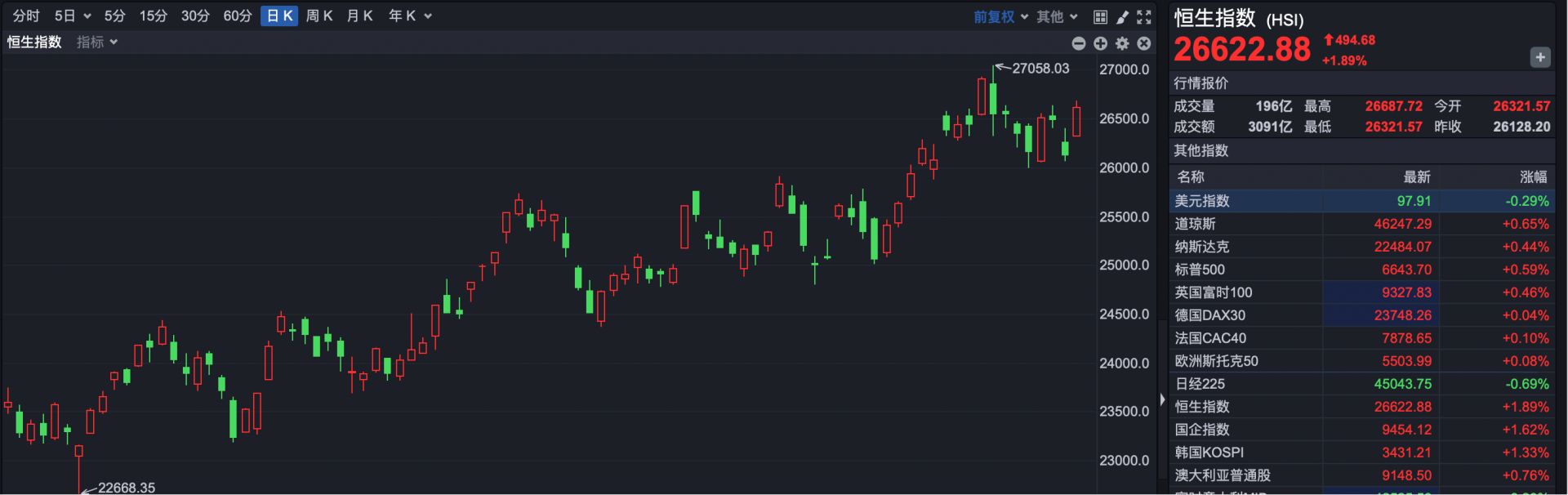
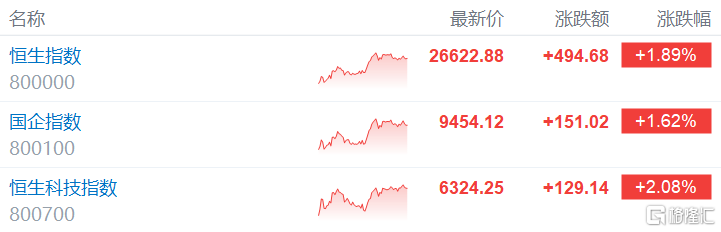
Market Performance - The Hong Kong stock market experienced a strong rebound, with the Hang Seng Index closing at 26,622.88 points, up 494.86 points, a rise of 1.89% [1] - The Hang Seng Tech Index surged by 129.14 points, closing at 6,324.25 points, reflecting a gain of 2.08% [1] Fund Flow - Despite the strong performance of the Hong Kong stocks, southbound funds showed a cautious attitude, with a net sell of over 1.6 billion HKD by the close [3] - In the previous week, southbound funds had a net buy of approximately 44 billion HKD in Hong Kong stocks [3] - Analysts suggest that the net selling may be related to the upcoming National Day and Mid-Autumn Festival holidays, as the A-shares will be closed for 8 days, leading to a temporary exit of some southbound funds [3] Sector Performance - Chinese brokerage stocks saw significant gains, with Huatai Securities (06886.HK), GF Securities (01776.HK), and Shenwan Hongyuan Hong Kong (00218.HK) rising over 12% [5] - Other notable performers included CITIC Securities (06030.HK) and Dongfang Securities (03958.HK), both up over 11% [5] - Tech stocks also performed well, with Alibaba-W (09988.HK) and Kuaishou-W (01024.HK) rising over 4%, and JD Group (09618.HK) increasing over 3% [7] - Gold stocks and lithium battery stocks also saw gains, with Tongguan Gold (00340.HK) up over 6% and CATL (03750.HK) up over 3% [7] Market Outlook - Huatai Securities noted a historical pattern in the Hong Kong market, indicating a "pre-holiday defense, mid-holiday rally, and post-holiday switch" effect [8] - Despite the closure of the southbound trading, internal factors are expected to remain more significant than external ones, with investor focus on domestic consumption data and fourth-quarter policy strength [9] - Historical data suggests a high success rate for "holding stocks over the holiday," with recommendations to maintain allocations in growth and consumer sectors before the holiday and shift to defensive positions afterward [9]


港股收评:恒指飙涨近500点,恒科指涨超2%,大金融、黄金股齐涨
Ge Long Hui A P P· 2025-09-29 08:45
Market Overview - The Hong Kong stock market saw significant gains, with the Hang Seng Index rising by 1.89%, reclaiming the 26,500-point level, driven by strong performances in the financial, insurance, and real estate sectors [1] - The Hang Seng Tech Index increased by 2.08%, indicating a recovery from previous declines [1] Financial Sector - Major Chinese brokerage stocks experienced substantial gains, with Huatai Securities and GF Securities both rising over 12% [5] - Other notable performers included CITIC Securities, which rose nearly 12%, and China Galaxy Securities, which increased by approximately 9% [5] - Insurance stocks also performed well, with New China Life Insurance up over 6% and China Life Insurance rising more than 4% [6] Technology Sector - Large tech stocks rebounded, with Alibaba and Kuaishou both gaining over 4%, and JD.com increasing by more than 3% [3] - Semiconductor stocks were active, with Huahong Semiconductor rising by 5.64% and SMIC increasing by 4.87% [9] Gold and Precious Metals - Gold prices surged, breaking the $3,810 mark, marking a year-to-date increase of over 45% [1] - Gold mining stocks collectively rose, with Zhaojin Mining and Tongguan Gold both increasing by over 6% [7] Other Sectors - The gambling sector saw gains, with New Macau International Development rising over 11% and MGM China increasing by more than 5% [11] - Education stocks also saw a rise, with Australia Chengfeng Higher Education leading with a gain of over 50% [12] - Lithium battery stocks experienced significant increases, with Tianneng Power rising by 14.18% and Zhongxin Innovation rising by 8.47% [14] - Wind power stocks continued their upward trend, with Longyuan Power increasing by nearly 5% [15] Market Sentiment - The People's Bank of China emphasized the need for a moderately loose monetary policy, encouraging financial institutions to increase credit supply [6] - Looking ahead, analysts expect the Hong Kong stock market to continue reaching new highs in the fourth quarter, driven by favorable factors such as foreign capital inflows and a shift in focus towards AI-enabled narratives [19]
港股科网股午后震荡走高,快手涨超4%
Mei Ri Jing Ji Xin Wen· 2025-09-29 06:41
每经AI快讯,9月29日,港股科网股午后震荡走高,阿里巴巴(09988.HK)、快手(01024.HK)均涨超4%, 腾讯控股(00700.HK)涨超3%,携程集团-S(09961.HK)、美团(03690.HK)、百度(09888.HK)、网易 (09999.HK)等个股跟涨。 ...
恒生科技指数涨2%


Zheng Quan Shi Bao Wang· 2025-09-29 02:51
Core Viewpoint - The Hang Seng Tech Index increased by 2%, indicating a positive trend in the technology sector in Hong Kong [1] Company Performance - SenseTime, Hua Hong Semiconductor, and Alibaba each saw their stock prices rise by over 4% [1] - Kuaishou and Kingdee International experienced stock price increases of over 3% [1]
智通港股通持股解析|9月29日
智通财经网· 2025-09-29 00:33
Core Insights - The top three companies by Hong Kong Stock Connect holding ratios are COSCO Shipping Energy (70.65%), China Telecom (70.49%), and Yangtze Optical Fibre and Cable (70.24%) [1] - Alibaba (W) saw the largest increase in holding amount over the last five trading days, with an increase of 9.659 billion yuan, followed by Tencent Holdings with 2.552 billion yuan, and SMIC with 1.472 billion yuan [1] - The companies with the largest decrease in holding amounts over the same period include Pop Mart (-0.976 billion yuan), CSPC Pharmaceutical (-0.594 billion yuan), and Hang Seng China Enterprises (-0.560 billion yuan) [1] Group 1: Top Holding Ratios - COSCO Shipping Energy (01138) has a holding ratio of 70.65% with 916 million shares [1] - China Telecom (00728) has a holding ratio of 70.49% with 9.784 billion shares [1] - Yangtze Optical Fibre and Cable (06869) has a holding ratio of 70.24% with 247 million shares [1] Group 2: Recent Increases in Holdings - Alibaba (W) (09988) increased its holding amount by 9.659 billion yuan, with a change of 58.0117 million shares [1] - Tencent Holdings (00700) increased its holding amount by 2.552 billion yuan, with a change of 3.9628 million shares [1] - SMIC (00981) increased its holding amount by 1.472 billion yuan, with a change of 2.0176 million shares [1] Group 3: Recent Decreases in Holdings - Pop Mart (09992) decreased its holding amount by 0.976 billion yuan, with a change of -3.6698 million shares [3] - CSPC Pharmaceutical (01093) decreased its holding amount by 0.594 billion yuan, with a change of -6.5368 million shares [3] - Hang Seng China Enterprises (02828) decreased its holding amount by 0.560 billion yuan, with a change of -589,320 shares [3]


腾讯研究院AI速递 20250929
腾讯研究院· 2025-09-28 16:01
Group 1: OpenAI and Model Changes - OpenAI has been reported to reroute models like GPT-4 and GPT-5 to lower-capacity sensitive models without user knowledge [1] - The rerouting occurs when the system detects sensitive topics, and this judgment is based on subjective context [1] - OpenAI's VP stated that the changes are temporary and part of testing a new safety routing system, raising user concerns about rights [1] Group 2: Tencent's Hunyuan Image 3.0 - Tencent launched Hunyuan Image 3.0, the first industrial-grade native multimodal model with 80 billion parameters, recognized as the largest open-source model [2] - The model excels in semantic understanding, capable of parsing complex semantics and generating both long and short texts with high aesthetic quality [2] - Hunyuan Image 3.0 is based on Hunyuan-A13B, trained on 5 billion image-text pairs and 6 trillion tokens, and is available under Apache 2.0 license [2] Group 3: Kuaishou's KAT Series - Kuaishou's Kwaipilot team introduced KAT-Dev-32B (open-source) and KAT-Coder (closed-source) models, achieving a 62.4% solution rate on SWE-Bench Verified [3] - KAT-Coder reached a 73.4% solution rate, comparable to top closed-source models, utilizing a chain training structure [3] - The team developed entropy-based tree pruning technology and a large-scale reinforcement learning training framework, observing new capabilities in dialogue and tool usage [3] Group 4: AI Teachers by TAL Education - TAL Education's CTO proposed a grading theory for AI teachers, evolving from assistants (L2) to true teacher roles (L3) [4] - L3 AI teachers can observe students' problem-solving steps in real-time and provide targeted guidance, forming a data feedback loop [5] - The "XiaoSi AI One-on-One" program supports personalized education across various learning environments, achieving a 98.1% accuracy in math problem-solving [5] Group 5: Meta's Humanoid Robots - Meta plans to invest billions in humanoid robot development, equating its importance to augmented reality projects [6] - The focus will be on software development rather than hardware manufacturing, aiming to create industry standards [6] - A new "Superintelligent AI Lab" is collaborating with robotics teams to build a "world model" simulating real physical laws [6] Group 6: Richard Sutton's Critique on Language Models - Richard Sutton criticized large language models as a flawed starting point, emphasizing that true intelligence comes from experiential learning [7] - He argued that large models lack the ability to predict real-world events and do not adapt to changes in the external world [7] - Sutton advocates for a learning approach based on actions, observations, and continuous learning as the essence of intelligence [7] Group 7: RLMT Method by Chen Danqi - Chen Danqi's team proposed the RLMT method, integrating explicit reasoning into general chat models to bridge the gap between specialized reasoning and general dialogue capabilities [8] - RLMT combines preference alignment and reasoning abilities, requiring models to generate reasoning paths before final answers [8] - Experiments show RLMT models excel in chat benchmarks, shifting reasoning styles to iterative thinking akin to skilled writers [9] Group 8: DeepMind's Veo 3 Emergence - DeepMind's Veo 3 demonstrates four progressive capabilities: perception, modeling, manipulation, and reasoning [10] - The concept of Chain-of-Frames (CoF) allows Veo 3 to perform cross-temporal reasoning through frame-by-frame video generation [10] - Quantitative assessments indicate significant improvements over Veo 2, suggesting video models are becoming foundational in visual tasks [10] Group 9: NVIDIA's Future in AI Infrastructure - NVIDIA is transitioning from a chip company to an AI infrastructure partner, focusing on total cost advantages rather than individual chips [11] - AI inference is expected to grow by a factor of a billion, driven by three expansion laws, potentially accelerating global GDP growth [11] - Huang Renxun emphasizes the need for independent AI infrastructure in the sovereign AI era, advocating for maximizing influence through technology exports [11]




这些互联网大厂为何集体被约谈
Jing Ji Wang· 2025-09-28 09:19
Core Viewpoint - The recent regulatory actions taken by the National Cyberspace Administration of China against major internet platforms highlight concerns over the manipulation of trending topics and the prevalence of celebrity gossip, which detracts from public discourse and important information dissemination [1][2][3] Group 1: Regulatory Actions - The National Cyberspace Administration has guided local offices in cities like Shanghai, Beijing, and Guangdong to conduct interviews and impose corrective measures on platforms such as Xiaohongshu, Weibo, Kuaishou, UC, and Toutiao for their handling of trending topics [1][2] - The platforms have acknowledged the regulatory requirements and committed to establishing special working groups for rectification and improving the ecology of trending topics [3] Group 2: Issues with Trending Topics - The trending topics on these platforms have been criticized for focusing excessively on celebrity personal lives, which crowds out public issues and important content [3] - The prevalence of entertainment news and celebrity gossip can lead to a distorted value system among users, fostering negative behaviors and extreme sentiments within fan communities [3] Group 3: Economic Incentives and Algorithmic Responsibility - The platforms are driven by a "traffic monetization" logic, where algorithms are designed to maximize user engagement and attention, often at the expense of content quality [4][5] - Experts argue that algorithms are not value-neutral and reflect the priorities and biases of their creators, which can lead to irresponsible content promotion [4][5] Group 4: Social Responsibility and Governance - The platforms are urged to go beyond mere commercial interests and take responsibility for maintaining a healthy online content ecosystem, ensuring data security, and promoting fair algorithms [5][6] - Measures such as limiting overly entertainment-focused content and increasing the visibility of public interest content are suggested to improve the situation [6]
