ICBC(01398)

Search documents
助力上海自贸区更高水平制度型开放 工商银行上海市分行自由贸易账户功能升级首单落地
2 1 Shi Ji Jing Ji Bao Dao· 2025-12-05 16:45
Core Viewpoint - The People's Bank of China has launched a financial reform policy to optimize and upgrade the functions of free trade accounts, which is now in practical application as of December 5, 2025 [2][3]. Group 1: Policy Implementation - The upgraded free trade account allows qualified enterprises to manage cross-border funds with a certain degree of control while enabling free receipt and payment of funds across borders [2]. - The implementation of the policy is supported by the Shanghai Free Trade Zone's new guidelines, which enhance the existing free trade account system [2]. Group 2: Banking Operations - Industrial and Commercial Bank of China (ICBC) Shanghai Branch has successfully processed cross-border RMB loans and USD payment for goods using the upgraded free trade account [2]. - The bank utilized a "no-review" method for capital project cross-border debt transactions, improving the efficiency of cross-border financial services in the Shanghai Free Trade Zone [3]. Group 3: Business Impact - The upgraded free trade account is expected to facilitate the cross-border flow of RMB funds, with enterprises indicating plans to use it as their primary account for trade settlements [3]. - ICBC Shanghai Branch aims to promote the upgraded free trade account model to enhance cross-border trade and investment liberalization, contributing to the internationalization of the RMB [3].


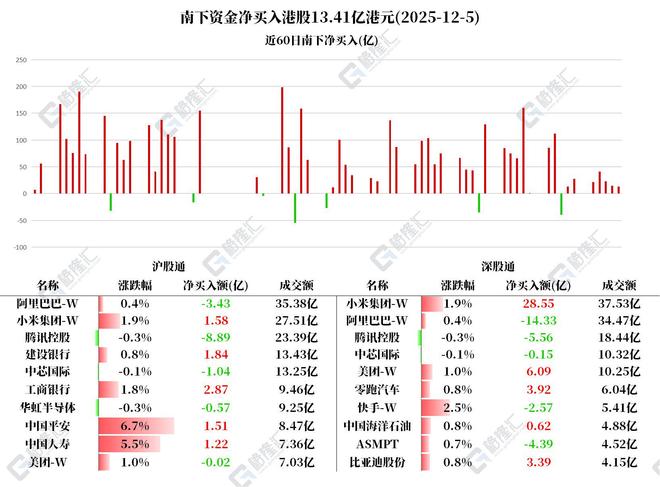
12月5日港股通净买入13.41亿港元
Zheng Quan Shi Bao Wang· 2025-12-05 15:05
Core Viewpoint - On December 5, the Hang Seng Index rose by 0.58% to close at 26,085.08 points, with a net inflow of HKD 1.341 billion through the southbound trading channel [1] Group 1: Market Activity - The total trading amount for the southbound trading on December 5 was HKD 82.7 billion, with a net buy of HKD 1.341 billion [1] - The Shanghai Stock Exchange's southbound trading had a total trading amount of HKD 47.323 billion, resulting in a net sell of HKD 0.394 billion [1] - The Shenzhen Stock Exchange's southbound trading had a total trading amount of HKD 35.377 billion, resulting in a net buy of HKD 1.735 billion [1] Group 2: Active Stocks - In the Shanghai Stock Exchange's southbound trading, Alibaba-W had the highest trading amount at HKD 3.538 billion, followed by Xiaomi Group-W at HKD 2.751 billion and Tencent Holdings at HKD 2.339 billion [1] - In terms of net buy amounts, Industrial and Commercial Bank of China had the highest net buy of HKD 0.287 billion, with its stock price increasing by 1.77% [1] - Tencent Holdings experienced the highest net sell amount of HKD 0.889 billion, with its stock price decreasing by 0.33% [1] Group 3: Shenzhen Stock Exchange Active Stocks - In the Shenzhen Stock Exchange's southbound trading, Xiaomi Group-W led with a trading amount of HKD 3.753 billion and a net buy of HKD 2.855 billion, closing up by 1.91% [2] - Alibaba-W had a net sell of HKD 1.433 billion, closing up by 0.39% despite the sell-off [2] - Tencent Holdings had a net sell of HKD 0.889 billion, closing down by 0.33% [2]




南向资金今日净买入13.41亿港元,小米集团-W净买入30.13亿港元
Zheng Quan Shi Bao Wang· 2025-12-05 15:01
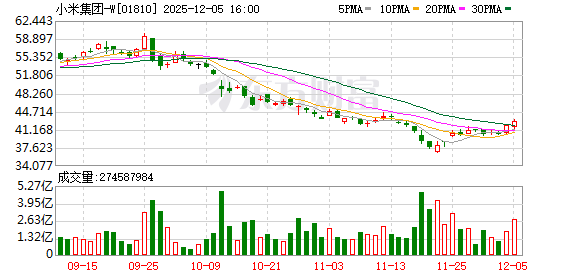
Core Viewpoint - The Hang Seng Index rose by 0.58% on December 5, with southbound capital recording a total transaction amount of HKD 82.7 billion, resulting in a net inflow of HKD 13.41 billion [2] Group 1: Southbound Capital Transactions - Total southbound capital transactions amounted to HKD 82.7 billion, with buy transactions at HKD 42.02 billion and sell transactions at HKD 40.68 billion, leading to a net buy of HKD 13.41 billion [2] - The Shenzhen Stock Connect saw a cumulative transaction amount of HKD 35.38 billion, with net buying of HKD 17.35 billion, while the Shanghai Stock Connect recorded a cumulative transaction amount of HKD 47.32 billion, resulting in a net sell of HKD 3.94 billion [2] Group 2: Active Stocks - Alibaba-W had the highest transaction amount among southbound stocks at HKD 69.86 billion, but experienced a net sell of HKD 17.76 billion, despite a closing price increase of 0.39% [2][3] - Xiaomi Group-W recorded a total transaction amount of HKD 65.04 billion with a net buy of HKD 30.13 billion, closing up by 1.91% [3] - Meituan-W had a total transaction amount of HKD 17.28 billion with a net buy of HKD 6.07 billion, closing up by 0.97% [3] Group 3: Continuous Net Buying and Selling - Xiaomi Group-W and Meituan-W were among the stocks with the longest continuous net buying days, with 6 and 7 days respectively, and total net buys of HKD 50.66 billion and HKD 28.96 billion [3] - Tencent Holdings and SMIC were notable for continuous net selling, with total net sells of HKD 39.05 billion and HKD 35.68 billion respectively [3][4]

跨境金融“加速度”:工商银行成都分行护航上市公司子公司出口劳务新实践
Sou Hu Cai Jing· 2025-12-05 14:25
Group 1 - The core project involves two nickel-iron alloy smelting projects in Indonesia, which are key initiatives under the Belt and Road Initiative, aimed at enhancing Indonesia's nickel resource supply chain for the global new energy industry [1] - Approximately 4,000 Chinese technical workers are engaged in the construction of these projects, operating advanced smelting equipment and monitoring data in high-temperature environments [1] - The projects are expected to provide critical raw materials for the global new energy sector, thereby supporting the development of the industry [1] Group 2 - The financial challenges faced by foreign enterprises in cross-border payment processes have been highlighted, particularly the delays in salary disbursement due to stringent review requirements [3] - The Industrial and Commercial Bank of China (ICBC) Chengdu Branch has established a special service team to address these challenges, significantly reducing the processing time for cross-border transactions by 80% [3] - ICBC Chengdu Branch has successfully processed 80 million RMB in cross-border settlements for a foreign enterprise, ensuring same-day fund transfers and salary payments, thus fulfilling their commitment to timely payroll [4] Group 3 - The ongoing operations of the nickel-iron alloy production line in Jakarta reflect the steady progress of the projects, supported by the dedication of the Chinese workers [4] - ICBC Chengdu Branch aims to enhance the professionalism of its financial services, providing comprehensive support for the high-quality development of new productivity as companies expand internationally [4] - The bank's efforts are positioned as a crucial support mechanism for the implementation of the Belt and Road Initiative, emphasizing the importance of financial services in facilitating international cooperation [4]
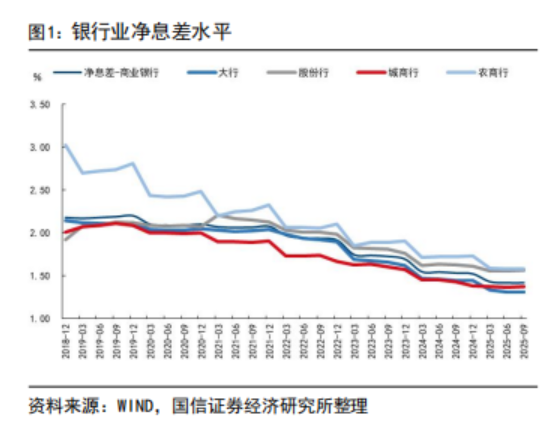
【国信银行·深度】银行业2026年经营展望之价格篇:货币政策相机抉择,净息差下降尾声
Xin Lang Cai Jing· 2025-12-05 12:56
Group 1: Core Insights - The current bottom line for the net interest margin (NIM) of major banks is approximately 1.2% to 1.3%, indicating limited room for further significant declines [1][6][84] - Maintaining a reasonable level of NIM is essential for economic growth and financial stability, as it relates to capital balance, breakeven points, and risk pricing mechanisms [6][20][21] Group 2: NIM Bottom Line Calculation - The projected nominal GDP growth during the "14th Five-Year Plan" period is estimated to be between 6.0% and 6.9%, which necessitates an M2 growth rate of about 7.0% to 8.0% [1][23][28] - The bottom line for NIM is calculated based on a required return on equity (ROE) of 7% to 8%, leading to a NIM bottom line of approximately 1.2% to 1.3% [36][84] Group 3: 2026 NIM Projections - If the Loan Prime Rate (LPR) decreases by 10 basis points (bps) and deposit rates remain unchanged, the NIM is expected to decline by approximately 5 to 8 bps in 2026 [2][85] - Without considering further interest rate cuts, the model predicts a decrease in loan rates by about 24 bps and deposit rates by 14 to 17 bps, resulting in a net interest margin contraction of about 2 to 5 bps [2][39][59] Group 4: Monetary Policy Outlook for 2026 - The monetary policy for 2026 is expected to be characterized by a "reasonable and ample" approach, with a likely LPR decrease of 10 bps and a reserve requirement ratio (RRR) cut of 50 bps [3][86] - The central bank's strategy will focus on balancing short-term and long-term goals, supporting economic growth while maintaining the health of the banking system [60][61] Group 5: Economic Recovery and Regulatory Impact - Economic recovery may not meet expectations, and regulatory changes could temporarily impact the banking sector's fundamentals [4][80] - The banking sector is under strong regulatory oversight, and any adverse policies could affect short-term valuations [80]


智通港股通活跃成交|12月5日





智通财经网· 2025-12-05 11:02
| 公司名称 | 成交金额 | 净买入额 | | --- | --- | --- | | 小米集团-W(01810) | 37.53 亿元 | +28.55 亿元 | | 阿里巴巴-W(09988) | 34.47 亿元 | -14.33 亿元 | | 腾讯控股(00700) | 18.44 亿元 | -5.56 亿元 | | 中芯国际(00981) | 10.32 亿元 | -1549.07 万元 | | 美团-W(03690) | 10.25 亿元 | +6.09 亿元 | | 零跑汽车(09863) | 6.04 亿元 | +3.92 亿元 | | 快手-W(01024) | 5.41 亿元 | -2.57 亿元 | | 中国海洋石油(00883) | 4.88 亿元 | +6206.91 万元 | | ASMPT(00522) | 4.52 亿元 | -4.39 亿元 | | 比亚迪股份(01211) | 4.15 亿元 | +3.39 亿元 | | 公司名称 | 成交金额 | 净买入额 | | --- | --- | --- | | 阿里巴巴-W(09988) | 35.38 亿元 | -3.43 ...
12月5日深港通金融R(港币)(483026)指数涨1.15%,成份股瑞达期货(002961)领涨
Sou Hu Cai Jing· 2025-12-05 11:01
Core Viewpoint - The Hang Seng Stock Connect Financial R (HKD) Index (483026) closed at 10,527.47 points, up 1.15%, with a trading volume of 51.949 billion HKD and a turnover rate of 0.43% on December 5 [1] Group 1: Index Performance - The index saw 65 constituent stocks rise, with Ruida Futures leading at a 10.01% increase, while 22 stocks declined, with Electric Power Investment and Financing leading at a 3.86% decrease [1] - The top ten constituent stocks by weight include HSBC Holdings (15.53%), China Construction Bank (11.08%), and AIA Group (8.37%) [1] Group 2: Market Capitalization - The total market capitalization of the top ten stocks includes HSBC Holdings at 1,733.079 billion HKD, China Construction Bank at 1,897.727 billion HKD, and Industrial and Commercial Bank of China at 2,050.886 billion HKD [1] Group 3: Capital Flow - The net inflow of main funds into the index's constituent stocks totaled 1.556 billion HKD, while speculative funds saw a net outflow of 488 million HKD, and retail investors experienced a net outflow of 1.068 billion HKD [3] - Notable net inflows include Dongfang Wealth at 532 million HKD and Guotai Junan Securities at 132 million HKD, while significant outflows were observed in Guangfa Securities and Changjiang Securities [3]




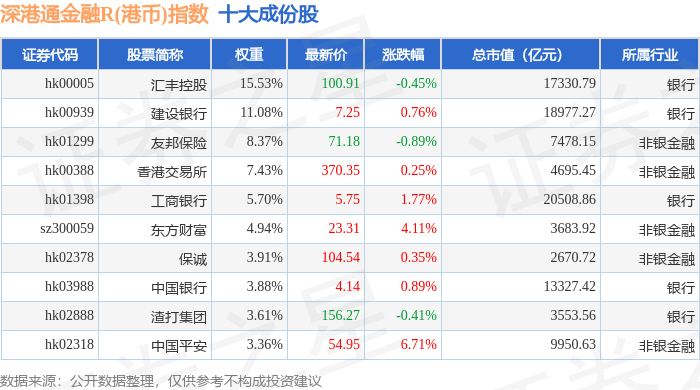
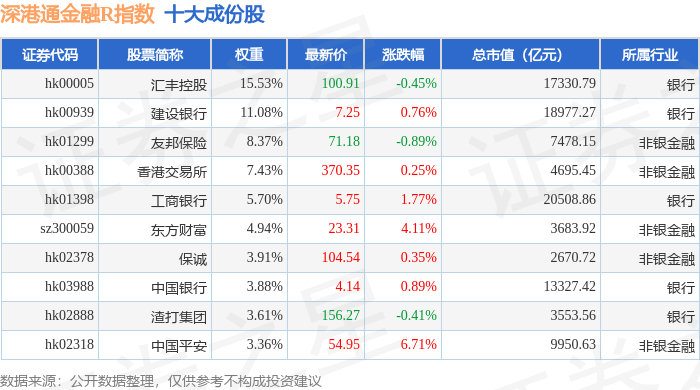
12月5日深港通金融R(483025)指数涨1.16%,成份股瑞达期货(002961)领涨
Sou Hu Cai Jing· 2025-12-05 11:01
Core Insights - The Shenzhen-Hong Kong Stock Connect Financial R Index (483025) closed at 10,743.61 points, up 1.16%, with a trading volume of 47.173 billion yuan and a turnover rate of 0.43% [1] - Among the index constituents, 65 stocks rose, with Ruida Futures leading with a 10.01% increase, while 22 stocks fell, with Electric Power Investment and Financing leading with a 3.86% decline [1] Index Constituents Summary - The top ten constituents of the Shenzhen-Hong Kong Stock Connect Financial R Index include major financial institutions such as HSBC Holdings, China Construction Bank, and AIA Group, with respective weights of 15.53%, 11.08%, and 8.37% [1] - The total market capitalization of the index constituents varies significantly, with China Construction Bank at 1,897.73 billion yuan and HSBC Holdings at 1,733.08 billion yuan [1] Capital Flow Analysis - The net inflow of main funds into the index constituents totaled 1.556 billion yuan, while retail funds experienced a net outflow of 1.068 billion yuan [3] - Notable net inflows were observed in stocks like Dongfang Wealth and Guotai Junan Securities, with net inflows of 532 million yuan and 132 million yuan respectively [3]

工商银行取得视频处理方法、装置、电子设备及存储介质专利
Sou Hu Cai Jing· 2025-12-05 10:27
Core Insights - China Industrial and Commercial Bank has obtained a patent for a video processing method, device, electronic equipment, and storage medium, with the authorization announcement number CN119788792B and an application date of December 2024 [1] Company Overview - China Industrial and Commercial Bank was established in 1985 and is located in Beijing, primarily engaged in monetary financial services [1] - The registered capital of the company is approximately 35.64 billion RMB [1] Investment and Operations - The company has invested in 28 enterprises and participated in 5,000 bidding projects [1] - It holds 988 trademark information records and 5,000 patent information records, along with 77 administrative licenses [1]
图解丨南下资金大幅加仓小米超30亿港元,减持阿里
Xin Lang Cai Jing· 2025-12-05 09:57
Group 1 - Southbound funds recorded a net purchase of HKD 1.341 billion in Hong Kong stocks today [1] - Notable net purchases included Xiaomi Group-W at HKD 3.013 billion, Tracker Fund at HKD 2.606 billion, and Meituan-W at HKD 607 million [1] - Continuous net buying trends were observed for Meituan over the past 7 days totaling HKD 2.89598 billion and for Xiaomi over the past 6 days totaling HKD 5.0656 billion [1] Group 2 - Significant net selling was noted for Alibaba-W at HKD 1.776 billion and Tencent Holdings at HKD 1.445 billion [1] - Semiconductor company ASMPT experienced a net sell of HKD 439 million, while Kuaishou-W and SMIC also saw net selling [1] - The trend of net selling for SMIC has persisted for 12 consecutive days, amounting to HKD 3.56848 billion [1]