
PSBC(01658)

Search documents
以点带面 让乡村产业“一池春水”持续涌动——邮储银行广西区分行深植“普惠金融”赋能千村万户
Zheng Quan Ri Bao Zhi Sheng· 2025-11-30 07:06
Core Insights - The article highlights the role of Postal Savings Bank of China in supporting agricultural modernization in Guangxi, addressing the financial challenges faced by local agricultural entities [1][6]. Group 1: Agricultural Modernization - Guangxi is a significant rice seed production base and livestock breeding province, with Yulin City being a key agricultural area rich in resources [1]. - The transformation towards modern agriculture is hindered by financial shortages, which the Postal Savings Bank aims to alleviate through inclusive financial services [1][6]. Group 2: Financial Support Initiatives - The bank has implemented innovative service models to provide timely financial support, such as a total of 2.47 million yuan in loans to a cooperative in Bo Bai County for expanding their seed production area [3]. - The bank's efforts have resulted in a cumulative loan issuance of 8.6 million yuan to the rice seed production industry by 2025 [3]. Group 3: Impact on Local Enterprises - A vegetable cooperative in Bo Bai County has expanded from 9 members and 400 acres to 118 members and 12,000 acres, creating over 1,200 jobs, demonstrating the need for substantial funding for growth [2]. - The success of Yulin's ecological chicken farm, which received a 500,000 yuan loan, showcases how financial support can lead to significant operational improvements and increased production value from 5 million yuan to 6.25 million yuan [5]. Group 4: Future Outlook - As of October 2025, the bank's agricultural loan balance exceeded 37.6 billion yuan, with an increase of over 3 billion yuan since the beginning of the year, indicating a strong commitment to rural financial support [6]. - The bank plans to continue optimizing credit policies and innovating service models to direct more financial resources to key agricultural sectors, contributing to the national rural revitalization strategy [6].
邮储银行汕头市分行助力潮汕烘焙品牌从街边小店迈向区域龙头
Zheng Quan Ri Bao Zhi Sheng· 2025-11-30 07:06
Core Insights - Danxi Food has established itself as a leading brand in the regional baking industry, leveraging a full industry chain from R&D to sales, supported by financial assistance from Postal Savings Bank of Shantou [1][3] - The company has expanded its operations significantly since 2020, increasing its store count and production capacity to support 100 stores, with 45% of products baked fresh daily [1][3] - The partnership with Postal Savings Bank has been crucial for Danxi Food, providing tailored financing solutions to address ongoing capital needs for equipment upgrades and store renovations [3][4] Company Overview - Danxi Food has been rooted in the Chaoshan region for 28 years and is recognized for its "Chaosi pastry-making skills," which is listed as a municipal intangible cultural heritage [1] - The company initially started as a fruit wholesale business before transitioning into the baking industry, now operating a central factory of 6,000 square meters [1][2] Financial Support and Growth - The initial loan of 1.26 million yuan from Postal Savings Bank was received within three days, alleviating immediate financial pressures [2] - Over time, the bank has provided a total of over 4 million yuan in credit, covering various operational costs including raw materials and R&D personnel salaries, which range from 25,000 to 30,000 yuan per month [3][4] - Danxi Food plans to expand further, with a flagship store and new product development funded by an additional 200 million yuan loan currently under approval [3] Future Development Plans - The company aims to establish a "central factory + regional production points" model to enhance service efficiency and reduce delivery costs [4] - Plans include upgrading equipment to achieve automation in production, thereby reducing labor costs [4] Banking Partnership - Postal Savings Bank has adapted its repayment methods to align with the company's operational rhythm, offering flexible repayment options and proactive loan renewal support [4] - As of August 2025, the bank's small and micro enterprise loan balance exceeded 8.7 billion yuan, benefiting over 6,600 enterprises [5]
邮储银行黑龙江省分行 为肉牛产业注入金融“养料”
Zheng Quan Ri Bao Zhi Sheng· 2025-11-30 07:06
Core Viewpoint - Heilongjiang Province is focusing on developing modern livestock farming, particularly in beef cattle, to enhance supply security and stabilize the livestock sector [1] Group 1: Financial Support and Services - Postal Savings Bank of Heilongjiang Province has issued over 2.4 billion yuan in loans to the beef cattle industry, with an annual surplus of 625 million yuan, aiming to stimulate the industry's internal growth [1] - The bank has established a "Research Team for Industrial Revitalization" to study key industrial chains, with beef cattle farming being a primary focus [1] - The bank has innovated credit products and streamlined approval processes to improve loan accessibility for beef cattle farmers [2][3] Group 2: Local Government Initiatives - The local government in Youyi County is implementing favorable policies to promote the beef cattle industry towards scale, standardization, and specialization [2] - The Postal Savings Bank's Youyi County branch has issued 164 loans totaling 22.23 million yuan to 36 local beef cattle farmers, providing essential financial support [2] Group 3: Customer Success Stories - A local beef cattle farmer, Jiang Yuxin, received a 600,000 yuan loan, which helped him expand his herd from over 100 to 200 cattle, significantly increasing his annual income [2] - The bank's support has been described as a "timely rain" for farmers facing funding shortages due to rising market demand [2] Group 4: Innovations in Loan Processing - The Youyi County branch has simplified loan procedures and introduced an "online application, offline review" model, significantly reducing loan approval times [3] - The bank offers interest rate discounts for beef cattle loan clients, lowering their financing costs [3] - Collaboration with government departments and insurance companies is being explored to establish risk-sharing mechanisms for sustainable development in the beef cattle industry [3]
工行、农行、中行、建行、交行、邮储 停售!
Zhong Guo Ji Jin Bao· 2025-11-29 03:28
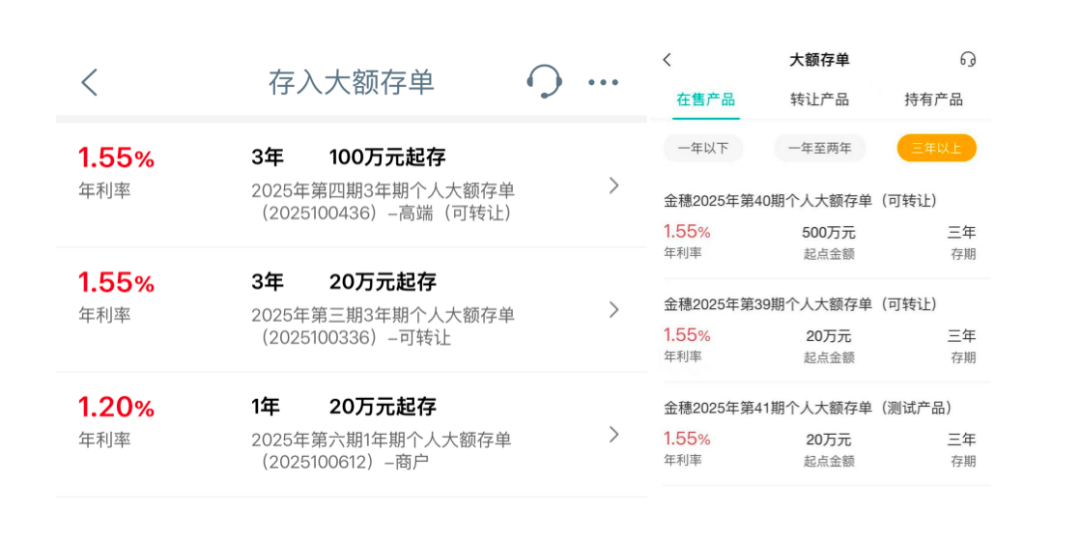
Core Viewpoint - The six major state-owned banks have collectively discontinued the 5-year large denomination certificates of deposit (CDs), reflecting a broader trend of adjustments in long-term deposit products among banks to reduce liability costs and stabilize net interest margins [1][3][8]. Group 1: Market Reactions and Adjustments - The discontinuation of 5-year large denomination CDs by major banks has drawn significant attention, as many smaller banks have also been adjusting their long-term deposit products [3][8]. - Some state-owned banks had already stopped offering 5-year CDs prior to this collective action, indicating a shift in the market [5][8]. - The adjustments in deposit products are primarily aimed at lowering high-cost liabilities and optimizing the banks' liability structures [9][10]. Group 2: Interest Rate Trends - Recent data shows that the net interest margin for commercial banks remains under pressure, with state-owned banks having the lowest net interest margin at 1.31% compared to 3.83% for private banks [8][10]. - The trend of lowering deposit rates is expected to continue, with banks likely to maintain a limited number of 5-year products at reduced rates [10][11]. - The adjustments reflect a significant transformation in the financial system under a low-interest-rate environment, with banks responding to declining asset yields by shortening deposit terms [9][10]. Group 3: Investor Guidance - Investors are advised to shift from a single deposit mindset to a diversified investment strategy, considering options like money market funds, cash management products, and government bonds to balance risk and return [11]. - The expectation of continued declines in deposit rates suggests that investors should lower their return expectations and adjust their investment strategies accordingly [11].




邮储银行11月28日大宗交易成交227.20万元
Zheng Quan Shi Bao Wang· 2025-11-28 15:33
Core Viewpoint - Postal Savings Bank of China experienced a block trade on November 28, with a transaction volume of 400,000 shares and a transaction value of 2.272 million yuan, at a price of 5.68 yuan per share [1] Group 1: Block Trade Details - The block trade involved a total volume of 400,000 shares and a transaction amount of 2.272 million yuan, with a transaction price of 5.68 yuan, reflecting no premium over the closing price [1] - The buyer was Guotai Junan Securities Co., Ltd. headquarters, while the seller was Industrial Securities Co., Ltd. Fuzhou Chaoyang Road Securities Business Department [1] Group 2: Recent Trading Activity - In the past three months, Postal Savings Bank has recorded a total of 9 block trades, with a cumulative transaction value of 34.72 million yuan [1] - The closing price on the day of the block trade was 5.68 yuan, down 1.90%, with a daily turnover rate of 0.37% and a total transaction amount of 1.401 billion yuan [1] - Over the last five days, the stock has seen a cumulative decline of 2.24%, with a total net outflow of 446 million yuan [1] Group 3: Margin Financing Data - The latest margin financing balance for Postal Savings Bank is 956 million yuan, with an increase of 33.24 million yuan over the past five days, representing a growth rate of 3.60% [1]
邮储银行研究员娄飞鹏:规范银行收费 能有效遏制隐性收费与转嫁成本行为
Shang Hai Zheng Quan Bao· 2025-11-28 13:29
Core Viewpoint - The revised "Guidelines for Enforcement of Charging Behavior of Commercial Banks" by the State Administration for Market Regulation aims to enhance transparency and fairness in bank fees, particularly benefiting small and medium-sized enterprises by reducing their financing burdens [1] Group 1: Regulatory Changes - The guidelines detail prohibited charging behaviors, including the fabrication of syndicate loan fees, charging commitment fees while collecting loan interest, and mandating the issuance of guarantees for fee collection [1] - The guidelines are a response to recent regulatory enforcement practices, aiming to clarify standards for identifying violations in various banking services [1] Group 2: Impact on Financial Services - The guidelines strengthen institutional safeguards for financial services to the real economy, ensuring banks are held accountable for their charging practices [1] - By curbing hidden fees and cost-shifting behaviors, the guidelines are expected to improve fee transparency and fairness in the banking sector [1] Group 3: Implications for Banks - The guidelines compel banks to enhance service quality and optimize internal assessment mechanisms while regulating their charging practices [1] - This regulatory shift is anticipated to foster a more favorable business environment, particularly for small and medium-sized enterprises [1]
银行批量上调代销基金风险等级 投资者如何应对?
Guo Ji Jin Rong Bao· 2025-11-28 12:52
Core Viewpoint - Banks are increasingly adjusting the risk levels of mutual fund products they distribute, with several banks, including China Construction Bank and Minsheng Bank, making multiple adjustments this year to align with market conditions and regulatory requirements [1][3][4]. Group 1: Bank Adjustments - China Construction Bank has announced a batch increase in the risk levels of 87 mutual fund products, marking the fourth adjustment this year [1][3]. - Minsheng Bank has also made four similar adjustments since October, with the latest announcement on November 18 regarding eight lower-risk fund products being raised to medium risk [1][3]. - Postal Savings Bank has adjusted the risk levels of 86 mutual fund products in two recent announcements [1][4]. Group 2: Reasons for Adjustments - The adjustments are attributed to a combination of mutual fund product characteristics, market conditions, and regulatory guidance, which aim to reduce the risk mismatch between investors and products [1][4]. - Changes in investment strategies and asset allocations of certain funds have increased their net value volatility, prompting institutions to reassess the risk-return alignment [4]. - Regulatory frameworks, such as the Asset Management New Regulations, are reinforcing the core requirement of "risk matching," compelling institutions to establish dynamic risk rating mechanisms [4][5]. Group 3: Future Implications - The adjustments may become a regular practice as banks are required to dynamically assess product risks to fulfill their suitability obligations and protect investor interests [5]. - Short-term impacts may lead conservative investors to redeem their investments due to increased risk levels, while long-term benefits include enhanced risk transparency and reduced risk mismatch [5][6]. - This shift is expected to drive the wealth management industry towards a service-oriented model, encouraging fund companies to improve their research and investment capabilities [5][6].

银行行业资金流出榜:中国银行、邮储银行等净流出资金居前
Zheng Quan Shi Bao Wang· 2025-11-28 10:08
Market Overview - The Shanghai Composite Index rose by 0.34% on November 28, with 29 out of the 31 sectors experiencing gains, led by the steel and agriculture sectors, both up by 1.59% [1] - The banking sector was the biggest loser, declining by 0.83%, followed by coal, which fell by 0.14% [1] Capital Flow - The net inflow of capital in the two markets was 10.84 billion yuan, with 19 sectors seeing net inflows [1] - The electronics sector had the highest net inflow, amounting to 3.423 billion yuan, with a daily increase of 1.30% [1] - The non-ferrous metals sector also performed well, with a daily increase of 1.44% and a net inflow of 3.051 billion yuan [1] Banking Sector Analysis - The banking sector saw a net outflow of 1.287 billion yuan, with 42 stocks in the sector, of which only 4 rose while 36 fell [2] - Among the banks, China Merchants Bank had the highest net inflow of 206 million yuan, followed by Jiangyin Bank and Hangzhou Bank with net inflows of 20.155 million yuan and 15.338 million yuan, respectively [2] - Major banks with significant net outflows included Bank of China (net outflow of 264 million yuan), Postal Savings Bank (222 million yuan), and Agricultural Bank (160 million yuan) [2] Individual Bank Performance - The following banks experienced notable declines in stock price and net capital outflow: - Bank of China: -1.62% with a net outflow of 263.56 million yuan [3] - Postal Savings Bank: -1.90% with a net outflow of 222.33 million yuan [3] - Agricultural Bank: -0.74% with a net outflow of 160.14 million yuan [3] - Other banks with significant declines included China Construction Bank (-0.51%), Bank of Communications (-1.56%), and Industrial and Commercial Bank (-0.61%) [3]

邮储银行今日大宗交易平价成交40万股,成交额227.2万元
Xin Lang Cai Jing· 2025-11-28 09:37
Group 1 - Postal Savings Bank conducted a block trade of 400,000 shares on November 28, with a transaction value of 2.272 million yuan, accounting for 0.16% of the total trading volume for the day [1] - The transaction price was 5.68 yuan, which was in line with the market closing price of 5.68 yuan [1]

邮储银行(601658) - H股公告
2025-11-28 09:15
香港交易及結算所有限公司及香港聯合交易所有限公司對本公告的內容概不負責,對其準確性 或完整性亦不發表任何聲明,並明確表示,概不對因本公告全部或任何部份內容而產生或因倚 賴該等內容而引致的任何損失承擔任何責任。 POSTAL SAVINGS BANK OF CHINA CO., LTD. 1658 暫停辦理股份過戶登記 承董事會命 中國郵政儲蓄銀行股份有限公司 杜春野 聯席公司秘書 中國,北京 2025年11月28日 於本公告日期,本行董事會包括董事長及非執行董事鄭國雨先生;執行董事劉建軍先生及 姚紅女士;非執行董事劉新安先生、張宣波先生、劉瑞鋼先生、胡宇霆先生、丁向明先生 及余明雄先生;獨立非執行董事溫鐵軍先生、鍾瑞明先生、潘英麗女士、唐志宏先生、 洪小源先生及楊勇先生。 * 中國郵政儲蓄銀行股份有限公司並非一家根據銀行業條例(香港法例第155章)之認可 機構,並不受限於香港金融管理局的監督,亦不獲授權在香港經營銀行及╱或接受存 款業務。 中國郵政儲蓄銀行股份有限公司(「本行」)董事會(「董事會」)宣佈,本行擬於 2025年1 2月1 9日(星期五)舉行2025年第三次臨時股東大會(「臨時股東大 會」)。 為 ...