PSBC(01658)

Search documents
经济热力站丨零距离感受邮储银行北京分行的“数字金融世界”
Bei Ke Cai Jing· 2025-11-26 07:37
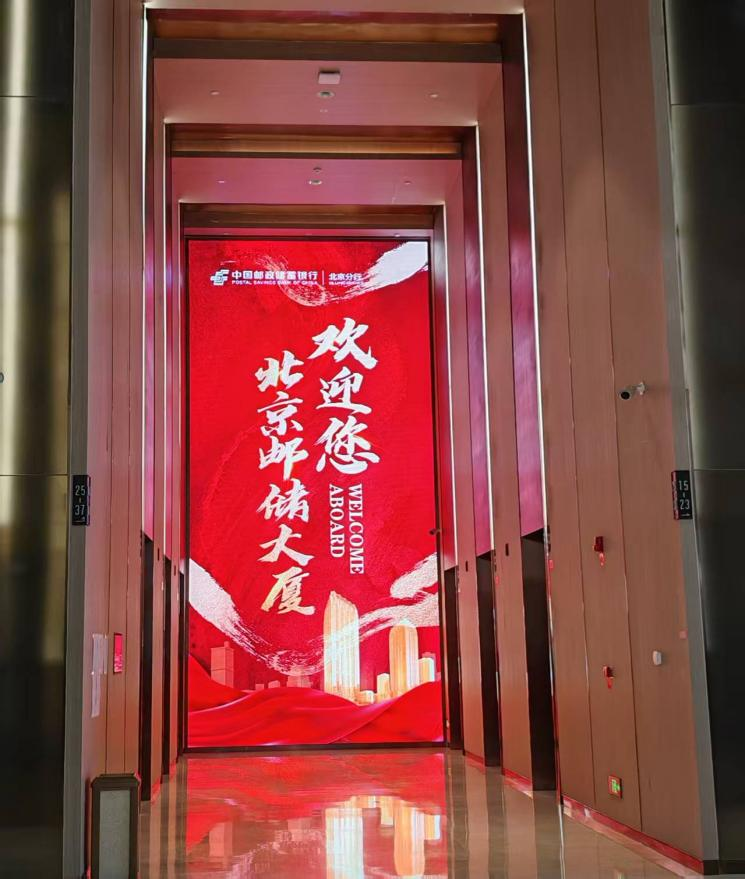
Core Insights - Postal Savings Bank of China (PSBC) is transforming its operations by establishing the first "Hongmeng Ecological Bank" in Beijing, integrating advanced digital technologies to enhance customer experience and service efficiency [1][4][19] - The bank's digital transformation focuses on creating a "digital financial neural network" that connects urban and rural areas, utilizing cloud services and digital currency to make financial services more accessible [9][14][15] Group 1: Digital Banking Innovations - The Hongmeng Ecological Bank features multi-language AI transparent screens and smart service devices, showcasing a blend of technology and customer service [1][4] - The bank employs smart calling machines and wearable devices to streamline customer interactions, allowing for a seamless service experience [5][6] - Personalized financial advice is provided through the "You Accompany" smart screen, which tailors recommendations based on the customer's life stage [7] Group 2: Cloud Services and Digital Currency - The "cloud cabinet" service allows customers to access banking services remotely, significantly increasing transaction volume, with over 130,000 transactions annually [13] - Digital currency applications are integrated into everyday transactions, enhancing consumer engagement and driving over 200 million yuan in consumption in 2024 [14][15] Group 3: Industry Empowerment and Future Directions - The bank's "U Yi Count" platform focuses on evaluating the technological capabilities of enterprises, facilitating financing for innovative companies [17][18] - The integration of financial services with industry needs exemplifies the bank's commitment to supporting digital economic growth and enhancing service offerings [19][18]


邮储银行跌2.04%,成交额6.77亿元,主力资金净流出1.13亿元
Xin Lang Cai Jing· 2025-11-26 03:35
Core Viewpoint - Postal Savings Bank of China (PSBC) experienced a decline in stock price, with a drop of 2.04% on November 26, trading at 5.76 CNY per share, and a total market capitalization of 691.75 billion CNY [1] Financial Performance - PSBC's stock price has increased by 6.31% year-to-date, with a slight rise of 0.52% over the last five trading days, but has seen a decline of 3.03% over the last 20 days and 8.13% over the last 60 days [2] - For the period from January to September 2025, PSBC reported a net profit of 76.56 billion CNY, reflecting a year-on-year growth of 0.98% [3] Business Operations - PSBC's main business segments include personal banking (65.15% of revenue), corporate banking (22.71%), and funding operations (12.10%) [2] - The bank provides a variety of financial services, including personal loans, corporate loans, and asset management [2] Shareholder Information - As of September 30, 2025, PSBC had 142,600 shareholders, a decrease of 13.09% from the previous period, with an average of 478,570 circulating shares per shareholder, an increase of 15.29% [3] - The bank has distributed a total of 137.80 billion CNY in dividends since its A-share listing, with 77.40 billion CNY distributed over the last three years [4] Institutional Holdings - As of September 30, 2025, major institutional shareholders include Hong Kong Central Clearing Limited and various ETFs, with notable reductions in their holdings compared to the previous period [4]
邮储银行11月25日获融资买入9809.07万元,融资余额9.19亿元
Xin Lang Cai Jing· 2025-11-26 01:49
Group 1: Stock Performance and Financing - Postal Savings Bank of China saw a stock increase of 1.55% on November 25, with a trading volume of 1.185 billion yuan [1] - On the same day, the bank recorded a financing buy amount of 98.09 million yuan and a financing repayment of 103 million yuan, resulting in a net financing buy of -4.61 million yuan [1] - As of November 25, the total financing and securities balance for the bank was 924 million yuan, with a financing balance of 919 million yuan, representing 0.23% of the circulating market value, which is below the 30th percentile level over the past year [1] Group 2: Securities Lending - On November 25, the bank repaid 104,800 shares in securities lending and sold 51,800 shares, with a selling amount of 304,600 yuan based on the closing price [1] - The securities lending balance stood at 4.9615 million yuan, with a remaining quantity of 843,800 shares, which exceeds the 70th percentile level over the past year, indicating a relatively high position [1] Group 3: Company Overview and Financial Performance - Postal Savings Bank of China, established on March 6, 2007, and listed on December 10, 2019, provides banking and related financial services in China [2] - The bank's main business segments include personal banking (65.15% of revenue), corporate banking (22.71%), and funding operations (12.10%) [2] - For the period from January to September 2025, the bank achieved a net profit of 76.562 billion yuan, reflecting a year-on-year growth of 0.98% [2] Group 4: Shareholder Information and Dividends - Since its A-share listing, the bank has distributed a total of 137.796 billion yuan in dividends, with 77.395 billion yuan distributed over the past three years [3] - As of September 30, 2025, the number of shareholders decreased by 13.09% to 142,600, while the average circulating shares per person increased by 15.29% to 478,570 shares [2][3] - Major shareholders include Hong Kong Central Clearing Limited, which holds 520 million shares, a decrease of 422 million shares from the previous period [3]
这家超级保险代理商终于拿到自己的牌照了!
Jing Ji Guan Cha Wang· 2025-11-26 00:46
Core Viewpoint - The China Post has received approval from the National Financial Regulatory Administration to operate as an insurance agent, expanding its financial services and addressing compliance issues related to its previous operations under Postal Savings Bank's license [2][6]. Group 1: Business Operations - China Post operates a diverse business model that includes postal services, express logistics, finance, and e-commerce, with subsidiaries like Postal Savings Bank, China Post Insurance, and China Post Securities [3]. - The operational model for banking and insurance involves "self-operated + agency" and "self-operated + management," allowing China Post to leverage its extensive network for financial services [3]. Group 2: Historical Context - Postal Savings Bank was established in 2007, evolving from the China Post's savings bureau, and has been publicly listed since 2016 [4]. - To avoid internal competition, China Post previously committed to not engaging in insurance agency business, leading to the cancellation of several agency licenses held by its subsidiaries [4][5]. Group 3: Market Presence - China Post has over 54,000 service points, with more than 32,000 offering financial services, significantly contributing to Postal Savings Bank's revenue [6]. - The annual premium volume for China Post's insurance agency business exceeds 300 billion yuan, with China Post Insurance accounting for less than 40% of this total [6].


产业贷款施“粮”策 金融活水润粮仓
Jiang Nan Shi Bao· 2025-11-25 14:17
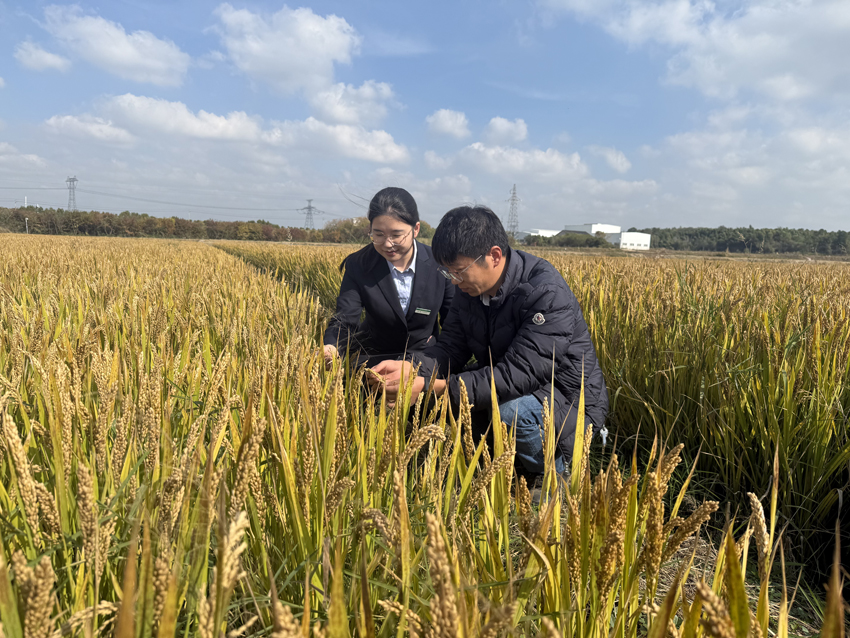
Core Viewpoint - The integration of finance and agriculture is driving rural progress and agricultural development, with a focus on enhancing food security and supporting high-quality agricultural growth [2][3][4]. Financial Support for Agriculture - Postal Savings Bank of China (PSBC) Nanjing Branch has increased its support for agricultural financing, providing 3 million yuan in "industry loans" to enhance grain purchasing capabilities and improve operational efficiency by over 30% [3][4]. - The bank has established a "1+N" credit product system, offering loans up to 5 million yuan and expedited processing times, significantly reducing financing costs for agricultural enterprises [7][10]. Agricultural Production and Efficiency - The implementation of modern agricultural practices and technology has led to a significant increase in production capacity, with companies like Jingjian Rice Industry achieving a daily processing capacity of 300 tons and an annual capacity of 100,000 tons [4][5]. - The integration of financial services has improved the efficiency of grain collection and processing, with a reported 40% increase in settlement efficiency for grain enterprises [6][10]. Rural Development and Income Growth - The support from PSBC has enabled local farmers to increase their income, with one company expanding its operational area from 3,000 mu to 4,200 mu and achieving profits of over 40 million yuan [8][9]. - The bank's financial services have created over 30 stable job opportunities and helped 456 local farmers increase their income [9]. Innovative Financial Solutions - The introduction of the "Smart Payment" system has streamlined the payment process for farmers, allowing for real-time transactions without the need for cash, thus reducing risks associated with cash handling [10][11]. - The system is designed to cater to rural needs, ensuring ease of use for older farmers and enhancing the overall efficiency of grain transactions [11].
邮储银行独创“木玩产业贷” 无差别覆盖融资需求
Zhong Guo Jin Rong Xin Xi Wang· 2025-11-25 10:27
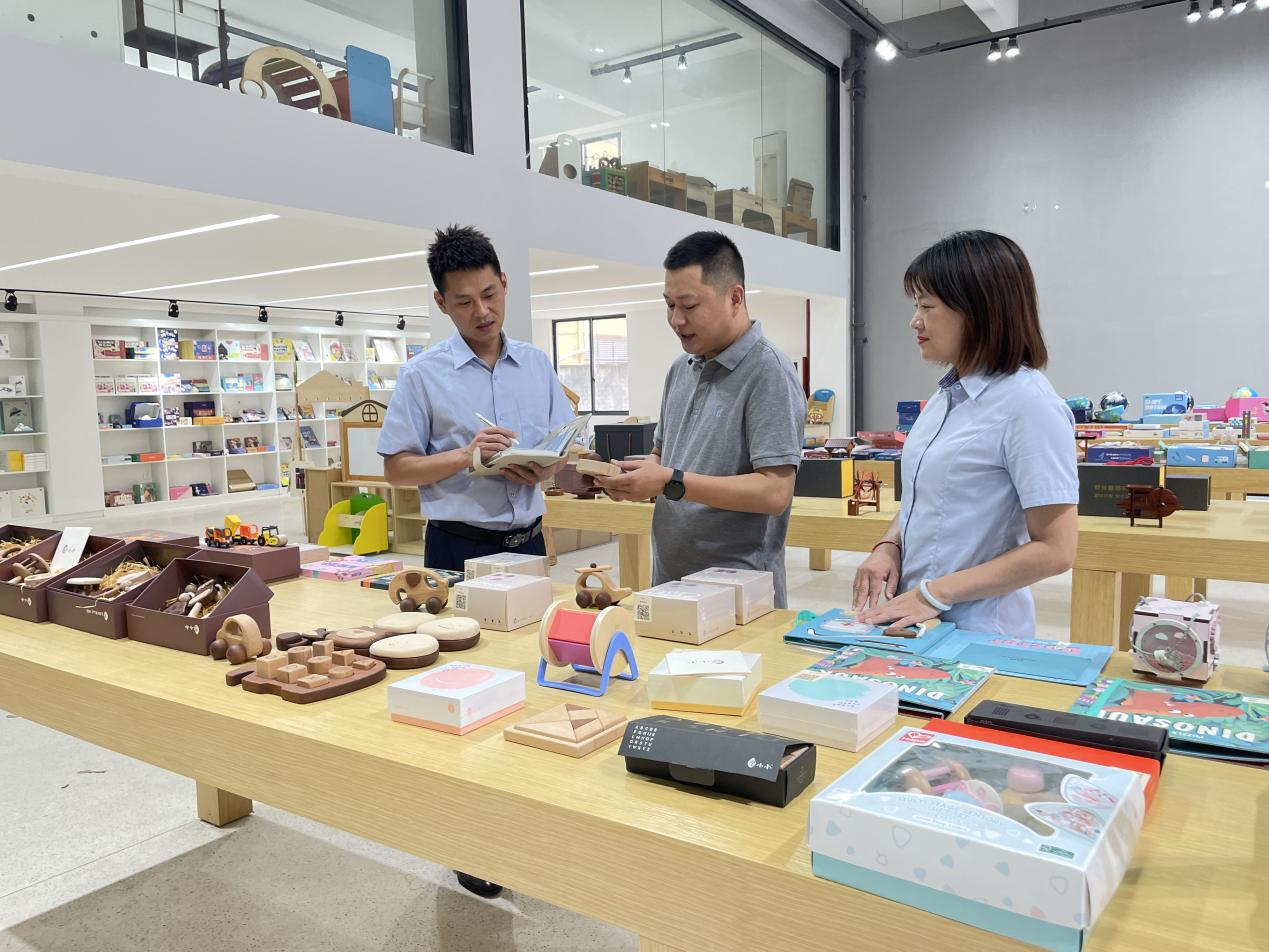
Core Viewpoint - The wood toy industry in Yunhe County, Zhejiang Province, is experiencing significant growth, supported by the introduction of a unique financial product, the "Wood Toy Industry Loan," which addresses the financing challenges faced by small and medium-sized enterprises (SMEs) in the sector [1][3]. Industry Overview - Yunhe County, known as "China's Wooden Toy City," has over 1,100 wood toy production enterprises, with more than 50 large-scale companies and around 15 enterprises generating over 100 million yuan in output [2]. - The wood toy industry accounts for 66% of China's production and 40% of global output, with exports expected to exceed 4 billion yuan in 2024, representing 70% of the county's total foreign trade exports [2]. Financial Innovation - The "Wood Toy Industry Loan" was launched by Postal Savings Bank to provide financial support specifically tailored to the needs of wood toy enterprises, particularly SMEs that often face high barriers to traditional credit [3][6]. - This innovative loan product allows companies to qualify based on various criteria such as operating cash flow and tax payments, significantly lowering the financing threshold and increasing credit limits for businesses without collateral [3][6]. Impact on Enterprises - The loan product has already provided substantial financial support to local enterprises, with 46 companies receiving a total credit of approximately 89.26 million yuan, and 44 of these companies utilizing loans amounting to about 81.18 million yuan [6]. - A specific company, established in 2008, focuses on developing age-appropriate toys and has seen sales growth between 10% and 20%, necessitating an expansion of production capacity to meet increasing market demand [4][6]. Future Prospects - The financial support from the "Wood Toy Industry Loan" is expected to facilitate the transformation and upgrading of the wood toy industry, aligning with government strategies for technological improvement, digital transformation, and cultural integration [2][6]. - The initiative is part of a broader commitment to support local economies and promote rural revitalization through the development of the wood toy industry [6].
中国邮政储蓄银行将在11月27日至12月5日期间对系统进行维护
Jin Tou Wang· 2025-11-25 03:51
Core Points - China Postal Savings Bank announced system maintenance to enhance service quality [1] - Maintenance will occur during specified time slots in late November and early December 2025 [1] - Various banking functions will be temporarily unavailable during the maintenance period [1] Summary by Category Announcement - China Postal Savings Bank is conducting system maintenance to improve service quality [1] Maintenance Schedule - Maintenance will take place on: - November 27, 2025, from 22:00 to November 28, 2025, 05:00 [1] - December 1, 2025, from 22:00 to December 2, 2025, 05:00 [1] - December 4, 2025, from 22:00 to December 5, 2025, 05:00 [1] Impact on Services - During the maintenance, the following services will be unavailable: - Personal mobile banking functions including rights claim, query, exchange, and user registration [1] - Corporate banking functions including user registration, login, and management [1] - Other services such as electronic account opening and various system logins [1]
锚定“十五五”发展蓝图 写好金融“五篇大文章”
Nan Fang Du Shi Bao· 2025-11-24 23:11
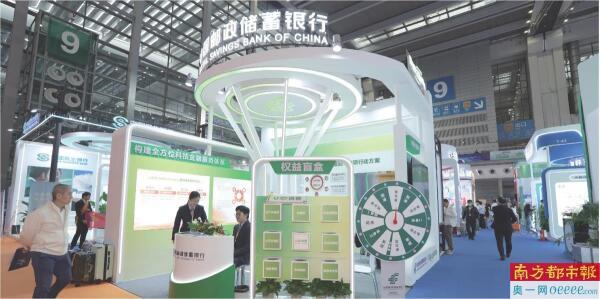
Core Viewpoint - The article emphasizes the role of China Postal Savings Bank's Shenzhen branch in supporting the real economy through targeted financial services aligned with national strategies, particularly focusing on the "14th Five-Year Plan" and its five key areas of financial development [2][6]. Group 1: Financial Support for Real Economy - The Shenzhen branch integrates its services with the "14th Five-Year Plan" by focusing on the development of a modern industrial system and strengthening the real economy [2]. - The branch has developed a comprehensive service system that aligns with the "20+8" industrial cluster strategy, ensuring a precise match between financial resources and the needs of Shenzhen's real economy [2][3]. Group 2: Inclusive Finance Initiatives - The branch utilizes its 69 outlets across the city to enhance financial accessibility, particularly in urban agriculture and rural revitalization, launching products like "U Grain Easy Loan" to support the grain industry [3]. - It has served over 3,000 small and micro enterprises, issuing loans exceeding 15 billion yuan, focusing on advanced manufacturing and technology-driven businesses [3]. Group 3: Technological and Green Finance - The branch has established a dedicated technology finance division, offering specialized products like "Tech Innovation Loans" and "Intellectual Property Pledge Loans" to support key sectors such as integrated circuits and artificial intelligence [4]. - It is actively involved in green finance, supporting Shenzhen's dual carbon goals through various financial instruments, including green loans and bonds, particularly in sectors like new energy vehicles and green buildings [4]. Group 4: Regional Development and Strategic Partnerships - The branch has signed strategic cooperation agreements with local governments and organizations, channeling over 1 trillion yuan into major projects within the Guangdong-Hong Kong-Macao Greater Bay Area [5]. - It is committed to enhancing service capabilities through digital transformation and risk management improvements, ensuring robust support for the local economy [6]. Group 5: Focus on Livelihood and Consumer Finance - The branch has launched initiatives to boost local consumption, including personal loan subsidies and partnerships with merchants to enhance consumer experiences [7][8]. - It has developed a comprehensive pension finance system, supporting various aspects of elderly care and financial literacy, with significant growth in personal pension accounts [8]. Group 6: Commitment to Continuous Improvement - The Shenzhen branch aims to deepen its financial services' precision and effectiveness, contributing to the high-quality development of the real economy and supporting Shenzhen's role as a model for socialism with Chinese characteristics [8].
年末部分银行推出零息、贴息等汽车金融优惠
Zheng Quan Ri Bao Zhi Sheng· 2025-11-24 16:43
Core Viewpoint - Banks are intensifying their automotive consumer finance support as the year-end car buying season approaches, implementing measures such as zero interest rates and subsidies to stimulate the automotive market [1][2] Group 1: Bank Initiatives - Postal Savings Bank of China offers up to 4,500 yuan in financial subsidies for the new BJ40 model, with annual loan rates ranging from 0% to 6% [1] - Ping An Bank has launched a year-end car purchase campaign with a minimum interest rate of 0%, offering loans from 10,000 yuan to a maximum of 1 million yuan [1] - Zhongyuan Bank has introduced a "Car Purchase Guide" for its car loan products, with online approval and loan amounts up to 3 million yuan at an interest rate starting from 4.37% [1] Group 2: Market Dynamics - The increase in automotive consumer finance incentives by banks is driven by the year-end buying season and government measures to boost consumption [2] - Banks are focusing on activating car purchase demand through low rates, subsidies, and flexible guarantees amid slowing retail credit growth [2] - The automotive finance sector is transitioning from extensive expansion to a more refined operation centered on scenario-based, digital, and personalized services [2] Group 3: Future Trends - Future competition in automotive finance will shift from interest rate comparisons to capabilities in scenario embedding, technological responsiveness, and ecological collaboration [3] - Key trends include deepening engagement in the new energy sector, enhancing technological empowerment and risk control, and promoting product differentiation for various consumer segments [3] - The focus will also be on establishing partnerships with quality car manufacturers and dealers, creating a comprehensive financial service ecosystem for car owners, and leveraging digital platforms to align with government consumption incentives [3]

多家银行挂牌信用卡不良资产
Zhong Guo Ji Jin Bao· 2025-11-24 16:29
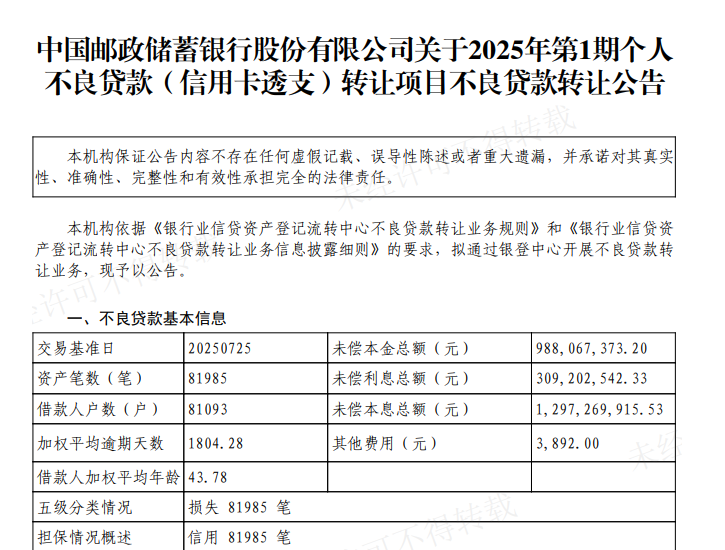
Core Viewpoint - Postal Savings Bank and Ping An Bank are transferring personal non-performing loans totaling 2.1 billion yuan, indicating a trend of accelerated asset clearance in the banking sector as they seek to manage rising non-performing loan ratios and meet regulatory requirements [1][6]. Group 1: Loan Transfer Details - Postal Savings Bank is transferring its first batch of personal non-performing loans for 2025, involving 81,985 loans and 81,093 borrowers, with a total unpaid principal of 988 million yuan and unpaid interest of 309 million yuan, amounting to a total of 1.297 billion yuan [3][5]. - The weighted average overdue days for Postal Savings Bank's non-performing loans is 1,804.28 days (approximately 5 years), with a weighted average borrower age of 43.78 years [5]. - Ping An Bank is transferring two batches of personal non-performing loans, with the first batch involving 33,631 loans and a total unpaid principal and interest of 477 million yuan, and the second batch involving 27,522 loans with a total of 328 million yuan [5]. Group 2: Industry Trends - Since entering the fourth quarter, banks have accelerated the clearance of non-performing assets, with over 20 announcements related to personal non-performing loans in the credit card sector reported this month [6]. - The trend of increasing non-performing loan ratios in retail loans is evident, with credit card loan non-performing rates continuing to rise, although the rate of increase is slowing [6]. - Banks are motivated to transfer non-performing assets to reduce their non-performing loan balances and free up capital tied to inefficient assets, driven by regulatory assessments and the need to optimize financial statements [6].