INNOVENT BIO(01801)

Search documents
阿里健康与信达生物达成战略合作,打造科学减重全周期服务新生态
Zheng Quan Shi Bao Wang· 2025-08-13 13:00
Core Insights - Alibaba Health and Innovent Biologics have signed a strategic cooperation agreement to enhance post-disease management, supply chain, and digital marketing services for consumers [1][2] Group 1: Strategic Cooperation - The collaboration will focus on developing a post-disease management system that includes medication guidance, lifestyle consultation, and supportive services for patients [2] - Customized supply chain solutions will be provided by Alibaba Health to ensure compliance and safe delivery of temperature-sensitive medications [2] - Joint efforts will be made in digital marketing to promote scientific weight loss knowledge and facilitate online appointment services [2] Group 2: Company Profiles - Alibaba Health is a flagship platform of Alibaba Group that integrates online and offline resources in the pharmaceutical and health industry, offering a one-stop medical solution [1] - Innovent Biologics is a leading biopharmaceutical company in China with 16 innovative drugs on the market, including a recently approved weight loss drug [1][2] - The partnership aims to leverage the strengths of both companies in medical innovation and healthcare accessibility [2][3] Group 3: Future Aspirations - Alibaba Health aims to utilize its digital operations and supply chain advantages to efficiently deliver quality medications and services to patients [3] - There is an expectation to explore further collaborations in areas such as oncology and ophthalmology to provide sustainable high-quality healthcare services [3]

FIT HON TENG近一个月首次上榜港股通成交活跃榜





Zheng Quan Shi Bao Wang· 2025-08-13 12:28
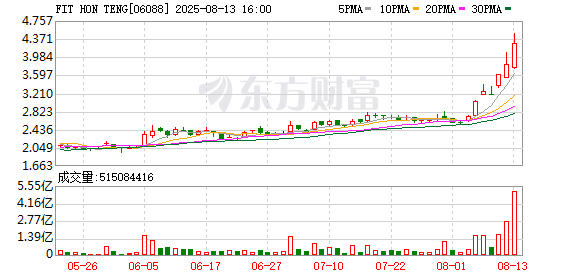
FIT HON TENG为近一个月首次上榜,当日港股通成交额为9.22亿港元,成交净买入2.35亿港元,该股 当日收盘上涨11.78%。(数据宝) 8月13日港股通成交活跃股榜单 | 证券 | 证券简称 | 成交金额(亿 | 净买入金额(亿 | 近一个月上榜 | 最新收盘价 | 日涨跌幅 | | --- | --- | --- | --- | --- | --- | --- | | 代码 | | 港元) | 港元) | 次数 | (港元) | (%) | | 00700 | 腾讯控股 | 90.93 | -2.50 | 23 | 586.000 | 4.74 | | 00981 | 中芯国际 | 40.42 | 0.12 | 23 | 52.050 | 1.76 | | 01810 | 小米集团 W | 43.17 | 1.76 | 23 | 53.250 | 3.00 | | 09988 | 阿里巴巴 W | 85.97 | -2.43 | 23 | 123.700 | 6.09 | | 03690 | 美团-W | 40.05 | -1.88 | 20 | 124.300 | 4.10 | | 01788 ...

南向资金今日成交活跃股名单(8月13日)
Zheng Quan Shi Bao Wang· 2025-08-13 12:28
| 代码 | 简称 | 成交金额(万港元) | 成交净买入(万港元) | 今日涨跌幅(%) | | --- | --- | --- | --- | --- | | 01801 | 信达生物 | 126973.63 | 70920.60 | 8.82 | | 02015 | 理想汽车-W | 251365.27 | 36684.97 | 3.30 | | 06088 | FITHONTENG | 92228.55 | 23494.79 | 11.78 | | 01810 | 小米集团-W | 431651.31 | 17588.47 | 3.00 | | 01788 | 国泰君安国际 | 139526.24 | 5618.78 | -1.47 | | 01024 | 快手-W | 124943.81 | 1929.62 | 4.68 | | 00981 | 中芯国际 | 404165.75 | 1244.92 | 1.76 | | 02228 | 晶泰控股 | 164926.30 | -5391.42 | 9.80 | | 03690 | 美团-W | 400524.52 | -18823.57 | 4.10 ...

8月13日中银创新医疗混合C净值增长3.87%,近6个月累计上涨86.76%
Sou Hu Cai Jing· 2025-08-13 12:22
Group 1 - The core viewpoint of the news is the performance and holdings of the Zhongyin Innovation Medical Mixed Fund C, which has shown significant growth in recent months and has a strong portfolio in the healthcare sector [1][3]. - As of August 13, 2025, the latest net value of Zhongyin Innovation Medical Mixed Fund C is 2.1969 yuan, reflecting a growth of 3.87% [1]. - The fund has achieved a return of 15.09% over the past month, ranking 1008 out of 4699 in its category [1]. - Over the last six months, the fund's return is 86.76%, ranking 26 out of 4543 [1]. - Year-to-date, the fund has returned 85.33%, ranking 30 out of 4501 [1]. - The top ten stock holdings of the fund account for a total of 62.83%, with significant positions in companies such as Innovent Biologics (8.33%), Kelun-Biotech (8.15%), and Hengrui Medicine (8.08%) [1]. Group 2 - The Zhongyin Innovation Medical Mixed Fund C was established on October 30, 2020, and as of June 30, 2025, it has a total scale of 2.686 billion yuan [1]. - The fund manager, Zheng Ning, has a background in asset management and has held various positions in the investment industry, including roles at Taikang Asset Management and Zhonggeng Fund Management [2]. - Zheng Ning has been managing the Zhongyin Innovation Medical Mixed Fund C since July 1, 2022, and has also taken on management roles for other funds within the healthcare sector [2].



智通港股通活跃成交|8月13日
智通财经网· 2025-08-13 11:08
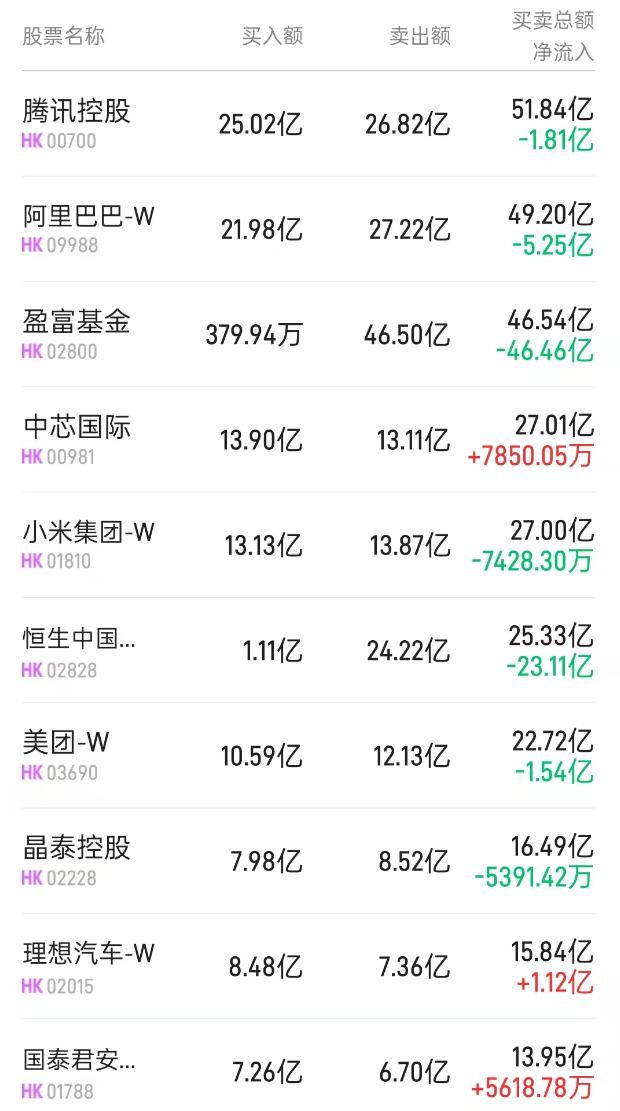
深港通(南向)十大活跃成交公司 2025年8月13日当天,腾讯控股(00700)、阿里巴巴-W(09988)、盈富基金(02800)位居沪港通(南向)成 交额前3位,成交额分别为51.84 亿元、49.20 亿元、46.54 亿元;腾讯控股(00700)、阿里巴巴- W(09988)、盈富基金(02800) 位居深港通(南向)成交额前3位,成交额分别为39.10 亿元、36.78 亿 元、22.08 亿元。 沪港通(南向)十大活跃成交公司 | 公司名称 | 成交金额 | 净买入额 | | --- | --- | --- | | 腾讯控股(00700) | 51.84 亿元 | -1.81 亿元 | | 阿里巴巴-W(09988) | 49.20 亿元 | -5.25 亿元 | | 盈富基金(02800) | 46.54 亿元 | -46.46 亿元 | | 中芯国际(00981) | 27.01 亿元 | +7850.05 万元 | | 小米集团-W(01810) | 27.00 亿元 | -7428.30 万元 | | 恒生中国企业(02828) | 25.33 亿元 | -23.11 亿元 | | 美团- ...
南向资金8月13日净买出超-82亿港元:加仓信达生物7.09亿港元
Jin Rong Jie· 2025-08-13 10:08
Core Insights - Southbound capital recorded a total transaction of 153.78 billion HKD on August 13, with a net outflow of approximately 8.28 billion HKD [1] - The Shanghai-Hong Kong Stock Connect experienced a net outflow of about 8.46 billion HKD, while the Shenzhen-Hong Kong Stock Connect saw a net inflow of around 0.18 billion HKD [1] Group 1: Significant Net Purchases - Xinda Biologics (01801.HK) had a net purchase of 709 million HKD and saw a price increase of 8.82% [1] - Li Auto-W (02015.HK) recorded a net purchase of 367 million HKD, with a price increase of 3.30% [1] - FIT HON TENG (06088.HK) experienced a net purchase of 235 million HKD and a price increase of 11.78% [1] - Xiaomi Group-W (01810.HK) had a net purchase of 176 million HKD, with a price increase of 3.00% [2] - Guotai Junan International (01788.HK) saw a net purchase of 56.18 million HKD despite a price drop of 1.47% [3] - Kuaishou-W (01024.HK) had a net purchase of 19.30 million HKD and a price increase of 4.68% [4] Group 2: Significant Net Sales - The Yingfu Fund (02800.HK) faced a net sale of approximately 6850.25 million HKD, with a price increase of 2.35% [5] - The Hang Seng China Enterprises Index (02828.HK) had a net sale of about 2311.16 million HKD, with a price increase of 2.76% [6] - Tencent Holdings (00700.HK) recorded a net sale of approximately 250.29 million HKD, with a price increase of 4.74% [7] - Alibaba Group-W (09988.HK) experienced a net sale of about 242.99 million HKD, with a price increase of 6.09% [8]
北水动向|北水成交净卖出82.77亿 腾讯(00700)绩前遭抛售 北水再度减持港股ETF
智通财经网· 2025-08-13 10:00
| 股票名称 | 买入额 | 卖出额 | 买卖总额 | | --- | --- | --- | --- | | | | | 净流入 | | 腾讯控股 | 25.02亿 | 26.82 乙 | 51.84 乙 | | HK 00700 | | | -1.81 Z | | 阿里巴巴-W | 21.98 乙 | 27.22 乙 | 49.20亿 | | HK 09988 | | | -5.25 亿 | | 盈富基金 | 379.94万 | 46.50 乙 | 46.54亿 | | HK 02800 | | | -46.46 Z | | 中芯国际 | 13.90亿 | 13.11亿 | 27.01亿 | | HK 00981 | | | +7850.05万 | | 小米集团-W | 13.13 乙 | 13.87亿 | 27.00亿 | | HK 01810 | | | -7428.30万 | | 恒牛中国 ... | 1.11亿 | 24.221Z | 25.33亿 | | HK 02828 | | | -23.11 乙 | | 美团-W | 10.59 乙 | 12.13亿 | 22.72亿 | | HK 036 ...
国金证券:从IL-2双抗 看TAA、细胞及趋化因子的PD-1升级新方向
Zhi Tong Cai Jing· 2025-08-13 09:14
Core Viewpoint - The report from Guojin Securities highlights the rise of innovative drugs in China, indicating that the industry is in the early stages of realizing innovation outcomes, with significant opportunities for independent development and large-scale licensing transactions in the future [1] Group 1: Industry Trends - The global oncology immunotherapy landscape is entering a new era characterized by the combination of PD-1 and TAA (tumor-associated antigens) with cytokines [2] - Multinational pharmaceutical companies are facing patent cliffs for their blockbuster drugs while new innovative drug assets are rapidly emerging globally, including in China, leading to a trend of licensing agreements to fill pipeline gaps [2] - The global innovative drug business development (BD) upfront payments have reached the billion-dollar level, with China accounting for 40% of the total upfront payments [2] Group 2: Drug Development Focus - The evolution from single antibodies to dual and multi-target molecules is ongoing, with a focus on enhancing efficacy and reducing toxicity [3] - The exploration of new molecular constructs has progressed from combinations of immune checkpoint inhibitors (ICIs) and TAAs to combinations with cytokines like IL-2, aiming for better therapeutic outcomes [3][4] - The next wave of innovation in the post-PD-1 era is just beginning, with numerous companies exploring combinations of PD-1 with IL-2 and other structural innovations [4] Group 3: Potential Investment Targets - The report suggests that promising new products may emerge from segments such as TCE (T-cell engagers), other dual/multi-antibodies, and innovative ADCs (antibody-drug conjugates), with a focus on leading clinical enterprises [5] - Recommended companies to watch include Innovent Biologics (01801), Kintor Pharmaceutical (09926), and Kelun-Biotech (06990) [5]

阿里健康与信达生物达成战略合作
Xin Lang Cai Jing· 2025-08-13 08:16
Core Viewpoint - Alibaba Health and Innovent Biologics signed a strategic cooperation agreement to collaborate in post-disease management, supply chain, and digital marketing [1] Group 1: Strategic Cooperation - The partnership will focus on deep collaboration in multiple areas including post-disease management and digital marketing [1] - Both companies aim to enhance their capabilities in supply chain management, particularly for temperature-sensitive medications [1] Group 2: Supply Chain Solutions - Alibaba Health will provide customized supply chain solutions for GLP-1 class drugs that require cold chain distribution at 2-8°C [1]
玛仕度肽上线一个月搜索量超百万 京东健康携手信达生物助力民众科学减重
Zheng Quan Ri Bao Wang· 2025-08-13 08:10
Group 1 - JD Health participated in the "Weight Management Industry Conference 2025" and shared its advantages in providing convenient and scientific weight management solutions through an online and offline retail supply chain and professional healthcare services [1] - The new generation weight loss drug "Masitide" (brand name: Xin'ermei) from Innovent Biologics was launched on JD Health's platform shortly after its approval, highlighting the collaboration between the two companies to promote health knowledge related to weight loss and diabetes [1] - From July 4 to August 4, the search volume for "Xin'ermei" on JD's platform exceeded one million, with over 30,000 users served in the first month, indicating a strong demand for scientific weight loss medications [1] Group 2 - JD Health has established a nationwide network of 33 pharmaceutical warehouses, ensuring that 90% of orders can be delivered on the same day or the next day in nearly 400 cities [2] - For GLP-1 drugs requiring 2-8°C cold chain delivery, JD Health offers same-city cold chain delivery within 2 hours, and the "JD Buy Medicine Fast Delivery" service can deliver in as little as 9 minutes [2] - JD Health plans to deepen its collaboration with Innovent Biologics to leverage its comprehensive health weight management system, aiming to make innovative drugs accessible to more people in need [2]