
SUNAC(01918)

Search documents
港股收评:恒指涨0.37%,黄金、半导体芯片股大涨
Ge Long Hui· 2026-01-21 08:34
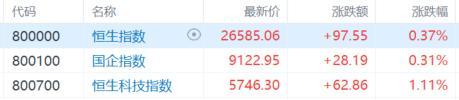
Market Performance - The Hong Kong stock market showed resilience, with the Hang Seng Index and the Hang Seng Tech Index recovering from previous declines, closing up by 0.37% and 1.11% respectively [1][2] - The overall market remained stable despite a significant drop in US stocks overnight [1] Sector Performance - Major technology stocks saw gains, with notable increases in shares of Hua Hong Semiconductor (up over 5%) and SenseTime (up over 4%) [4][5] - Semiconductor stocks were active, driven by positive sentiment in the AI-driven storage cycle, with companies like Zhaoyi Innovation reaching new highs [2][7] - Gold stocks surged, led by Chifeng Jilong Gold (up over 9%) and Lingbao Gold (up over 8%), as spot gold prices broke through $4,880 [6][8] Individual Stock Movements - The stock of Skyworth Group soared over 37% after announcing a distribution of shares in Skyworth Photovoltaic and plans for a mainboard listing [16] - Southbound funds recorded a net inflow of HKD 13.93 billion, indicating strong investor interest [19] Future Outlook - Analysts predict that the Hang Seng Index could challenge the 30,000 to 31,000 point range by 2026, as current valuations remain below historical averages [21]

支持居民改善需求,销售环比回升
ZHONGTAI SECURITIES· 2026-01-21 07:25
Investment Rating - The report maintains an "Overweight" rating for the real estate industry [2] Core Views - The report highlights a rebound in sales on a month-on-month basis, supported by policies aimed at improving housing conditions for residents [7] - The overall market performance is weak, with the Shenwan Real Estate Index declining by 3.52% compared to a 0.57% drop in the CSI 300 Index, resulting in a relative return of -2.95% [4][12] - The report emphasizes the importance of financially stable real estate companies, suggesting a focus on leading firms that can effectively navigate market fluctuations [7] Summary by Sections Weekly Market Review - The Shenwan Real Estate Index decreased by 3.52%, while the CSI 300 Index fell by 0.57%, indicating underperformance of the sector relative to the broader market [4][12] Industry Fundamentals - For the week of January 9-15, 2026, the total number of new homes sold in 38 key cities was 21,770 units, reflecting a year-on-year decline of 14.7% but a month-on-month increase of 12.4%. The total area sold was 201.4 million square meters, down 25.3% year-on-year but up 12.8% month-on-month [5][22] - In the same week, the total number of second-hand homes sold in 16 key cities was 18,991 units, with a year-on-year decline of 11.5% and a month-on-month increase of 17.2%. The total area sold was 188 million square meters, down 11.6% year-on-year but up 18.3% month-on-month [5][40] Land Market Analysis - During the week of January 5-11, 2026, land supply was 2,198.8 million square meters, a year-on-year decrease of 2.6%, with an average supply price of 858 yuan per square meter, down 42% year-on-year. Land transactions totaled 1,503.1 million square meters, down 41.4% year-on-year, with a transaction value of 18.91 billion yuan, down 49.5% year-on-year [6] Investment Recommendations - The report suggests focusing on financially sound leading real estate companies such as Yuexiu Property, China Merchants Shekou, Poly Developments, and others, which are expected to perform well in the current policy environment [7]



未知机构:天风地产今日简讯2026年1月20日行情速览A股今日申万房地产指数-20260121
未知机构· 2026-01-21 02:05
Summary of Key Points from Conference Call Records Industry Overview - The records pertain to the real estate industry in China, specifically focusing on policies and market dynamics affecting urban development and housing. Core Insights and Arguments - The Ministry of Natural Resources and the Ministry of Housing and Urban-Rural Development issued measures to support urban renewal, allowing the use of existing land and property resources for state-supported industries with a transitional policy period not exceeding 5 years [2] - The 2026 National Housing and Urban-Rural Development Work Conference identified "high-quality urban renewal" as a key annual focus, emphasizing the implementation of various livelihood, development, and safety projects [2] - A sustainable model for urban renewal is proposed, involving government guidance, market operations, and public participation, with an emphasis on community engagement and the revitalization of idle assets [2] - The Guangzhou Housing and Urban-Rural Development Bureau plans to promote real estate market stability through strategies focused on "controlling growth, reducing inventory, and optimizing supply" [3] - In 2026, Guangzhou aims to complete fixed asset investments of 120 billion yuan in urban village renovations, with a focus on 52 new model projects to ensure the availability of resettlement housing [3] - The Beijing Planning and Natural Resources Committee has set a land supply plan for 2026, aiming for 65% of land supply to come from existing construction, with a specific focus on urban renewal [3] Additional Important Content - The records highlight the importance of legislative efforts for updating old housing and urban areas, including dilapidated buildings and historical districts, to enhance urban quality [3] - The emphasis on community involvement and the establishment of a legal framework for urban renewal indicates a shift towards more participatory governance in urban development [2][3]





港股异动丨内房股逆势上涨 行业利好政策持续出台 2026年曙光渐行渐近
Ge Long Hui· 2026-01-20 03:10
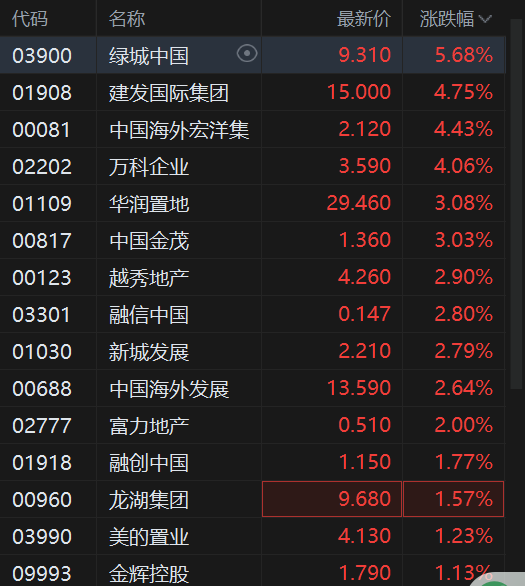
Group 1 - The core viewpoint of the articles highlights a significant rebound in Hong Kong's property stocks, driven by recent financial measures from mainland China aimed at stabilizing the real estate market [1] - Notable stock performances include Greentown China rising nearly 6%, Jianfa International Group up nearly 5%, and China Overseas Hong Kong Group increasing by 4.4% [2] - Recent financial measures include a 25 basis point reduction in the People's Bank of China's re-lending rate and a decrease in the minimum down payment ratio for commercial real estate from 50% to 30% [1] Group 2 - Shenwan Hongyuan believes that the fundamentals of China's real estate sector have undergone a deep adjustment, with a positive shift in policy expectations following central government directives to stabilize the market [1] - Ping An Securities forecasts a narrowing decline in the housing market by 2025, with signs of recovery expected by 2026, emphasizing that quality properties will be key to boosting new home sales [1]


融创中国(01918)根据强制可转换债券发行13.66亿股
智通财经网· 2026-01-19 09:39
智通财经APP讯,融创中国(01918)发布公告,于2026年1月19日根据强制可转换债券配发及发行13.66亿 股新股。 ...
融创中国根据强制可转换债券发行13.66亿股
Zhi Tong Cai Jing· 2026-01-19 09:37
融创中国(01918)发布公告,于2026年1月19日根据强制可转换债券配发及发行13.66亿股新股。 ...
融创中国(01918) - 翌日披露报表
2026-01-19 09:30
FF305 | 3). 轉換可轉換債券/票據 - 涉及新股 | | 83,637,338 | 0.66 % | HKD | 6.8 | | | --- | --- | --- | --- | --- | --- | --- | | 根據強制可轉換債券1配發及發行新股 | | | | | | | | 變動日期 | 2026年1月14日 | | | | | | | 4). 轉換可轉換債券/票據 - 涉及新股 | | 1,365,520,551 | 10.82 % | HKD | 6.8 | | | 根據強制可轉換債券1配發及發行新股 | | | | | | | | 變動日期 | 2026年1月19日 | | | | | | | 於下列日期結束時的結存 (註5及6) | 2026年1月19日 | 14,334,136,758 | | 0 | | 14,334,136,758 | | B. 贖回/購回股份 (擬註銷但截至期終結存日期尚未註銷) (註5及6) | | | | | | | 翌日披露報表 (股份發行人 ── 已發行股份或庫存股份變動、股份購回及/或在場内出售庫存股份) 表格類別: 股票 狀態: 新提交 公司 ...
智通港股空仓持单统计|1月16日
智通财经网· 2026-01-16 10:37
Core Insights - The top three companies with the highest short positions as of January 9 are Vanke Enterprises (02202), Dongfang Electric (01072), and COSCO Shipping Holdings (01919), with short ratios of 18.74%, 17.39%, and 16.49% respectively [1][2] - The companies with the largest absolute increase in short positions are Goldwind Technology (02208), Zhaoyan New Drug (06127), and Jingtai Holdings (02228), with increases of 6.84%, 2.14%, and 1.85% respectively [1][2] - The companies with the largest absolute decrease in short positions are COSCO Shipping Energy (01138), Sanhua Intelligent Control (02050), and Huahong Semiconductor (01347), with decreases of -1.77%, -0.80%, and -0.71% respectively [1][3] Top 10 Short Positions - Vanke Enterprises (02202) has a short position of 413 million shares, representing a short ratio of 18.74% [2] - Dongfang Electric (01072) has a short position of 70.93 million shares, with a short ratio of 17.39% [2] - COSCO Shipping Holdings (01919) has a short position of 475 million shares, with a short ratio of 16.49% [2] - Other notable companies in the top 10 include Heng Rui Medicine (01276) at 15.19% and Ping An Insurance (02318) at 14.74% [2] Largest Increases in Short Positions - Goldwind Technology (02208) saw its short ratio increase from 4.35% to 11.18%, an increase of 6.84% [2] - Zhaoyan New Drug (06127) increased from 6.65% to 8.79%, an increase of 2.14% [2] - Jingtai Holdings (02228) increased from 3.34% to 5.19%, an increase of 1.85% [2] Largest Decreases in Short Positions - COSCO Shipping Energy (01138) decreased from 7.11% to 5.34%, a decrease of -1.77% [3] - Sanhua Intelligent Control (02050) decreased from 6.52% to 5.72%, a decrease of -0.80% [3] - Huahong Semiconductor (01347) decreased from 4.85% to 4.13%, a decrease of -0.71% [3]

港股内房股涨幅居前 雅居乐集团涨4.84%
Mei Ri Jing Ji Xin Wen· 2026-01-15 02:13
Group 1 - Hong Kong property stocks are experiencing significant gains, with major companies showing notable increases in share prices [1] - Agile Group (03383.HK) has risen by 4.84%, trading at 0.325 HKD [1] - R&F Properties (02777.HK) has increased by 3.92%, trading at 0.53 HKD [1] - Sunac China (01918.HK) has seen a rise of 3.45%, with shares priced at 1.2 HKD [1] - Vanke Enterprises (02202.HK) has grown by 2.98%, with a share price of 3.46 HKD [1]
港股异动 | 内房股涨幅居前 据报房企白名单项目展期松绑在即 机构称政策预期氛围浓厚
智通财经网· 2026-01-15 01:58
Core Viewpoint - The recent rise in Chinese real estate stocks is attributed to new policy guidance from regulatory authorities regarding financing coordination mechanisms, which allows certain projects on the "white list" to extend loans with original banks [1] Group 1: Stock Performance - Aoyuan Group (03383) increased by 4.84%, trading at HKD 0.325 [1] - R&F Properties (02777) rose by 3.92%, trading at HKD 0.53 [1] - Sunac China (01918) saw a 3.45% increase, trading at HKD 1.2 [1] - Vanke Enterprises (02202) grew by 2.98%, trading at HKD 3.46 [1] Group 2: Policy Developments - Regulatory authorities have issued new policy guidance for the real estate financing coordination mechanism, allowing eligible projects to extend loans with original banks [1] - The article published in "Qiushi" magazine emphasizes improving and stabilizing expectations in the real estate market [1] Group 3: Market Outlook - Guolian Minsheng Securities released a report indicating that the market anticipates continued implementation of real estate policies following positive signals from the Central Economic Work Conference at the end of 2025 and early 2026 [1] - This expectation may lead to a spring rally in the real estate sector [1]