
WUXI BIO(02269)

Search documents
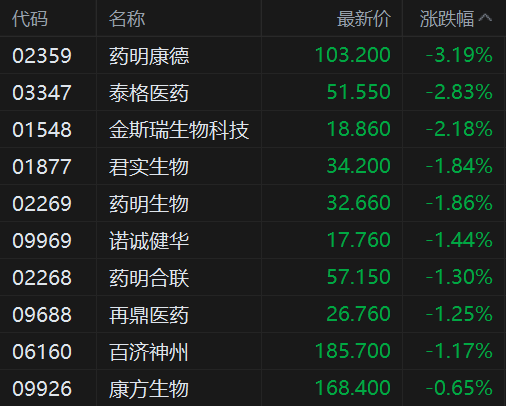
港股异动丨生物医药股普跌 特朗普称将迅速对药品征收关税
Ge Long Hui· 2025-08-26 03:03
Group 1 - The core viewpoint of the article highlights the overall poor performance of Hong Kong's biopharmaceutical stocks, with significant declines in major companies such as WuXi AppTec, Tigermed, and King’s Ray Biotech [1] - U.S. President Trump announced plans to reduce drug prices to 1/1400 to 1/1500 of current prices and to impose tariffs on pharmaceuticals, which could create volatility in the global pharmaceutical industry [1] - The Chinese biopharmaceutical sector faces both opportunities and challenges due to these developments, with potential short-term market fluctuations driven by uncertainty, particularly for businesses exposed to the U.S. market [1] Group 2 - In the long term, China's pharmaceutical industry may leverage its innovation and supply chain advantages to find new growth opportunities in the global pharmaceutical landscape, especially in areas like CDMO and internationalization of innovative drugs [1] - The article lists the latest prices and percentage changes for various biopharmaceutical stocks, indicating a general downward trend across the sector [1]



药明生物(02269)下跌2.1%,报32.58元/股
Jin Rong Jie· 2025-08-26 02:04
Core Viewpoint - WuXi Biologics (02269) experienced a 2.1% decline in stock price, trading at 32.58 HKD per share with a transaction volume of 304 million HKD as of 09:46 on August 26 [1] Group 1: Company Overview - WuXi Biologics is a leading global provider of biologics services, offering comprehensive, integrated, and highly customized services throughout the entire process from discovery and development to production of biologics [1] - The company held a 48% market share in China's biologics R&D market in 2016 and has established partnerships with 12 out of the top 20 global pharmaceutical companies [1] Group 2: Financial Performance - As of the mid-year report in 2025, WuXi Biologics reported total revenue of 9.953 billion CNY and a net profit of 2.339 billion CNY [2]
大行评级丨高盛:上调药明生物目标价至29.3港元 管理层料下半年毛利率续改善
Ge Long Hui· 2025-08-25 08:28
Core Viewpoint - Goldman Sachs raised its earnings per share forecast for WuXi Biologics (2269.HK) for the years 2023 to 2027 by 11.9% to 15.9%, reflecting better-than-expected gross margin improvement [1] Group 1 - Target price increased from HKD 25.6 to HKD 29.3, maintaining a price-to-earnings ratio target of 23 times, with a neutral rating [1] - The company's mid-term gross margin expanded by 3.6 percentage points to 42.7%, driven by reduced employee stock compensation, increased milestone revenue recognition from R&D, and improved utilization of new capacity, offsetting losses from the Ireland project [1] - Management expects gross margin improvement to continue in the second half of the year, based on operational enhancements and increased capacity utilization, with a long-term gross margin target of 50%, and the Singapore facility's gross margin expected to reach approximately 45% [1]
里昂:升药明生物(02269)目标价至42.6港元 料重新加速增长
智通财经网· 2025-08-25 07:13
Group 1 - The core viewpoint of the article is that Jefferies has raised its revenue and net profit forecasts for WuXi Biologics (02269) for the years 2025 to 2027, indicating a positive outlook for the company's growth [1] - Revenue forecast has been adjusted upwards by 0% to 4%, while net profit forecast has been increased by 0% to 7% [1] - The gross margin is expected to rise from 28.5% in 2024 to 30.8% in 2027 [1] Group 2 - Jefferies has raised the target price for WuXi Biologics from HKD 34.8 to HKD 42.6, maintaining an outperform rating [1] - The profitability and valuation of the Contract Research Organization (CRO) industry are sensitive to changes in the funding environment [1] - The potential interest rate cuts in the US in the second half of the year are expected to enhance market preference for the CRO sector [1] Group 3 - It is anticipated that global biotech companies will increase R&D investments in a more favorable funding environment from the second half of this year into next year [1] - Pharmaceutical companies are also expected to expand R&D spending to alleviate patent barrier pressures, which will continue to benefit WuXi Biologics [1]
里昂:升药明生物目标价至42.6港元 料重新加速增长
Zhi Tong Cai Jing· 2025-08-25 07:12
Core Viewpoint - The report from Citi indicates that WuXi Biologics (02269) is expected to accelerate growth again between 2025 and 2027, with revenue forecasts raised by 0% to 4% and net profit forecasts increased by 0% to 7% [1] Group 1: Financial Projections - Gross margin is projected to improve from 28.5% in 2024 to 30.8% in 2027 [1] - The target price for the company has been raised from HKD 34.8 to HKD 42.6, maintaining an outperform rating [1] Group 2: Industry Insights - The profitability and valuation of the Contract Research Organization (CRO) industry are sensitive to changes in the funding environment [1] - A potential interest rate cut in the US in the second half of the year is expected to enhance market preference for the CRO sector [1] - Global biotech companies are anticipated to increase R&D investments in a more favorable funding environment, while pharmaceutical companies will also expand R&D spending to alleviate patent barrier pressures, benefiting WuXi Biologics [1]
药明生物(02269):港股公司信息更新报告:2025H1业绩表现亮眼,持续深化全球产能布局
KAIYUAN SECURITIES· 2025-08-25 02:31
Investment Rating - The investment rating for WuXi Biologics (02269.HK) is "Buy" (maintained) [4][13] Core Views - The company achieved a robust revenue growth of 16.08% year-on-year in H1 2025, with total revenue reaching 9.953 billion yuan and a net profit of 2.339 billion yuan, reflecting a significant increase of 56.05% [4] - The company has raised its full-year revenue guidance for 2025 to a growth range of 14%-16%, supported by a backlog of unfulfilled orders amounting to approximately 20.34 billion USD [4] - The report highlights the strong growth momentum in preclinical services and anticipates future growth in CMO (Contract Manufacturing Organization) business [5] Financial Performance - In H1 2025, the company reported a gross margin of approximately 42.73%, an increase of about 3.6 percentage points year-on-year [4] - The adjusted net profit for H1 2025 was 2.840 billion yuan, representing a year-on-year growth of 11.60% [4] - The company’s earnings per share (EPS) for 2025-2027 are projected to be 1.1, 1.3, and 1.5 yuan respectively, with corresponding price-to-earnings (P/E) ratios of 26.7, 23.9, and 19.5 times [4] Business Growth and Strategy - The preclinical business achieved revenue of 4.147 billion yuan in H1 2025, marking a year-on-year growth of approximately 35.2% [5] - The company has a total of 864 projects in various stages, with 429 in preclinical, 259 in Phase I, 85 in Phase II, 67 in Phase III, and 24 in commercialization [5] - WuXi Biologics is expanding its global capacity with five research service centers, eight drug development centers, and eight commercial production centers [6] Regional Performance - Revenue growth in North America was robust at 20.1%, while Europe and China saw growth rates of 5.7% and a decline of 8.5% respectively [6] - The company’s strategic expansion in North America is expected to continue driving revenue growth [6]
药明生物(2269.HK):整体项目数再创新高 商业化生产逐步提速
Ge Long Hui· 2025-08-24 18:52
Core Viewpoint - The company reported a strong performance in the first half of 2025, with revenue reaching 9.953 billion yuan, a year-over-year increase of 16.1%, and a net profit attributable to shareholders of 2.339 billion yuan, up 56.0% year-over-year, indicating significant improvement in profitability and meeting expectations [1] Group 1: Financial Performance - The company's gross margin improved by 3.6 percentage points to 42.7% [1] - The total number of projects reached a record high of 864, with 86 new projects added in the first half of 2025, including 9 "winning molecule" projects, of which 2 are in Phase III clinical trials [1] - Revenue from preclinical services increased by 35.2% year-over-year, while early-stage clinical revenue decreased by 29.7% due to several large projects advancing to later development or commercialization stages [1] Group 2: Market Performance - Revenue from North America grew by 20.1%, serving as the main driver for the company's overall revenue [1] - Revenue from Europe and China remained stable, with year-over-year growth of 5.7% in Europe and a decline of 8.5% in China [1] - Other regions saw a rapid revenue increase of 136%, reflecting the company's efforts to expand in emerging markets [1] Group 3: Order Backlog and Future Projections - As of the first half of 2025, the company had an unfulfilled order total of 20.3 billion USD, including 11.4 billion USD in service orders and 9 billion USD in potential milestone payments [2] - The company expects to complete 25 Process Performance Qualifications (PPQ) in 2025, a significant increase from 16 in 2024, with a 98% success rate in PPQ production [2] - The number of ongoing Phase III and commercial production projects stands at 67 and 24, respectively, with revenue from these projects increasing by 24.9% year-over-year, supporting future potential orders [2]
药明生物(2269.HK):上调全年指引 CRDMO模式价值凸显
Ge Long Hui· 2025-08-24 18:52
Core Viewpoint - WuXi Biologics has raised its full-year revenue guidance following its interim report, indicating a gradual recovery in the global biopharmaceutical R&D and production landscape, with the CRDMO model expected to contribute revenue across various stages of R&D [1][2] Group 1: Financial Projections - The company projects EPS for 2025, 2026, and 2027 to be 1.11, 1.28, and 1.49 CNY respectively [1] - A PE valuation method is applied, with a target PE multiple of 40 for 2025, leading to a target price of HKD 48.18 per share, maintaining a "Buy" rating [1] Group 2: Project Pipeline and Orders - The number of projects in the pipeline is expanding, with a record high of 86 new projects added in the first half of 2025, over half of which are from the U.S. [1] - The company has 864 projects as of the first half of 2025, including 67 in Phase III clinical trials and 24 in commercial production, laying a solid foundation for future revenue growth [1] - The total unfulfilled orders amount to USD 20.3 billion, with approximately USD 11.4 billion in service orders, driven by the advancement of Phase III projects and early-stage clinical progress [1] Group 3: Revenue Growth and Market Resilience - Revenue from the M-end continues to grow rapidly, with North America showing resilience, as preclinical revenue increased by 35.2% year-on-year, driven by research services and preclinical development projects [2] - Clinical Phase III and commercial revenue rose by 24.9% year-on-year, reflecting the maturation of early-stage projects and the ongoing ramp-up of existing commercial projects [2] - North American revenue grew by 20.1% year-on-year, demonstrating sustained demand resilience amid a dynamic trade environment [2] Group 4: CRDMO Model and Profit Potential - The CRDMO model is rare, with proprietary technology molecules expected to contribute revenue at various R&D stages [2] - For every USD 1 billion in proprietary technology drug sales, WuXi Biologics is expected to earn USD 100 million annually, with 100% of projects produced by WuXi exempt from cell line royalties [2] - Projects not produced by WuXi will incur a cell line royalty typically at 0.5% of drug sales, with gross margins exceeding 80%, potentially generating significant profits, and over 600 projects expected to generate potential cell line royalties by the end of 2025 [2]
药明生物(02269):临床前和临床后期表现亮眼,上调全年业绩指引
Xinda Securities· 2025-08-24 13:02
Investment Rating - The report upgrades the revenue growth guidance for the year from 12%-15% to 14%-16% based on the strong performance in the first half of 2025 [5] Core Insights - The company achieved a revenue of 9.953 billion yuan in H1 2025, representing a year-on-year growth of 16.1%. The gross profit reached 4.253 billion yuan, with a gross margin of 42.7%, up by 3.6 percentage points year-on-year [1] - The growth was primarily driven by overseas markets, with North American revenue increasing by 20.1% to 6.018 billion yuan, while revenue from European clients grew by 5.7% to 1.969 billion yuan. However, revenue from Chinese clients declined by 8.5% to 1.297 billion yuan [2][3] - The company signed a record 86 new projects in H1 2025, including 9 "winning molecule" projects, indicating a robust project and order reserve [4][5] Financial Performance Summary - For H1 2025, the company reported a net profit attributable to shareholders of 2.339 billion yuan, a significant increase of 56.0% year-on-year. The adjusted net profit was 2.840 billion yuan, up by 11.6% [1] - The company expects to complete 25 PPQ projects in 2025, contributing to a strong growth foundation [4][5] - The financial projections for 2025-2027 indicate revenues of 21.503 billion yuan, 24.572 billion yuan, and 27.580 billion yuan, respectively, with net profits of 4.405 billion yuan, 5.082 billion yuan, and 5.756 billion yuan [6][7]
药明生物(02269):2025 年半年报点评:上调全年指引,CRDMO模式价值凸显
GUOTAI HAITONG SECURITIES· 2025-08-23 13:01
Investment Rating - The report maintains an "Accumulate" rating for WuXi Biologics (2269) [5][6] Core Insights - WuXi Biologics has raised its full-year revenue guidance, reflecting a gradual recovery in the global biopharmaceutical R&D and manufacturing landscape. The CRDMO model is expected to leverage proprietary technology molecules to contribute revenue across various stages of R&D [2][3] Financial Summary - Total revenue projections for WuXi Biologics are as follows (in million RMB): - 2023: 17,051 (+12%) - 2024: 18,675 (+10%) - 2025E: 21,612 (+16%) - 2026E: 24,483 (+13%) - 2027E: 27,329 (+12%) - Gross profit and net profit forecasts are: - Gross profit for 2025E: 9,293 million RMB - Net profit for 2025E: 4,510 million RMB (+34%) [3][11] Project and Order Trends - The number of projects in the pipeline is expanding, with 86 new projects added in the first half of 2025, marking a historical high for 1H. Over half of these new projects are from the United States, with bispecific antibodies, multi-specific antibodies, and antibody-drug conjugates making up over 70% of new projects [9][10] - As of the first half of 2025, the company has 864 projects, including 67 in Phase III clinical trials and 24 in commercial production, laying a solid foundation for future revenue growth [9][10] Revenue Growth and Market Resilience - Revenue from the M segment is growing rapidly, with North America showing resilience in revenue growth. Preclinical revenue increased by 35.2% year-on-year in the first half of 2025, driven by research services and preclinical development projects [9][10] - The North American revenue grew by 20.1% year-on-year, demonstrating sustained demand and project ramp-up in a dynamic trade environment [9][10] CRDMO Model and Profit Potential - The CRDMO model is rare, and proprietary technology molecules have the potential to contribute revenue at various stages of R&D. For every $1 billion in proprietary technology drug sales, WuXi Biologics is expected to earn $100 million annually [9][10]