PING AN OF CHINA(02318)

Search documents
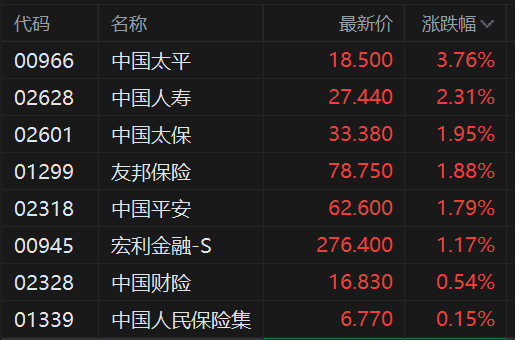
港股异动丨内险股普涨 中国太平涨近4% 中国平安涨近2% 机构看好保险业前景
Ge Long Hui· 2025-12-12 03:49
Group 1 - The core viewpoint of the news is that the Hong Kong insurance stocks have collectively risen, driven by positive market sentiment and favorable regulatory changes [1] - China Taiping increased by nearly 4%, China Life by 2.3%, and other major insurers like China Ping An and China Taibao saw gains of nearly 2% [2] - Guosheng Securities reported that the insurance industry will benefit from the trend of bank deposits moving to insurance products, with diverse demands in retirement, healthcare, and savings expected to drive industry expansion [1] Group 2 - Short-term progress in the insurance companies' performance is expected to boost the liability side for 2026, with a significant reduction in the scheduled interest rates alleviating the risk of industry spread losses [1] - UBS highlighted that the recent notification from the National Financial Regulatory Administration to adjust risk factors for insurance companies encourages long-term patient capital, which is beneficial for market sentiment [1] - UBS reiterated China Ping An as the industry’s top pick with a "buy" rating and a target price of 70 HKD, citing attractive risk-reward dynamics [1]



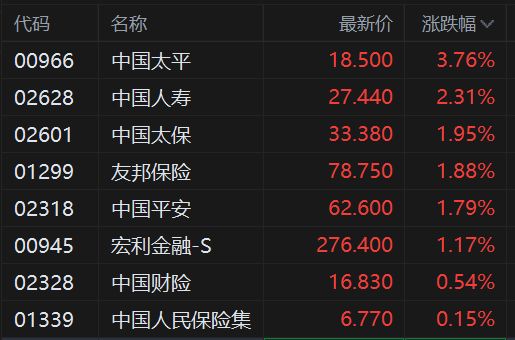
内险股普涨 中国太平涨近4% 中国平安涨近2% 机构看好保险业前景
Ge Long Hui· 2025-12-12 03:47
Core Viewpoint - The Hong Kong insurance sector experienced a collective rise, driven by positive market sentiment and favorable regulatory changes, indicating a strong outlook for the industry in both the short and long term [1] Group 1: Market Performance - On December 12, major Hong Kong insurance stocks saw significant gains, with China Taiping rising nearly 4%, China Life up 2.3%, and China Ping An, China Taibao, and AIA increasing by nearly 2% [1] - The stock prices and their respective changes include: - China Taiping: 18.500, +3.76% - China Life: 27.440, +2.31% - China Taibao: 33.380, +1.95% - AIA: 78.750, +1.88% - China Ping An: 62.600, +1.79% - China Pacific Insurance: 16.830, +0.54% - China People's Insurance: 6.770, +0.15% [2] Group 2: Industry Outlook - Guosheng Securities reported that the insurance industry will benefit from the trend of bank deposits moving to insurance products, with diverse demands in retirement, healthcare, and savings expected to drive industry expansion [1] - The smooth progress of the insurance companies' "opening red" is anticipated to boost the liability performance in 2026 [1] - The adjustment of product reservation interest rates is expected to significantly alleviate the risk of industry interest spread losses, while the "integration of reporting and operations" is promoting a reduction in internal competition and increasing concentration among leading companies [1] Group 3: Regulatory Impact - UBS highlighted that the recent notification from the National Financial Regulatory Administration, which adjusts risk factors for insurance companies, reinforces the policy direction encouraging long-term patient capital, thus enhancing market sentiment [1] - The recent rise in Chinese government bond yields and the steepening yield curve are seen as beneficial for insurance companies in the long run [1] - UBS reiterated its preference for China Ping An as the top choice in the industry, maintaining a "buy" rating with a target price of 70 HKD, citing attractive risk-reward dynamics [1]
安顺金融监管分局同意平安产险贵州分公司关岭支公司变更营业场所
Jin Tou Wang· 2025-12-12 03:46
Group 1 - The Anshun Financial Regulatory Bureau approved the request for the change of workplace for China Ping An Property Insurance Co., Ltd. Guizhou Branch, Guanshan Sub-branch [1] - The new business location is specified as No. 10-3-2, Walking Street, Southwest Side of the Publicity and Cultural Center, Guanshan Buyi and Miao Autonomous County, Anshun City, Guizhou Province [1] - China Ping An Property Insurance Co., Ltd. Guizhou Branch is required to handle the change and license renewal in accordance with relevant regulations [1]
“老七家”,15款分红增额寿,全面榜单
Xin Lang Cai Jing· 2025-12-12 01:37
Core Insights - The insurance industry is shifting focus towards participating insurance products due to declining market interest rates, with guaranteed rates for fixed income products at 2% and for participating products at 1.75%, resulting in a narrow 0.25% rate difference [2][22] - The "old seven" major insurance companies in mainland China have launched a total of 15 participating whole life insurance products this year, with Taiping Life Insurance offering the most at five products, while the others offer one to two products each [2][22] - The highest illustrated rates among these products are 3.75% for Taiping's Xinfu Xiangban Chuan Shi version and 3.9% for Xinhua's Shengshi Rongyao Qingtian version, with most others around 3.5% [2][22] Group 1: Product Performance Analysis - In the case of single premium payments, the top three products based on guaranteed cash value performance are Taiping's Xinfu Xiangban Chuan Shi version, Xinhua's Shengshi Rongyao Qingtian version, and China Life's Xin Yue Chuan Jia Qingtian version [3][23] - For five-year premium payments, the leading products in terms of guaranteed cash value are Taiping's Xinfu Xiangban Chuan Shi version, Xinhua's Shengshi Rongyao Qingtian version, and Taikang's Le Zeng Shou Qingtian version [8][10] - Under six-year premium payments, the top three products are China Life's Xin Yue Chuan Jia Qingtian version, Renbao's Fu Lu Man Tang 2025, and Taikang's Xin Xiang Shi Jia 2026 [12][14] - For ten-year premium payments, the best performing products are Taiping's Xinfu Xiangban Chuan Shi version, Renbao's Fu Lu Man Tang 2025, and Ping An's Yu Xiang Jin Yue 2026 [16][18] Group 2: Long-term Value Considerations - The performance of products with higher illustrated rates does not necessarily translate to better actual cash value, emphasizing the importance of evaluating specific numerical data [19] - Taiping Life Insurance has shown significant improvements in its product offerings, actively embracing the internet and launching numerous participating whole life insurance products, establishing a notable advantage among the "old seven" [19] - The dividend realization rates have improved for Ping An, China Life, and Taiping, with Taiping's new products demonstrating generous illustrated data, while China Life and Ping An maintain a conservative approach [19]



践行金融“五篇大文章”:平安融易以“三省”服务精准滴灌江苏实体经济
Cai Fu Zai Xian· 2025-12-11 09:01
Core Viewpoint - The article emphasizes the role of finance as a vital engine for the economy, highlighting the importance of developing various types of finance, including technology finance, green finance, inclusive finance, pension finance, and digital finance, to support the real economy and innovation [1] Group 1: Financial Services Innovation - Ping An Rongyi focuses on serving national strategies by advancing financial "five major articles" through technological innovation and personalized services [1] - The company utilizes AI, big data, and blockchain to create a "technology + finance" dual-drive model, enhancing service efficiency and promoting intelligent and scenario-based financial services [1] - The service philosophy of "saving worry, time, and money" integrates cutting-edge technology throughout the service process, aiming for a win-win vision of inclusive finance [1] Group 2: Support for Small and Micro Enterprises - Ping An Rongyi employs a "three savings" service concept to provide full-cycle financing support for small and micro enterprises, exemplified by a case where a client received 747,000 yuan in financing during peak sales seasons [2] - The company’s AI-driven "Xingyun 2.0" system allows 95% of small micro clients to obtain loans within 1.3 hours, significantly reducing processing time and enhancing decision-making accuracy [2] - Digital risk control and intelligent credit assessment align financing services with the growth pace of enterprises, showcasing the effectiveness of digital inclusive finance [2] Group 3: Green Finance Initiatives - Traditional industries are under pressure to transform, with a case study highlighting a client transitioning from plastic recycling to green plant cultivation, supported by a 250,000 yuan loan from Ping An Rongyi [3] - The company actively supports small micro enterprises in green transformation through flexible and efficient financial services, reflecting its social responsibility in promoting environmental sustainability [4] - Ping An Rongyi's offline consulting team focuses on key sectors such as clean energy and infrastructure upgrades, providing tailored financial support to meet the funding needs of small micro enterprises [4] Group 4: Future Directions - The company aims to deepen green finance innovation to contribute to the "dual carbon" goals and high-quality development, maintaining its commitment to serving small micro enterprises [4] - Ping An Rongyi will continue to integrate the "three savings" service concept into professional engagements, ensuring precise financial support reaches critical areas of the economy [4] - The company is dedicated to leveraging technology and personalized service to assist small micro enterprises in achieving sustainable growth, contributing to the modernization of China's financial landscape [4]

先行突破!中国平安旗下居家养老管家服务获“五星级评价”
Zhong Guo Jing Ji Wang· 2025-12-11 08:49
Core Viewpoint - China Ping An's home elderly care service has become the first in the country to receive a five-star rating from the China Quality Certification Center (CQC), setting a benchmark for high-quality development in the home elderly care industry [1] Group 1: Service Evaluation - The evaluation was based on the "Home Elderly Care Service Evaluation Technical Specification," covering four core dimensions: basic guarantee capability, service process standardization, professional service capability, and user satisfaction, with a total of 10 secondary evaluation indicators [1] - Ping An's home elderly care service achieved a comprehensive score of 95 out of 100, marking it as the first service project in the country to receive this rating [1] Group 2: Service Highlights - The CQC highlighted three key strengths of Ping An's home elderly care service: 1. Outstanding resource coordination ability, utilizing a smart speaker as a unified platform to connect various services [2] 2. Strong professionalism of service personnel, with qualifications such as emergency rescue certificates and extensive clinical experience [2] 3. A comprehensive standard system developed in collaboration with industry partners, including six group standards and service process standards [2] Group 3: Service Expansion and Features - Ping An's home elderly care service is characterized by its intelligent, standardized, and professional approach, providing a one-stop solution that combines insurance and home elderly care [3] - As of early November, the service has covered 100 cities in China, with nearly 240,000 customers qualifying for home elderly care services, and the smart guardian service has responded to over 100,000 customers with a 100% alert response rate [3] Group 4: Future Commitment - Ping An views the five-star rating as recognition and motivation for its professional services, committing to continue its mission of "finance for the people" and to innovate in the "insurance + medical" and "insurance + elderly care" models [4]

中国平安跌0.03%,成交额29.91亿元,近3日主力净流入-7.34亿
Xin Lang Cai Jing· 2025-12-11 07:33
Core Viewpoint - China Ping An's stock performance shows a slight decline of 0.03% with a trading volume of 2.991 billion yuan and a market capitalization of 1,132.271 billion yuan [1] Group 1: Dividend and Shareholder Information - The dividend yields for China Ping An over the past three years were 5.15%, 6.03%, and 4.84% [2] - The top ten circulating shareholders include Central Huijin Asset Management Co., Ltd. and China Securities Finance Corporation [2] - Since its A-share listing, China Ping An has distributed a total of 391.904 billion yuan in dividends, with 134.54 billion yuan distributed in the last three years [7] Group 2: Financial Performance - For the period from January to September 2025, China Ping An reported a revenue of 832.94 billion yuan, reflecting a year-on-year growth of 7.42%, and a net profit attributable to shareholders of 132.856 billion yuan, up 11.47% year-on-year [6] Group 3: Business Overview - China Ping An, established on March 21, 1988, and listed on March 1, 2007, is headquartered in Shenzhen, Guangdong Province, and offers a diverse range of financial services including insurance, banking, securities, and trust [6] - The company's revenue composition includes life and health insurance (45.76%), property insurance (34.46%), banking (13.87%), asset management (5.27%), and financial empowerment (3.85%) [6] Group 4: Market Activity and Technical Analysis - The stock has seen a net outflow of 411 million yuan today, with a continuous reduction in main funds over the past three days [3][4] - The average trading cost of the stock is 53.01 yuan, with recent accumulation activity noted, although the strength of this accumulation is weak [5] - The stock price is approaching a resistance level of 63.80 yuan, indicating potential for a pullback unless this level is breached [5]
分歧添新动向,平安系起诉华夏幸福和王某|快讯

Hua Xia Shi Bao· 2025-12-11 04:12
Core Viewpoint - The ongoing conflict between Ping An Group and China Fortune Land Development (CFLD) has escalated, with Ping An initiating legal action to confirm the validity of an arbitration agreement against CFLD and its representative Wang [2] Group 1: Legal Proceedings - Ping An Life Insurance Co. and Ping An Asset Management Co. have filed a lawsuit against CFLD and Wang, with a court hearing scheduled for December 17 at the Shanghai Financial Court [2] - The lawsuit follows CFLD's application for pre-restructuring, which was accepted by the Langfang Intermediate Court, prompting Ping An to publicly question the compliance of the pre-restructuring process [2] Group 2: Financial Investigations - As the chair unit of CFLD's creditor committee, Ping An is leading a special financial due diligence investigation into CFLD, while CFLD asserts that the pre-restructuring process is compliant and has cooperated with the court-appointed temporary administrator for asset and liability investigations [2] Group 3: Shareholding Changes - Ping An originally planned to reduce its stake in CFLD by 3% through block trades or centralized bidding between September and November 2025, but as of November 30, only 0.2% of the reduction was completed [2] - After the reduction, Ping An still holds a 24.99% stake in CFLD, maintaining its position as the largest shareholder [2]

昭通金融监管分局同意平安产险水富支公司营业场所变更
Jin Tou Wang· 2025-12-11 04:02
Core Points - The Zhaotong Financial Regulatory Bureau approved the request from China Ping An Property & Casualty Insurance Company for a change of business location for its Shuifu branch [1] Group 1 - The business location of China Ping An's Shuifu branch has been changed from "No. 01, 21, B Building, Middle Section of People's East Road, Yunfu Street Office, Shuifu City, Zhaotong, Yunnan" to "Room 11, 2nd Floor, Secondary Passenger Station, East Side of Maple Leaf New City, Shuifu City, Zhaotong, Yunnan" [1] - The approval was documented in the official response numbered Pingbao Chan Yun Fen Zhaotong Zhong Zhi Fa [2025] No. 20 [1] - China Ping An is required to handle the change and obtain new permits in accordance with relevant regulations [1]
保险行业2025行情回顾:阶段性超额收益显著,全年跑输大盘
GOLDEN SUN SECURITIES· 2025-12-11 02:54
Investment Rating - The report indicates a positive long-term outlook for the insurance industry, suggesting a "Buy" rating for companies like China Ping An, China Life, and China Pacific Insurance [3][37]. Core Insights - The insurance industry has shown significant phase-specific excess returns but has underperformed the broader market for the year. The A-share market has rebounded significantly, with the overall A index up by 25.76% and the CSI 300 by 17.46% as of December 8, 2025. The insurance industry index increased by 18.17%, outperforming the CSI 300 by 0.71 percentage points but lagging behind the overall A index by 7.59 percentage points [8][10]. - Individual stock performance within the insurance sector has varied widely, with New China Life leading with a 40.73% increase, followed by Ping An at 25.93%, and others showing lower gains [10][19]. - The differences in stock performance are attributed to three main factors: investment and performance, liability side growth, and differences in index component weight and actual trading volume [13][24]. Summary by Sections Investment and Performance - The total investment return rates for listed insurance companies have significantly improved, with New China Life showing the most notable increase at 8.6% as of Q2 2025. Other companies like China Life and China Pacific reported returns of 6.4% and 5.2%, respectively [19][21]. - The insurance sector's total investment balance reached 36.12 trillion yuan, with stocks and funds accounting for 15.5% of this balance, marking a record high [14][16]. Liability Side - New single premium growth has been robust, particularly for New China Life, which reported a 55.2% year-on-year increase in new single premiums. Other companies like China Pacific and China Life also showed positive growth, albeit at lower rates [24][27]. - The adjustment of product pricing rates has positively impacted the new business value (NBV), with New China Life's NBV increasing by 50.8% year-on-year [24][28]. Index Component Weight and Trading Volume - The weight of the five major insurance companies in the CSI 300 index is concentrated, with Ping An holding the largest share at 2.59%. The actual trading volume of shares varies significantly among these companies, affecting their stock price elasticity [33][36]. - The actual trading market capitalization for these companies as of December 8, 2025, shows Ping An at 568.7 billion yuan, while New China Life and China Life have lower trading volumes of 47.7 billion yuan and 30.7 billion yuan, respectively [36][39].