
PING AN OF CHINA(02318)

Search documents
港股收评:指数集体上扬!大金融股、黄金股走强,药品股低迷


Sou Hu Cai Jing· 2025-12-12 09:01
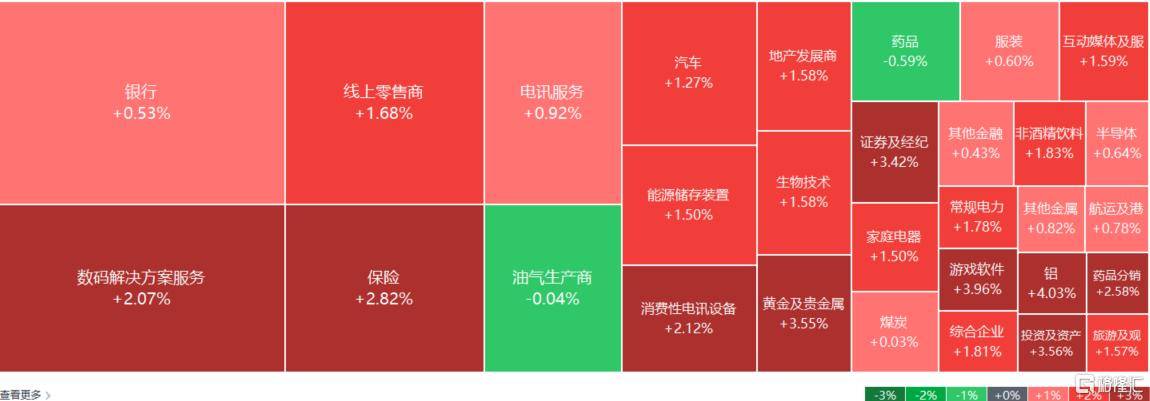
Market Overview - The market sentiment improved significantly due to favorable news from the Central Economic Work Conference, with the Hang Seng Index rising by 1.75% and returning to 26,000 points [1] - Major technology stocks collectively increased, with NetEase rising over 4%, Tencent and Alibaba up over 2%, and other tech companies like Xiaomi, Baidu, JD.com, and Kuaishou also seeing gains [1][3] Sector Performance - **Electric Power Equipment**: Strong performance with Dongfang Electric up over 13% and other companies like Harbin Electric and Shanghai Electric also showing significant gains [1][5] - **Financial Sector**: All major financial stocks, including China Pacific Insurance and CITIC Securities, saw increases, with HSBC reaching a market value of over HKD 2 trillion [1][8] - **Precious Metals**: Gold and silver prices surged, leading to active trading in gold stocks, with China Silver Group rising nearly 6% [1][6] - **Consumer Sector**: Restaurant stocks were active, with companies like Da Shi and Haidilao seeing notable increases, driven by policies aimed at boosting consumption [10] - **Real Estate**: Property stocks rose, with Longguang Group increasing over 4%, supported by policies to stabilize the real estate market [12] Individual Stock Highlights - **NetEase**: Stock price increased by 4.20% to HKD 218.40 [4] - **Dongfang Electric**: Stock price surged by 13.59% to HKD 24.90 [5] - **China Pacific Insurance**: Stock price rose by 5.68% to HKD 34.60 [9] - **China Silver Group**: Stock price increased by 5.80% to HKD 0.730 [7] - **Xuan Bamboo Bio**: Stock price increased by 25.19% to HKD 96.90, reaching a new high [16][19] Economic Policy Impact - The Central Economic Work Conference emphasized the importance of domestic demand and consumer spending, with plans to implement measures to boost consumption and stabilize the real estate market [10][12]

做民生 “缓冲垫” 当产业 “压舱石” 重庆保险业惠企利民促发展
Zhong Guo Xin Wen Wang· 2025-12-12 08:10
Core Viewpoint - The insurance industry in Chongqing is transforming from a reactive compensation model to a proactive service model, focusing on risk prevention and tailored solutions to enhance both public welfare and industrial development [1][8]. Group 1: Insurance as a "Buffer" for Livelihood - A low-cost accident insurance for the elderly, costing only 50 yuan, provides a coverage of 6,000 yuan for medical expenses, demonstrating the industry's commitment to supporting senior citizens [2]. - The insurance has already covered over 25,000 individuals, providing a total risk coverage of 1.58 billion yuan by September 2025 [2]. - New employment sectors, such as delivery and ride-sharing, have been provided with specialized insurance, covering 120,000 workers and resulting in over 4,300 claims amounting to more than 50 million yuan since 2023 [3]. Group 2: Insurance as an "Anchor" for Industry - Customized insurance solutions for businesses, such as food safety and employee accident insurance, have provided over 100 million yuan in risk coverage for companies like Sanhui Catering Culture Co., Ltd [4]. - The insurance industry is actively involved in risk management, offering services like safety training and hazard inspections alongside traditional coverage [4]. - A new insurance product for autonomous vehicles has been launched, enhancing claims efficiency through an integrated solution for liability determination [5]. Group 3: Safety as a "Firewall" for Risk Prevention - The insurance sector is shifting towards preventive measures, such as the "Red and Green Light" initiative, which has reduced accident rates by 50% in high-risk areas through infrastructure improvements [7]. - Risk reduction services have been implemented in tourist areas, providing 40 million yuan in risk coverage and enhancing safety through various precautionary measures [7]. - The insurance industry is increasingly seen as a proactive player in community safety, offering solutions that go beyond mere compensation [8].


540亿投资打水漂?从联姻到决裂,平安起诉华夏幸福和王文学
Sou Hu Cai Jing· 2025-12-12 07:06
就在昨天,平安起诉了华夏幸福,还有华夏幸福的董事长王文学。两家公司之前积攒的矛盾,彻底爆发 了。 2018年,华夏幸福因为环京楼市限购,陷入困境。 2022年,反对华夏幸福的"以股抵债";后来又因为"2元置换带"方案,反对它2025年半年报净亏68亿, 然后减持股份; 中国平安与华夏幸福,彻底决裂了! 平安看中了它的产业新城模式,以"白马骑士"的身份两次入股,合计投入了180亿,拿下华夏幸福25% 的股权,成为了第二大股东。 却没想到,华夏幸福在2021年暴雷。原来的大股东华夏控股的质押股份被平仓,平安被动成为了第一大 股东。 平安本来想拉华夏幸福一把,买了它十几笔金融产品,新增了360亿的债权投资。前前后后,对华夏幸 福的风险敞口达到540亿。 从暴雷后到2021年,平安对华夏幸福一直是支持的态度,牵头成立债委会、帮助它推进债务重组。 但之后隔阂就产生了。 但华夏幸福也有苦衷,金融负债高达2192亿,从2021年债务重组到今年11月,虽然已经化解了将近1927 亿,但也只是解决了债务的"形式"问题。 现在已经资不抵债,现金流和资产变现能力,根本无法支撑还债,预重整是彻底解决的途径。 但平安认为,预重整的程序 ...


港股异动 内险股午后全线拉升 保险投资股票风险因子调降 险企资本运用效率有望提升
Jin Rong Jie· 2025-12-12 06:14
消息面上,12月5日,金管总局调降保险公司投资相关股票的风险因子。东海证券指出,此次调整有望 降低险企资本占用压力,提升资金使用效率,推动长期价值投资进一步深化。同时,对保险资金"耐心 资本"的持续引导,也将进一步支持科技创新和实际经济赋能,优化行业资产负债匹配结构。保险板块 目前处历史低估值区间,重视板块配置机遇,建议关注拥有明显护城河的大型上市险企。 国盛证券发布研报称,长期来看,保险行业持续受益于银行存款搬家趋势,多元化的养老、医疗、理财 储蓄等保险需求有望推动行业持续扩容。短期来看,险企开门红进展顺利,有望提振2026年负债端表 现。产品预定利率阶梯型下调大幅缓解行业利差损风险,"报行合一"推动行业反内卷和头部公司集中度 提升,积极看好保险板块的配置价值。 本文源自:智通财经网 智通财经获悉,内险股午后全线拉升,截至发稿,中国人寿(02628)涨4.4%,报28港元;中国太保 (02601)涨4.09%,报34.08港元;中国平安(02318)涨2.85%,报63.25港元;中国财险(02328)涨0.96%,报 16.9港元。 ...
港股异动 | 内险股午后全线拉升 保险投资股票风险因子调降 险企资本运用效率有望提升
Zhi Tong Cai Jing· 2025-12-12 05:53
Group 1 - The core viewpoint of the news is that the insurance sector in Hong Kong experienced a significant rally, driven by a reduction in the risk factor for insurance companies investing in stocks, which is expected to enhance capital efficiency and support long-term value investment [1] - As of the report, major insurance stocks such as China Life, China Pacific Insurance, China Ping An, and China Property & Casualty Insurance saw notable increases in their share prices, indicating positive market sentiment [1] - The adjustment by the financial regulatory authority is anticipated to alleviate capital occupation pressure for insurance companies, thereby optimizing the asset-liability matching structure within the industry [1] Group 2 - The insurance industry is expected to benefit from the trend of bank deposits moving towards insurance products, with diverse demands in areas such as retirement, healthcare, and savings likely to drive industry expansion [2] - Short-term developments indicate that insurance companies are progressing well with their new year product offerings, which may enhance their liabilities performance in 2026 [2] - The reduction in the scheduled interest rates for insurance products is expected to significantly mitigate the risk of interest spread losses, while the integration of insurance and banking services is likely to promote industry consolidation and improve the concentration of leading companies [2]
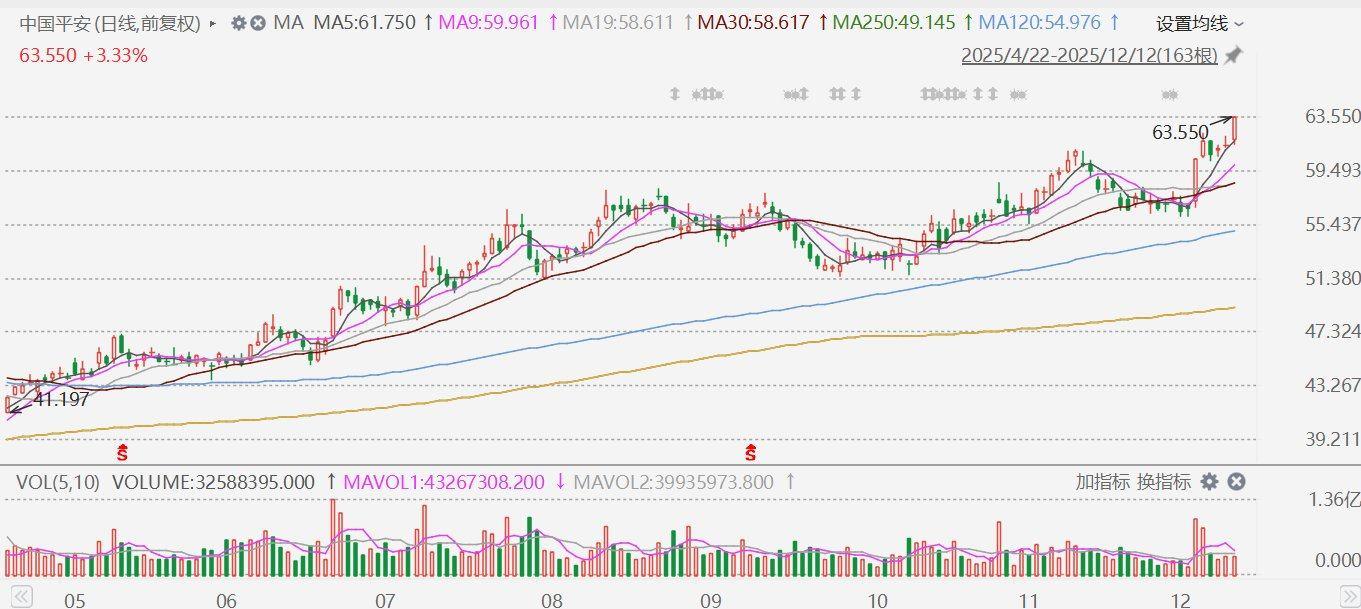
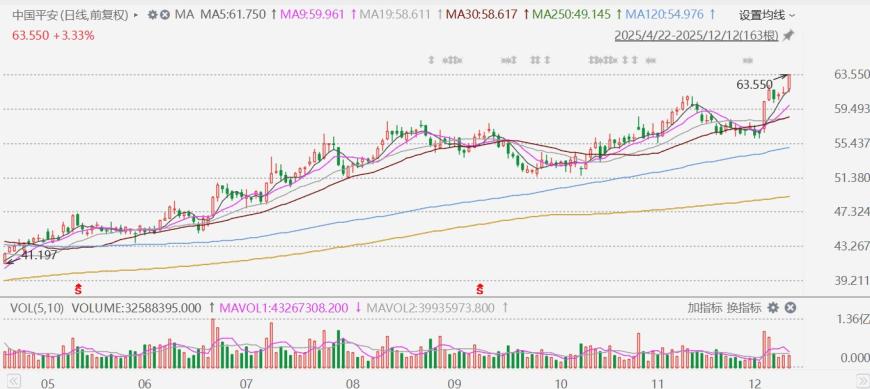
港股保险股涨幅扩大,中国太平、中国人寿、中国太保涨超4%,阳光保险、中国平安涨超3%!中国平安股价再创2021年6月以来新高
Ge Long Hui· 2025-12-12 05:51
Group 1 - The core viewpoint of the article highlights a significant increase in the stock prices of Hong Kong insurance companies, with notable gains for China Taiping, China Life, and China Pacific, all rising over 4% [1] - China Ping An's stock price has reached a new high since June 2021, indicating strong market performance [1] - The overall trend shows a positive sentiment in the insurance sector, as several companies are experiencing substantial stock price increases [1]


内险股午后全线拉升 保险投资股票风险因子调降 险企资本运用效率有望提升
Zhi Tong Cai Jing· 2025-12-12 05:47
Core Viewpoint - The insurance sector is experiencing a significant rally, driven by regulatory changes that lower investment risk factors for insurance companies, enhancing capital efficiency and supporting long-term value investment [1] Group 1: Stock Performance - As of the report, major insurance stocks have seen substantial gains: China Life (601628) up 4.4% to HKD 28, China Pacific Insurance (601601) up 4.09% to HKD 34.08, China Ping An (601318) up 2.85% to HKD 63.25, and China Property & Casualty Insurance (02328) up 0.96% to HKD 16.9 [1] Group 2: Regulatory Impact - On December 5, the Financial Supervisory Commission lowered the risk factors for insurance companies investing in related stocks, which is expected to reduce capital occupation pressure and enhance fund utilization efficiency [1] - The adjustment is anticipated to support the continuous guidance of insurance funds as "patient capital," further promoting technological innovation and empowering the real economy [1] Group 3: Industry Outlook - Donghai Securities noted that the insurance sector is currently in a historically undervalued range, suggesting a focus on large listed insurance companies with significant competitive advantages [1] - Guosheng Securities highlighted that the insurance industry will benefit from the trend of bank deposits moving, with diversified demands in pensions, healthcare, and savings expected to drive industry expansion [1] - Short-term progress in the insurance companies' New Year business is expected to boost liability performance in 2026, while the adjustment of product interest rates is likely to alleviate industry spread loss risks [1] - The "reporting and operation integration" is seen as a way to reduce internal competition and increase concentration among leading companies, indicating a positive outlook for the insurance sector's allocation value [1]
中国平安H涨超3%,再创2021年6月以来新高
Ge Long Hui· 2025-12-12 05:43
Core Viewpoint - Hong Kong insurance stocks experienced significant gains, with major companies seeing their stock prices rise, indicating a positive market sentiment towards the insurance sector [1]. Group 1: Stock Performance - China Taiping, China Life, and China Pacific Insurance all saw their stock prices increase by over 4% [1]. - Sunshine Insurance and Ping An of China recorded stock price increases of more than 3% [1]. - Ping An of China reached its highest stock price since June 2021 [1].
中国平安,把华夏幸福老板告了
Xin Lang Cai Jing· 2025-12-12 04:16
Core Viewpoint - China Ping An Life Insurance Co., Ltd. and Ping An Asset Management Co., Ltd. have filed a lawsuit against China Fortune Land Development Co., Ltd. and its chairman Wang Wenhua, seeking to confirm the validity of an arbitration agreement, with the court hearing scheduled for December 17, 2025 [1][4][11] Group 1: Legal Proceedings - The lawsuit is aimed at confirming the effectiveness of the arbitration agreement [4][11] - The case number is (2025) Hu 74 Min Te 127, and it will be heard at the Shanghai Financial Court [5][13] - Wang Wenhua is identified as the chairman of China Fortune Land Development [2] Group 2: Financial Distress and Restructuring - Recently, China Fortune Land Development announced it received a notice from creditor Longcheng Construction Engineering Co., Ltd. regarding its failure to repay debts and lack of repayment capability, leading to a request for restructuring [6][18] - The Langfang Intermediate People's Court has accepted the application for pre-restructuring of China Fortune Land Development [6][18] - The company's board member Wang Wei publicly stated he was unaware of the announcement regarding restructuring and has filed a complaint with regulatory authorities [14] Group 3: Financial Performance - In 2021, China Fortune Land Development faced nearly 90 billion yuan in debt defaults [18] - For the first three quarters of 2025, the company reported revenue of 3.882 billion yuan, a year-on-year decline of 72.09%, and a net profit attributable to shareholders of -9.829 billion yuan [18] Group 4: Shareholding Changes - Ping An has been reducing its stake in China Fortune Land Development, planning to sell up to 117.4 million shares, representing 3% of the total share capital, between September 1 and November 30, 2025 [8][17] - Ping An became the largest shareholder of China Fortune Land Development after the forced disposal of shares by the original controlling shareholder in September 2021 [8][18]
刘莉萍:53岁高才"上岸",在平安人寿把职业做成终生事业
Jin Rong Jie· 2025-12-12 03:51
Core Insights - The article highlights the journey of Liu Liping, who entered the insurance industry at the age of 49 and achieved significant success, demonstrating that it is never too late to start a new career [1][8] - Liu's transition from a stable financial accounting role to a wealth and health advisor showcases the importance of finding the right platform for career growth and professional development [4][8] Background and Experience - Prior to joining the insurance industry, Liu Liping worked as a financial accountant in a manufacturing hub, building a strong client base among factory owners who trusted her expertise [2] - She recognized the evolving financial challenges faced by her clients during economic transitions and saw the potential of insurance products to provide comprehensive solutions for wealth management and legacy planning [2] Key Opportunities - Liu's decision to join Ping An Life was influenced by the company's "High Talent Program," which offered income security and professional development opportunities, addressing common concerns of transitioning professionals [4] - The scale and resources of Ping An Life provided Liu with renewed confidence in her career, allowing her to envision a long-term commitment to the insurance profession [4] Continuous Learning and Development - Liu emphasizes the importance of continuous learning, especially as one ages, and credits Ping An Life's comprehensive training mechanisms for her professional growth [5][6] - The "Zhi Niao" platform offered by Ping An Life allows for flexible, on-the-go learning, enabling agents to stay updated and engage more effectively with clients [6] Service Enhancement and Career Longevity - Since joining Ping An Life, Liu has been able to provide more comprehensive and systematic solutions to her clients, integrating various resources to address their wealth planning and quality of life needs [7] - The company’s ecosystem includes family offices, trust tools, and healthcare services, facilitating a holistic approach to client needs from wealth management to life quality [7] Conclusion - Liu Liping's experience illustrates that age is not a barrier to success in the insurance industry; rather, the right platform and mindset can redefine one's career path [8] - The article encourages professionals to seize opportunities within established companies to build a sustainable and rewarding career in insurance [8]