
PING AN OF CHINA(02318)

Search documents
大摩闭门会:机器人、金融、保险行业更新行业更新
2025-12-11 02:16
Summary of Key Points from the Conference Call Industry Overview - The conference covered updates on the robotics, finance, and insurance industries, with a focus on the global embodied intelligence market and its future outlook [1][3][30]. Robotics Industry Insights - A comprehensive report on embodied intelligence predicts the market will reach $25 trillion by 2050, up from $100 billion in 2025, indicating a growth of 250 times over 25 years [7]. - The humanoid robotics market is expected to reach $7.5 trillion by 2050, with autonomous vehicles projected at $5.6 trillion, and service robots at $5 trillion [7]. - Key components in the robotics sector are forecasted to see significant growth: cameras (95x), radar (300x), lidar (300x), motors (260x), and batteries (1400x) over the next 25 years [9][10]. Humanoid Robots - The average price of humanoid robots in the U.S. is projected to decrease from $180,000 to $75,000 by 2050, while demand is expected to grow cautiously, with an estimated 5,000 units in 2024 [11][12]. - In China, the humanoid robot market is expected to double from 7,000 units in 2023 to 15,000 units in 2024, with a long-term outlook of 30-40% of global demand by 2050 [14][15]. Market Adoption and Challenges - A survey of 86 executives indicated a high willingness to adopt humanoid robots, with 62% expecting to test them by 2027. However, concerns about product maturity and cost sensitivity were noted [16][17]. - 92% of respondents believe humanoid robots should not exceed 200,000 RMB in price, with 50% preferring a price below 100,000 RMB [17]. Automotive Industry Insights - The report predicts that the number of L4/L5 autonomous vehicles will increase from 3 million in 2030 to nearly 700 million by 2050, with China leading in growth [20][21]. - By 2050, China is expected to have over 165 million L4/L5 autonomous vehicles, accounting for about 25% of the global market [22]. Challenges and Opportunities - The focus is shifting from whether autonomous vehicles can operate to whether they can be profitable, with significant attention on safety, cost, and operational efficiency [23][24]. - The development of electric vertical takeoff and landing (eVTOL) aircraft is anticipated to create a new low-altitude economy, with China expected to lead in commercial operations by 2030 [26][27]. Insurance Industry Insights - The report on Ping An Insurance highlights three major market opportunities: continuous growth in household wealth, increasing demand for healthcare and retirement services, and the integration of insurance products with financial services [31][32]. - Ping An's stock has seen a 60-70% increase, outperforming the market, despite concerns about real estate exposure and the need for risk management [34][35]. Financial Performance and Outlook - The insurance sector is expected to benefit from a recovering real estate market, with Ping An's asset management division projected to return to profitability by 2027 [38][39]. - The company is also leveraging AI applications and technology to enhance its service offerings, maintaining a strong capital position [40][41]. Fund Management Industry Insights - The public fund industry in China has seen AUM exceed 38 trillion RMB, with a projected growth rate of 10-11% in the coming years [48][55]. - The industry is undergoing a transformation towards healthier fee structures, with a significant reduction in reliance on sales-driven models [53][54]. Future Growth Drivers - The growth of household financial assets and the increasing demand for diversified investment options are expected to drive the public fund market [56][57]. - The report suggests that the public fund sector will continue to gain market share in the non-deposit portion of household financial assets, with a rebound in equity allocations anticipated [59][60]. Conclusion - The conference provided a comprehensive overview of the robotics, automotive, insurance, and fund management industries, highlighting significant growth opportunities and challenges ahead. The insights gathered will be crucial for investors looking to navigate these evolving markets.

大摩闭门会:机器人、金融、保险行业更新行业更新 _AI 纪要
2025-12-11 02:16
Summary of Key Points from Conference Call Records Industry Overview Embodied Intelligence Market - The global embodied intelligence market is projected to reach $25 trillion by 2050, growing from approximately $100 billion in 2025, indicating a 250-fold increase over 25 years [3][1] - Key segments include humanoid robots ($7.5 trillion), autonomous vehicles ($5.6 trillion), service robots ($5 trillion), aircraft and drones ($4.7 trillion), and non-humanoid robots ($2.2 trillion) [3][1] Humanoid Robots in China - The humanoid robot market in China is expected to double by 2026, with potential sales reaching 50 million units by 2050, accounting for 30%-40% of global demand [1][7] - Current testing willingness among enterprises is high, with 62% expected to test humanoid robots by 2027 [1][8] - Price sensitivity is significant, with most enterprises preferring prices below 200,000 RMB, and 50% wanting prices under 100,000 RMB [1][9] Autonomous Driving - China is leading in the autonomous driving sector, with L4/L5 vehicles expected to exceed 165 million units by 2050, representing about 25% of the global market [1][10] - The focus in 2026 will shift to the profitability of autonomous ride-hailing services [1][11] Low-altitude Economy - China is making strides in the eVTOL (electric Vertical Take-Off and Landing) sector, expected to be the first country to achieve large-scale commercial operations by 2030, supplying over 60% of global demand [1][12] Company Insights Ping An Insurance - Ping An is benefiting from the growth in resident wealth, increasing demand for retirement and healthcare services, with a projected compound annual growth rate (CAGR) of 8% from 2024 to 2030 [4][15] - The asset management sector is gradually recovering from losses, with expectations of profitability by 2027 [4][15] - The company is reducing real estate exposure and optimizing asset structure to mitigate risks associated with declining property prices [4][15] Public Fund Industry - The public fund industry is facing transformation pressures, with expected management scale growth of 10%-11% in the coming years, driven by increasing resident financial assets [4][21] - The industry has seen a decline in income by 28% despite a 28% increase in management scale from 2021 to 2024 [4][19] - The sales channel income is shifting from being heavily reliant on sales volume to being more performance-based [4][20] Key Components and Growth Projections Core Components for Embodied Intelligence - Significant growth is anticipated in key components: visual cameras (95x), radar and lidar (300x), motors (260x), bearings (200x), and batteries (1,400x) [5][1] Market Dynamics - The public fund industry is expected to see a rebound in equity allocation, with a projected recovery in the proportion of actively managed equity products [4][26] - The shift towards mixed products is anticipated, with a focus on fixed income to meet the demand for stable returns among domestic investors [4][28] Conclusion - The embodied intelligence and autonomous driving sectors present substantial growth opportunities, particularly in China, while Ping An Insurance is well-positioned to capitalize on demographic trends and market demands. The public fund industry is undergoing significant changes, with a focus on performance-based income and a shift in investment strategies.
智通港股沽空统计|12月11日
智通财经网· 2025-12-11 00:26
Group 1 - The top short-selling ratios are led by China Resources Beer (80291), AIA Insurance (81299), and Anta Sports (82020), all at 100.00% [1][2] - The highest short-selling amounts are recorded for Alibaba (09988) at 1.485 billion, Tencent Holdings (00700) at 1.163 billion, and China Construction Bank (00939) at 921 million [1][2] - The highest deviation values are for China Resources Beer (80291) at 37.08%, AIA Insurance (81299) at 34.84%, and Spring Health (01858) at 34.29% [1][2] Group 2 - The top ten short-selling ratios include JD Health (86618) at 100.00%, SenseTime (80020) at 89.60%, and Lenovo Group (80992) at 87.78% [2] - The top ten short-selling amounts also feature Xiaomi Group (01810) at 914 million and Pop Mart (09992) at 826 million [2] - The top ten short-selling deviation values include Baidu Group (89888) at 32.64% and Yum China (09987) at 29.58% [2]





中国平安起诉华夏控股 业内:历史遗留问题影响不大
Nan Fang Du Shi Bao· 2025-12-10 13:44
Core Viewpoint - Ping An Life and Ping An Asset have filed a lawsuit against China Fortune Land Development Co., Ltd. and an individual named Wang, seeking to confirm the validity of an arbitration agreement, with the hearing scheduled for December 17 at the Shanghai Financial Court [2] Group 1: Legal Actions and Shareholding Changes - Ping An Asset acquired a 19.7% stake in China Fortune for 13.77 billion yuan in July 2018, becoming the second-largest shareholder, marking the beginning of a capital partnership [2] - Following a debt crisis in February 2021, Ping An gradually became the largest shareholder as the first major shareholder's stake decreased [2] - As of the end of Q3 2025, China Fortune reported a total revenue of 3.882 billion yuan, a year-on-year decline of 72.09%, and a net loss attributable to shareholders of 9.829 billion yuan, compared to a loss of 2.241 billion yuan in the same period last year [2] Group 2: Share Reduction and Financial Strategies - In August 2023, Ping An announced plans to reduce its holdings in China Fortune by up to 117.4 million shares, representing 3% of the total share capital, through block trades or centralized bidding from September 1 to November 30, 2025 [3] - Ping An's representatives voted against two proposals in China Fortune's semi-annual report, citing concerns over the prudence of debt handling, which has raised calls for fair debt restructuring [3] - The core conflict between Ping An and China Fortune revolves around the compliance of pre-restructuring procedures and differences in debt resolution strategies, impacting debt restructuring progress and shareholder reduction dynamics [3] Group 3: Market Outlook and Risk Management - Morgan Stanley's recent report suggests that historical issues are unlikely to burden Ping An in the short term, as the group has been actively de-risking its real estate exposure across all subsidiaries, including insurance, banking, trust, and real estate [3]




中国平安旗下“平安管家”提供的居养服务已覆盖全国100个城市
Zhong Zheng Wang· 2025-12-10 12:13
Core Viewpoint - China Ping An's home care service system has been upgraded to better meet the core needs of the elderly population, focusing on health care, safety, and personalized care [1] Group 1: Service Plans - The new service plans include "someone to manage illness, someone to assist with safety, and someone to provide care" [1] - Services are delivered through a model consisting of one doctor manager, multiple specialist teams, and case management teams, offering longevity management, chronic disease management, and medical treatment services [1] Group 2: Technological Integration - The service incorporates smart guardianship and age-friendly modifications to create comprehensive age-friendly solutions [1] - The "smart guardianship" alarm response rate has reached 100% [1] Group 3: Coverage and Expansion - As of now, the "Ping An Manager" home care services have expanded to cover 100 cities nationwide, with 25 cities added in 2025 alone [1] - Nearly 240,000 clients have qualified for home care services [1]
平安居家养老管家服务获全国首个“五星级评价”
Zheng Quan Ri Bao Wang· 2025-12-10 11:42
Core Viewpoint - Ping An's home elderly care service has become the first in China to receive a five-star rating from the China Quality Certification Center (CQC), setting a benchmark for high-quality development in the home elderly care industry [1][2]. Group 1: Certification and Evaluation - The evaluation was based on the "Home Elderly Care Service Evaluation Technical Specification," covering four core dimensions: basic support capability, service process standardization, professional service capability, and user satisfaction [1]. - Ping An's home elderly care service achieved a comprehensive score of 95 out of 100, marking it as the first service project in the country to receive this rating [1][2]. Group 2: Service Highlights - The CQC highlighted three key strengths of Ping An's service: 1. Outstanding resource coordination through a unified platform using smart speakers, enabling elderly users to access services via voice or phone [2]. 2. Strong professionalism of service personnel, with qualifications including emergency rescue certificates and extensive clinical experience [2]. 3. A comprehensive standard system developed in collaboration with industry partners, including multiple group standards for service processes [2]. Group 3: Service Coverage and Impact - As of early November, Ping An's home elderly care service has expanded to cover 100 cities in China, with nearly 240,000 clients qualifying for the service [3]. - The smart care system has served over 100,000 clients, achieving a 100% response rate for the "smart protection" alerts [3].
中国平安宣布马龙成为品牌大使
Qi Lu Wan Bao· 2025-12-10 11:24
Core Points - China Ping An has appointed renowned table tennis player Ma Long as its brand ambassador, aligning with the company's mission to promote health and a positive lifestyle [1][2] - The company has launched the eShengbao series of medical insurance products, which feature low premiums, high coverage limits, and flexible combinations to meet diverse customer needs [1][2] Product Features - The eShengbao series offers a premium of only 410 yuan for a 30-year-old male with basic medical insurance, with a total coverage limit of up to 8 million yuan [1][4] - The insurance covers both public and private hospitals and includes specific drugs and advanced therapies in the eShengbao Plus version [1][4] - The "base + optional" combination model allows customers to tailor their insurance plans according to their needs and financial capabilities [1][5] Service Offerings - The eShengbao series is complemented by the "Anyouyi" health service plan, which provides comprehensive medical assistance, including pre-hospital, in-hospital, and post-hospital services [2][7] - The collaboration with Ma Long signifies an upgrade in health protection services, merging insurance expertise with sports spirit to strengthen health protection for families [2][8]
助你当下省钱、未来省心
Qi Lu Wan Bao· 2025-12-10 11:24
为应对人口老龄化带来的挑战、持续丰富养老保险产品供给、充分满足人民群众的养老保障需求,平安 人寿响应政策推出个人养老金保险产品——盛世优享(2026)养老年金保险(分红型)(以下简称"盛世优享 红26"),该产品具备多种交期可选,按约领取、更添分红惊喜,开通个人养老金账户并缴费后,还可享受递延 纳税优惠政策,为客户提供"当下省钱、未来省心"的养老保障解决方案。 中国社会老龄化程度的持续加深和长寿时代的到来,不仅带来了养老需求的显著扩大,也对养老金支付体 系产生了深远影响。从"全民参保"到"个人养老金",标志着我国养老保障体系正迈向更加多元、市场化 的发展阶段。 个人养老金是政府政策支持、个人自愿参加、市场化运营的实现养老保险补充功能的制度,面向城镇职 工基本养老保险或者城乡居民基本养老保险的参保人,实行个人账户制,交费完全由参加人本人承担,实行 完全积累。账户资金可用于购买经过金融监管机构严格筛选、运作规范、侧重长期保值的金融产品,实 现相应收益,为今后的养老多一重保障,这也是养老保险体系"第三支柱"的意义所在。该制度自2022年推 出以来广受好评,人力资源和社会保障部的通报数据显示,截至2024年11月底, ...
中国平安起诉华夏幸福
Xin Lang Cai Jing· 2025-12-10 11:07
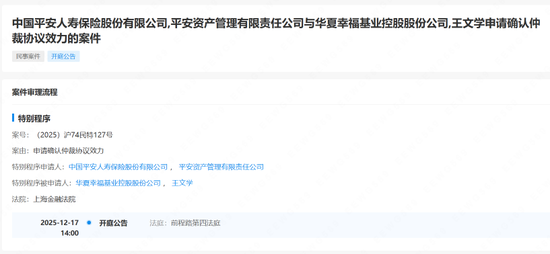
"中国平安与华夏幸福的纠纷终于从线下口水战打到了法庭上,平安人寿及平安资管起诉华夏幸福及其 董事长王文学。此前华夏幸福曾公布被债权人申请重整消息激怒了中国平安。" 来源:险联社 减持完成后,平安人寿及平安资管合计持有华夏幸福24.99%股权,仍为华夏幸福第一大股东。 | 减持计划首次披露日期 | 2025年8月9日 | | --- | --- | | 减持数量 | 7.815.487股 | | 减持期间 | 2025年10月20日~2025年10月21日 | | 减持方式及对应减持数量 | 集中竞价减持,7,815,487 股 | | 减持价格区间 | 2.09~2.12元/股 | | 减持总金额 | 16,475,681.01元 | | 减持完成情况 | 未完成:109.596,123 股 | | 减持比例 | 0. 20% | | 原计划减持比例 | 不超过:3.00% | | 当前持股数量 | 977,914,066股 | | 当前持股比例 | 24. 99% | 企查查信息显示,中国平安人寿保险股份有限公司及平安资产管理有限责任公司起诉华夏幸福基业控股 股份公司及其董事长王文学。 根据开庭公告详情,本 ...
“双精准”革新:科技驱动下的创新实践
Qi Lu Wan Bao· 2025-12-10 11:04
Core Viewpoint - Ping An Property & Casualty Insurance Company of Qingdao has launched a digital map-based agricultural insurance model called "Double Precision," marking a significant step towards high-quality development in agricultural insurance [1][2]. Group 1: Innovation in Agricultural Insurance - The "Double Precision" model addresses traditional agricultural insurance challenges such as inaccurate data, vague loss assessment, and unfair claims by utilizing a high-precision digital map for comprehensive digital mapping of "land, rights, assets, and people" [1]. - The model transitions from "experience-driven" to "data-driven," employing satellite remote sensing, AI recognition, and meteorological big data to create an integrated monitoring system for dynamic tracking of crop growth throughout its lifecycle [1][2]. - The system provides early warnings before disasters and combines online remote loss estimation with offline inspections post-disaster to ensure objective and fair loss assessments, enhancing claims efficiency and protecting the rights of insured farmers [1]. Group 2: Accessibility and Fairness in Services - The "Ainongbao" app allows farmers to self-insure, verify standards, report claims, and check claim statuses, ensuring equal recording and verification of all land information, thus breaking down service barriers that favored larger agricultural operators [2]. - The accurate ecological data generated supports the development of green insurance products, contributing to the advancement of "green finance" and promoting sustainable agricultural transformation [2]. Group 3: Recognition and Future Plans - The innovative practices of Ping An Property & Casualty Insurance in Qingdao have received high praise from authoritative bodies, including the Ministry of Agriculture and Rural Affairs and experts from Central University of Finance and Economics, for their replicable and promotable value [2]. - The company aims to deepen the "insurance + technology + service" model and solidify its leading position in the industry, providing robust support for rural revitalization and contributing to financial services for agriculture [3].