PICC P&C(02328)

Search documents
开年“瘦身”步履不停 险企渠道转型聚焦精细化服务
Jin Rong Shi Bao· 2026-01-14 02:37
Core Viewpoint - The insurance industry is undergoing a significant transformation characterized by the continuous withdrawal of branch offices, reflecting a shift from extensive expansion to a focus on value and efficiency [5][6]. Group 1: Branch Withdrawals - In early 2026, multiple insurance companies, including China Life and Sunshine Insurance, have received approval to withdraw branch offices, continuing a trend observed in recent years [1]. - Over the past six years, more than 13,000 branch offices have been closed, with the number of withdrawals increasing from 971 in 2020 to over 3,100 in 2025, marking a new high [2]. - The majority of the withdrawn branches are located in third and fourth-tier cities, with over 70% of the closures in 2025 being marketing service departments [2][3]. Group 2: Factors Driving Closures - The closures are driven by three main factors: regulatory policies, changing market conditions, and technological advancements [4]. - Regulatory bodies have pushed for the elimination of "empty" and "inefficient" branches, particularly following the implementation of the "reporting and operation integration" policy [4]. - The competitive insurance market and rising operational costs have made it essential for companies to optimize branch structures and eliminate low-efficiency outlets [4]. Group 3: Industry Transformation - The ongoing withdrawal of branch offices is seen as a necessary process for the industry to abandon extensive expansion and reconstruct channel value [5]. - The industry is at a critical juncture, focusing on high-quality transformation while addressing challenges such as customer service continuity and talent retention [7]. - Companies are shifting from a traditional sales model to a service-oriented approach, integrating insurance products with health management and other value-added services to enhance customer loyalty [8]. Group 4: Future Outlook - The future of insurance branch offices will not be a complete replacement by online channels but rather a transformation of their functions to enhance customer experience and provide specialized services [8]. - The new channel structure will consist of comprehensive service points in major cities, grid-based service units in lower-tier markets, and a blend of online and offline services [8].


港股内险股表现强势 中国平安涨2.85%
Mei Ri Jing Ji Xin Wen· 2026-01-13 02:36
Core Viewpoint - The Hong Kong insurance stocks are showing strong performance, with notable increases in share prices for major companies in the sector [1] Company Performance - China Ping An (02318.HK) increased by 2.85%, reaching HKD 70.45 [1] - China Pacific Insurance (02328.HK) rose by 2.52%, reaching HKD 16.66 [1] - China Life Insurance (02628.HK) saw a rise of 2.32%, with shares priced at HKD 32.62 [1] - New China Life Insurance (01336.HK) increased by 2.14%, with shares at HKD 62.15 [1]

内险股表现强势 2026年开门红数据超预期 到期存款有望向保险配置转移
Zhi Tong Cai Jing· 2026-01-13 02:33
Core Viewpoint - The strong performance of insurance stocks is driven by better-than-expected data for the 2026 New Year sales, with leading insurance companies showing significant growth in new policies [1] Group 1: Stock Performance - China Ping An (601318) rose by 2.85% to HKD 70.45 [1] - China Pacific Insurance (02328) increased by 2.52% to HKD 16.66 [1] - China Life (601628) saw a rise of 2.32% to HKD 32.62 [1] - New China Life (601336) grew by 2.14% to HKD 62.15 [1] Group 2: Market Drivers - Huaxi Securities reported that the strong performance in new policy sales during the 2026 New Year period, with some leading insurers showing over 70% year-on-year growth in new policies, is a direct catalyst for the current rise in insurance stocks [1] - The low base from the previous year contributes to the strong momentum observed in the leading insurance companies this year [1] Group 3: Investment Trends - Insurance products are expected to attract part of the funds from savings due to their relative yield advantages [1] - Concerns regarding interest margin losses have significantly eased, leading to a gradual elimination of valuation pressures on the sector [1] Group 4: Future Projections - Guojin Securities anticipates that the shift of bank insurance will drive high growth in new policies and new business value (NBV) in 2026 [1] - Since 2020, residents have increased their precautionary savings, with new deposits consistently exceeding CNY 10 trillion, particularly in 2021, 2023, and 2024, with new deposits of CNY 9.9 trillion, CNY 16.67 trillion, and CNY 14.26 trillion respectively [1] - A significant portion of these high-interest deposits is expected to mature in 2026, with a potential shift of funds towards insurance products amid declining deposit rates and a shortage of medium to long-term deposit supply [1]


港股异动 | 内险股表现强势 2026年开门红数据超预期 到期存款有望向保险配置转移
智通财经网· 2026-01-13 02:31
Core Viewpoint - The strong performance of Chinese insurance stocks is driven by better-than-expected data for the 2026 New Year sales, with leading insurers showing significant growth in new policies [1] Group 1: Stock Performance - China Ping An (02318) increased by 2.85%, reaching HKD 70.45 [1] - China Pacific Insurance (02328) rose by 2.52%, reaching HKD 16.66 [1] - China Life Insurance (02628) gained 2.32%, reaching HKD 32.62 [1] - New China Life Insurance (01336) increased by 2.14%, reaching HKD 62.15 [1] Group 2: Market Drivers - Huaxi Securities reported that leading insurers saw a more than 70% year-on-year increase in new policy sales over the first three days of 2026, supported by a low base from the previous year [1] - The insurance sector is expected to attract part of the funds from savings due to the relative yield advantage of insurance products [1] - Concerns over interest margin losses have eased, gradually eliminating valuation pressures on the sector [1] Group 3: Future Growth Potential - Guojin Securities indicated that the shift of bank insurance is expected to drive high growth in new policies and new business value (NBV) in 2026 [1] - Since 2020, household savings have increased significantly, with new deposits consistently exceeding CNY 10 trillion, including CNY 9.9 trillion in 2021, CNY 16.67 trillion in 2023, and CNY 14.26 trillion in 2024 [1] - A significant portion of these early high-interest deposits is expected to mature in 2026, with two-thirds of 2/3/5-year deposits likely to shift towards insurance investments amid declining deposit rates and a shortage of medium to long-term deposit supply [1]
人保财险:热血奉献践初心 金融护航守民生
Jin Rong Jie Zi Xun· 2026-01-13 01:31
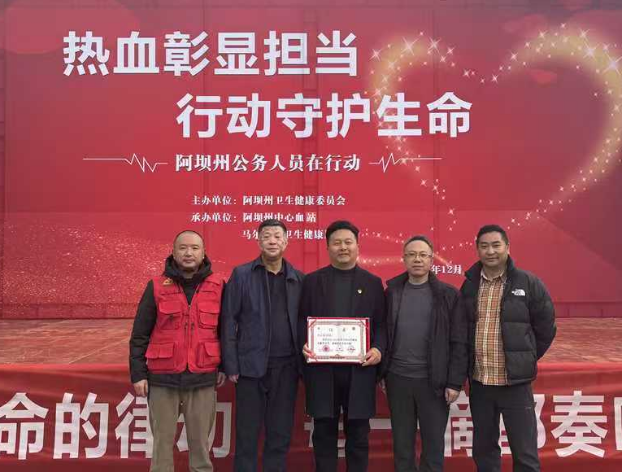
Core Viewpoint - The article emphasizes the commitment of China People's Insurance Company (PICC) to volunteer service and social responsibility, aligning with the directives from the 20th Central Committee and the 2025 Central Economic Work Conference to enhance public welfare and improve people's livelihoods [1][2]. Group 1: Volunteer Spirit and Community Engagement - PICC volunteers embody the spirit of "dedication, friendship, mutual assistance, and progress," actively delivering warmth and care to various community needs [1]. - Retired employee Hou Zhirong from PICC Sichuan Aba branch has dedicated 18 years to blood donation, saving over 20 lives, and received the "Blood Donation Contribution Gold Award" for his efforts [2][4]. - Young volunteer Xiong Dong from PICC Guizhou donated hematopoietic stem cells, successfully matching with a patient, showcasing the impact of volunteerism in life-saving initiatives [4][6]. Group 2: Financial Safety and Public Awareness - PICC volunteers play a crucial role in enhancing public safety and financial security, particularly targeting vulnerable groups like the elderly to prevent financial fraud [6][7]. - The "Qing Qibing" volunteer service team in Shenzhen effectively engages the community through interactive games to educate residents about fraud prevention, reaching over 30,000 individuals [7][9]. - In Qingdao, the "Financial Consumer Protection Volunteer Service Team" conducts workshops for elderly residents, teaching them to identify scams and ensuring financial literacy tailored to their understanding [9][10]. Group 3: Commitment to Social Responsibility - Over the past three years, nearly 60,000 PICC employees have participated in volunteer services, benefiting over 1.6 million people, demonstrating the company's dedication to fulfilling its social responsibilities [12]. - PICC aims to integrate volunteer services with the improvement of people's livelihoods, establishing a volunteer service system that meets the needs of the new era and contributes to China's modernization efforts [12].

报行合一”重塑财险半壁江山 五千亿非车险告别“野蛮生长
2 1 Shi Ji Jing Ji Bao Dao· 2026-01-13 00:52
Core Viewpoint - The rapid growth of China's non-auto insurance sector, with an average annual growth rate exceeding 10% over the past decade, has led to high costs and irrational competition, prompting regulatory measures to reshape the market dynamics towards risk pricing and service capability [2][3][12]. Group 1: Industry Growth and Challenges - Non-auto insurance premiums accounted for over 50% of total premiums, with a significant increase in the average annual growth rate of 14.4% from 2014 to 2024, compared to 5.2% for auto insurance [3][12]. - Major insurance companies, including PICC, Ping An, and Taiping, have reported that their average non-auto insurance comprehensive cost ratio has remained above 100% since 2019, indicating underwriting losses primarily offset by auto insurance profits [4][12]. - The industry faces challenges such as high expense levels, inadequate premium sufficiency, persistent underwriting losses, and high accounts receivable [2][3]. Group 2: Regulatory Measures - The China Banking and Insurance Regulatory Commission (CBIRC) has issued several notifications and guidelines to address irrational competition and high costs in the non-auto insurance sector, including the recent "Questions and Answers on Comprehensive Governance of Non-Auto Insurance" [2][4][12]. - The new regulations emphasize the principle of "reporting and operating in unison," requiring insurance companies to strictly adhere to approved insurance terms and rates, thereby enhancing market behavior regulation [4][11]. - The regulations aim to reduce the emphasis on premium scale and growth, shifting the focus towards compliance, quality, and consumer rights protection [6][12]. Group 3: Company Responses - Leading insurers like PICC, Ping An, and Taiping have proactively initiated product term filings and cost governance in response to regulatory changes, indicating a strong commitment to compliance [6][7]. - Companies are restructuring their business models to transition from cost competition to risk pricing and service capability, with a focus on enhancing internal management and product innovation [7][8]. - Smaller insurers are encouraged to focus on niche markets and specialized products to differentiate themselves and build competitive advantages [15][16]. Group 4: Market Dynamics and Future Outlook - The implementation of the "reporting and operating in unison" policy is expected to compress some business operations in the short term but will ultimately lead to a more sustainable competitive environment based on risk identification and service quality [10][12]. - The regulatory framework aims to clarify responsibilities and streamline processes, pushing the market towards a more structured and compliant operational model [10][11]. - The anticipated market concentration will favor larger, well-managed companies, while smaller firms may need to adapt by focusing on specialized areas to survive [15][16].



“报行合一”重塑财险半壁江山 五千亿非车险告别“野蛮生长”
2 1 Shi Ji Jing Ji Bao Dao· 2026-01-12 11:57
Core Insights - The non-auto insurance sector in China has experienced an average annual growth rate exceeding 10% over the past decade, with premiums now accounting for over 50% of total insurance premiums, but this growth has been driven by high costs rather than sustainable practices [1][2] - The National Financial Regulatory Administration has issued several guidelines to address irrational competition and high costs in the non-auto insurance sector, aiming to shift the focus from price wars to risk pricing and service capabilities [1][4][9] Industry Growth and Trends - Non-auto insurance premiums have grown at an average annual rate of 14.4% from 2014 to 2024, significantly outpacing the 5.2% growth rate of auto insurance [2] - By mid-2025, the total insurance premium income in the property insurance industry is projected to reach 965.4 billion yuan, with non-auto insurance contributing 514.9 billion yuan, surpassing 50% of the total [2] Regulatory Changes - The recent regulatory measures include the "reporting and operation unity" policy, which mandates that insurance companies adhere strictly to approved insurance terms and rates, aiming to eliminate high fees that do not correspond to services provided [3][4][6] - The new regulations are expected to compress some business operations in the short term but will ultimately reshape the competitive landscape by emphasizing risk assessment and service quality [9][10] Company Responses - Major insurance companies like PICC, Ping An, and Taikang have begun to implement changes in response to the new regulations, focusing on compliance and optimizing their cost structures [5][7][8] - Companies are restructuring their business models to transition from fee-based competition to risk pricing and service capability enhancement [7][10] Market Dynamics - The regulatory changes are anticipated to accelerate industry differentiation, with larger firms solidifying their competitive advantages while smaller firms may struggle to adapt [15][16] - The new policies may lead to a concentration of market power among larger firms, but they also provide a buffer for smaller companies to transition and innovate within niche markets [16][17] Future Outlook - The shift towards a more regulated and quality-focused market is expected to enhance the sustainability of the non-auto insurance sector, fostering a competitive environment based on risk management and service excellence [10][12] - Smaller companies are encouraged to focus on specialized markets and innovative products to establish competitive advantages, rather than competing directly with larger firms [17][18]
行业研究|行业周报|投资银行业与经纪业:政策持续净化资本市场生态,建议重视板块业绩高增长预期-20260112
Changjiang Securities· 2026-01-12 08:12
Investment Rating - The report maintains a "Positive" investment rating for the non-bank financial sector [7] Core Insights - The non-bank sector has shown strong performance this week, with brokers experiencing increased trading activity while maintaining historical highs. The insurance sector is expected to see improved long-term ROE and valuation recovery, indicating a rising cost-effectiveness for overall allocation [2][4] - Recommendations include stable profit growth and dividend rates for Jiangsu Jinzu, high dividend yield for China Ping An, and companies with strong business models and market positions like China Pacific Insurance. Additional recommendations include New China Life, China Life, Hong Kong Stock Exchange, CITIC Securities, Dongfang Caifu, Tonghuashun, and Jiufang Zhitu Holdings based on performance elasticity and valuation levels [4] Market Performance - The non-bank financial index increased by 2.6% this week, with a year-to-date performance of 2.6%, ranking 21 out of 31 sectors. The average daily trading volume in the two markets reached 28,519.51 billion yuan, up 34.00% week-on-week, with a daily turnover rate of 2.77%, up 61.14 basis points [5][15] - The market has seen a recovery in trading activity, with the Shanghai Composite Index rising by 5.11% and the bond index declining by 0.23%. Long-term interest rates have increased, with the 10-year government bond yield rising by 3.09 basis points to 1.8782% [5][39] Insurance Sector Overview - In November 2025, the cumulative premium income reached 57,629 billion yuan, a year-on-year increase of 7.56%. Life insurance premiums increased by 9.06%, while property insurance premiums rose by 3.88% [19][20] - The total assets of insurance companies reached 40.65 trillion yuan, with life insurance companies holding 35.75 trillion yuan, reflecting a stable asset allocation with a slight decrease in deposit proportions and an increase in bond and equity fund allocations [25][26] Brokerage and Investment Business - The brokerage business has seen a recovery in trading volumes, with a two-market average daily trading volume of 28,519.51 billion yuan, indicating a gradual recovery in profitability as commission rates stabilize [40] - The investment business has also rebounded, with the Shanghai Composite Index increasing by 2.79% and the ChiNext Index by 3.89%. The proportion of equity investments in brokerage assets is approximately 10%-30%, while bond investments account for 70%-90% [44] Financing Activities - In December 2025, equity financing reached 663.12 billion yuan, a 30.9% increase, while bond financing totaled 7.34 trillion yuan, up 4.0%. This indicates a positive trend in financing activities, with expectations for increased stock underwriting in the future [51] - The asset management sector saw a rebound in new issuance, with 61.14 billion units issued in December, a 39.0% increase compared to previous months [53]
人保财险海东市分公司违规被罚 内控制度执行不到位
Zhong Guo Jing Ji Wang· 2026-01-12 02:41
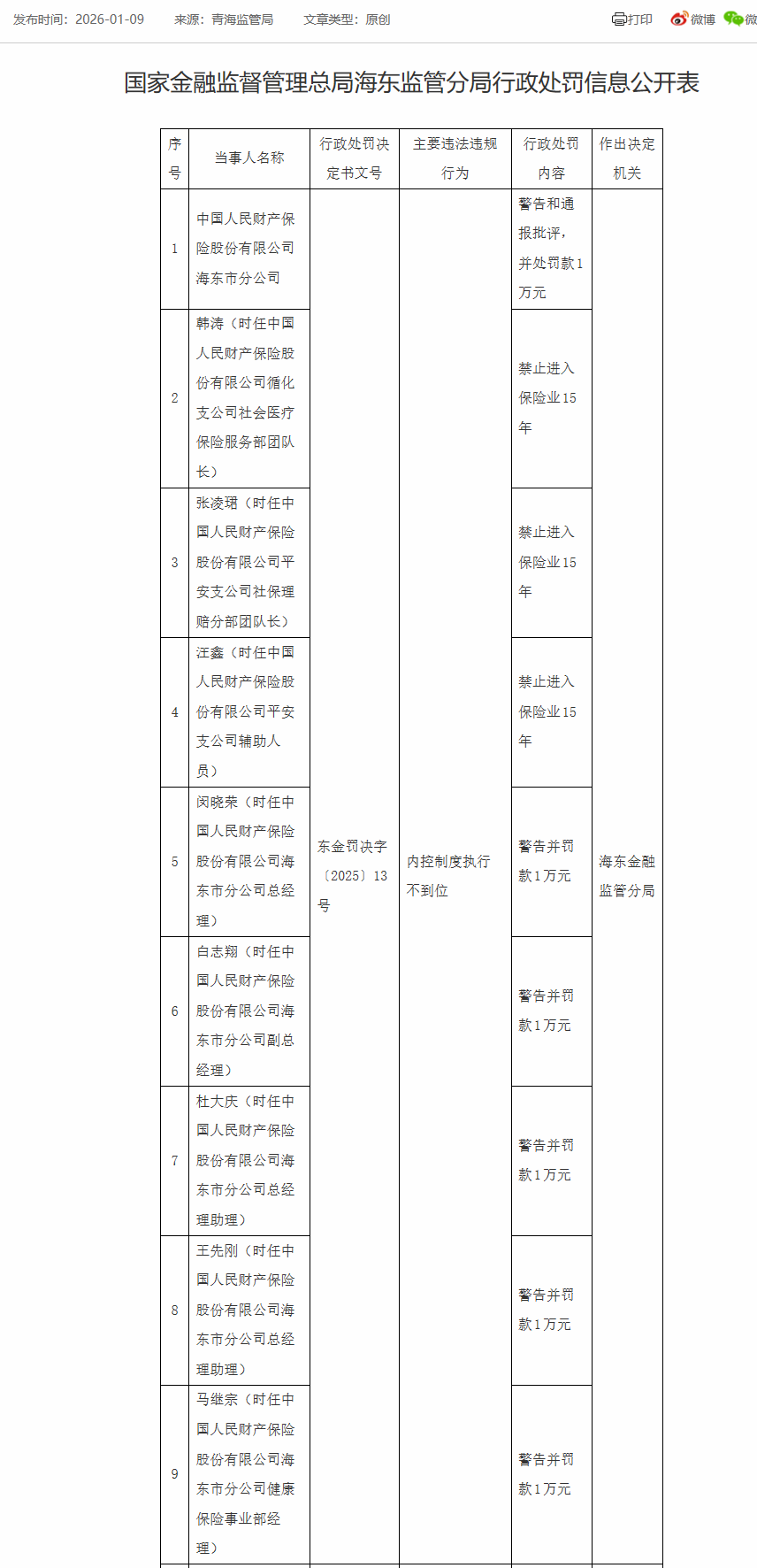
Core Viewpoint - The China People's Property Insurance Company, Haidong Branch, faced administrative penalties due to inadequate execution of internal control systems, resulting in a warning and a fine of 10,000 yuan [1][2]. Summary by Relevant Categories Administrative Penalties - The Haidong Financial Regulatory Bureau issued a warning and a fine of 10,000 yuan to the China People's Property Insurance Company, Haidong Branch, for failing to properly implement internal control systems [1][2]. Individual Sanctions - Han Tao, former team leader of the social medical insurance service department, was banned from the insurance industry for 15 years [1][2]. - Zhang Lingjun, former team leader of the social security claims department, was also banned from the insurance industry for 15 years [1][2]. - Wang Xin, former auxiliary staff member, received a 15-year ban from the insurance industry [1][2]. - Min Xiaorong, former general manager of the Haidong Branch, received a warning and a fine of 10,000 yuan [1][2]. - Bai Zhixiang, former deputy general manager, received a warning and a fine of 10,000 yuan [1][2]. - Du Daqing, former assistant to the general manager, received a warning and a fine of 10,000 yuan [1][2]. - Wang Xiangang, former assistant to the general manager, received a warning and a fine of 10,000 yuan [1][2]. - Ma Jizong, former manager of the health insurance department, received a warning and a fine of 10,000 yuan [1][2].
2025年保险业两千余张罚单罚超4亿,百万级“大单”频出,49人遭终身禁业
Xin Lang Cai Jing· 2026-01-12 01:40
Core Viewpoint - The insurance industry in 2025 continues to experience strict regulation, with approximately 2300 fines issued totaling around 407 million yuan, primarily for violations such as providing benefits outside of contracts, false financial data, and fabricating business to extract funds [2][3][16]. Regulatory Actions - In 2025, the regulatory body issued about 2300 fines affecting approximately 1381 insurance companies and branches, with a total penalty amount of about 407 million yuan [3][17]. - The number of fines decreased compared to 2024, but the total amount of fines significantly increased [3][17]. - The distribution of fines shows that property insurance companies received 1018 fines (43.9%), while life insurance companies received 968 fines (41.74%) [3][17]. Penalty Details - The first quarter saw 600 fines totaling 108 million yuan, the second quarter had 453 fines totaling 62 million yuan, the third quarter had 632 fines totaling 134 million yuan, and the fourth quarter had 634 fines totaling 103 million yuan [4][18]. - Major companies like People's Insurance Company and Taikang Online received fines exceeding 10 million yuan, while others like Dadi Insurance and Beida Fangzheng Life received fines over 2 million yuan [6][20]. Individual Accountability - The "double penalty system" has become the norm, with 2268 warnings and 2239 fines issued to individuals, totaling approximately 83.76 million yuan in penalties [9][22]. - A total of 119 individuals were banned from the insurance industry, with 49 receiving lifetime bans [9][22]. Violations and Compliance Issues - Common violations include providing benefits outside of contracts, false financial data, and fabricating business to extract funds [6][19]. - Experts indicate that the root cause of persistent violations is the tendency of some institutions, especially leading ones, to prioritize scale over compliance, leading to practices that disrupt market order and undermine the industry's solvency [6][19]. Impact of Regulatory Changes - The increase in penalties, particularly lifetime bans for key personnel, aims to shift the focus from institutional penalties to individual accountability, enhancing compliance within the industry [12][22]. - The regulatory environment is evolving towards a more quality-focused and accountability-driven approach, compelling institutions to abandon lax operational practices [5][19].