PICC P&C(02328)

Search documents
专家学者共商金融气象发展 五大议题探索行业新路径
Xin Lang Cai Jing· 2026-01-11 06:51
Core Viewpoint - The second Financial Meteorology Academic Annual Conference was held in Guangzhou, focusing on enhancing collaboration between the financial sector and meteorological departments to support high-quality development [1][2]. Group 1: Conference Overview - The conference aimed to build a high-level, cross-disciplinary communication platform to promote the integration of finance and meteorology, enhancing the development of both sectors [1]. - Key attendees included prominent figures from the China Meteorological Society, Fudan University, and the Chinese Academy of Engineering, indicating the event's significance [1]. Group 2: Key Themes and Discussions - The conference featured five sub-forums covering topics such as the development and application of financial meteorological indices, insurance meteorology innovations, and climate risk quantification [2]. - The first financial meteorological AI model, "Entropy Machine" (version 1.0), was launched during the conference, showcasing advancements in the field [2]. Group 3: Future Directions - The Financial Meteorology Professional Committee plans to focus on national strategies, talent development, and the transformation of precise meteorological services into practical outcomes [2].
固原金融监管分局同意中国人保财险原州支公司彭堡营销服务部变更营业场所
Jin Tou Wang· 2026-01-10 12:53
Group 1 - The China People's Property Insurance Company has received approval to change the business location of its Yuanzhou branch's Pengbao marketing service department to a self-built office at the entrance of the grain depot in Pengbao Town, Yuanzhou District, Guyuan City, Ningxia Hui Autonomous Region [1] - The company is required to handle the change and license renewal matters in accordance with relevant regulations in a timely manner [1] Group 2 - The Guyuan Financial Regulatory Bureau issued a reply on December 31, 2025, confirming the receipt of the request regarding the change of business address for the China People's Property Insurance Company Yuanzhou branch's Pengbao marketing service department [2]

给具身机器人上保险
经济观察报· 2026-01-10 08:22
Core Viewpoint - The demand for insurance has become a prerequisite for the mass sales of embodied robots, which is a significant shift in the industry [5][10]. Group 1: Market Development - The founder of an embodied robot company, Hu Lei, is optimistic about producing over 200 robots for commercial performances this year, which is more than five times the output expected in 2025 [2]. - The "Ecological Report on Humanoid Robots 2025" indicates that the industry is entering a phase of large-scale production, with leading companies expected to deliver thousands of units [3]. - The spending on embodied intelligent robots in China is projected to exceed $1.4 billion in 2025 and soar to $77 billion by 2030, with a compound annual growth rate (CAGR) of 94% [9]. Group 2: Insurance Demand - As the number of robots purchased increases, downstream companies are increasingly aware of the risks and are requesting insurance to cover potential damages and liabilities [4][10]. - Major insurance companies have begun to offer specialized insurance products for embodied robots, but they face challenges in risk assessment due to a lack of operational data from manufacturers [5][15]. - The relationship between embodied robots and insurance is likened to the necessity of car insurance for vehicles, highlighting the growing need for insurance as robots are used in various applications [12]. Group 3: Challenges in Insurance - Insurance companies are hesitant to offer mass coverage due to the absence of critical operational data, which is often withheld by manufacturers citing confidentiality [15][16]. - The uniform appearance of robots poses a risk of fraud in claims, leading insurers to limit the number of robots they cover [16]. - The rapid technological advancements in embodied robots outpace the development of insurance risk models, complicating the underwriting process [21][22]. Group 4: Solutions and Innovations - Insurance companies are exploring partnerships with robot leasing platforms to obtain necessary data while managing risks through innovative models like "insurance + leasing" [19][20]. - There is a push for dynamic risk assessment models that can adapt to the fast-paced changes in robot technology and application scenarios [22]. - Collaborative efforts between insurance companies, research institutions, and manufacturers are essential for developing a comprehensive risk database for accurate pricing and risk management [22].




【金融头条】给具身机器人上保险
Jing Ji Guan Cha Bao· 2026-01-10 04:45
Core Insights - The article highlights the significant growth and challenges in the production and insurance of embodied robots, indicating a shift towards mass production and the necessity for insurance coverage to mitigate risks associated with their use [1][2][3]. Group 1: Production and Market Growth - The founder of an embodied robot company, Hu Lei, is optimistic about producing over 200 robots for commercial performances this year, which is more than five times the expected output by 2025 [1]. - The Shanghai University of Finance and Economics reported that the embodied robot industry is entering a phase of large-scale production, with leading companies expected to deliver thousands of units [2]. - The market for embodied intelligent robots in China is projected to exceed $1.4 billion by 2025 and reach $77 billion by 2030, with a compound annual growth rate (CAGR) of 94% [8]. Group 2: Insurance Challenges - As the quantity of robots purchased increases, downstream companies are increasingly concerned about the financial risks associated with accidents, leading them to request insurance coverage for the robots [3][9]. - Major insurance companies have begun to offer specialized insurance products for embodied robots, but they face challenges in risk assessment due to a lack of operational data from manufacturers [5][12]. - The insurance market for embodied robots is currently characterized by limited coverage, with most policies only insuring a small number of units due to the need for extensive operational data that companies are reluctant to share [12][13]. Group 3: Solutions and Innovations - Insurance companies are exploring partnerships with robot leasing platforms to address data acquisition challenges and reduce moral hazard risks [15][16]. - The integration of insurance with leasing models is seen as a potential solution to enhance data sharing and risk management, allowing for better risk assessment and coverage [15][17]. - There is a push for dynamic risk modeling and intelligent underwriting management to keep pace with the rapid technological advancements in embodied robots [17][18].

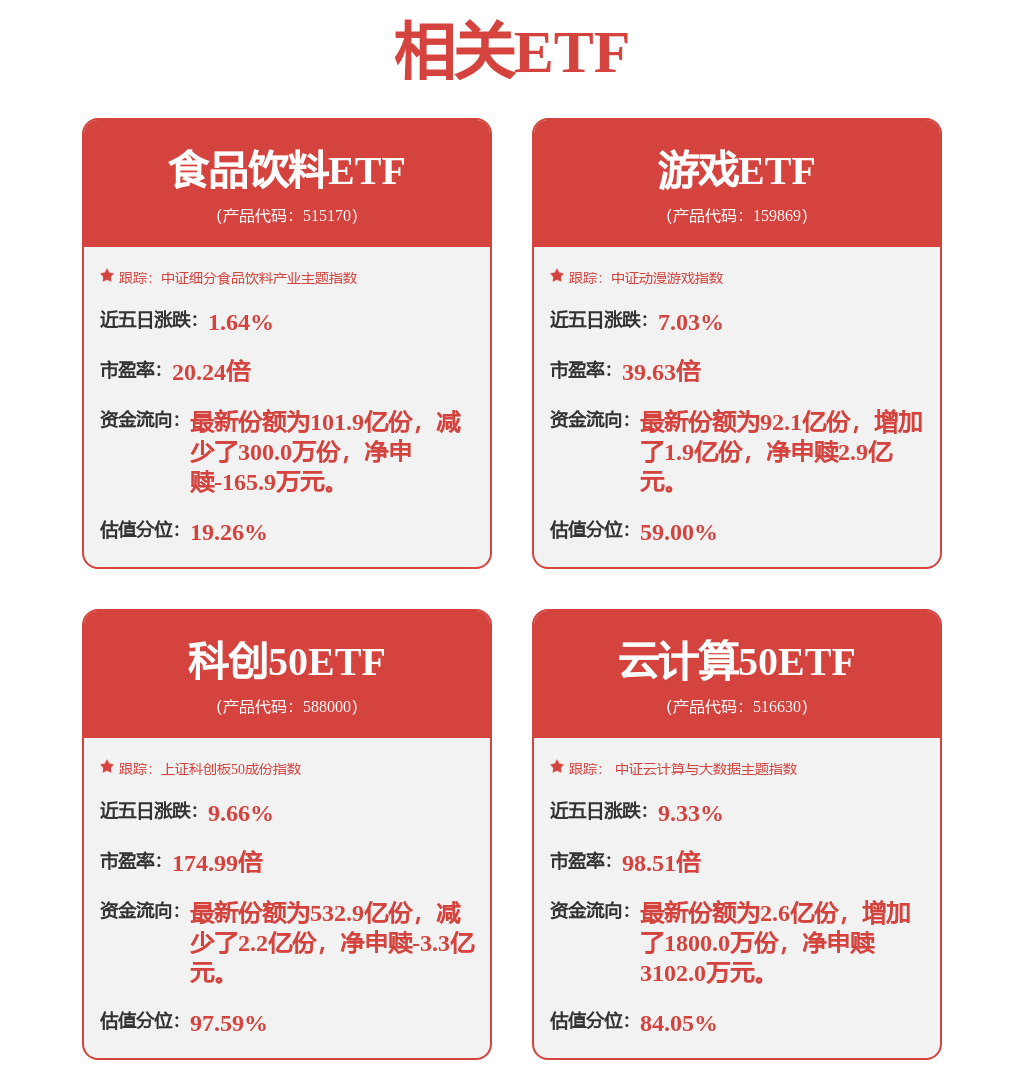
非车险“报行合一”最权威解释出炉;利明光接任中国人寿法人;中国人寿2025年理赔金额超1004亿|13精周报
13个精算师· 2026-01-10 03:04
Regulatory Dynamics - The Financial Regulatory Bureau has provided the most authoritative explanation for the "reporting and operation integration" of non-auto insurance [6] - The Guangdong Financial Regulatory Bureau is promoting the establishment of private equity securities investment funds by insurance companies in Guangdong [11] - The Jiangxi government supports insurance institutions in enhancing risk reduction service levels and providing comprehensive insurance solutions for technology-based enterprises [14] Company Dynamics - Ping An Life has made its fourth stake increase in China Merchants Bank H-shares, reaching a holding ratio of over 20% [18] - Ping An Life has also increased its stake in Agricultural Bank of China H-shares to over 20% [19] - Sunshine Life plans to reduce its stake in Huakang Clean by 3% [22] - China Life has reported over 62.24 million claims in 2025, with total payouts exceeding 100.4 billion [32] - New China Life reported a maximum payout of 10.5 million in 2025 [33] - People's Insurance Company of China reported over 2 billion claims in 2025, with a year-on-year growth of over 10% [36] Industry Dynamics - The short-term large-denomination deposit rates have entered the "0" range, with experts predicting a continued downward trend [47] - Insurance stocks have collectively surged, with Ping An, New China Life, and China Pacific Insurance reaching historical highs [49][50] - The issuance scale of insurance companies' bonds has exceeded 100 billion for three consecutive years [54] - 93.4% of combination-type insurance asset management products achieved positive returns in 2025 [55] - The insurance industry has entered a new cycle of predetermined interest rates, with significant changes in pricing logic [56]



险企“瘦身” 撤销分支机构 加速数字化转型
Shang Hai Zheng Quan Bao· 2026-01-09 18:35
Core Viewpoint - The insurance industry is undergoing a "downsizing" trend, with numerous branch offices being closed as companies accelerate their digital transformation efforts to reduce operational costs and optimize resource allocation [1][2][3]. Group 1: Downsizing Actions - As of January 9, 2026, regulatory approvals have been granted for the closure of over 40 branch offices across approximately 10 insurance companies, including China Life, PICC Property and Casualty, and Dadi Insurance [1]. - The majority of the closed branches are marketing service departments and sub-branches, accounting for over 90% of the total closures [1]. - Since 2021, an average of over a thousand branch offices have been closed each year, indicating a trend towards downsizing in the insurance sector [2]. Group 2: Digital Transformation - The shift towards online insurance purchasing is becoming a significant trend, driven by advancements in technology such as the internet, big data, and artificial intelligence [3]. - The closure of traditional, high-cost physical branches is a key measure for insurance companies to reduce costs and improve efficiency [3]. - The increasing competition and regulatory policies have made the traditional model of expanding through physical branches unsustainable, prompting companies to adopt a more refined and digital management approach [3]. Group 3: Service Quality Concerns - The closure of branch offices raises concerns about service accessibility, particularly for consumers who may lack digital skills, such as the elderly population [4][5]. - The "digital divide" poses challenges for certain demographics, especially older individuals in rural areas who may struggle to access insurance services without physical branches [5]. - Recommendations include enhancing agent services, deploying self-service machines, and optimizing telephone support to ensure that all consumers, including those less familiar with digital technology, can access quality insurance services [5].
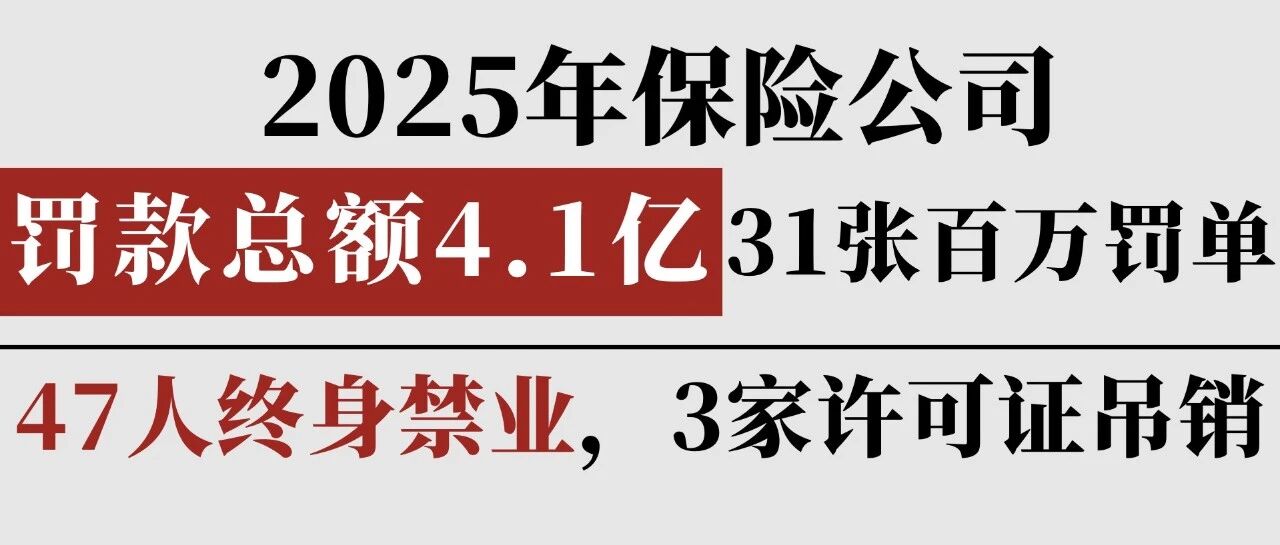
2025年保险公司罚款超4.1亿:3家许可证被吊销,31张百万罚单,47人终身禁业,13人撤职,3家停新!
13个精算师· 2026-01-08 14:26
Core Points - The insurance industry faced significant penalties in 2025, with a total of over 410 million yuan in fines imposed on 134 companies, marking a historical high [3][8][10] - The regulatory environment has intensified, with 31 fines exceeding 1 million yuan and 115 individuals banned from the industry, including 47 receiving lifetime bans [8][20][24] - Major companies such as Huaxia Life and Tianan Life had their licenses revoked, indicating a shift towards stricter enforcement and accountability [11][14] Summary by Sections Penalties Overview - In 2025, the total fines for insurance companies exceeded 410 million yuan, with 2802 penalties issued, reflecting a 16% increase compared to the previous year [10][8] - A total of 31 fines were classified as "million-level," with one fine exceeding 10 million yuan and several others surpassing 5 million yuan [19][14] Regulatory Actions - The regulatory body has adopted a "responsibility to individuals" approach, resulting in 115 individuals facing various degrees of industry bans, with 47 receiving lifetime bans [20][24] - The trend of increasing penalties is evident, with the number of individuals banned doubling from the previous year [24] Company-Specific Actions - Companies such as Huaxia Life, Tianan Life, and Tianan Property had their business licenses revoked, indicating a more severe approach to regulatory compliance [11][14] - The penalties for these companies included not only fines but also the revocation of positions for responsible personnel, showcasing a comprehensive enforcement strategy [12][14] Industry Trends - The insurance sector is experiencing a shift towards high-quality development, driven by regulatory measures aimed at improving operational management and compliance [10][14] - The increase in penalties and the revocation of licenses reflect a broader trend of tightening regulations within the insurance industry [10][14]
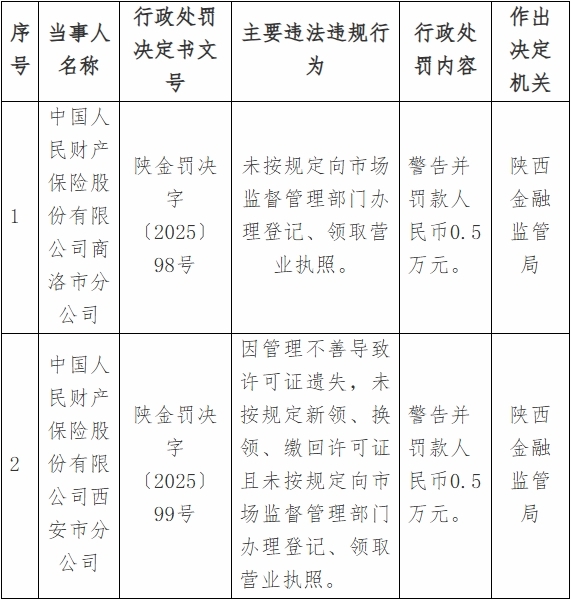
人保财险陕西2分公司被罚 未按规定领取营业执照等
Zhong Guo Jing Ji Wang· 2026-01-08 09:04
Group 1 - The article reports administrative penalties imposed by the Shaanxi Financial Regulatory Bureau on China People's Property Insurance Company, Shanzhou Branch, and Xi'an Branch for regulatory violations [1][2] - The Shanzhou Branch was fined 5,000 RMB for failing to register and obtain a business license as required by market supervision authorities [1][2] - The Xi'an Branch was also fined 5,000 RMB due to mismanagement leading to the loss of its license and failure to reapply or return the license as mandated [1][2]
重磅!非车险“报行合一”最权威解释出炉:松绑“见费出单”,政策性业务满足一定条件可出单,退运险等应实时结算或2日内结算
Sou Hu Cai Jing· 2026-01-08 03:54
Core Viewpoint - The implementation of the "reporting and issuing together" policy for non-auto insurance continues to advance, with the National Financial Regulatory Administration providing detailed answers to various issues arising during the process, aiming to clarify policy implications and unify industry standards [1][2]. Group 1: Regulatory Framework - The core content of the recent notification includes that short-term health insurance is not applicable under the "reporting and issuing together" policy, with some exceptions [2]. - Insurance intermediaries collecting premiums are not considered as "reporting and issuing together" [4]. - Agricultural insurance should follow relevant regulations and execute "reporting and issuing together" [8]. Group 2: Business Scenarios and Requirements - Certain businesses, such as those involving public interest funded by government finances, may not strictly adhere to "reporting and issuing together" [8][10]. - From July 1, 2026, high-frequency, fragmented, and scenario-based internet insurance products like return freight insurance should achieve real-time settlement or periodic settlement within two natural days after issuance [9]. - Policies issued after March 1, 2026, should generally be issued after premium collection and invoicing, with allowances for companies facing difficulties in changing payment methods [12][17]. Group 3: Specific Business Types - For foreign currency or offshore RMB businesses, insurance companies can use bank transfer or other verifiable payment proofs to issue policies [5]. - In the case of RMB business, a bank acceptance bill can be considered as "reporting and issuing together" [6]. - For co-insurance, the main underwriting company can issue policies and invoices after collecting premiums, which will be regarded as "reporting and issuing together" [7]. Group 4: Payment Management - The notification specifies that for public interest businesses using government funds, insurance companies can issue policies based on signed government documents without immediate premium collection [10]. - For businesses where the government subsidizes premiums, the full premium must be collected before issuing policies [10]. - The notification emphasizes that installment payment structures should not be manipulated as competitive leverage, and the last payment should not exceed the average installment amount [12].

证券研究报告、晨会聚焦:非银葛玉翔:OCI选择权的两面性,税务追溯对现金流影响有限-20260107
ZHONGTAI SECURITIES· 2026-01-07 13:24
Core Insights - The report discusses the dual nature of the OCI (Other Comprehensive Income) option in the context of the tax adjustments for insurance companies transitioning to new accounting standards, indicating that the impact on cash flow from tax retroactivity is limited [3][4][6]. Summary by Sections Tax Adjustment Overview - The Ministry of Finance and the State Administration of Taxation issued a notice regarding the tax treatment for the transition to new insurance contract standards, effective from 2026, allowing companies to smooth out tax differences over five years [3][6]. - The overall impact of this tax adjustment on listed insurance companies is deemed limited, as most have already implemented the new standards since early 2023 [3][4]. Profitability and Tax Rates - Listed insurance companies have seen record high profits, with pre-tax profits in the first three quarters of 2025 exceeding the total for 2024, while actual tax rates have remained low, indicating a disconnect between tax obligations and operational performance [4][5]. - The average effective tax rates from 2020 to Q3 2025 were 10%, 8%, -1%, -6%, 12%, and 17%, with some companies reporting negative tax rates in certain years [4]. Impact of New Accounting Standards - The core difference in profits under the old and new accounting standards is attributed to the 750 curve, which has declined, affecting net profit levels, particularly for life insurance companies [5]. - The new standards provide an OCI option that mitigates the impact of interest rate declines on net profit, but it also removes the tax shield previously available under the old standards [5]. Cash Flow Implications - The tax adjustments are expected to have a minimal impact on operating cash flows, with the average effect on listed insurance companies estimated at 2.27%, while companies like Xinhua and China Life may experience a more significant impact of around 14% [6]. - The choice of how to account for retained earnings from the new standards will influence the actual cash flow effects, with options to either include them in the taxable income for 2026 or spread them over five years [6]. Investment Recommendations - The report suggests monitoring major listed insurance companies such as China Life, Ping An, China Pacific Insurance, Xinhua Insurance, and China Property & Casualty Insurance for potential investment opportunities [7].