BOC HONG KONG(02388)

Search documents
中银香港(02388) - 董事名单与其角色和职能
2026-03-11 12:20
董事名單與其角色和職能 執行董事 中銀香港(控股)有限公司董事會(「董事會」)成員載列如下: 孫 煜先生(副董事長兼總裁) 非執行董事 葛海蛟先生(董事長) 張 輝先生(副董事長) 蔡 釗先生 C 有關附屬委員會的主席 M 有關附屬委員會的成員 2026年3月11日 董事會下設五個常設附屬委員會。下表提供若干董事會成員於這些附屬委員會中所擔任 的職位: | 附屬委員會 | | 審計 | 提名及薪酬 | 風險 | 戰略及預算 | 可持續發展 | | --- | --- | --- | --- | --- | --- | --- | | 董事 | | 委員會 | 委員會 | 委員會 | 委員會 | 委員會 | | 葛海蛟先生 | | | | | C | | | 張 | 輝先生 | | M | | M | | | 孫 | 煜先生 | | | | M | M | | 蔡 | 釗先生 | | | | M | | | 鄭汝樺女士 | | M | | | M | C | | 蔡冠深博士 | | | C | | M | M | | 馮婉眉女士 | | M | M | C | M | M | | 羅義坤先生 | | M | | ...
中银香港(02388) - 委任廖长江先生為独立非执行董事及董事会附属委员会成员
2026-03-11 12:16
會常務委員。於 2014 年獲授勳銀紫荊星章,2019 年獲授勳金紫荊星 章及 2024 年獲授大紫荊勳章 。彼獲選為中華人民共和國第十一屆、 第 十 二 屆 及 第 十 三 屆 全 國 人 民 代 表 大 會 代 表 ( 香 港 特 別 行 政 區 ), 曾 於 2012 年至 2025 年擔任香港特別行政區立法會議員。廖先生曾任打 擊洗錢及恐怖分子資金 籌集覆核審裁處主席 、香港學術及資歷評審局 主席、 廉政公署貪污問題諮詢委員會主席 及銀行業覆核審裁處和資本 充足事宜覆核審裁處成員 。廖先生 畢業於倫敦大學學院 ,於 1982 年 取得經濟學榮譽理學士學位及於 1985 年取得法律碩士學位。 香港交易及結算所有限公司及香港聯合交易所有限公司對本公告的內容概不負責, 對其準確性或完整性亦不發表任何聲明,並明確表示,概不對因本公告全部或任何 部分內容而產生或因倚賴該等內容而引致的任何損失承擔任何責任。 委任廖長江先生為獨立非執行董事及 董事會附屬委員會成員 董事會欣然宣佈,廖長江先生自 2026 年 3 月 11 日起獲委任為本公司及 本銀行獨立 非執行 董事 ,以及 提名及 薪酬 委員會 、 風險 委員會 ...
中银香港(02388.HK):3月9日南向资金减持98.45万股
Sou Hu Cai Jing· 2026-03-09 19:29
Group 1 - Southbound funds reduced their holdings in Bank of China Hong Kong (02388.HK) by 984,500 shares on March 9 [1] - Over the past five trading days, there were three days of net reductions by southbound funds, totaling 3.545 million shares [1] - In the last twenty trading days, there were ten days of net reductions, amounting to 8.1015 million shares [1] - Currently, southbound funds hold 367 million shares of Bank of China Hong Kong, representing 3.46% of the company's total issued ordinary shares [1] Group 2 - Bank of China Hong Kong is one of the three note-issuing banks in Hong Kong and the only RMB clearing bank in the region [2] - The bank is a leading player in major business markets, leveraging its advantages in RMB services to attract clients [2] - It offers comprehensive financial and investment services through a vast branch network and diverse service channels, including online and mobile banking [2] - The bank provides full-scale and high-quality cross-border services to multinational companies, cross-border clients, and various central banks and supranational institutions [2]


港股异动 | 香港银行股继续走低 渣打集团(02888)跌近6% 中东地缘政治不确定性短期为港...
Xin Lang Cai Jing· 2026-03-09 02:54
Group 1 - Hong Kong bank stocks are experiencing a decline, with Standard Chartered Group down 5.55% to HKD 168.4, Bank of China Hong Kong down 4.59% to HKD 40.34, HSBC Holdings down 4.44% to HKD 129.2, and East Asia Bank down 3.44% to HKD 13.46 [1] - The ongoing geopolitical situation in the Middle East is creating uncertainty for Asian banks' loans in the Gulf region, where Asian and Chinese banks issued over USD 15 billion in loans last year, marking a historical high [1] - JPMorgan's report indicates that geopolitical uncertainty in the Middle East is a short-term driving factor for Hong Kong bank stock prices, with Standard Chartered expected to face a notable correction due to its high exposure to the region [1] Group 2 - Standard Chartered's loans and revenue exposure in the UAE for 2025 are projected to be 2.5% and 5.6% respectively, while HSBC's exposure in the Middle East is 2.3% for loans and 3.8% for revenue [1]

港股银行股继续走低 渣打集团跌近6%
Mei Ri Jing Ji Xin Wen· 2026-03-09 02:53
Group 1 - Hong Kong bank stocks continue to decline, with Standard Chartered Group (02888.HK) down 5.55% to HKD 168.4 [1] - Bank of China Hong Kong (02388.HK) decreased by 4.59% to HKD 40.34 [1] - HSBC Holdings (0005) fell 4.44% to HKD 129.2 [1] - East Asia Bank (00023.HK) dropped 3.44% to HKD 13.46 [1]
香港银行股继续走低 渣打集团跌近6% 中东地缘政治不确定性短期为港银股价驱动因素
Zhi Tong Cai Jing· 2026-03-09 02:50
Core Viewpoint - Hong Kong bank stocks are experiencing a decline due to ongoing geopolitical uncertainties in the Middle East, impacting the loan exposure of Asian banks in the Gulf region [1] Group 1: Stock Performance - Standard Chartered Group (02888) has dropped by 5.55%, trading at HKD 168.4 [1] - Bank of China Hong Kong (02388) has decreased by 4.59%, trading at HKD 40.34 [1] - HSBC Holdings (0005) has fallen by 4.44%, trading at HKD 129.2 [1] - Bank of East Asia (00023) has declined by 3.44%, trading at HKD 13.46 [1] Group 2: Loan Exposure and Risks - Asian and Chinese banks are major financial institutions in the Gulf region, having issued over USD 15 billion in loans last year, marking a historical high [1] - The Hong Kong Monetary Authority has contacted at least two local banks to assess their risk exposure related to loans and bonds in the Middle East [1] Group 3: Analyst Insights - JPMorgan has indicated that geopolitical uncertainties in the Middle East are short-term drivers for Hong Kong bank stock prices [1] - JPMorgan previously noted that Standard Chartered Group may face a significant pullback due to its high exposure in the Middle East [1] - Standard Chartered's loans and revenue from the UAE are projected to account for 2.5% and 5.6% respectively by 2025, while HSBC's figures are 2.3% and 3.8% [1]
中银香港(02388.HK):3月3日南向资金增持71.25万股
Sou Hu Cai Jing· 2026-03-03 19:44
Group 1 - The core point of the news is that southbound funds have increased their holdings in Bank of China Hong Kong (02388.HK) by 712,500 shares on March 3, with a total net increase of 2,168,500 shares over the past five trading days [1] - Over the last 20 trading days, there have been 10 days of net reductions in southbound fund holdings, totaling a decrease of 7,544,500 shares [1] - Currently, southbound funds hold 371 million shares of Bank of China Hong Kong, representing 3.5% of the company's total issued ordinary shares [1] Group 2 - Bank of China Hong Kong is one of the three note-issuing banks in Hong Kong and the only RMB clearing bank in the region, holding a leading position in major business markets [2] - The bank's RMB services are a preferred choice for clients, supported by a vast branch network and diverse service channels, including online and mobile banking [2] - Through close collaboration with its parent company, Bank of China, the bank provides comprehensive cross-border services to multinational corporations, cross-border clients, and various central banks and supranational institutions [2]
中银香港(02388) - 截至2026年2月28日的股份发行人的证券变动月报表
2026-03-02 09:14
II. 已發行股份及/或庫存股份變動及足夠公眾持股量的確認 | 截至月份: | 2026年2月28日 | 狀態: 新提交 | | --- | --- | --- | | 致:香港交易及結算所有限公司 | | | | 公司名稱: | 中銀香港(控股)有限公司 | | | 呈交日期: | 2026年3月2日 | | | I. 法定/註冊股本變動 | 不適用 | | | 備註: | | | | 本公司可發行的股份數目上限為20,000,000,000股普通股股份及其股本並無股份面值。 | | | | 1. 股份分類 | 普通股 | | 股份類別 | 不適用 | | 於香港聯交所上市 (註1) | 是 | | | --- | --- | --- | --- | --- | --- | --- | --- | --- | | 證券代號 (如上市) | 02388 | | 說明 | | | | | | | 多櫃檯證券代號 | 82388 | RMB 說明 | | | | | | | | | | 已發行股份(不包括庫存股份)數目 | | | 庫存股份數目 | | 已發行股份總數 | | | 上月底結存 | | | | 10 ...
金融行业周报(2026、03、01):外资机构座谈会召开,坚定金融市场改革决心-20260301
Western Securities· 2026-03-01 09:06
Investment Rating - The report does not explicitly state an investment rating for the non-bank financial sector, but it provides insights into various segments such as insurance, brokerage, and banking, indicating potential investment opportunities and strategies [1][2][3]. Core Insights - The non-bank financial index decreased by 1.18% this week, underperforming the CSI 300 index by 2.26 percentage points. The insurance sector saw a decline of 3.74%, while the brokerage sector fell by 0.39%. In contrast, the diversified financial index increased by 3.90% [1][10]. - The insurance sector is experiencing a short-term adjustment due to profit-taking, a shift of funds towards growth sectors, and a lack of policy and earnings reports. However, the medium-term outlook remains positive as insurance companies are expected to increase equity allocations in 2026, supported by economic recovery and low valuations [2][14]. - The brokerage sector is expected to benefit from the recent capital market planning discussions, which emphasize market openness and reform. The report suggests that leading brokerages with strong cross-border capabilities will likely gain from these developments [2][16]. - The banking sector is viewed as a potential investment opportunity, particularly as macroeconomic conditions improve. The report recommends focusing on banks with high earnings elasticity, high dividend yields, and those expected to benefit from convertible bond catalysts [3][19]. Summary by Sections Insurance Sector - The insurance sector's index fell by 3.74%, underperforming the CSI 300 index by 4.82 percentage points. The decline is attributed to profit-taking and a shift in market sentiment towards growth sectors [2][13]. - Despite the short-term pullback, the long-term outlook for the insurance sector is optimistic, with expectations of increased equity allocations and a favorable economic environment supporting valuation recovery [14][15]. - Recommended stocks include New China Life Insurance, China Pacific Insurance, China Ping An, and China Life Insurance [15]. Brokerage Sector - The brokerage sector index decreased by 0.39%, underperforming the CSI 300 index by 1.47 percentage points. The sector's price-to-book (PB) ratio is currently at 1.33x, indicating a mismatch between earnings and valuations [2][16][17]. - The report highlights the importance of selecting brokerages based on their strengths and potential for mergers and acquisitions, recommending firms like Guotai Junan and Huatai Securities [17][18]. - The recent discussions by the China Securities Regulatory Commission signal a commitment to market reform and openness, which could benefit leading brokerages [16]. Banking Sector - The banking sector index fell by 0.92%, underperforming the CSI 300 index by 2.00 percentage points. The sector's PB ratio is at 0.50x, suggesting potential undervaluation [3][18]. - The report emphasizes the banking sector's resilience and potential for recovery as macroeconomic conditions improve, recommending banks with strong earnings potential and high dividend yields [19]. - Suggested banks for investment include Hangzhou Bank, Ningbo Bank, and China Merchants Bank, among others [19].




智通ADR统计 | 2月28日




智通财经网· 2026-02-27 23:41
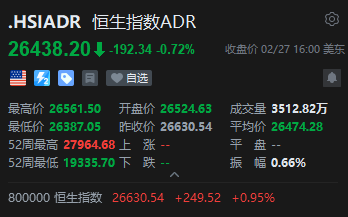
Market Overview - US stock indices experienced a decline on Friday, with the Hang Seng Index ADR closing at 26,438.20 points, down 192.34 points or 0.72% from the Hong Kong close [1] - The highest price for the ADR was 26,561.50, while the lowest was 26,387.05, with a trading volume of 35.1282 million [1] Major Blue-Chip Stocks - Most large-cap stocks fell, with HSBC Holdings closing at HKD 145.765, down 1.04% from the Hong Kong close [2] - Tencent Holdings closed at HKD 513.995, down 0.77% from the Hong Kong close [2] Stock Performance Summary - Tencent Holdings (00700) latest price: HKD 518.000, up 1.17% with an ADR price of USD 65.700, down 0.77% [3] - Alibaba Group (09988) latest price: HKD 142.900, down 0.07% with an ADR price of USD 144.110, down 1.38% [3] - HSBC Holdings (00005) latest price: HKD 147.300, up 1.59% with an ADR price of USD 93.160, down 1.04% [3] - Other notable stocks include AIA Group (01299) up 2.48%, and NetEase (099999) up 2.40% [3]