
China Life(02628)

Search documents
图解丨南下资金净买入港股139亿,加仓阿里、中国人寿和快手
Ge Long Hui A P P· 2026-01-21 10:15
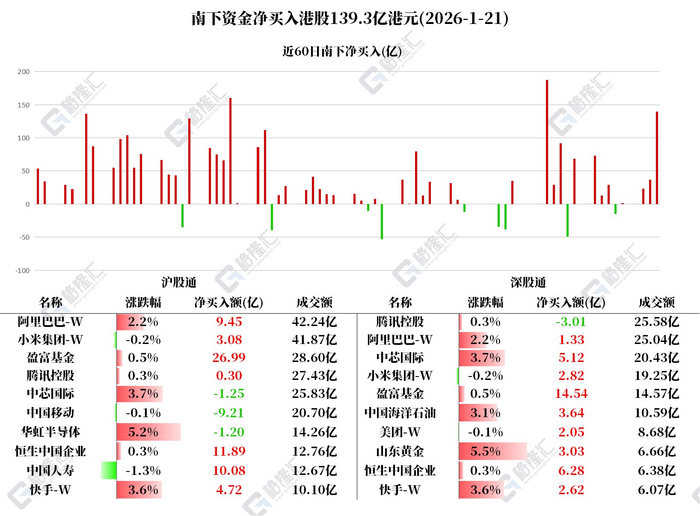
Group 1 - Southbound funds net bought Hong Kong stocks worth 13.93 billion HKD today [1] - The top net purchases included: - Tracker Fund of Hong Kong: 4.153 billion HKD - Hang Seng China Enterprises: 1.817 billion HKD - Alibaba Group: 1.078 billion HKD - China Life: 1.008 billion HKD - Kuaishou Technology: 733 million HKD [1] - Southbound funds have net bought Alibaba for 8 consecutive days, totaling 5.83455 billion HKD, and have net bought Xiaomi for 4 consecutive days, totaling 2.01881 billion HKD [1] Group 2 - In the Shanghai Stock Connect, Alibaba saw a net purchase of 9.45 billion HKD with a price increase of 2.2% [4] - Xiaomi experienced a slight decline of 0.2% with a net purchase of 3.08 billion HKD [4] - Tencent Holdings had a net sell of 3.01 billion HKD with a price increase of 0.3% [4] Group 3 - China Mobile faced a net sell of 9.21 billion HKD with a price decrease of 0.1% [4] - China National Offshore Oil Corporation had a net purchase of 3.64 billion HKD with a price increase of 3.1% [4] - Shandong Gold experienced a price increase of 5.5% with a net purchase of 3.03 billion HKD [4]


北水动向|北水成交净买入139.3亿 北水再度加仓港股ETF 抢筹盈富基金(02800)超41亿港元
Zhi Tong Cai Jing· 2026-01-21 10:08
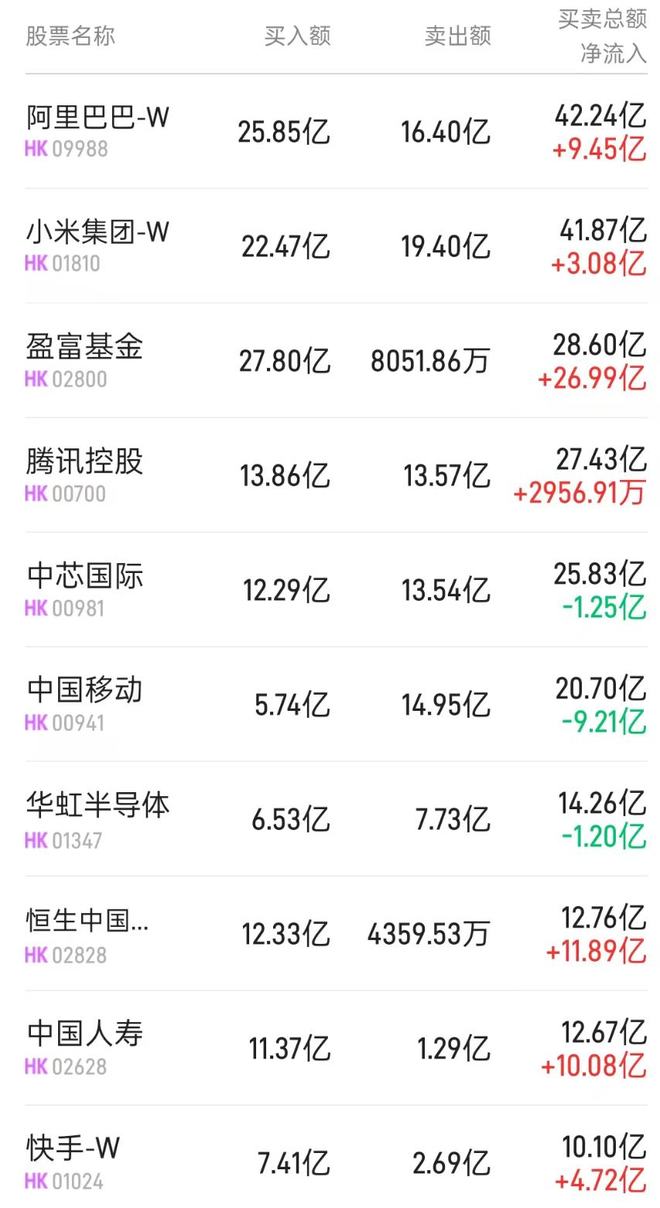
Group 1 - Northbound capital recorded a net buy of HKD 139.3 billion on January 21, with HK Stock Connect (Shanghai) contributing HKD 77.89 billion and HK Stock Connect (Shenzhen) contributing HKD 61.41 billion [1] - The most bought stocks included the Tracker Fund of Hong Kong (02800), Hang Seng China Enterprises (02828), and Alibaba-W (09988), while the most sold stocks were China Mobile (00941), Tencent (00700), and Hua Hong Semiconductor (01347) [1] - Alibaba-W received a net buy of HKD 10.77 billion, with significant growth in its AI model downloads, surpassing 100 million downloads [5] - China Life (02628) saw a net buy of HKD 10.07 billion, driven by positive expectations in the life insurance sector [5] - Kuaishou-W (01024) gained a net buy of HKD 7.33 billion, with its AI product showing a 350% increase in paid user growth [5] Group 2 - Semiconductor stocks showed divergence, with SMIC (00981) receiving a net buy of HKD 3.87 billion, while Hua Hong Semiconductor (01347) faced a net sell of HKD 1.2 billion [6] - TSMC's increased capital expenditure forecast indicates strong long-term demand driven by AI [6] - Shandong Gold (01787) received a net buy of HKD 3.03 billion, with gold prices hitting historical highs amid geopolitical tensions [7] - CNOOC (00883) saw a net buy of HKD 3.64 billion, with ongoing geopolitical tensions affecting oil prices [7] - Xiaomi Group-W (01810) and Meituan-W (03690) received net buys of HKD 5.89 billion and HKD 2.04 billion, respectively, while China Mobile (00941) and Tencent (00700) faced net sells of HKD 9.21 billion and HKD 2.71 billion [7]





2026银保“开门红”一片火热?新单保费或超700亿,背后有这几大影响因素…
Xin Lang Cai Jing· 2026-01-21 09:14
Core Insights - The insurance sector has seen a significant surge in new business through the bancassurance channel, with nearly 40 life insurance companies reporting a total new business scale exceeding 71.1 billion yuan, marking a substantial year-on-year increase [1][5] - The driving force behind this growth is attributed to the ongoing low interest rate environment, which has diminished the attractiveness of traditional deposits, prompting funds to seek alternative investment channels [6][8] Group 1: Market Dynamics - The bancassurance channel has successfully captured a large volume of funds that are looking for new outlets due to the declining interest rates, with the one-year and above fixed deposit maturity amount reaching 50 trillion yuan in 2026 [2][6] - The appeal of bancassurance products has been amplified in the context of low deposit rates, with standard products offering a maximum guaranteed interest rate of 2.0% and participating products providing a minimum return of 1.75% plus floating dividends [2][6] Group 2: Policy and Structural Changes - Recent policy adjustments, including the integration of insurance and banking services, have facilitated the growth of the bancassurance channel, allowing it to surpass individual insurance as the leading distribution channel in the first half of 2025 [3][7] - The growth in bancassurance premiums has translated into increased commission earnings for customer managers, enhancing customer retention and providing banks with a stable source of funds [7][8] Group 3: Future Outlook - The bancassurance channel's performance in 2026 is expected to be a result of both the low interest rate environment and the structural changes within the banking sector, with projections indicating that new business premium growth for listed insurance companies through this channel could exceed 30% [4][8]

智通AH统计|1月21日
智通财经网· 2026-01-21 08:18
Core Viewpoint - The report highlights the current premium rates of AH shares, with Northeast Electric, Zhejiang Shibao, and Junda Co. leading in premium rates, while CATL, Hengrui Medicine, and China Merchants Bank are at the bottom of the list [1][2]. Premium Rate Rankings - Northeast Electric (00042) has a premium rate of 815.25%, followed by Zhejiang Shibao (01057) at 378.67% and Junda Co. (02865) at 342.63% [2]. - The lowest premium rates are recorded for CATL (03750) at -13.79%, Hengrui Medicine (01276) at -2.52%, and China Merchants Bank (03968) at -2.22% [1][2]. Deviation Values - Junda Co. (02865) has the highest deviation value at 104.89%, followed by Goldwind Technology (02208) at 23.62% and Guanghetong (00638) at 20.17% [1][2]. - The lowest deviation values are for Northeast Electric (00042) at -35.64%, Chenming Paper (01812) at -16.87%, and China Life (02628) at -15.34% [1][4]. Additional Insights - The report includes a detailed table of the top ten and bottom ten AH stocks based on premium rates and deviation values, providing a comprehensive overview of the current market situation [2][3][4].

中国人寿海外公司总资产超4500亿元 参与多宗香港H股明星IPO
Zhong Guo Jing Ying Bao· 2026-01-21 06:58
Group 1 - The core viewpoint of the article highlights that as of December 31, 2025, China Life Overseas Company has total assets exceeding 452.8 billion HKD, emphasizing its significant role in the financial sector [2] - The investment strategy of China Life Overseas Company focuses on risk management and long-term value creation, contributing to the sustainable development of Hong Kong as an international financial center [2] - In November 2025, the Hong Kong SAR government issued multi-currency digital green bonds, and China Life Overseas Company participated in all four currency subscriptions, totaling approximately 2.4 billion HKD, making it the largest subscriber among Chinese insurance companies [2] Group 2 - In 2025, China Life Overseas Company participated in multiple Hong Kong H-share IPOs, supporting the Hong Kong Stock Exchange's Chapter 18A, which allows unprofitable biotech companies to list [2] - The company actively invested in hot sectors such as semiconductors, AI, and healthcare, aiding excellent Chinese enterprises in achieving reasonable pricing during IPOs [2] - China Life Overseas Company also engaged in equity investments in several star innovative enterprises through multiple private equity funds in sectors like semiconductors, AI, and healthcare, including investments in Hesai Technology and MiniMax, which recently listed on the Hong Kong Stock Exchange [2]
4Q25人身保险业利率研究专家咨询委员会例会点评:预定利率研究值或已筑底确认,中期再迎“炒停售”季概率较低
ZHONGTAI SECURITIES· 2026-01-21 05:37
Investment Rating - The report maintains an "Overweight" rating for the industry [1]. Core Insights - The current preset interest rate for ordinary life insurance products is 1.89%, a slight decrease from the previous value of 1.90%, indicating a narrowing decline in the preset interest rate research values over recent quarters [4]. - The report highlights that the long-end interest rates have stabilized since 2025, with a gradual upward trend established in the second half of 2025, suggesting a positive outlook for the industry [4]. - The report emphasizes the implementation of a dynamic adjustment mechanism linking preset interest rates to market rates, which is expected to guide companies in prudent pricing and asset-liability management [4]. - The likelihood of a "buy-stop" season in 2026 is considered low, as the preset interest rate research value is close to the maximum allowable rate for current products, making significant adjustments unlikely [4]. Summary by Sections Industry Overview - The report notes that the preset interest rate research values have shown a decreasing trend, with recent declines of 21bps, 14bps, 9bps, and 1bps, indicating a gradual stabilization [3]. - The financial regulatory authority has issued guidelines to link preset interest rates with market rates, which is expected to enhance the industry's pricing strategies [4]. Market Trends - The report indicates that the 5-year LPR remains at 3.5%, the 5-year fixed deposit benchmark rate at 1.3%, and the 10-year government bond yield at 1.85%, all showing stability compared to the previous quarter [4]. - The report suggests that the insurance sector has experienced a positive cyclical recovery since December of the previous year, with expectations for improved performance and valuation recovery [4]. Investment Recommendations - The report recommends continued attention to key players in the insurance sector, including China Life, China Pacific Insurance, Ping An Insurance, New China Life, China Property & Casualty Insurance, and AIA Group, as they are expected to benefit from the anticipated market conditions [4].

楚雄金融监管分局同意中国人寿财险楚雄市支公司营业场所变更
Jin Tou Wang· 2026-01-21 03:33
2026年1月8日,楚雄金融监管分局发布批复称,《关于中国人寿(601628)财产保险股份有限公司楚雄 市支公司申请变更营业场所的请示》(国寿财险楚发〔2025〕142号)收悉。经审核,现批复如下: 二、中国人寿财产保险股份有限公司应按照有关规定及时办理变更及许可证换领事宜。 一、同意中国人寿财产保险股份有限公司楚雄市支公司营业场所变更为:云南省楚雄彝族自治州楚雄市 开发区紫溪大道三号桥头北侧尚城商务中心主楼14层14-4室。 ...
中国人寿养老金融实践入选人民网“2025建设金融强国创新实践案例库”
Jin Rong Jie Zi Xun· 2026-01-21 02:24
Core Viewpoint - China Life Insurance Co., Ltd. has successfully entered the "2025 Financial Power Construction Innovation Practice Case Library" with its innovative project "Silver Age Health and Financial Respect for the Elderly" [1][3]. Group 1: Project Overview - The project aims to address issues faced by the elderly, such as the lack of insurance products, delayed emergency responses, and difficulties in accessing healthcare [3]. - It employs a "Five+" model to enhance the quality of life for the elderly, ensuring they have access to care, medical services, and social engagement [3]. Group 2: Community Support Initiatives - The project includes a community support model that pairs elder care facilities with resources to improve their operational sustainability and service offerings [3]. - It provides nine types of elder care services, including emergency rescue plans in collaboration with telecommunications operators [3]. Group 3: Health Services - The initiative has introduced smart health service stations that offer free health check-ups for the elderly, addressing common healthcare access issues [5]. - By integrating online platforms, the project provides 24/7 expert consultations and digital health management services [5]. Group 4: Insurance Solutions - A specially designed "Silver Age Health Insurance" plan is available at a minimum cost of 20 yuan, providing extensive coverage without age restrictions [7]. - The project aims to provide accident insurance coverage to approximately 130,000 elderly individuals, with total coverage exceeding 2 billion yuan [7]. Group 5: Financial Education and Community Engagement - The project promotes financial literacy among the elderly through various educational initiatives and community activities [8]. - It has organized over 100 financial safety awareness events and created platforms for elderly individuals to sell homegrown products, enhancing their income and social value [8]. Group 6: Digital Inclusion - The initiative focuses on adapting services and facilities to better serve the elderly, including the installation of user-friendly technology and personalized assistance [10]. - The project has received recognition from local governments and has been awarded multiple accolades for its innovative practices [10]. Group 7: Future Directions - China Life aims to continue enhancing its pension financial services, focusing on the needs of the elderly and contributing to the high-quality development of the silver economy [11].
科技驱动理赔全面提速
Jin Rong Shi Bao· 2026-01-21 01:44
Core Insights - The insurance industry has significantly improved claims processing speed and service efficiency by 2025, with "fast and full compensation" becoming a standard service feature [1][2][3] Group 1: Claims Processing Efficiency - In the life insurance sector, Xinhua Insurance reports that claims for small medical insurance under 5,000 yuan are settled in an average of 0.5 days, with 17% of claims processed within one hour and 70% within eight hours [1] - Ping An Life achieved a record claim payment in just 8 seconds, while ICBC-AXA's medical insurance claims can be settled in as little as 8 minutes for major claims [1] - China Life Property Insurance processed a claim in just 2.5 minutes, demonstrating strong emergency service capabilities even in complex disaster scenarios [2] Group 2: Digital Transformation and Technology Integration - The rapid improvement in claims speed is attributed to the implementation of digital transformation strategies and advanced technologies in the insurance sector [3] - Ping An Life introduced the DeepSeek model for intelligent claims review, achieving 93% of automated claims processed within 60 seconds [3] - China Life Health's intelligent claims review increased by 33.2% year-on-year, with an intelligent input rate exceeding 69% [3] Group 3: Expanded Insurance Services - Insurance services are evolving beyond mere financial compensation to encompass comprehensive health management and proactive risk reduction [4] - China Pacific Insurance aims to bridge the digital divide by providing personalized services for the elderly and vulnerable groups, reaching 947,000 people through online claims services [4] - The integration of technology is reshaping every aspect of the claims value chain, from reporting to payment, creating a more efficient and customer-friendly insurance service environment [4]



气象指数保险破解 水产养殖理赔难题
Jin Rong Shi Bao· 2026-01-21 01:44
Core Viewpoint - The introduction of comprehensive meteorological index insurance for freshwater fish farming in Shandong Province effectively mitigates risks associated with extreme weather, providing financial security for farmers and enhancing the sustainability of the industry [1][2]. Group 1: Insurance Product Overview - The comprehensive meteorological index insurance is designed to address the challenges of determining post-disaster loss in aquaculture, allowing automatic claims to be triggered based on predefined weather index thresholds [2]. - The insurance guarantees a compensation of 3,000 yuan per mu, ensuring that even in the event of total fish mortality, farmers can recover their investment costs [2]. - In 2024 and 2025, the insurance covered 7,808 mu, with a total risk coverage of 23.424 million yuan, demonstrating significant financial backing for the aquaculture sector [2]. Group 2: Impact of Extreme Weather - Extreme weather conditions, such as heavy rainfall and prolonged low temperatures, have been identified as major threats to the freshwater fish farming industry, leading to substantial fish mortality [1][3]. - The insurance product has already proven effective, with claims totaling 937,000 yuan triggered by recorded rainfall that met the insurance criteria [2]. Group 3: Expansion and Adaptation - Following the successful pilot in Yicheng District, local authorities have expanded the insurance product to include coverage for high-temperature events, responding to farmers' needs for additional protection against heat-related losses [3]. - The collaborative efforts between China Life Property & Casualty Insurance and local agricultural, financial, and meteorological departments have led to the optimization of the insurance scheme, enhancing its relevance and effectiveness for local farmers [3]. Group 4: Economic and Policy Implications - The introduction of this insurance product fills a significant gap in the insurance market for fish farming in Shandong Province, reducing the financial burden on farmers and improving the efficiency of fiscal subsidies [3]. - The integration of policy, insurance, and technology is revitalizing the modern aquaculture landscape in Shandong, providing a robust framework for sustainable industry growth [3].