
BANK COMM(03328)

Search documents
交通银行加速科技金融布局全力助推高水平科技自立自强
2 1 Shi Ji Jing Ji Bao Dao· 2025-12-16 05:14
Core Viewpoint - Technology is the foundation of national strength, and the company emphasizes the importance of "technology finance" as a key initiative to enhance its political and social responsibilities in financial work [1] Group 1: Strengthening Top-Level Design - The company has revised its Articles of Association to optimize the positioning of the Board's Strategic Committee, aiming to align its governance system with the strategic deployment of the "Five Major Articles" [3] - A Technology Finance Committee has been established to enhance the organizational structure, creating an efficient four-level working mechanism [3] - By June 2025, the company plans to implement action measures to promote high-quality development in technology finance, focusing on six key areas including organizational optimization and credit service upgrades [3] Group 2: Launching "Jiaoyin Science and Technology Innovation" - The company has integrated resources to launch the "Jiaoyin Science and Technology Innovation" brand, introducing a "4+3" service model to support the growth of technology enterprises [4] - A product system including "Science and Technology Easy Loan," "Easy Investment," "Easy Financing," and "Easy Leasing" has been established to address financing challenges for technology enterprises [4] - The company has developed a proprietary evaluation model for technology enterprises, which is applied across the organization to enhance marketing and risk management processes [4] Group 3: Improving Differentiated Policies - The company has created a dedicated product line for "Science and Technology Easy Loan" tailored to the different stages of enterprise development [5] - By June 2025, the company's technology loan balance is expected to exceed 1.5 trillion yuan, supporting over 63,700 enterprises [5] Group 4: Leveraging Full-License Advantages - The company is utilizing its full-license advantages to facilitate direct financing for technology enterprises, including collaboration with national-level funds [6] - By June 2025, the total financing scale of the company's technology finance is projected to exceed 1.7 trillion yuan [6] Group 5: Promoting Local Implementation - The company is actively implementing technology finance at the local level, optimizing branch organizational structures to establish specialized technology finance institutions [8] - Currently, 30 branches have set up dedicated technology finance organizations, creating nearly 100 specialized technology branches [8] Group 6: Strengthening Group Collaboration - The company is leveraging its integrated operations to provide cross-border financing services for technology enterprises, including loans and overseas listings [9] - The "Jiaoyin Trade and Finance" platform offers various online products to facilitate cross-border settlement and financing services for technology enterprises [9]


交通银行加速科技金融布局全力助推高水平科技自立自强
21世纪经济报道· 2025-12-16 05:04
Core Viewpoint - Technology is the foundation of national strength, and the company emphasizes the importance of "technology finance" as a key initiative to enhance financial services for technology enterprises, aiming to establish a robust financial service system that aligns with high-level technological self-reliance and national strength in technology [1] Group 1: Strengthening Top-Level Design - The company is revising its articles of association to optimize the positioning of the Board's Strategic Committee, aiming to create a governance system that aligns with the "Five Major Articles" strategic deployment [4] - A Technology Finance Committee is established to enhance the organizational structure, forming an efficient four-level working mechanism [4] - By June 2025, the company plans to implement action measures to promote high-quality development in technology finance, focusing on six key areas including organizational mechanism optimization and credit service system upgrades [4] Group 2: Launching "Jiaoyin Science and Technology Innovation" - The company integrates resources to launch the "Jiaoyin Science and Technology Innovation" brand, introducing a "4+3" service model to support the growth of technology enterprises [6] - A product system including "Science and Technology Easy Loan," "Easy Investment," "Easy Financing," and "Easy Leasing" is established to address financing pain points for technology enterprises [6] - The company develops a proprietary "1+N" evaluation model for technology enterprises, which is applied across the organization to enhance marketing, credit processes, and risk management [6] Group 3: Improving Differentiated Policies - The company creates a dedicated product line for "Science and Technology Easy Loan" tailored to the different stages of enterprise development, promoting an "active credit" innovation model [8] - By June 2025, the company's technology loan balance is expected to exceed 1.5 trillion yuan, supporting 63,700 enterprises [8] Group 4: Leveraging Full License Advantages - The company utilizes its full license advantages to assist technology enterprises in direct financing, enhancing cooperation with national-level guiding funds [10] - By June 2025, the total financing scale of the company's technology finance is projected to exceed 1.7 trillion yuan [10] Group 5: Promoting Technology Finance Expansion - The company emphasizes both top-level design and local implementation, optimizing branch organizational structures to establish specialized technology finance promotion institutions [12] - Currently, 30 branches have set up specialized technology finance organizations, creating nearly 100 technology branches and specialized branches [12] Group 6: Strengthening Group Collaboration - The company leverages its integrated operations to provide cross-border financing services for technology enterprises, including cross-border loans and overseas listings [14] - The "Jiaoyin Trade and Finance" platform offers convenient cross-border settlement and financing services for technology enterprises [14]

交通银行一高管因工作调动辞任!3个月前刚升任业务总监
Nan Fang Du Shi Bao· 2025-12-16 03:11
对于唐朔"下一站"去哪儿,有消息称,其已任建设银行党委委员,在走完必要的程序后,唐朔或将出任 建行副行长一职。如建行副行长任职资格落定,他或将成为六家国有大行中最为年轻的一位副行长。 建行官网信息显示,目前该行高级管理层包括行长张毅,副行长纪志宏、李建江、韩静和雷鸣,以及首 席财务官生柳荣。 采写:南都湾财社记者 刘兰兰 公告显示,唐朔1978年出生,今年47岁。于2001年加入交通银行,在该行连续服务24年,曾任交通银行 北京市分行行长,广东省分行行长,江西省分行行长、副行长(代为履行行长职责),北京市分行副行 长、行长助理,总行公司机构业务部(投资银行部)副总经理,北京市分行个人金融业务部总经理、望 京支行行长、林萃路支行副行长等职务。 "任职期间勤勉敬业、恪尽职守,为本行改革发展事业作出了重要贡献。董事会谨此向唐先生表示衷心 感谢!"交通银行董事会在公告中表示。 值得一提的是,今年8月份,唐朔刚刚被提拔为业务总监。据交通银行8月29日发布的公告,公司董事会 会议同意聘任唐朔为业务总监(公司与机构业务)。这意味着,唐朔在业务总监(公司与机构业务)位 置上仅任职3个多月。 近日,交通银行发布公告称,唐朔因工 ...


筑牢“三农”根基 绘就振兴画卷 交通银行全力支持农业强国建设
Jin Rong Shi Bao· 2025-12-16 02:46
Core Viewpoint - The modernization of agriculture and rural areas is crucial for China's overall modernization, and the focus is on accelerating rural revitalization through financial innovation and support for key agricultural sectors [1][9]. Group 1: Financial Support for Agriculture - The company has established a dedicated leadership group for rural revitalization, ensuring a solid management system from strategic decision-making to grassroots execution [2]. - A "Four Special Mechanism" has been implemented to enhance credit support, including specialized policy guidelines and a dedicated approval channel for agricultural loans [2][3]. - The company has developed innovative financial products such as "Yinong e-loan" and "Agricultural Trade e-loan" to support agricultural product development and enhance supply security [3]. Group 2: Technology and Risk Management - The company utilizes big data risk control models to automate loan approvals, significantly reducing approval times and enhancing service accessibility in rural areas [3]. - A proactive credit service model has been introduced, leveraging mobile banking to extend financial services to rural communities [3]. Group 3: Food Security Initiatives - The company emphasizes food security as a national priority, supporting the agricultural supply chain in key grain-producing regions like Hebei, which produces over 700 billion jin of grain annually [6]. - A comprehensive financial ecosystem has been established to support the entire grain industry chain, from seed research to market circulation [6]. Group 4: Support for Local Industries - The company focuses on activating local特色产业 (characteristic industries) by providing tailored financial support to align with local resources and promote unique agricultural products [7]. - The "Agricultural Breeding Loan" product has been developed to assist livestock farmers in overcoming financing challenges through a data-driven approach [8]. Group 5: Future Commitment - The company is committed to continuing its support for rural revitalization and aligning its strategies with national development plans, aiming to contribute to the modernization of rural areas in China [9].

智通ADR统计 | 12月16日
智通财经网· 2025-12-15 22:43
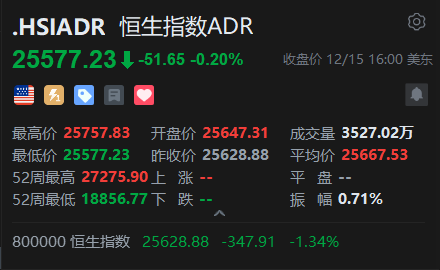
Market Overview - The Hang Seng Index (HSI) closed at 25,577.23, down by 51.65 points or 0.20% from the previous close [1] - The index reached a high of 25,757.83 and a low of 25,577.23 during the trading session, with a trading volume of 35.27 million [1] Major Blue-Chip Stocks Performance - HSBC Holdings closed at HKD 117.167, up by 0.83% compared to the Hong Kong close [2] - Tencent Holdings closed at HKD 600.386, down by 0.43% compared to the Hong Kong close [2] Stock Price Movements - Tencent Holdings (00700) latest price is HKD 603.000, down by HKD 13.000 or 2.11% [3] - Alibaba Group (09988) latest price is HKD 148.600, down by HKD 5.500 or 3.57% [3] - HSBC Holdings (00005) latest price is HKD 116.200, down by HKD 1.100 or 0.94% [3] - AIA Group (01299) latest price is HKD 80.650, up by HKD 1.650 or 2.09% [3] - BYD Company (01211) latest price is HKD 96.000, down by HKD 2.500 or 2.54% [3] - Baidu Group (09888) latest price is HKD 118.700, down by HKD 7.300 or 5.79% [3] - JD.com (09618) latest price is HKD 113.500, down by HKD 2.100 or 1.82% [3]





于细微处做好养老金融大文章——交通银行全力打造长者友好型银行
Shang Hai Zheng Quan Bao· 2025-12-15 19:19
Core Viewpoint - The article emphasizes the importance of addressing China's aging population through innovative pension financial practices by the Bank of Communications, aiming to enhance the well-being of the elderly and contribute to national development [2]. Group 1: Pension Financial Innovations - The Bank of Communications has launched its first pension service brand, "Jiaoyin Pension," focusing on creating a senior-friendly banking environment with core values of stability, security, warmth, and happiness [2]. - By the end of November 2025, the bank's pension industry loan balance is expected to increase by over 40% compared to the previous year, indicating rapid growth in pension financial business [2]. Group 2: Addressing Elderly Needs - The bank's approach to pension finance is centered around the diverse needs of elderly customers, integrating financial services with essential life scenarios such as medical care, food, housing, transportation, travel, and education [3]. - In the medical sector, the bank has introduced a "Medical Accompaniment Payment Subsidy" program in response to the challenges faced by the elderly, allowing them to book medical accompaniment services through a dedicated app with payment discounts [3]. Group 3: Collaborative Initiatives - The bank collaborates with payment institutions and elderly meal service providers to offer dining discounts for seniors, enhancing their dining experience [4]. - In partnership with Ctrip's Senior Friends Club, the bank provides exclusive travel services and discounts for customers over 50, including tailored travel routes and additional services in tourist areas [5]. Group 4: Building a Comprehensive Pension Ecosystem - The bank is working with government bodies and third-party organizations to create a comprehensive pension support network, addressing the safety of pre-paid funds in elderly care institutions [6]. - The introduction of the "Pension e-loan" product aims to alleviate funding shortages in elderly care institutions by providing online financing solutions, with successful pilot programs already in place [6]. Group 5: Comprehensive Pension Financial Service System - The bank has established a comprehensive pension financial service system covering five key areas: pension industry finance, pension wealth finance, pension consumption finance, financial services for the elderly, and rights protection [7]. - The bank aims to deliver professional and compassionate pension financial services, ensuring the happiness of the elderly population [7].

交通银行大宗交易成交68.00万股 成交额498.44万元
Zheng Quan Shi Bao Wang· 2025-12-15 14:50
机构评级来看,近5日共有1家机构给予该股评级,预计目标价最高的是国泰海通证券,12月10日国泰海 通证券发布的研报预计公司目标价为8.58元。(数据宝) 12月15日交通银行大宗交易一览 | 成交量 | 成交金额 | 成交价 | 相对当日收盘 | | | | --- | --- | --- | --- | --- | --- | | (万 | (万元) | 格 | 折溢价(%) | 买方营业部 | 卖方营业部 | | 股) | | (元) | | | | | 68.00 | 498.44 | 7.33 | 0.00 | 平安证券股份有限公司 | 中国国际金融股份有限公司北 | | | | | | 深圳金田路证券营业部 | 京建国门外大街证券营业部 | (文章来源:证券时报网) 交通银行12月15日大宗交易平台出现一笔成交,成交量68.00万股,成交金额498.44万元,大宗交易成交 价为7.33元。该笔交易的买方营业部为平安证券股份有限公司深圳金田路证券营业部,卖方营业部为中 国国际金融股份有限公司北京建国门外大街证券营业部。 进一步统计,近3个月内该股累计发生10笔大宗交易,合计成交金额为1.05亿元。 证 ...
交通银行:唐朔辞任业务总监职务
Zhi Tong Cai Jing· 2025-12-15 14:03
交通银行(601328)(03328)公布,唐朔先生因工作调动原因,今日已向该行董事会提交书面报告,辞 去该行业务总监(公司与机构业务)职务,辞任自 2025 年 12 月 15 日起生效 ...
交行业务总监唐朔公告离任,下一站料是国有大行副行长
Hua Er Jie Jian Wen· 2025-12-15 12:34
12月15日晚间,交通银行公告,唐朔因工作调动原因,已向交通银行董事会提交书面报告,辞去该行业 务总监(公司与机构业务)职务,辞任自2025年12月15日起生效。 唐朔已确认与交通银行董事会和高管层没有任何意见分歧,同时也没有任何与辞任有关而需要通知该行 股东和债权人的事项。 来自相关媒体的报道,唐朔已出任建设银行党委委员,在走完必要的程序后,唐朔大概率将出任建行副 行长一职。 当年10月31日,交通银行公告收到《国家金融监督管理总局关于唐朔交通银行业务总监(公司与机构业 务)任职资格的批复》,唐朔先生任本行业务总监(公司与机构业务)的任职资格获国家金融监督管理 总局核准生效。 未料,短短3个多月过去后,唐朔再次出现了工作调动。 交通银行称,唐朔任职期间勤勉敬业、恪尽职守,为该行改革发展事业做出了重要贡献。董事会向唐朔 表示衷心感谢。风险提示及免责条款市场有风险,投资需谨慎。本文不构成个人投资建议,也未考虑到 个别用户特殊的投资目标、财务状况或需要。用户应考虑本文中的任何意见、观点或结论是否符合其特 定状况。据此投资,责任自负。 资料显示,唐朔,1978年生,2001年于西安交通大学获法学学士学位,2018年 ...
交通银行(03328):唐朔辞任业务总监职务
智通财经网· 2025-12-15 11:08
智通财经APP讯,交通银行(03328)公布,唐朔先生因工作调动原因,今日已向该行董事会提交书面报 告,辞去该行业务总监(公司与机构业务)职务,辞任自 2025 年 12 月 15 日起生效 ...