Chongqing Rural Commercial Bank(03618)

Search documents
上证380指数下跌0.25%,前十大权重包含渝农商行等
Jin Rong Jie· 2025-04-15 07:52
Core Points - The A-share market's three major indices closed mixed, with the Shanghai 380 Index down 0.25% at 5304.0 points and a trading volume of 88.591 billion yuan [1] - The Shanghai 380 Index has decreased by 6.15% over the past month, increased by 1.25% over the past three months, and has fallen by 1.15% year-to-date [1] - The index is composed of 380 securities selected from the Shanghai Stock Exchange based on criteria such as revenue growth rate, return on equity, trading volume, and total market capitalization [1] Index Composition - The top ten weighted stocks in the Shanghai 380 Index include: Hu Nong Commercial Bank (1.28%), Chifeng Gold (1.21%), Chengdu Bank (1.14%), Yunnan Agricultural Commercial Bank (1.02%), Yutong Bus (0.94%), Rockchip (0.87%), Hengtong Optic-Electric (0.80%), China Software (0.78%), Shengyi Technology (0.74%), and Hongfa Technology (0.72%) [1] - The index is entirely composed of stocks listed on the Shanghai Stock Exchange, with a 100% allocation [1] Industry Breakdown - The industry composition of the Shanghai 380 Index includes: Industrial (26.66%), Information Technology (14.56%), Materials (12.26%), Financials (10.34%), Healthcare (10.20%), Consumer Discretionary (8.46%), Communication Services (4.72%), Energy (3.72%), Consumer Staples (3.55%), Utilities (3.37%), and Real Estate (2.15%) [2] - The index samples are adjusted biannually, with changes implemented on the next trading day following the second Friday of June and December, with a sample adjustment limit of 10% [2] - Special adjustments may occur under certain circumstances, such as when a sample is delisted or undergoes mergers, acquisitions, or splits [2]


银行角度看3月社融:政府债维持高增,低基数下信贷增长有所恢复
ZHONGTAI SECURITIES· 2025-04-14 12:41
Investment Rating - The report maintains an "Overweight" rating for the banking sector [5][40]. Core Insights - The report highlights that the growth in social financing (社融) is supported by both credit and government bonds, with March's new social financing reaching 5.89 trillion yuan, exceeding expectations [6][14]. - The credit situation shows a recovery due to a low base effect, with new loans in March increasing by 3.64 trillion yuan, which is 550 billion yuan more than the same period last year [8][20]. - The report emphasizes the importance of government bond issuance, which maintained high growth, with new financing in March amounting to 1.5 trillion yuan, a year-on-year increase of 1 trillion yuan [18][31]. Summary by Sections Social Financing Overview - In March, social financing increased by 5.89 trillion yuan, which is 1.0544 trillion yuan more than the same month last year, and the stock of social financing grew by 8.4% year-on-year [6][14]. - The structure of new financing in March was composed of 64.5% from loans, 25.2% from government bonds, and -0.8% from corporate bonds [15][18]. Credit Situation - The report notes that the increase in credit is primarily driven by a low base effect, with new RMB loans increasing by 5.358 billion yuan year-on-year [18][20]. - The breakdown of new loans shows that corporate short-term loans increased significantly, while residential loans remained stable compared to last year [20][22]. Market Trends - The report indicates that M1 growth has improved, with M0, M1, and M2 growing by 11.5%, 1.6%, and 7.0% respectively in March [31][33]. - New deposits in March totaled 4.25 trillion yuan, with a year-on-year increase of 6.7%, although this was a decrease of 0.55 trillion yuan compared to the previous year [33][34]. Investment Recommendations - The report suggests focusing on bank stocks due to their dividend attributes, particularly large banks and quality city commercial banks [11][39]. - Two main investment themes are highlighted: high-dividend large banks and city commercial banks with strong regional advantages [11][39].



银行业周报(20250407-20250413):业绩增速边际改善,核心营收贡献增大-20250413
Huachuang Securities· 2025-04-13 11:42
Investment Rating - The report maintains a "Recommended" investment rating for the banking industry, expecting the industry index to outperform the benchmark index by over 5% in the next 3-6 months [21]. Core Insights - The report highlights a marginal improvement in performance growth, with core revenue contributions increasing. As of April 12, 2024, 25 out of 42 listed banks reported a year-on-year revenue growth of -0.4% and a net profit growth of 2.0%, both showing a 1 percentage point improvement compared to the previous three quarters [5][6]. - The report anticipates that the banking sector will benefit from strong fiscal policies implemented since October 2024, which are expected to boost economic confidence and stabilize asset quality. If these policies effectively stimulate the real estate and consumer sectors, there will be opportunities for cyclical strategies [5][6]. Summary by Sections Industry Basic Data - The banking sector consists of 42 listed companies with a total market capitalization of approximately 114,992 billion and a circulating market value of about 78,974 billion [2]. Relative Index Performance - The absolute performance of the banking sector over the past month is 5.0%, 17.3% over six months, and 17.7% over twelve months. The relative performance is 2.8%, 15.6%, and 24.4% respectively [3]. Market Review - For the week of April 7-13, 2025, the major indices saw declines, with the Shanghai Composite Index down 3.11% and the Shenzhen Component Index down 6.73%. The average daily trading volume in the A-share market was 10,349 billion, up 41.54% from the previous week [5]. Investment Recommendations - The report suggests focusing on banks with high dividend yields and strong asset quality, such as state-owned banks and regional banks with high provision coverage ratios. It also recommends banks with a high proportion of retail assets, which are expected to show greater resilience in the economic recovery [5][6]. Specific banks highlighted include: - Ningbo Bank, Jiangsu Bank, and China Merchants Bank, all rated as "Recommended" with projected EPS growth for 2025 [6].
重庆农商行2024年报暨2025年一季报发布: 规模效益“双增” 高质量发展蹄疾步稳
Sou Hu Cai Jing· 2025-04-12 13:23
Core Viewpoint - Chongqing Rural Commercial Bank (CRCB) has demonstrated significant growth in both scale and profitability while reducing risks and costs, maintaining its leading position in the western banking sector [1] Group 1: Financial Performance - As of the end of 2024, CRCB's total assets reached 1.51 trillion yuan, an increase of 738.60 billion yuan from the previous year [2] - The bank's deposit balance was 941.95 billion yuan, up by 457.44 billion yuan year-on-year, while loan balances increased to 714.27 billion yuan, a rise of 375.62 billion yuan [2] - For 2024, CRCB reported operating income of 28.26 billion yuan and net profit of 11.79 billion yuan, reflecting year-on-year growth of 1.09% and 5.97% respectively [2] - By the end of Q1 2025, CRCB's total assets exceeded 1.61 trillion yuan, marking a growth of 953.88 billion yuan, or 6.30% [3] - The bank achieved a net profit of 3.82 billion yuan in Q1 2025, an increase of 4.24% year-on-year [3] Group 2: Asset Quality and Risk Management - CRCB's non-performing loan (NPL) ratio was 1.18% at the end of 2024, with a capital adequacy ratio of 16.12% and a provision coverage ratio of 363.44% [2] - By the end of Q1 2025, the NPL ratio slightly improved to 1.17%, with the provision coverage ratio remaining stable at 363.30% [3] Group 3: Strategic Initiatives - CRCB actively participates in national and local strategic initiatives, contributing to the Chengdu-Chongqing economic circle and the Western Land-Sea New Corridor, providing loans for 176 key projects totaling 26.5 billion yuan [4] - The bank has established a specialized financial service mechanism for the "33618" modern manufacturing cluster, with related loan balances exceeding 66 billion yuan [4] Group 4: Financial Innovations and Services - CRCB has made significant strides in various financial sectors, including technology finance, green finance, inclusive finance, pension finance, and digital finance, with technology loans reaching 76.88 billion yuan [5] - The bank's green loan balance increased by 11.2 billion yuan year-on-year, while inclusive finance initiatives expanded its coverage to all townships in Chongqing [5] Group 5: Market Position and Future Outlook - CRCB ranked 14th nationally and first in the central and western regions in the banking competitiveness list by Tsinghua Financial Review [7] - The bank's A-share stock price saw a daily increase of 3.65% in Q1 2025, leading the western region's listed banks [7] - Looking ahead, CRCB aims to enhance financial services, strengthen risk management, and promote digital transformation to establish itself as a benchmark bank in the western region [7]
重庆农村商业银行(03618) - 2024 - 年度财报
2025-04-10 08:37
Financial Performance - Operating income and net profit grew by 0.98% and 5.97% year-on-year, achieving a dual increase in scale and efficiency[11]. - The company achieved a net profit of RMB 11.79 billion in 2024, an increase of RMB 663.9 million or 5.97% year-on-year[41]. - Net profit for the year was RMB 11,789.1 million, reflecting a year-on-year growth of 5.97%[33]. - The company's net profit increased by CNY 666 million, a growth rate of 5.97%, driven by improved revenue and cost management[119]. - The company's pre-tax profit for 2024 was RMB 12,817.4 million, reflecting an increase of RMB 621.5 million or 5.10% year-on-year[55]. - The company reported a significant increase in revenue, reaching $1.2 billion, representing a 15% year-over-year growth[1]. - The company reported a net profit margin of 12%, an improvement from 10% in the previous year[9]. Asset and Loan Growth - The asset scale, deposit and loan balances increased by 5.12%, 5.10%, and 5.55% respectively compared to the end of the previous year[11]. - Customer loans and advances increased by 5.55% to RMB 714,273 million[34]. - The total amount of loans and advances reached RMB 358.13 billion, an increase of RMB 30.35 billion, representing a growth of 9.26% compared to the end of the previous year[59]. - The balance of loans to technology enterprises increased by 6.3 billion RMB compared to the end of the previous year[12]. - The balance of green loans increased by 11.2 billion RMB, representing an 18% growth compared to the end of the previous year[12]. - The balance of loans to small and micro enterprises increased by 9% compared to the end of the previous year[12]. - The total customer loans and advances amounted to RMB 714.27 billion, with a non-performing loan rate of 1.18%, consistent with the previous year[75]. Non-Performing Loans and Asset Quality - The non-performing loan ratio decreased by 0.01 percentage points compared to the end of the previous year[11]. - The non-performing loan (NPL) ratio was 1.18%, a slight improvement from 1.19% in the previous year[34]. - The non-performing loan ratio stood at 1.18% at the end of 2024, a decrease of 0.01 percentage points from the previous year, indicating stable asset quality[125]. - The overdue loan ratio decreased to 1.32%, down by 0.10 percentage points year-on-year, reflecting effective overdue management[125]. - The company maintained a prudent classification principle for loans, focusing on asset quality monitoring and control, with a significant emphasis on the collection and disposal of non-performing assets[74]. Digital Transformation and Innovation - The company plans to enhance its digital transformation projects to improve service scenarios and functionalities, leveraging big data and artificial intelligence[16]. - The company emphasizes digital transformation, aiming to enhance customer experience and operational efficiency through a "digital rural commercial bank" model[28]. - Digital loan products reached a scale of RMB 156.72 billion, with mobile banking users exceeding 15 million[41]. - The intelligent data decision platform provided a total of 301 million decision services, with a daily average of 822,000 and a decision success rate of 99.9%[110]. - The company launched 14 new digital products, with four products achieving over CNY 10 billion in business growth[111]. Customer and Market Engagement - The total number of customers served reached 28 million, with over 1 million service businesses, further solidifying the competitive advantage[14]. - The number of credit cards and consumer credit balances approached 150 billion RMB[12]. - The balance of credit cards and consumer loans reached RMB 149.18 billion, indicating a strong push for inclusive finance[41]. - The company signed service agreements with 417 enterprises for its treasury system, enhancing its digital transformation efforts[39]. - The company issued loans totaling RMB 41.3 billion to 42,000 small micro market entities, enhancing financing support[99]. Financial Management and Cost Control - The cost-to-income ratio improved, decreasing by 2.04 percentage points to 31.90%[33]. - The average cost of customer deposits was 1.73% in 2024, down from 1.88% in 2023[44]. - The company aims to achieve breakthroughs in total deposits and general loan increments, ensuring robust financial performance[15]. - The company is committed to technological innovation, focusing on digital finance and intelligent risk control to improve service quality[28]. - The company has a streamlined management structure that enhances decision-making efficiency and adaptability to market changes[27]. Strategic Focus and Future Plans - The company aims to become a leading regional bank in China, focusing on "supporting agriculture and small enterprises" and serving the real economy[24][25]. - The company has a strategic focus on the Chengdu-Chongqing economic circle and rural revitalization initiatives, aligning with national development strategies[25]. - The company plans to enhance its financial services across various sectors, including green finance, inclusive finance, and digital finance, to improve service quality and efficiency[159]. - The company aims to implement a development strategy focused on "retail banking, technology-driven operations, and talent enhancement" by 2025[159]. - The company is committed to leveraging market opportunities in Chongqing and expanding its business through tailored financial services[121]. Governance and Leadership Changes - The company is focused on enhancing its governance structure with the recent appointments and transitions among its senior management team[171]. - The company is undergoing a leadership transition with several executives stepping down, including Xie Wenhui and Zhang Peizong, effective in late 2024[168]. - The company appointed new executives, including Sui Jun as the Deputy Secretary of the Party Committee and President since March 2023[166]. - The company has confirmed the appointment of Peng Yulong as a non-executive director starting December 2024, following his previous roles in the Fosun Group[180]. - The company has maintained stability in its board composition, with no significant changes in the shareholdings of current directors during the reporting period[173].
渝农商行(601077) - 2025 Q1 - 季度业绩
2025-04-08 00:23
Financial Performance - In Q1 2025, the company achieved operating income of RMB 72.24 billion, an increase of 1.35% year-on-year[3] - The total profit for Q1 2025 was RMB 42.39 billion, reflecting an increase of 11.85% compared to the same period last year[4] - Net profit attributable to shareholders was RMB 37.45 billion, up by 6.27% year-on-year[4] - Basic earnings per share for Q1 2025 were RMB 0.33, an increase of 6.45% from RMB 0.31 in Q1 2024[3] - The weighted average return on equity (annualized) was 12.00%, a slight decrease of 0.01 percentage points from the previous year[3] Assets and Liabilities - As of March 31, 2025, total assets reached RMB 16,103.30 billion, a year-on-year increase of 6.30%[4] - The total liabilities increased to RMB 14,749.64 billion, marking a 6.78% rise from the end of the previous year[4] Loan Quality - The non-performing loan ratio stood at 1.17%, a decrease of 0.01 percentage points from the end of last year[4] - The provision coverage ratio was 363.30%, remaining stable compared to the previous year-end[4] Financial Data Disclaimer - The company warns that the preliminary financial data may differ from the final report, with expected discrepancies not exceeding 10%[5]
深度:“对等关税”对我国银行业影响:息差额外压力,资产质量稳健,投资价值凸显
ZHONGTAI SECURITIES· 2025-04-06 12:42
Investment Rating - The report maintains an "Overweight" rating for the banking sector [2] Core Insights - The impact of "reciprocal tariffs" on China's banking industry is profound, leading to additional pressure on loan demand and net interest margins, while asset quality remains stable. The investment value of bank stocks is highlighted, particularly for large banks, China Merchants Bank, and quality city commercial banks [7][12][14] Summary by Sections 1. Impact Mechanism of "Reciprocal Tariffs" on Bank Stocks - The economic impact includes weakened external demand, pressuring the credit demand and asset quality of banks [12][14] - Policy measures may boost retail credit demand through increased monetary easing [12][14] - Investment sentiment shifts towards banks due to enhanced dividend value amidst rising risk aversion [12][14] 2. Credit Demand: Pressure Points and Support - Economic growth pressure leads to declining credit growth, with a potential credit increment shortfall of CNY 2.139 billion in 2025 [15][19] - Export-related customer demand is expected to decline, while consumption-related customers may receive support from policy measures [27][28] 3. Net Interest Margin: Pressure Points and Support - A decline in credit growth could lead to a 14 basis points drop in net interest margins [33] - Monetary policy adjustments, including potential rate cuts, may exert additional pressure on margins [33][34] - The long-term outlook suggests that net interest margins are nearing their bottom, estimated at 1.24% [39][46] 4. Asset Quality: Pressure Points and Support - The impact on asset quality is manageable, with export-related sectors facing direct effects from tariffs [48] - The real estate sector's pressure is expected to ease, while retail sector non-performing loans may improve under supportive policies [48] 5. Investment Recommendations - The report emphasizes the dividend characteristics of bank stocks, recommending a focus on large banks and quality city commercial banks [7][12][14]
部分上市农商行信用卡不良率攀升
Zhong Guo Jing Ying Bao· 2025-04-05 22:13
信用卡不良资产包密集挂牌 本报记者 郭建杭 北京报道 随着上市银行2024年年报陆续发布,数据显示多家上市农商行信用卡不良率较上年末有上升。 近日多家上市农商行年报中披露2024年信用卡业务情况。例如,常熟农商行年报数据显示,2024年不良 贷款率总体稳定,略有上升。具体来看,该行2024年不良贷款率为0.77%,其中个人贷款不良率为 0.94%,较上年年末上升0.16个百分点,信用卡不良率更是由2023年年末的1.40%大幅提升至4.14%,上 升幅度达2.74个百分点。 重庆农商行的年报数据显示,截至2024年年末,该行不良贷款率为1.18%,较上年年末下降0.01个百分 点。2024年个体经营户和小微企业主均面临经营压力,个人贷款不良生成压力依然存在。由个人消费贷 及信用卡贷款组成的"其他贷款",其不良率由上期末的1.49%上升至本期末的2%,其他贷款的规模由上 期末的11.78亿元上升为16.08亿元。年报指出,逾期管控取得成效,截至2024年年末,重庆农商行逾期 贷款占比1.32%,较上年年末下降0.10个百分点。 此外,2024年农商行信用卡发放规模也有变化。 常熟农商行数据显示,信用卡贷款规模逐 ...
9家上市行“反向追薪”超1.13亿!渤海银行人均退薪3.93万,招商银行未再披露
Xin Lang Cai Jing· 2025-04-03 00:23
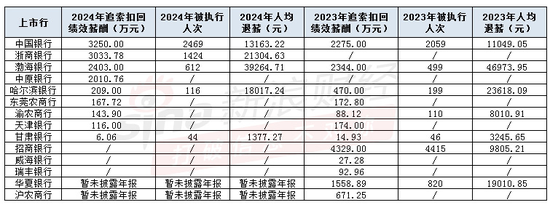
Core Viewpoint - The 2024 annual reports of listed banks reveal significant performance salary clawbacks, with a total amount exceeding 113 million yuan across nine banks, indicating a growing trend in enforcing accountability in executive compensation [1][4]. Summary by Category Performance Salary Clawbacks - Nine listed banks have disclosed their performance salary clawback situations in their 2024 annual reports, including major banks like Bank of China, Zhejiang Commercial Bank, and Bohai Bank [1][4]. - The total amount of clawbacks reported by these banks exceeds 113 million yuan, with Bank of China leading at 32.5 million yuan [1][4]. - The average clawback amount per person was highest at Bohai Bank, reaching 39,264.71 yuan, while Bank of China and Harbin Bank also reported significant average clawbacks exceeding 10,000 yuan [2][4]. Year-on-Year Comparison - Compared to 2023, several banks, including China Merchants Bank and Weihai Bank, did not disclose specific clawback amounts for 2024, despite having reported significant figures in the previous year [6]. - In 2023, China Merchants Bank had the highest clawback amount at 43.29 million yuan, affecting 4,415 employees with an average clawback of approximately 9,805 yuan [6]. Disclosure Trends - Zhejiang Commercial Bank and Zhongyuan Bank disclosed specific clawback amounts for the first time in 2024, indicating an improvement in transparency [7]. - Bohai Bank and Dongguan Rural Commercial Bank have consistently disclosed their clawback amounts for three consecutive years, showing a commitment to accountability [5][6]. Regulatory Context - The regulatory framework for performance salary clawbacks has been strengthened over the years, with guidelines established by the former China Banking Regulatory Commission and the China Banking and Insurance Regulatory Commission [10][11]. - As of 2023, over 95% of banking institutions have implemented performance salary clawback mechanisms, reflecting a significant shift towards more robust governance in the banking sector [11].


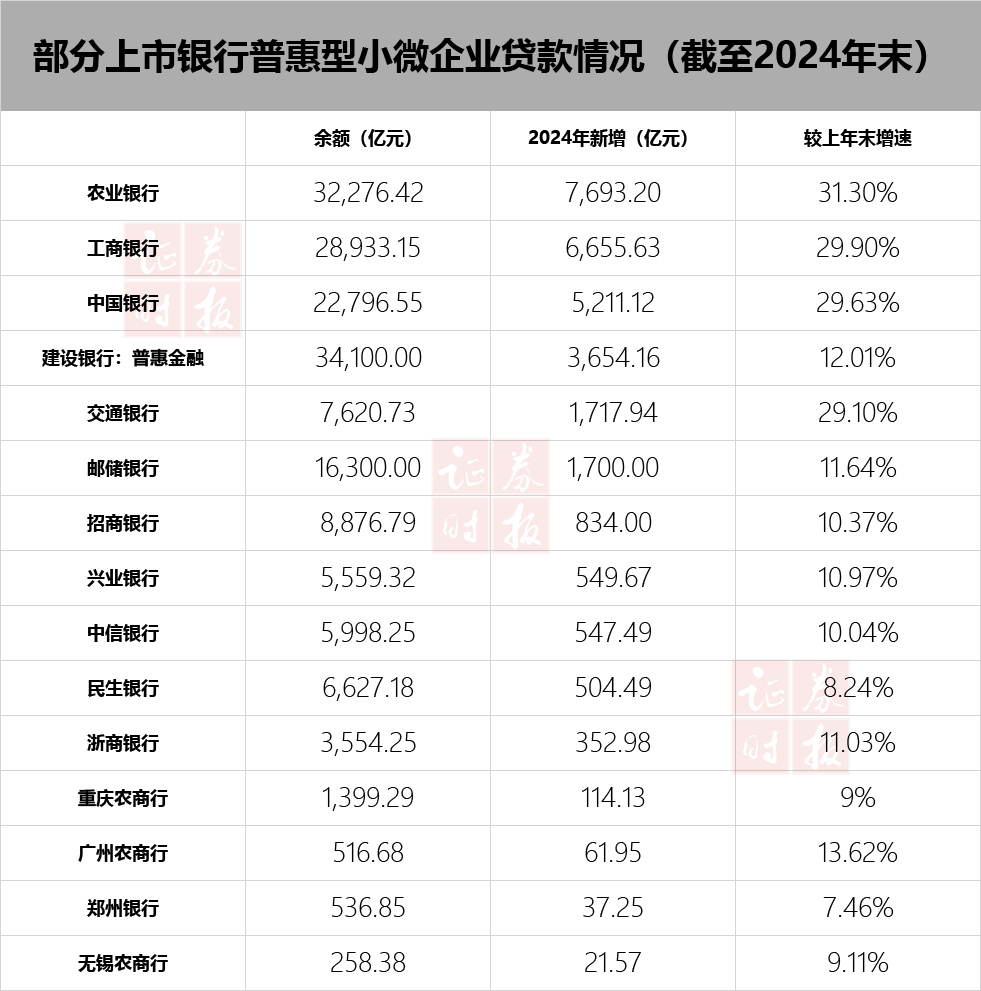
普惠小微贷款延续高增 各地专班精准破解企业融资个性化难题
Zheng Quan Shi Bao· 2025-04-02 14:49
Core Insights - The establishment of a four-level coordination mechanism for financing support to small and micro enterprises aims to enhance the efficiency and quality of financial services provided to these businesses [1][6][9] Group 1: Policy and Mechanism - The financial regulatory authority and the National Development and Reform Commission have initiated a mechanism to improve financing for small and micro enterprises, focusing on information sharing and tailored support [1][6] - Local governments have formed specialized teams to address the unique financing challenges faced by small and micro enterprises, breaking down previous departmental silos [6][7] Group 2: Loan Growth and Performance - Major state-owned banks have reported significant growth in inclusive small and micro enterprise loans, with Agricultural Bank of China, Industrial and Commercial Bank of China, and China Bank showing growth rates exceeding 29% [2][3] - As of February 2025, the total balance of inclusive small and micro enterprise loans in China approached 34 trillion yuan, with a year-on-year growth rate of 12.6%, outpacing other loan categories by 5.7 percentage points [4][6] Group 3: Case Studies and Implementation - Local teams have successfully facilitated financing for specific enterprises by addressing regulatory hurdles and providing necessary documentation to banks, demonstrating the effectiveness of the new coordination mechanism [7][8] - The focus has shifted from merely providing loans to ensuring the quality and suitability of financial products for small and micro enterprises, highlighting the importance of personalized solutions [8][9]