CM BANK(03968)

Search documents
万亿公募总经理获晋升,35年银行业老将掌舵博时基金,财富管理短板有望补齐
3 6 Ke· 2025-10-16 11:06
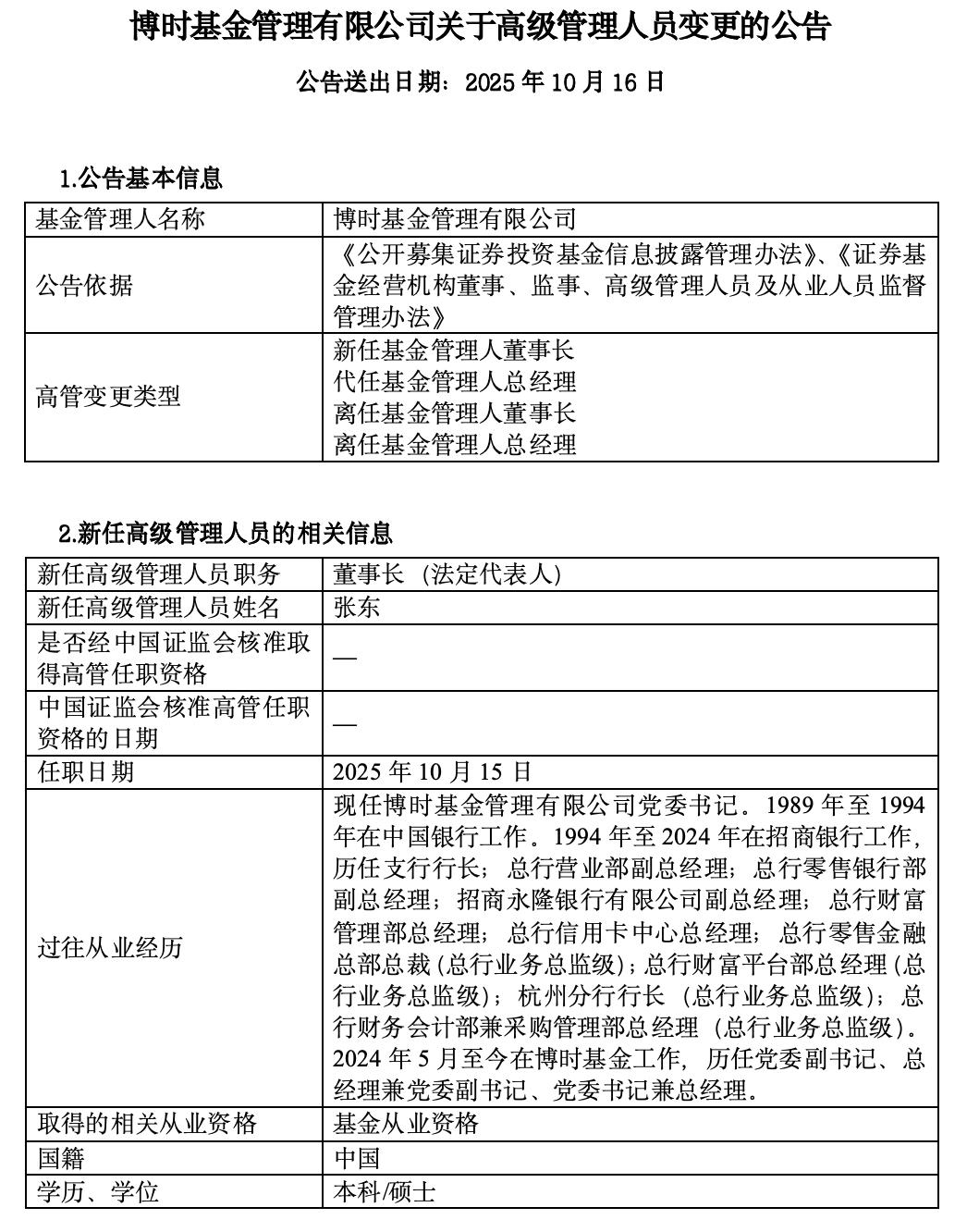
Core Viewpoint - The leadership change at Bosera Asset Management has been officially confirmed, with Zhang Dong taking over as Chairman and acting General Manager following Jiang Xiangyang's resignation, marking a significant transition in the company's management structure [1][2]. Group 1: Management Changes - Jiang Xiangyang resigned as Chairman on October 15, 2025, after a decade of leadership, during which Bosera maintained a top ten position in the public fund industry [2][8]. - Zhang Dong, with over 36 years of experience in the financial sector, has been appointed as the new Chairman and will also serve as acting General Manager for a period not exceeding six months [1][5]. - Zhang Dong's previous roles include significant positions at China Merchants Bank, where he contributed to the development of the bank's wealth management system [6][9]. Group 2: Company Performance - Bosera Asset Management has achieved a management scale of 1.09 trillion yuan, ranking 8th among 214 public funds in China [9]. - In the first half of 2025, the company reported revenue of 2.356 billion yuan, a year-on-year increase of 6.36%, and a net profit of 763 million yuan, up 0.20% [9]. - The company has seen a significant increase in the performance of its equity products, with 17 products doubling their performance over the past year [9]. Group 3: Strategic Direction - Under Zhang Dong's leadership, Bosera aims to enhance its integrated investment research capabilities and provide multi-asset allocation solutions, focusing on value orientation and long-termism [10]. - The company plans to coordinate the development of fixed income and equity, active and passive management, and both domestic and international markets to create customer value and discover investment opportunities [10].


智通AH统计|10月16日
智通财经网· 2025-10-16 08:20
Core Insights - The article highlights the top and bottom AH premium rates for various stocks as of October 16, with Northeast Electric (00042) leading with a premium rate of 770.97% [1] - The article also provides a detailed ranking of stocks based on their deviation values, indicating significant discrepancies between H-shares and A-shares [2] AH Premium Rate Rankings - Northeast Electric (00042) has the highest AH premium rate at 770.97%, followed by Hongye Futures (03678) at 243.57% and Zhejiang Shibao (01057) at 235.64% [1] - The lowest AH premium rates are recorded for Ningde Times (03750) at -17.41%, followed by Heng Rui Medicine (01276) at -2.37% and China Merchants Bank (03968) at 1.87% [1] Deviation Value Rankings - The top three stocks with the highest deviation values are Chenming Paper (01812) at 23.69%, Jieli Yongci (06680) at 22.33%, and Nanjing Panda Electronics (00553) at 21.48% [1] - The stocks with the lowest deviation values include Northeast Electric (00042) at -40.29%, Shanghai Electric (02727) at -24.14%, and China Southern Airlines (01055) at -12.55% [2]
金价,飙太猛!银行紧急上调
Jing Ji Wang· 2025-10-16 03:08
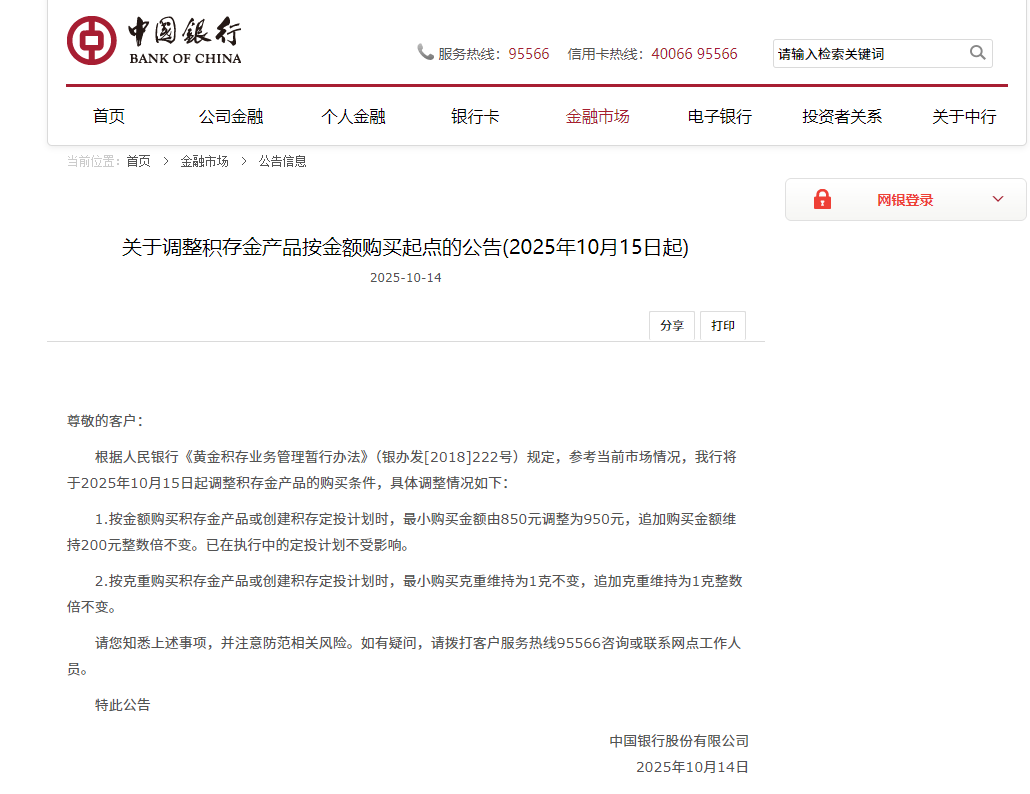
Core Viewpoint - The price of gold has surged approximately 55% this year, driven by expectations of interest rate cuts from the Federal Reserve, global central bank gold purchases, and increased holdings in gold ETFs, prompting several banks to adjust their gold accumulation business [1] Group 1: Bank Adjustments to Gold Accumulation Business - On October 14, Bank of China announced an increase in the minimum purchase amount for its gold accumulation products from 850 yuan to 950 yuan, effective October 15, 2025 [2] - On October 11, Industrial and Commercial Bank of China raised the minimum investment amount for its gold accumulation business from 850 yuan to 1000 yuan, while maintaining the minimum weight accumulation at 1 gram [2] - Ningbo Bank announced on October 9 that it would increase the minimum purchase amount for its gold accumulation business from 900 yuan to 1000 yuan, effective October 11, 2025 [4] - Agricultural Bank of China has adjusted its gold accumulation product's minimum purchase point to fluctuate with gold prices, marking its third adjustment this year [4][5] Group 2: Reasons for Adjustments - Banks are raising the minimum purchase thresholds primarily due to compliance requirements to ensure the minimum amount covers the real-time price of 1 gram of gold and to control risks by reducing speculative behavior [4][5] - The recent volatility in domestic gold prices has prompted these adjustments, with industry insiders expecting more banks to follow suit [5] Group 3: Historical Adjustments - Throughout 2023, several banks have repeatedly raised the minimum purchase amounts for their gold accumulation products, with Industrial and Commercial Bank of China increasing its minimum investment from 650 yuan to 1000 yuan in several steps [7][9] - Ningbo Bank also raised its minimum purchase amount from 700 yuan to 800 yuan earlier this year [8] Group 4: Market Adjustments and Risk Management - On September 24, Agricultural Bank of China announced adjustments to the trading limits for gold contracts, increasing the price fluctuation limits for various gold and silver contracts [6] - Banks are also enhancing risk management measures, with China Construction Bank and other institutions advising investors to be cautious due to increased market volatility [10]


中国平安增持招行、邮储,年内耗资千亿港元加仓银行H股!银行AH优选ETF(517900)盘中涨近1%
2 1 Shi Ji Jing Ji Bao Dao· 2025-10-16 03:00
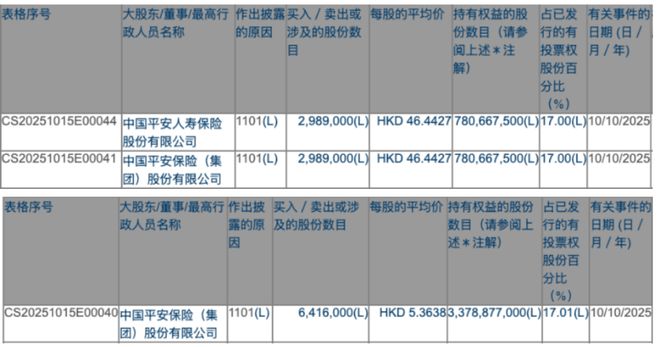
Core Viewpoint - The banking sector is experiencing a rally, with significant increases in stock prices for various banks, driven by insurance capital increasing their holdings in Hong Kong bank stocks, particularly by China Ping An [1][2]. Group 1: Investment Activities - China Ping An's subsidiary, Ping An Life, increased its holdings in China Merchants Bank (CMB) by 2.989 million H-shares, raising its total to 781 million shares, which represents 17% of CMB's H-shares [2]. - On the same day, China Ping An purchased 641,600 H-shares of Postal Savings Bank, increasing its stake to 17.01% [2]. - Since the beginning of the year, China Ping An has significantly increased its investments in H-shares of banks, including Agricultural Bank and Industrial and Commercial Bank, with total expenditures exceeding 100 billion Hong Kong dollars [4]. Group 2: Market Trends - The banking sector has seen a net inflow of nearly 100 million yuan into the Bank AH Preferred ETF (517900) over four consecutive days, indicating strong investor interest [7]. - The insurance sector's stock holdings have increased by 26.69% since the beginning of the year, with banks consistently representing the highest proportion of these holdings, reaching 47.2% by mid-2025 [4][6]. Group 3: Performance Metrics - The China Banking Index has experienced a cumulative decline of 15.21% from July 11 to October 9, while the CSI 300 Index rose by 17.44% during the same period [9]. - Since the launch of the Bank AH Total Return Index on December 6, 2017, it has achieved a cumulative return of 82.26%, outperforming the China Banking Total Return Index by 21.49% [9][11].


银行行业点评报告:关注“资金属性”增强过程中的银行经营分化
KAIYUAN SECURITIES· 2025-10-16 02:14
Investment Rating - The industry investment rating is "Positive" (maintained) [1] Core Viewpoints - The banking sector is experiencing a shift towards "wealthization" of deposits, indicating a change in customer behavior and banking operations [9] - The report highlights a divergence in bank operations, with some banks benefiting from enhanced funding attributes while others struggle [8] - The overall sentiment in the banking sector is improving, with dividend yields becoming attractive again after a period of adjustment [9] Summary by Sections Financial Data Analysis - In September, M1 growth was 7.2%, up 1.2 percentage points from the previous month, while M2 growth decreased to 8.4%, down 0.4 percentage points [5] - Social financing (社融) increased by 3.53 trillion yuan in September, with a year-on-year decrease of 229.7 billion yuan, resulting in a stock growth rate of 8.7% [6] - New RMB loans in September amounted to 1.29 trillion yuan, a year-on-year decrease of 300 billion yuan, with a balance growth rate of 6.6% [7] Banking Sector Insights - The report indicates that banks are focusing on a "quantity-price balance" in credit issuance, with a continued trend towards the "wealthization" of deposits [8] - The contribution of funding business to revenue has increased for most state-owned banks, except for Industrial and Commercial Bank of China [23] - The report suggests that banks with a more market-oriented approach and comprehensive licenses will have a competitive advantage in the evolving landscape [8] Investment Recommendations - The report recommends focusing on banks that are well-positioned to benefit from the wealthization of deposits, highlighting specific banks such as China Merchants Bank and Industrial Bank [9] - It emphasizes the attractiveness of H-shares over A-shares in terms of value [9]


很多人,都低估了30年房贷的杀伤力
Sou Hu Cai Jing· 2025-10-15 16:45
Core Viewpoint - The article discusses the changing dynamics of the housing market and the misconceptions surrounding mortgage loans, emphasizing the need for a defensive financial strategy in light of shifting economic, demographic, and social factors [2][20]. Financial Structure - A case study illustrates the financial burden of a mortgage, where a buyer purchased a home for 4.26 million with a loan of 2.98 million, only to face foreclosure and a sale price of 2.4 million, resulting in significant financial loss [4][5]. - The concept of "interest front-loading" is highlighted, where banks prioritize collecting interest in the initial years of a mortgage, leading to a situation where homeowners may not own a significant portion of their property early on [6][8]. Psychological Effects - The article points out a psychological effect termed "illusory ownership," where homeowners believe they own their property while actually prepaying a large amount of rent to the bank and bearing the risk of asset depreciation [8][9]. Mismatched Cycles - There are mismatches between personal career cycles and debt cycles, as individuals may face significant career changes while being locked into long-term mortgage commitments [11]. - The article also discusses the mismatch between family life cycles and fixed cash flows, emphasizing the need for flexible financial resources to handle life events [12]. - Additionally, it highlights the mismatch between personal decision-making cycles and asset price cycles, where individuals may make significant purchasing decisions at market peaks [13]. Changing Assumptions - The article identifies three foundational assumptions that have changed: demographic trends showing a decline in birth rates affecting housing demand, economic shifts from high growth to moderate quality development impacting income levels, and a societal shift towards a more conservative outlook on financial stability [14][15][16][18]. Strategic Recommendations - The article advocates for a defensive financial strategy, suggesting the construction of financial redundancy by limiting mortgage payments to 30% of income and maintaining emergency savings to cover at least 12 months of expenses [22][23]. - It emphasizes the importance of not underestimating the long-term implications of a mortgage and making informed decisions rather than being influenced by external pressures [24].


买买买!险资,继续“扫货”!
券商中国· 2025-10-15 15:09
Core Viewpoint - China Ping An and its subsidiaries continue to increase their holdings in bank stocks, particularly in China Merchants Bank and Postal Savings Bank, reflecting a strategic investment approach in the banking sector [1][4][5]. Group 1: Investment Activities - On October 10, Ping An Life increased its holdings in China Merchants Bank by 2.989 million shares, raising its total to 781 million shares, which constitutes 17% of the bank's H-shares [1][2]. - On the same day, China Ping An purchased 6.416 million shares of Postal Savings Bank, increasing its holdings to 3.378 billion shares, representing 17.01% of the bank's H-shares [1][2]. - Since the beginning of the year, Ping An has been actively buying bank stocks, with a notable increase in its holdings in China Merchants Bank from 2.3 million shares in January to over 781 million shares by October [4][5]. Group 2: Broader Investment Strategy - Ping An's investment strategy includes a "sweeping" approach to acquiring bank and insurance stocks, indicating a strong confidence in these sectors [4][5]. - The company has also been increasing its stakes in Agricultural Bank of China, with holdings exceeding 19% when including its subsidiaries [4][5]. - Ping An's total expenditure on bank stocks this year has surpassed 100 billion HKD, reflecting a significant commitment to this investment strategy [5]. Group 3: Market Context and Trends - The insurance sector has seen a notable increase in stock holdings, with a reported 26.69% growth in the market value of stocks held by life insurance companies as of mid-year [8]. - Regulatory changes have facilitated greater investment from insurance funds into equities, allowing companies like Ping An to pursue larger investments in stable, high-dividend stocks [10]. - The overall performance of the A-share market has improved, leading to enhanced investment returns for insurance companies, which in turn supports their profitability [12][13].

托管撤单、代销份额下滑,银行基金业务步入“围城”
Bei Jing Shang Bao· 2025-10-15 14:04
Core Viewpoint - The banking sector is facing significant challenges in its fund sales business due to increased competition from internet platforms, changing investor behaviors, stricter regulations, and a shift towards quality-driven growth rather than scale-driven growth [1][11]. Group 1: Fund Custody Business - The entry barriers for fund custody qualifications have increased, leading to some small and medium-sized banks withdrawing their applications, with Guangzhou Bank being the latest to do so after over three years of waiting [4][5]. - The new regulatory requirements demand a net asset threshold of 500 billion yuan and a strong market presence, which many smaller banks struggle to meet, resulting in a concentration of custody business among larger financial institutions [5][6][7]. - The top five banks dominate the fund custody market, holding approximately 47.93% of the market share, making it increasingly difficult for smaller institutions to compete [7]. Group 2: Sales Channel Dynamics - The withdrawal of custody applications signals a strategic retreat from high-cost, low-return business models, as many banks are opting to focus on more profitable areas [8]. - There is a noticeable trend of fund companies terminating sales partnerships with smaller banks, indicating a shift towards more rational and concentrated channel strategies [9][10]. - As of mid-2024, the bank channel's share of equity fund holdings has declined from 44.81% to approximately 41.93%, reflecting a broader trend of diminishing influence in the market [9][10]. Group 3: Revenue Growth Challenges - The reliance on traditional revenue models based on scale and licensing is becoming unsustainable, prompting banks to adopt "price for volume" strategies to attract customers [11][12]. - While lowering fees can temporarily boost transaction volumes, it compresses banks' intermediary income, which is primarily derived from subscription fees [12]. - To achieve sustainable growth, banks need to transition from merely selling products to providing comprehensive services, enhancing customer engagement, and developing a robust advisory framework [13].

China Merchants Bank Subsidiary Brings $3.8B Institutional Fund to BNB Chain
Yahoo Finance· 2025-10-15 12:18
Core Insights - CMB International (CMBIAM) has launched a $3.8 billion USD Money Market Fund on BNB Chain, represented by CMBMINT and CMBIMINT tokens, supported by DigiFT and OnChain [1][8] - The fund has been ranked 1 among Asia-Pacific peers by Bloomberg as of October 2025 and focuses on USD-denominated short-term deposits and high-quality money market instruments [1][2] Fund Performance - Since its inception in 2024, the fund has maintained consistent returns [2] Institutional Access and Blockchain Efficiency - Accredited investors can subscribe to the tokenized fund using fiat or stablecoins, with real-time redemption managed by proprietary liquidity management smart contracts from DigiFT [3] - The partnership allows CMBIAM to leverage BNB Chain's infrastructure to reach a broader global investor base securely and compliantly [4] Industry Trends - The launch is part of a broader trend of traditional financial products transitioning on-chain, following other major financial institutions that have adopted tokenization on BNB Chain [5] - BNB Chain is expanding its involvement with tokenized equities and has joined an alliance with Ondo's RWA platform to enhance access to tokenized stocks and real-world assets [6] Ecosystem Support - BNB Chain has taken steps to support users amid market volatility, including a $45 million airdrop to meme coin traders and a $300 million recovery initiative for traders affected by liquidations [7] Future Utility - The introduction of the CMBIAM fund adds a regulated, high-value real-world asset to BNB Chain, paving the way for new DeFi utility through planned integrations with protocols like Venus Protocol and ListaDAO [6][8]
招商银行研究院微信报告汇总(2025年三季度)
招商银行研究· 2025-10-15 10:06
Core Viewpoint - The article discusses the current state of the macroeconomic environment, focusing on monetary policy adjustments and their implications for the financial markets and the real economy [4][5][18]. Macroeconomic Analysis - The macroeconomic research highlights a gradual economic slowdown in China, with an opening of policy space to stimulate growth [5]. - The commentary on the U.S. Federal Reserve's recent meetings indicates a shift towards a more dovish stance, suggesting potential interest rate cuts in response to economic conditions [18][20]. Monetary Policy Insights - The "反内卷" (anti-involution) policy is emphasized in the context of the 2025 Q2 monetary policy execution report, aiming to alleviate financial pressures and promote sustainable growth [4]. - The analysis of the monetary policy execution report indicates a focus on maintaining liquidity while managing inflation expectations [4]. Capital Market Research - The capital market reports suggest that the bond market is facing headwinds, with recommendations to maintain a short to medium-term bond allocation strategy [9][10]. - The commentary on the bond market indicates that volatility is expected to increase, presenting potential opportunities for investors to capitalize on market corrections [11]. Economic Data Commentary - Recent economic data from China shows signs of resilience despite external pressures, with a focus on recovery and growth in key sectors [5]. - The analysis of U.S. non-farm payroll data indicates mixed signals, with employment growth slowing down, which may influence the Fed's future policy decisions [18].