CM BANK(03968)

Search documents
卫星扎堆「上天」,银行风控卷出「新高度」
Xin Lang Cai Jing· 2026-01-30 10:41
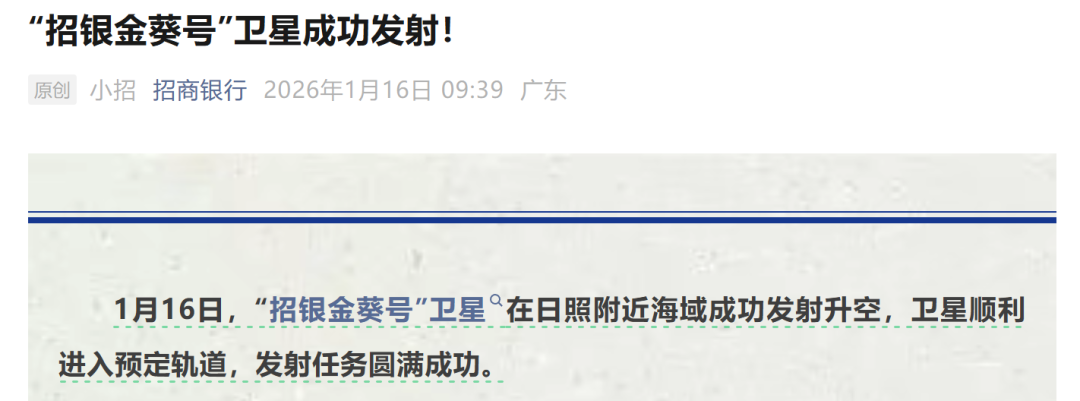
Core Insights - The commercial space industry is experiencing a surge in interest and investment, driven by increased policy support and the active participation of various sectors, including traditional banking [1][25][27]. Group 1: Policy and Industry Trends - Beijing has issued measures to promote the development and utilization of commercial satellite remote sensing data from 2026 to 2030, encouraging the construction of differentiated commercial satellite constellations with clear commercial value and application prospects [2][26]. - The banking sector, traditionally seen as unrelated to space, is now actively engaging in commercial space initiatives, with banks like China Merchants Bank and Shanghai Pudong Development Bank launching their own satellites [3][28]. Group 2: Satellite Launches and Applications - On January 16, 2024, China Merchants Bank's "Zhaoyin Jinkui" and Shanghai Pudong Development Bank's "Pudong Smart" satellites were successfully launched, both part of China's first global low-orbit satellite IoT constellation, "Tianqi Constellation" [4][29]. - The "Zhaoyin Jinkui" satellite is designed for high-precision monitoring of construction progress for first-hand mortgage properties, while the "Pudong Smart" satellite aims to enhance intelligent risk control and provide critical financial services during extreme scenarios like natural disasters [6][31]. Group 3: Evolution of Banking Risk Control - The trend of banks launching satellites signifies a shift from traditional ground-based data reliance to a "heaven and earth collaboration" model, enhancing risk control capabilities in response to complex and changing realities [12][45]. - Satellites provide high-resolution optical, radar, and multispectral sensors, offering banks a stable and objective "God's eye view" to address the core pain point of information asymmetry in traditional risk control [13][36]. Group 4: Innovations in Risk Management - The "Zhaoyin Jinkui" satellite can increase monitoring accuracy to over 95%, significantly improving traditional post-loan inspection efficiency [38]. - The integration of satellite technology with AI and deep learning, as seen in the "Dashanque" system by WeBank, allows for precise analysis of agricultural data, aiding in the determination of reasonable credit limits for farmers [38][40]. Group 5: Future Implications for Banking and Space - The banking sector's involvement in commercial space may lead to deeper due diligence and value discovery, as banks seek to understand and engage with the complexities of the commercial space industry [21][43]. - The future of financial competition may hinge on the ability to create intelligent collaborative networks between "starry skies" and "real ground," positioning banks to leverage new opportunities in the evolving commercial space landscape [24][46].





保险人更懂保险价值?中国平安频频举牌国寿背后的投资逻辑
Nan Fang Du Shi Bao· 2026-01-30 10:37
Core Viewpoint - The frequent equity stakes taken by insurance companies, particularly by Ping An Life, signal a strategic shift towards long-term investments in stable financial institutions and state-owned enterprises, moving away from short-term financial investments and arbitrage opportunities [2][3][5]. Group 1: Investment Activities - Ping An Life increased its stake in China Life's H-shares by purchasing 11.891 million shares at an average price of HKD 32.0553 per share, raising its holding from 8.98% to 9.14%, totaling approximately 681 million shares [2]. - In 2025, insurance capital was notably active in the capital market, with 41 public equity stakes recorded, the highest in nearly a decade, primarily in H-shares [3]. - Ping An Life has made multiple significant investments in Agricultural Bank of China H-shares, reaching a stake of 20% by December 30, 2025, with a total investment balance of approximately CNY 32.428 billion [3]. Group 2: Market Performance - The stock price of China Life H-shares increased by 150% from around HKD 14 in May to approximately HKD 35 by January 30, 2023, with its market capitalization nearing HKD 1 trillion [2]. - The insurance sector has shown strong performance at the beginning of the year, with several stocks, including New China Life and China Pacific Insurance, reaching historical highs [5]. Group 3: Investment Logic - Ping An's investment strategy is characterized by a focus on long-term value and strategic asset allocation, emphasizing patience and shared growth [5][6]. - The company adheres to a "three criteria" principle for investments: operational reliability, growth potential, and sustainable dividends, which guide its long-term investment decisions [6].




根本买不进去!金价回调,积存金业务火爆,有银行系统一度崩溃
Zhong Guo Zheng Quan Bao· 2026-01-30 09:10
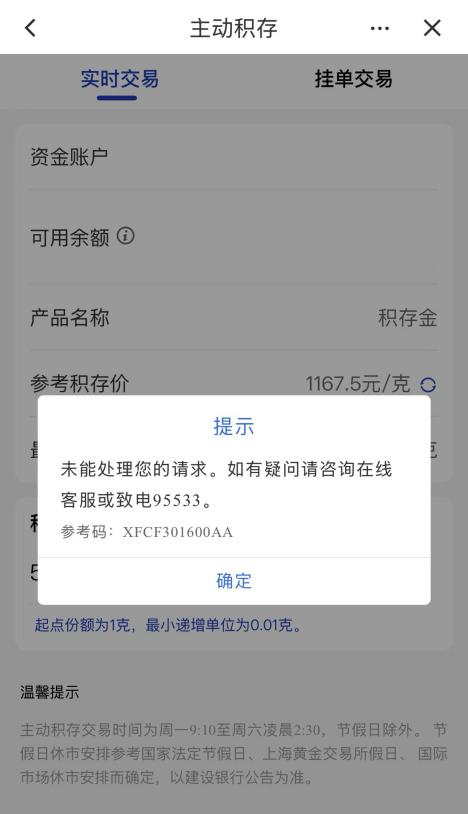
Core Viewpoint - The recent surge in gold prices has led to increased demand for gold accumulation products, causing significant strain on banking systems and prompting banks to adjust their policies to manage risks associated with market volatility [2][6]. Group 1: Market Dynamics - Gold prices have risen from 1150 CNY/gram to 1170 CNY/gram, leading to a rush among investors to purchase gold accumulation products [1]. - Many investors are attempting to capitalize on the price drop, viewing it as an opportunity to lower their average purchase price [2][5]. - The trading volume for gold accumulation products has surged, resulting in system overloads at various banks, including China Construction Bank and Industrial and Commercial Bank of China [2][5]. Group 2: Bank Responses - China Construction Bank announced an increase in the minimum investment amount for gold accumulation products to 1500 CNY, effective February 2, to manage risks associated with market fluctuations [6][8]. - Other banks, such as China Merchants Bank and Ningbo Bank, have also adjusted their policies regarding gold investment, reflecting a cautious approach in light of recent price volatility [6][9]. - Banks are advising customers to enhance their risk awareness and manage their investments prudently, considering their financial situation and risk tolerance [8][9].

智通AH统计|1月30日
智通财经网· 2026-01-30 08:17
Group 1 - The top three companies with the highest AH premium rates are Northeast Electric (00042) at 831.03%, Zhejiang Shibao (01057) at 339.32%, and Sinopec Oilfield Service (01033) at 323.71% [1][2] - The bottom three companies with the lowest AH premium rates are CATL (03750) at -14.62%, China Merchants Bank (03968) at -3.22%, and Hengrui Medicine (01276) at 1.77% [1][2] - Sinopec Oilfield Service (01033), Andeli Juice (02218), and Shandong Molong (00568) have the highest deviation values at 53.41%, 21.68%, and 19.01% respectively [1][2] Group 2 - The companies with the lowest deviation values include Zhejiang Shibao (01057) at -58.91%, Yangtze Optical Fibre and Cable (06869) at -49.00%, and Fudan Zhangjiang (01349) at -24.81% [1][2][4] - The top ten AH stocks by premium rate include companies like Hongye Futures (03678) and Beijing Electromechanical (00187) with premium rates of 258.91% and 257.99% respectively [2] - The bottom ten AH stocks by premium rate include Weichai Power (02338) and Midea Group (00300) with premium rates of 6.84% and 8.51% respectively [2]
10家银行业绩速览:浦发业绩回暖,8家下调拨备
2 1 Shi Ji Jing Ji Bao Dao· 2026-01-30 07:45
Core Viewpoint - The overall performance of the banking industry shows a steady improvement in asset scale expansion, profitability, and risk management as ten listed banks report their preliminary performance for 2025 [1] Group 1: Asset Scale Expansion - Ten banks achieved steady growth in total asset scale, with some banks reaching new milestones; for instance, China Merchants Bank's total assets exceeded 13 trillion yuan for the first time, reaching 13.07 trillion yuan, an increase of 918.49 billion yuan or 7.56% year-on-year [3][5] - CITIC Bank and Shanghai Pudong Development Bank both surpassed the 10 trillion yuan mark in total assets, indicating a significant expansion in their asset scale [5][4] - By the end of 2025, the total assets of CITIC Bank reached 10.13 trillion yuan, growing by 6.28%, while Shanghai Pudong Development Bank's total assets reached 10.08 trillion yuan, increasing by 6.55% [5][6] Group 2: Profitability Performance - Nine banks reported both revenue and net profit growth, with notable performances from Hangzhou Bank, Shanghai Pudong Development Bank, and Qingdao Bank, which achieved double-digit growth in net profit [8] - In 2025, Hangzhou Bank's operating income was 38.80 billion yuan, a year-on-year increase of 1.09%, with net profit attributable to shareholders reaching 19.03 billion yuan, up 12.05% [8] - Shanghai Pudong Development Bank's operating income was 173.96 billion yuan, an increase of 1.88%, while net profit attributable to shareholders rose by 10.52% to 50.02 billion yuan [9][10] Group 3: Risk Management - Half of the banks reported a decline in non-performing loan (NPL) ratios, indicating effective risk management; for example, CITIC Bank's NPL ratio was 1.15%, down by 0.01 percentage points [12][11] - The overall NPL ratio for the ten banks remained stable, with five banks showing a decrease, while others maintained their ratios, reflecting strong asset quality management [12][11] - The provision coverage ratio for eight banks decreased, but remained at sufficient levels to absorb potential risks, with Shanghai Pudong Development Bank and Qingdao Bank being the exceptions, as their ratios increased [15][14]


10家银行业绩速览:9家营收净利双增长,城商行两位数扩表
2 1 Shi Ji Jing Ji Bao Dao· 2026-01-30 07:39
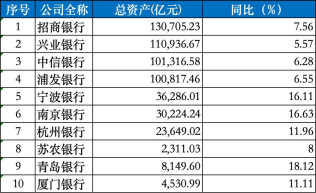
中信、浦发资产规模破十万亿,城商行保持两位数高增 具体来看,中信银行、浦发银行资产规模双双迈入十万亿关口;9家银行实现营收净利双增长,城商行 增速表现亮眼;半数银行不良率下行,拨备出现回调但风险缓冲空间依旧充足。 截至目前,10 家上市银行 2025 年业绩快报首批亮相。整体上,行业规模扩张、盈利表现、风险管控三 大核心维度均呈现稳健向好态势。 2025年,10家银行总资产规模均实现了稳步增长,且部分银行资产规模上了新台阶。其中,招商银行资 产总额首次超过13万亿元,截至2025年12月31日,招商银行资产总规模13.07万亿元,较上年末增加 9184.87亿元,增幅7.56%;负债总额11.79万亿元,较上年末增加8710.63亿元,增幅7.98%。 兴业银行总资产也突破11万亿元,截至年末达11.09万亿元,同比增长5.57%。从核心业务来看,其各项 贷款余额5.95万亿元,同比增长3.70%;各项存款余额5.93万亿元,同比增速达7.18%,存款端增长势头 强劲。 值得关注的是,中信银行、浦发银行的资产规模双双迈进10万亿元大关。 而截至2025年末,中信银行、浦发银行双双迈过十万亿门槛,使该俱乐部成员 ...
被萝卜章骗走3.5亿,光大银行起诉招商银行、平安银行、中山证券等机构
Guan Cha Zhe Wang· 2026-01-30 07:32
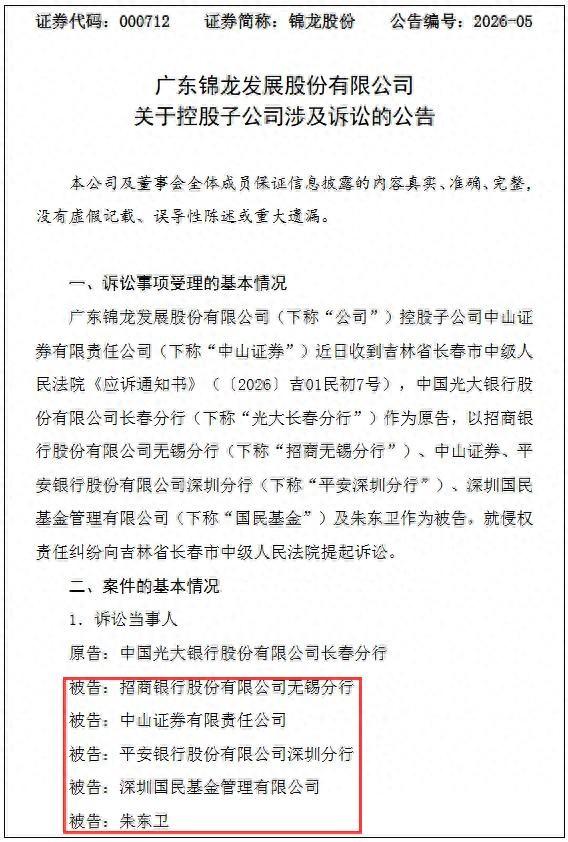
Core Viewpoint - Zhongshan Securities, a subsidiary of Jindong Co., is embroiled in a legal dispute involving approximately 490 million yuan, stemming from a financial fraud case that began 12 years ago [1][8]. Group 1: Lawsuit Details - The lawsuit was initiated by China Everbright Bank's Changchun branch against five defendants, including Zhongshan Securities, for tort liability [2][8]. - The case traces back to 2013 when Liu Xiaoyi, the legal representative of Liuhe Juxinyuan Rice Industry Co., misrepresented the company's financial status to secure a loan of 350 million yuan [3][4]. Group 2: Fraud Mechanism - Liu Xiaoyi collaborated with Zhang Lei, an assistant manager at Everbright Bank, to fabricate financial documents and mislead the bank into approving the loan [3][4]. - The fraudulent scheme involved a complex flow of funds, where Everbright Bank deposited 350 million yuan into China Merchants Bank, which was then transferred through Zhongshan Securities to Ping An Bank, ultimately reaching Liu's company [4][6]. Group 3: Legal Proceedings - After the fraud was uncovered in 2014, criminal charges were filed against Liu and Zhang, resulting in severe penalties, but only a small portion of the embezzled funds was recovered [6][7]. - In 2015, Everbright Bank filed a civil lawsuit against China Merchants Bank to recover the funds, but the Supreme Court ruled that the original agreement was invalid due to its fraudulent nature [7][8]. Group 4: Current Developments - In 2026, Everbright Bank reinitiated legal action, this time claiming tort liability and seeking a total of 489 million yuan, including principal and interest [8]. - The outcome of this case remains uncertain, with questions surrounding the liability of the involved banks and the potential for Everbright Bank to recover its losses from a decade-old fraud [9].


11 家大行去年理财代销增超万亿
Jing Ji Guan Cha Wang· 2026-01-30 02:45
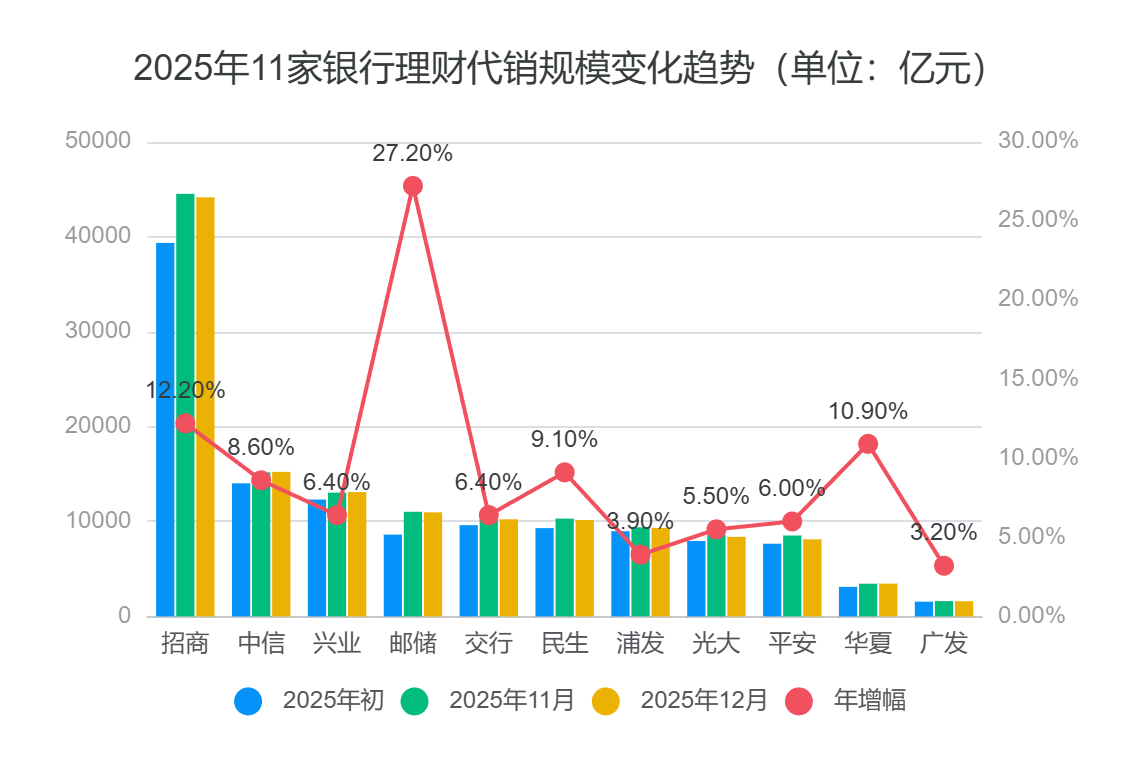
Core Viewpoint - The report highlights a decline in the scale of bank wealth management sales in December 2025, with a total of 13.46 trillion yuan, a decrease of 1.05% from November, but an increase of 10% from the beginning of the year. The growth is attributed to a "deposit migration" logic, indicating a shift in customer preferences towards wealth management products [2][6]. Group 1: Bank Performance - Postal Savings Bank showed a remarkable growth rate of 27.2%, leading among the 11 national banks, while China Merchants Bank followed with a 12.2% increase [2][4]. - In absolute terms, China Merchants Bank led with a wealth management sales scale of 4.41 trillion yuan, followed by CITIC Bank and Industrial Bank, each exceeding 1 trillion yuan [2][4]. - The ranking of the 11 banks remained relatively stable, with Postal Savings Bank rising from 7th to 4th place by the end of the year [2][4]. Group 2: Market Dynamics - The overall wealth management sales scale of the 11 banks increased by 1.22 trillion yuan, reflecting a 10% growth from the beginning of the year, with three banks (Postal Savings, China Merchants, and Huaxia) achieving growth rates above 10% [5][6]. - The average yield of wealth management products fell below 2% for the first time, at 1.98%, yet the number of investors increased by 14.37%, indicating a strong demand for stable-return products [8][9]. - The "deposit migration" narrative remains a key driver for the growth of wealth management, as banks focus on deeper market penetration and optimizing customer service [9][10]. Group 3: Future Outlook - Predictions suggest that by the end of 2026, the wealth management scale could reach approximately 38 trillion yuan, with a growth rate of around 12% [11]. - The average risk index is expected to gradually rise, and the proportion of long-term products is anticipated to increase, while T+0 products will decrease [11].



你的“年终奖”到账了吗?银行打响理财市场“抢收”大战
Xin Lang Cai Jing· 2026-01-30 00:54
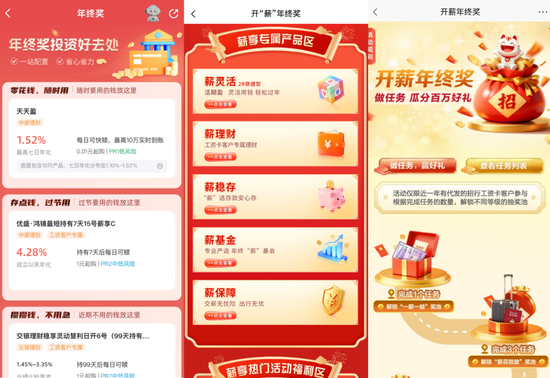
Core Viewpoint - Multiple banks are targeting the year-end bonuses of workers by launching exclusive financial products and promotional activities to attract customers [2][5][10]. Group 1: Year-End Bonus Financial Products - Several banks, including Postal Savings Bank, Bank of Communications, and China Merchants Bank, have introduced dedicated sections in their mobile banking apps for year-end bonus financial products [5][6][7]. - For example, Postal Savings Bank offers products like "Daily Earnings" with a maximum annualized rate of 1.52% and a low-risk product with an annualized rate of 4.28% [6]. - China Merchants Bank has a "Year-End Bonus" section that includes tasks for customers to unlock rewards, specifically targeting customers with salary accounts [7]. Group 2: Asset Allocation Strategies - Some banks are providing asset allocation strategies for year-end bonuses, suggesting a breakdown of funds into categories such as daily expenses, safety nets, stable investments, and growth investments [8]. - For instance, the Guangdong branch of China Construction Bank recommends allocating 10%-20% for daily expenses, 5%-10% for safety, 40%-60% for stable investments, and 10%-20% for growth [8]. Group 3: Market Trends and Data - As of the end of 2025, the total scale of the bank wealth management market reached 33.29 trillion yuan, an increase of 11.15% from the beginning of the year, with the number of investors growing by 14.37% [12][13]. - The report indicates that low-risk and medium-low-risk products dominate the market, with 95.73% of the total wealth management products falling into these categories [14]. - In 2025, wealth management products generated a total return of 730.3 billion yuan for investors, with an average yield of 1.98% [14].

21独家|去年银行理财代销大增 邮储劲增27%超越交行等
2 1 Shi Ji Jing Ji Bao Dao· 2026-01-29 09:49
Core Insights - The report highlights a decline in the scale of bank wealth management sales, with a total of 13.46 trillion yuan by December 2025, down 1.05% from November but up 10% from the beginning of the year [1][7] - Postal Savings Bank showed remarkable growth, leading with a 27.2% increase, while China Merchants Bank followed with a 12.2% increase [1][5] - The overall growth in wealth management sales is attributed to a "deposit migration" trend, where customers are shifting their funds into wealth management products [7][10] Group 1: Bank Performance - By December 2025, China Merchants Bank led with a wealth management sales scale of 4.41 trillion yuan, followed by CITIC Bank and Industrial Bank, both exceeding 1 trillion yuan [1][2] - Postal Savings Bank's rise in ranking from 7th to 4th among the 11 banks indicates a significant shift in market dynamics [2][4] - The total growth in wealth management sales among the 11 banks amounted to 1.22 trillion yuan, with a year-on-year increase of 10% [7][6] Group 2: Factors Driving Growth - The growth of Postal Savings Bank's wealth management sales is linked to strategic reforms and an expansion of distribution channels, with approximately 40,000 outlets enhancing customer reach [5][6] - The shift in focus from "product sales" to "product configuration" aims to cater to high-net-worth clients, which is seen as a crucial strategy for growth [5][10] - The demand for stable, low-volatility wealth management products remains strong, particularly in a low-interest-rate environment, driving customer interest [9][10] Group 3: Market Trends - The report notes a seasonal pattern in bank wealth management, characterized by "quarter-end contraction" and "quarter-beginning recovery," influenced by regulatory requirements [8][10] - Despite a slight contraction in December, the overall wealth management scale showed resilience, indicating strong underlying demand [8][9] - Predictions suggest that the wealth management scale could reach approximately 38 trillion yuan by the end of 2026, with a projected growth rate of around 12% [12]