CM BANK(03968)

Search documents
私人银行客户数两位数增长,“10万户俱乐部”扩容至7家
Di Yi Cai Jing· 2025-11-09 12:37
Core Insights - The domestic private banking sector continues to experience robust growth, with major banks reporting double-digit increases in private banking client numbers and assets under management (AUM) [1][2][3] Group 1: Client Growth and Market Dynamics - As of the end of Q3 2025, several banks, including Ping An Bank and China Merchants Bank, have seen their private banking client numbers grow significantly, with Ping An Bank surpassing 100,000 clients for the first time [1][2] - China Merchants Bank reported a 13.20% increase in private banking clients, reaching 191,418, while Ping An Bank's client base grew by 6.7% to 103,300 [2] - The total number of private banking clients exceeding 100,000 in China has reached seven, indicating a growing trend in the high-net-worth individual (HNWI) segment [1][3] Group 2: High-Net-Worth Individual Trends - The increase in private banking clients is attributed to the expanding base of high-net-worth individuals in China, which has reached 470,000, accounting for 20% of the global total [3] - New economic groups, particularly entrepreneurs and mid-level managers in technology, manufacturing, and pharmaceuticals, are contributing to the growth of private banking clients [3] Group 3: Service Evolution and Technology Integration - The private banking sector is shifting from a product-centric approach to a client-centric model, focusing on comprehensive wealth management and long-term client relationships [6][7] - Banks are enhancing their digital capabilities, with initiatives like AI-driven wealth management tools and 24/7 intelligent advisory services, which are increasing online transaction rates [5][6] Group 4: Competitive Landscape and Future Outlook - The competition among private banks is intensifying, with a shift in focus from the number of clients to the average AUM per client and overall client lifetime value [7] - Some banks are expected to streamline their client bases, concentrating on high-potential clients while reducing low-contribution clients [7]


你的支付优惠用了吗?各大银行加入双十一“狂欢”,算的什么账?
Sou Hu Cai Jing· 2025-11-08 00:51
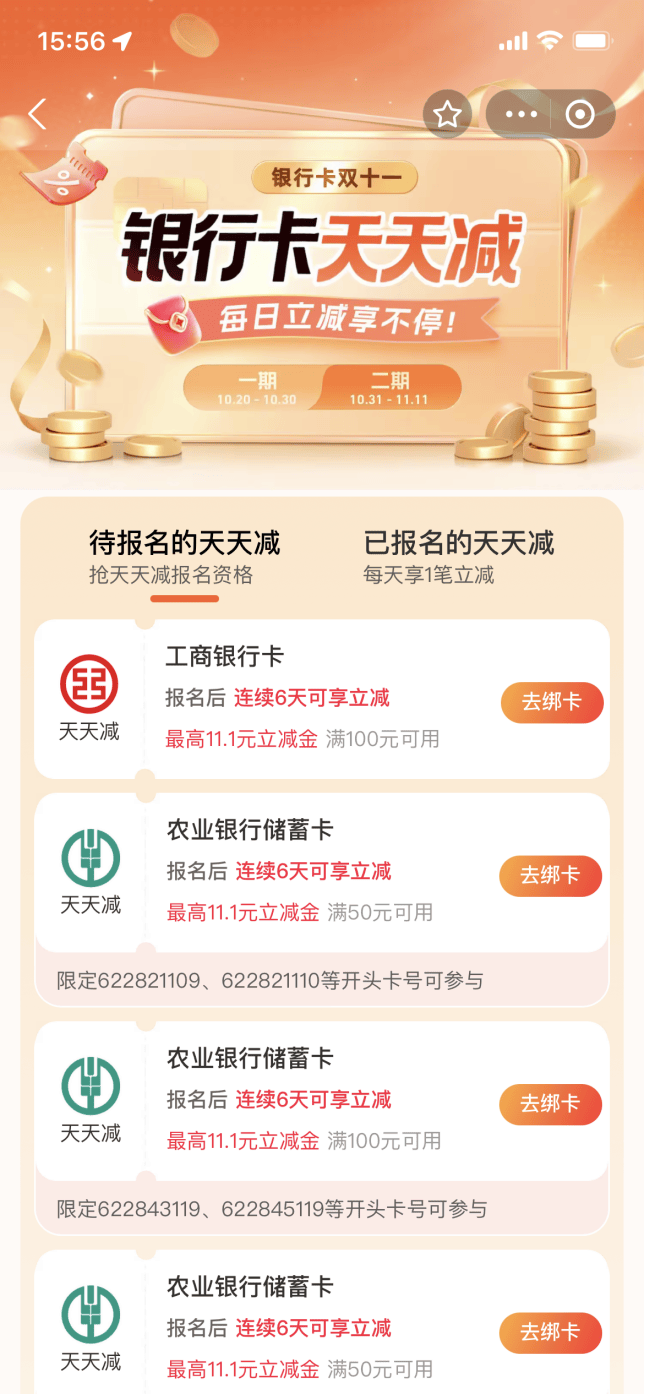
Core Viewpoint - The annual Double Eleven shopping season has officially started, with major commercial banks launching various promotional activities to stimulate consumer spending and boost business before the year-end [1][2]. Group 1: Promotional Activities by Banks - Major banks such as China Construction Bank, Bank of China, Agricultural Bank of China, and others have introduced cashback, discounts, installment benefits, and exclusive offers to attract consumers [1]. - Construction Bank offers a maximum discount of 400 yuan for credit card customers using installment payments on platforms like Alipay and Taobao, while Bank of China provides a random discount of up to 118 yuan for transactions made through Alipay [2]. - Other banks, including China Merchants Bank and Ping An Bank, have also launched various cashback and discount campaigns to engage customers during this shopping season [2]. Group 2: Strategic Insights - Experts suggest that the banks' promotional strategies represent a cost-effective method to acquire and retain customers, activating dormant accounts with low-cost random discounts [5]. - The focus on marketing during peak shopping seasons aims to enhance the usage of bank cards over third-party payment channels, thereby driving growth in credit and debit card transactions [5]. - Recommendations for banks post-Double Eleven include offering temporary credit limit increases and integrating with government consumption voucher programs to enhance customer experience and engagement [5].





智通ADR统计 | 11月8日
智通财经网· 2025-11-07 23:47
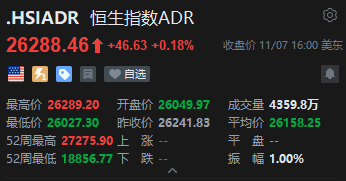
Market Overview - US stock indices showed mixed performance on Friday, with the Hang Seng Index ADR rising to 26,288.46 points, an increase of 46.63 or 0.18% compared to the Hong Kong close [1]. Major Blue-Chip Stocks - HSBC Holdings closed at 110.854 HKD, up 0.78% from the Hong Kong close; Tencent Holdings closed at 633.674 HKD, down 0.05% [2]. Stock Performance Summary - Tencent Holdings (00700) latest price: 634.000 HKD, down 10.000 HKD (-1.55%); ADR price: 81.480 USD [3] - Alibaba Group (09988) latest price: 160.100 HKD, down 4.900 HKD (-2.97%); ADR price: 166.340 USD [3] - HSBC Holdings (00005) latest price: 110.000 HKD, down 0.700 HKD (-0.63%); ADR price: 71.270 USD [3] - Xiaomi Group (01810) latest price: 42.240 HKD, down 1.200 HKD (-2.76%); ADR price: 27.000 USD [3] - AIA Group (01299) latest price: 81.500 HKD, up 0.300 HKD (0.37%); ADR price: 42.190 USD [3] - Meituan (03690) latest price: 102.000 HKD, down 1.300 HKD (-1.26%); ADR price: 26.270 USD [3] - JD.com (09618) latest price: 124.000 HKD, down 2.900 HKD (-2.29%); ADR price: 31.790 USD [3] - Kuaishou Technology (01024) latest price: 68.250 HKD, down 4.300 HKD (-5.93%); ADR price: 1.850 USD [3]





智通AH统计|11月7日
智通财经网· 2025-11-07 08:17
Core Insights - The article highlights the top and bottom AH premium rates for various stocks as of November 7, with Northeast Electric (00042) leading with a premium rate of 881.82% [1] - The article also provides a detailed ranking of stocks based on their deviation values, indicating significant discrepancies between H-shares and A-shares [1] AH Premium Rate Rankings - The top three stocks with the highest AH premium rates are: - Northeast Electric (00042): H-share at 0.275 HKD, A-share at 2.25 CNY, premium rate of 881.82%, deviation value of 47.50% [1] - Hongye Futures (03678): H-share at 3.600 HKD, A-share at 10.95 CNY, premium rate of 264.44%, deviation value of 26.95% [1] - Sinopec Oilfield Service (01033): H-share at 0.770 HKD, A-share at 2.31 CNY, premium rate of 259.74%, deviation value of 23.17% [1] - The bottom three stocks with the lowest AH premium rates are: - CATL (03750): H-share at 558.500 HKD, A-share at 395.37 CNY, premium rate of -15.21%, deviation value of 1.62% [1] - China Merchants Bank (03968): H-share at 51.250 HKD, A-share at 42.51 CNY, premium rate of -0.64%, deviation value of -2.86% [1] - Heng Rui Medicine (01276): H-share at 69.950 HKD, A-share at 61.74 CNY, premium rate of 5.72%, deviation value of 7.04% [1] Deviation Value Rankings - The top three stocks with the highest deviation values are: - Northeast Electric (00042): premium rate of 881.82%, deviation value of 47.50% [1] - Hongye Futures (03678): premium rate of 264.44%, deviation value of 26.95% [1] - Changfei Optical Fiber (06869): premium rate of 189.56%, deviation value of 26.59% [1] - The bottom three stocks with the lowest deviation values are: - COSCO Shipping Energy (01138): premium rate of 41.17%, deviation value of -13.87% [2] - China Eastern Airlines (00670): premium rate of 37.91%, deviation value of -11.53% [2] - China Life Insurance (02628): premium rate of 103.35%, deviation value of -11.12% [2]
招商银行南昌分行:以四维服务构建银发金融守护网
Zhong Guo Jin Rong Xin Xi Wang· 2025-11-07 07:18
Core Viewpoint - The Nanchang branch of China Merchants Bank is enhancing its services for elderly clients by creating a comprehensive service network that emphasizes warmth, care, and personalized attention during the Double Ninth Festival [1] Group 1: New Service Paradigm for the Elderly - The bank is focusing on optimizing the service environment and processes to cater to the specific needs of elderly clients, including visual and mobility considerations [2] - All branches are undergoing renovations to create elderly-friendly spaces, featuring large fonts for signage and comfortable seating [2] - Special service protocols have been established, including priority service windows for elderly clients to facilitate quick transactions without waiting in line [2] Group 2: Human-Centered Care Experience - Personalized interactions are being emphasized to make elderly clients feel respected and valued beyond just transactional relationships [3] - The bank has introduced unique services such as "anti-fraud health tea" and educational materials to raise awareness about fraud while providing a comfortable environment [3] - During the Double Ninth Festival, the bank engaged over 180 elderly clients through various activities aimed at educating them about fraud prevention [3] Group 3: Comprehensive Service Ecosystem - The bank is extending its services beyond physical branches by integrating community engagement and outreach programs [4] - Activities such as outdoor movie screenings and financial consultations in community spaces have attracted significant participation from elderly residents [4] - A financial service team is proactively visiting elderly clients at home to assist with banking needs and provide festive gifts [4] Group 4: Risk Prevention Measures - A comprehensive risk control system has been established, focusing on fraud prevention through education and proactive measures [6] - Regular training on fraud cases is conducted for staff to ensure they can identify and respond to potential scams effectively [6] - The bank has successfully intervened in potential fraud cases, demonstrating its commitment to safeguarding elderly clients [6]
多家股份行城商行前三季发力个人房贷
Feng Huang Wang· 2025-11-07 02:27
Core Insights - The latest reports indicate a significant increase in personal housing loans from several listed banks, contrasting with the decline observed in state-owned banks' mortgage lending [1][2][6][7] Group 1: Personal Housing Loan Growth - Nearly ten listed banks, including Minsheng Bank, Ping An Bank, and others, reported a clear increase in personal housing loans by the end of Q3 compared to the beginning of the year [1][2] - Specific banks like Ping An Bank reported a housing loan balance of 3,523.50 billion yuan, growing by 8.1% from the beginning of the year [2] - Minsheng Bank's mortgage loan balance increased by 180.41 billion yuan, marking a growth of 3.24% [2] Group 2: State-Owned Banks' Decline - The six major state-owned banks experienced a reduction of over 1,000 billion yuan in personal housing loans in the first half of the year, continuing a downward trend for three consecutive years [1][6] - By the end of Q3, the total personal housing loan balance for these banks was approximately 25.086 trillion yuan, reflecting a decrease of 1,078 billion yuan since the beginning of the year [6] Group 3: Market Dynamics and Regional Insights - The demand for housing loans remains strong in certain regions, such as Jiangsu, Zhejiang, and Shanghai, prompting banks to increase mortgage lending [4][5] - The new personal housing loans issued in key economic regions accounted for 87.70% of the total new loans issued by Shanghai Pudong Development Bank, indicating a regional focus in lending strategies [3] Group 4: Overall Market Trends - As of the end of Q3 2025, the total personal housing loan balance in the market was 37.44 trillion yuan, showing a year-on-year decline of 0.3% despite the growth from smaller banks [7] - The overall trend suggests that while some smaller banks are increasing their mortgage lending, it is not sufficient to offset the overall decline in the personal housing loan market driven by the larger state-owned banks [7]



智通港股沽空统计|11月7日
智通财经网· 2025-11-07 00:31
Short Selling Ratios - Anta Sports (82020) has the highest short selling ratio at 100.00% with a short selling amount of 440,500 HKD [1][2] - Lenovo Group (80992) follows with a short selling ratio of 88.65% and a short selling amount of 803,600 HKD [1][2] - Xiaomi Group (81810) ranks third with a short selling ratio of 75.57% and a short selling amount of 1,474,100 HKD [1][2] Short Selling Amounts - Alibaba (09988) leads in short selling amount with 2.261 billion HKD and a short selling ratio of 16.63% [1][2] - Tencent Holdings (00700) is second with a short selling amount of 1.662 billion HKD and a short selling ratio of 19.83% [1][2] - Semiconductor Manufacturing International Corporation (00981) ranks third with a short selling amount of 926 million HKD and a short selling ratio of 10.37% [1][2] Deviation Values - Shengjing Bank (02066) has the highest deviation value at 60.67% with a short selling ratio of 72.42% [1][2] - Xiaomi Group (81810) also shows a significant deviation value of 47.28% [1][2] - The third highest deviation value is not specified but is noted to be 39.69% for an unspecified stock [1][2]




私行业务成银行“香饽饽”?七家客户数破10万大关
Xin Lang Cai Jing· 2025-11-07 00:20
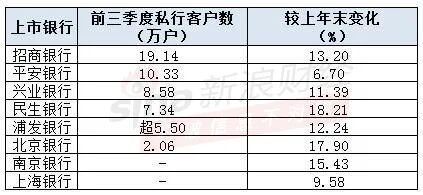
Core Insights - The private banking sector in China is experiencing significant growth, with several listed banks reporting an increase in private banking clients exceeding 10% [1][2][3] - Notably, Minsheng Bank, Beijing Bank, and Nanjing Bank have all reported client growth rates above 15% [1][2][3] - As of the end of September, the total number of private banking clients at Minsheng Bank reached 73,409, marking an 18.21% increase from the previous year [3][5] Private Banking Client Growth - Multiple banks have shown robust growth in private banking clients, with Minsheng Bank, Beijing Bank, and Nanjing Bank leading with growth rates over 15% [1][2][3] - As of September 30, 2023, the number of private banking clients at major banks is as follows: - China Merchants Bank: 191,418 clients, up 13.2% - Ping An Bank: 103,300 clients, up 6.7% - Minsheng Bank: 73,409 clients, up 18.21% - Beijing Bank: 20,586 clients, up 17.9% - Nanjing Bank: growth of 15.43% [3][5][6] Wealth Management Market Expansion - The wealth management market in China continues to expand, with listed banks reporting steady growth in wealth clients [8][9] - As of September 30, 2023, Ping An Bank reported 1.4911 million wealth clients, a 2.4% increase from the previous year [9] - Nanjing Bank's wealth clients grew by 16.31%, while Guiyang Bank's wealth clients increased by 7.77% [9] Asset Under Management (AUM) Growth - The total assets under management (AUM) for private banking clients at Minsheng Bank reached 1,014.72 billion yuan, an increase of 148.75 billion yuan, or 17.18% [3][5] - Beijing Bank's private banking AUM was 224 billion yuan, up 14.39% from the beginning of the year [4] Revenue from Wealth Management Services - Several banks reported positive growth in wealth management fee income, with many exceeding 15% growth [10][12] - For instance, China Merchants Bank's wealth management fee income reached 20.67 billion yuan, an 18.76% year-on-year increase [10] - Ping An Bank's wealth management fee income was 3.979 billion yuan, up 16.1% [10] Distribution and Sales Growth - The distribution of financial products has become a significant revenue source for banks, with many reporting substantial increases in sales [11][12] - For example, Ping An Bank's income from personal insurance sales grew by 48.7%, while its income from personal fund sales increased by 6.7% [12] - China Merchants Bank's income from fund sales rose by 38.76%, driven by increased sales and improved product structure [12]
5家银行不良率下降,零售AUM增长成亮点
Nan Fang Du Shi Bao· 2025-11-06 23:10
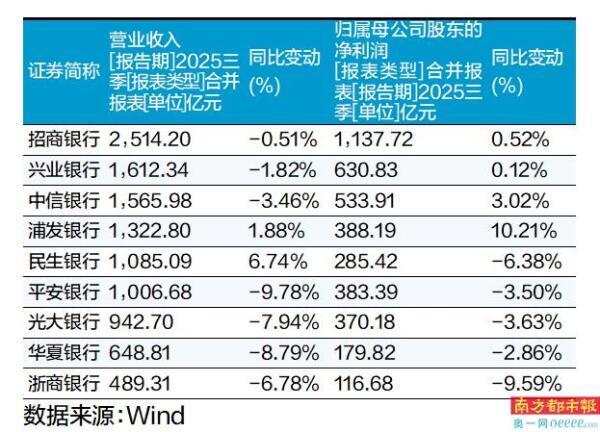
Core Viewpoint - The performance of A-share listed joint-stock banks in the third quarter of 2025 shows a mixed picture, with seven banks experiencing a year-on-year decline in operating income and five banks reporting a drop in net profit. Only Shanghai Pudong Development Bank achieved growth in both metrics [1][2][3]. Group 1: Revenue Performance - Among the nine listed joint-stock banks, only Shanghai Pudong Development Bank and Minsheng Bank reported year-on-year revenue growth, with Minsheng Bank achieving the highest growth rate of 6.74% [2]. - China Merchants Bank led in revenue scale with 2,514.20 billion yuan, followed by Industrial Bank and CITIC Bank with 1,612.34 billion yuan and 1,565.98 billion yuan, respectively [2][3]. - Ping An Bank experienced the most significant revenue decline at -9.78%, while several other banks, including Everbright Bank and Huaxia Bank, also saw declines exceeding 6% [2][3]. Group 2: Net Profit Analysis - China Merchants Bank maintained the highest net profit at 1,137.72 billion yuan, with a slight increase of 0.52% year-on-year. Shanghai Pudong Development Bank saw a notable increase of 10.21% in net profit [3]. - The banks that reported a decline in net profit include Zhejiang Commercial Bank, which had the largest drop at -9.59%, along with Minsheng Bank, Ping An Bank, and others experiencing varying degrees of decline [3]. Group 3: Interest Income and Net Interest Margin - Interest income growth varied significantly, with China Merchants Bank leading at 1,600.42 billion yuan and a 1.74% increase. Shanghai Pudong Development Bank had the highest growth rate in interest income at 3.93% [5]. - The net interest margin faced pressure across the industry, with CITIC Bank experiencing the largest decline of 16 basis points. Only Minsheng Bank reported a slight increase of 2 basis points [5][6]. Group 4: Asset Quality and Provision Coverage - The asset quality of joint-stock banks showed resilience, with a mixed performance in non-performing loan (NPL) ratios. China Merchants Bank had the best NPL ratio at 0.94%, while several banks saw slight increases in their NPL ratios [8]. - Provision coverage ratios decreased for most banks, with China Merchants Bank still leading at 405.93%, despite a decline of 6.05 percentage points [9][10]. Group 5: Loan Structure - The loan structure indicates a shift towards corporate loans, with all five banks reporting growth in corporate loans, while personal loan growth was weak for several banks [11][12]. - China Merchants Bank led in personal loan balance with nearly 3.7 trillion yuan, while corporate loan growth was particularly strong for CITIC Bank, which saw a 10.45% increase [11][12].
银行差异化应对“黄金征税”新政,黄金理财风向有变
Sou Hu Cai Jing· 2025-11-06 10:02
Core Viewpoint - The new gold tax policy, effective from November 1, 2025, distinguishes between "investment" and "non-investment" uses of gold, leading to significant adjustments in banking operations and investor behavior [1][2]. Group 1: Impact on Banking Operations - Major banks have temporarily suspended certain gold-related services, such as招商银行's "金生利" and工商银行's gold accumulation services, in response to the new tax policy [1][3]. - The new tax policy allows for VAT exemption on standard gold transactions through designated exchanges, while non-investment uses will incur a reduced VAT of 6% [2]. Group 2: Changes in Investor Behavior - Investors are shifting towards more rational investment strategies, with banks advising clients to limit gold investments to about 10% of their portfolios and to adopt a long-term holding approach [4]. - The demand for gold has surged, leading to increased prices and longer delivery times for gold products, with some banks adjusting their pricing strategies accordingly [3][4]. Group 3: Alternative Investment Products - With restrictions on physical gold, banks are promoting "paper gold" products, which allow for virtual trading of gold without the need for physical delivery, providing a more flexible investment option [6][9]. - "Paper gold" includes various forms such as gold accounts, gold ETFs, and gold futures, which offer advantages like low transaction costs and high liquidity [9].