BANK OF CHINA(03988)

Search documents
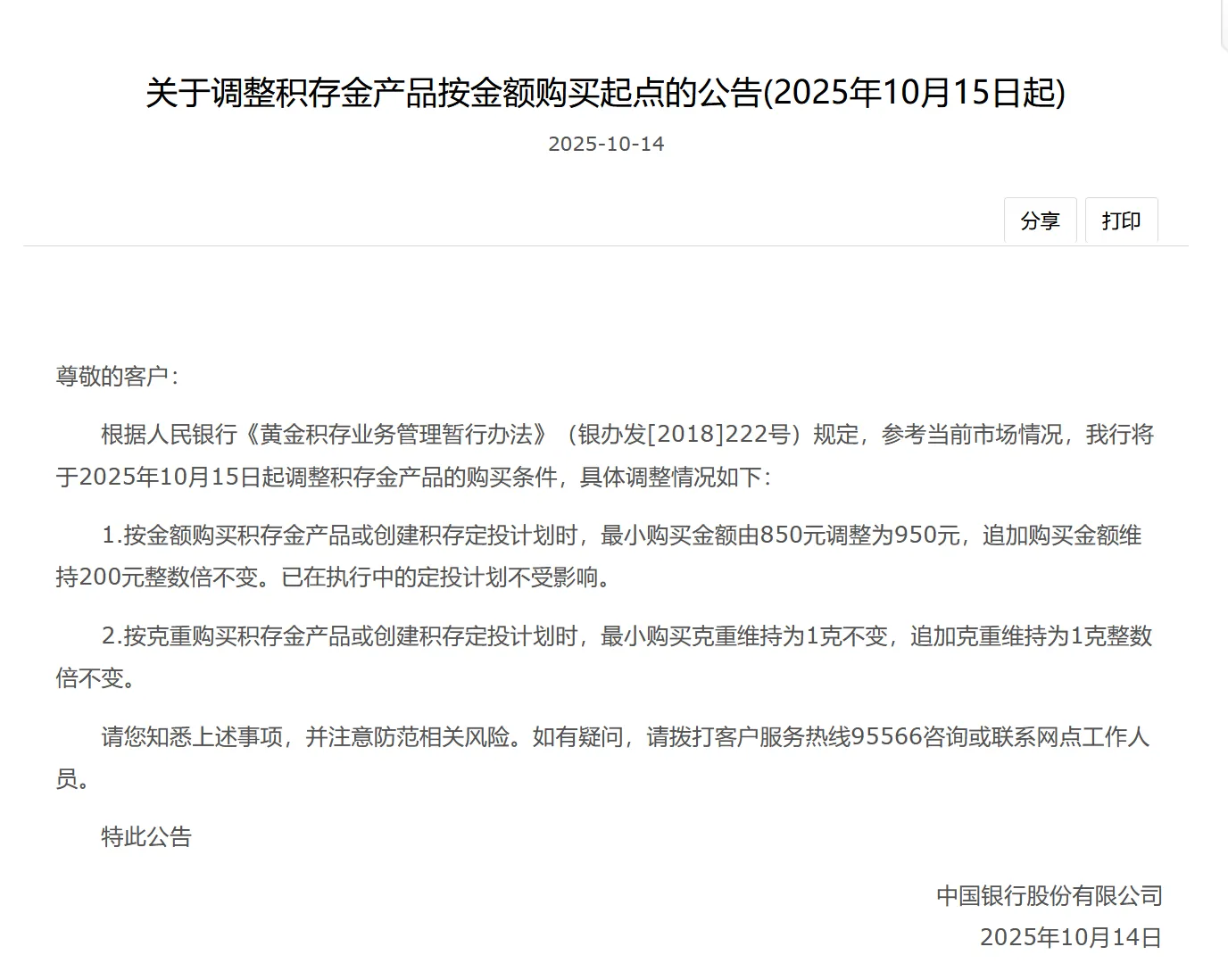
中国银行:10月15日起,将积存金产品最小购买金额由850元调整为950元
Cai Jing Wang· 2025-10-14 10:13
10月14日,中国银行发布公告称,根据人民银行《黄金积存业务管理暂行办法》(银办发[2018]222号)规定,参考当前市场情况,该行将于2025年10月15 日起调整积存金产品的购买条件,具体调整情况如下: 2.按克重购买积存金产品或创建积存定投计划时,最小购买克重维持为1克不变,追加克重维持为1克整数倍不变。 1.按金额购买积存金产品或创建积存定投计划时,最小购买金额由850元调整为950元,追加购买金额维持200元整数倍不变。已在执行中的定投计划不受影 响。 (中国银行) ...


“中国机构是迪拜金融中心发展的关键力量”
Guo Ji Jin Rong Bao· 2025-10-14 10:03
根据最新发布的全球金融中心指数(GFCI),迪拜正式跻身全球四大金融科技中心之列,成为中 东、非洲和南亚地区(MEASA)唯一入榜的全球领军金融中心。 这一成就的背后,迪拜国际金融中心(DIFC)功不可没。作为该地区首屈一指的全球金融枢纽, DIFC目前汇聚超过8000家企业和48000名专业人士。 过去十年间,DIFC首席执行官阿里夫·阿米里(Arif Amiri)带领DIFC实现了历史性的高速增长, 推动迪拜成为面向未来的金融发展引擎。同时,作为"未来技术与数字经济高级委员会"成员,阿米里正 致力于将DIFC打造为区域内人工智能(AI)、金融科技与数字资产的核心枢纽。 近日,阿米里在接受《国际金融报》记者的专访时表示,人工智能对金融业的改造将远不止"自动 化"。它将彻底重塑机构评估风险、服务客户、设计产品的底层逻辑。此外,他强调中国机构在DIFC的 快速集聚,正是双方共享发展机遇的有力体现。 目前,DIFC已成为阿联酋境内最受中国金融机构青睐的聚集地,中金公司、中国银行、工商银行 等多家头部机构均在此设立分支机构,以辐射中东、非洲及南亚等高增长市场。作为区域内唯一实现全 业态、规模化运营的金融中心,DIF ...


对低利率环境下国有大型商业银行净息差管理的思考|银行与保险
清华金融评论· 2025-10-14 09:39
Core Viewpoint - The article emphasizes that China's monetary policy has been moderately loose in response to a complex macroeconomic environment, leading to a sustained low interest rate environment. State-owned large commercial banks must focus on serving the real economy and create greater value in the context of high-quality economic development [2][4]. Group 1: Interest Margin Analysis - The net interest margin (NIM) of state-owned large commercial banks has been narrowing significantly due to the continuous decline in market interest rates. From the end of 2018 to the end of 2024, the average NIM of the four major banks is projected to decrease from 2.18% to 1.52%, a drop of 0.66% [6]. - The average loan yield for the four major banks has decreased from 4.34% in 2018 to 3.55% in 2024, a decline of 0.79%. Similarly, the average investment yield has fallen from 3.59% to 3.09%, a reduction of 0.5% [7][8]. Group 2: Cost of Interest-Bearing Liabilities - The average deposit interest rate for the four major banks increased from 1.47% in 2018 to 1.76% in 2024, raising the cost of interest-bearing liabilities by 0.29%. The proportion of deposits in interest-bearing liabilities has decreased from 83.79% to 78.64% during the same period [9]. - The net interest income has shown negative growth as the effect of expanding asset scale to offset the narrowing NIM has diminished. Starting from 2023, the positive scale effect can no longer compensate for the negative rate effect, leading to a decline in net interest income for some banks [10]. Group 3: Future Interest Rate Trends - The article suggests that the low interest rate environment in China may persist for a considerable time due to various internal and external factors, including economic slowdown and structural issues such as technological stagnation and the fading demographic dividend [12]. - Internationally, major developed economies have entered a rate-cutting cycle, with central banks like the Federal Reserve and the European Central Bank reducing rates in response to easing inflation pressures and slowing employment growth [13].


金价屡创新高带动“掘金”热,多家银行紧急出手降温
Di Yi Cai Jing· 2025-10-14 09:24
Core Viewpoint - Recent surges in international gold prices have prompted multiple banks to issue risk warnings regarding precious metal investments and to raise the minimum purchase amounts for gold accumulation products [2][3][4]. Group 1: Risk Warnings from Banks - Several banks, including China Construction Bank and Industrial and Commercial Bank of China, have issued warnings about increased volatility in precious metal prices, advising investors to enhance their risk awareness and manage their positions carefully [3][4]. - Banks are recommending that investors consider their financial situations and risk tolerance when investing in precious metals, emphasizing the importance of rational investment strategies [3][4]. Group 2: Changes in Investment Conditions - China Bank announced an increase in the minimum purchase amount for its gold accumulation products from 850 yuan to 950 yuan, effective October 15 [4]. - Industrial and Commercial Bank raised the minimum investment for its "Ruyi Gold Accumulation" product from 850 yuan to 1000 yuan, while maintaining a minimum accumulation of 1 gram [4]. - Ningbo Bank also increased its minimum purchase amount for gold accumulation from 900 yuan to 1000 yuan, highlighting the need for cautious investment decisions due to market volatility [4]. Group 3: Market Performance and Trends - October has been characterized as a "super month" for precious metals, with gold prices reaching historical highs, including a peak of 4085 USD per ounce on October 13 and a subsequent rise to over 4150 USD per ounce [5]. - Silver prices have also surged, with a peak of 53.579 USD per ounce on October 14, reflecting an annual increase of nearly 80% [5]. - The rising gold prices have led to increased consumer interest, with discussions about gold accumulation and ETF investments trending on social media platforms [5][6]. Group 4: Long-term Outlook for Gold Prices - Analysts believe that while short-term volatility poses risks, the long-term upward trend for gold prices remains intact, supported by ongoing central bank purchases and a shift in monetary policy [7][8]. - As of September, China's gold reserves reached 7406 million ounces, marking a continuous increase for 11 months, while global central banks collectively purchased 166 tons of gold in the second quarter [7]. - The anticipated continuation of interest rate cuts by the Federal Reserve is expected to further bolster gold's appeal as a safe-haven asset [7][8].
复旦张江(01349.HK)认购中国银行结构性存款产品
Ge Long Hui· 2025-10-14 09:07
Core Viewpoint - Fudan Zhangjiang (01349.HK) has entered into agreements with Bank of China to subscribe to structured deposit products totaling RMB 170 million using temporarily idle funds raised from its A-share public offering [1] Related Events - Fudan Zhangjiang (01349.HK) has subscribed to structured deposit products from Bank of China [1] - Fudan Zhangjiang (688505.SH) faced a setback as its drug application for Obecholic Acid Tablets for the treatment of primary biliary cholangitis was not approved [1]
中国工商银行、中国银行最新公告:上调!
Mei Ri Jing Ji Xin Wen· 2025-10-14 09:06
每经编辑|张锦河 10月14日,中国银行发布关于调整积存金产品按金额购买起点的公告。将于2025年10月15日起调整积存金产品的购买条件,具体调整情况如下: 1.按金额购买积存金产品或创建积存定投计划时,最小购买金额由850元调整为950元,追加购买金额维持200元整数倍不变。已在执行中的定投计划不受影 响。 2.按克重购买积存金产品或创建积存定投计划时,最小购买克重维持为1克不变,追加克重维持为1克整数倍不变。 另据媒体报道,10月14日14点30分,记者发现,支付宝工商银行积存金目前不可开户,提示原因为系统维护暂不可开户。 此前10月11日,工商银行网站发布通告,为顺应市场形势变化,我行将对如意金积存业务"按金额"积存方式的最低投资额进行调整:自北京时间2025年10月 13日起,该行如意金积存业务最低投资额(即积存起点金额)由850元上调至1000元;按克数积存的积存起点仍为1克。 积存金是银行发行的黄金产品,目前只有工商银行积存金可以通过支付宝买入。产品相关通知显示,自2025年8月28日起,蚂蚁财富工银积存金客户通过主 动积存方式买入工银积存金可享受0手续费优惠,卖出交易手续费维持不变,为交易金额的 ...
10月15日起!中国银行积存金产品按金额购买起点调整为950元
Bei Jing Shang Bao· 2025-10-14 08:57
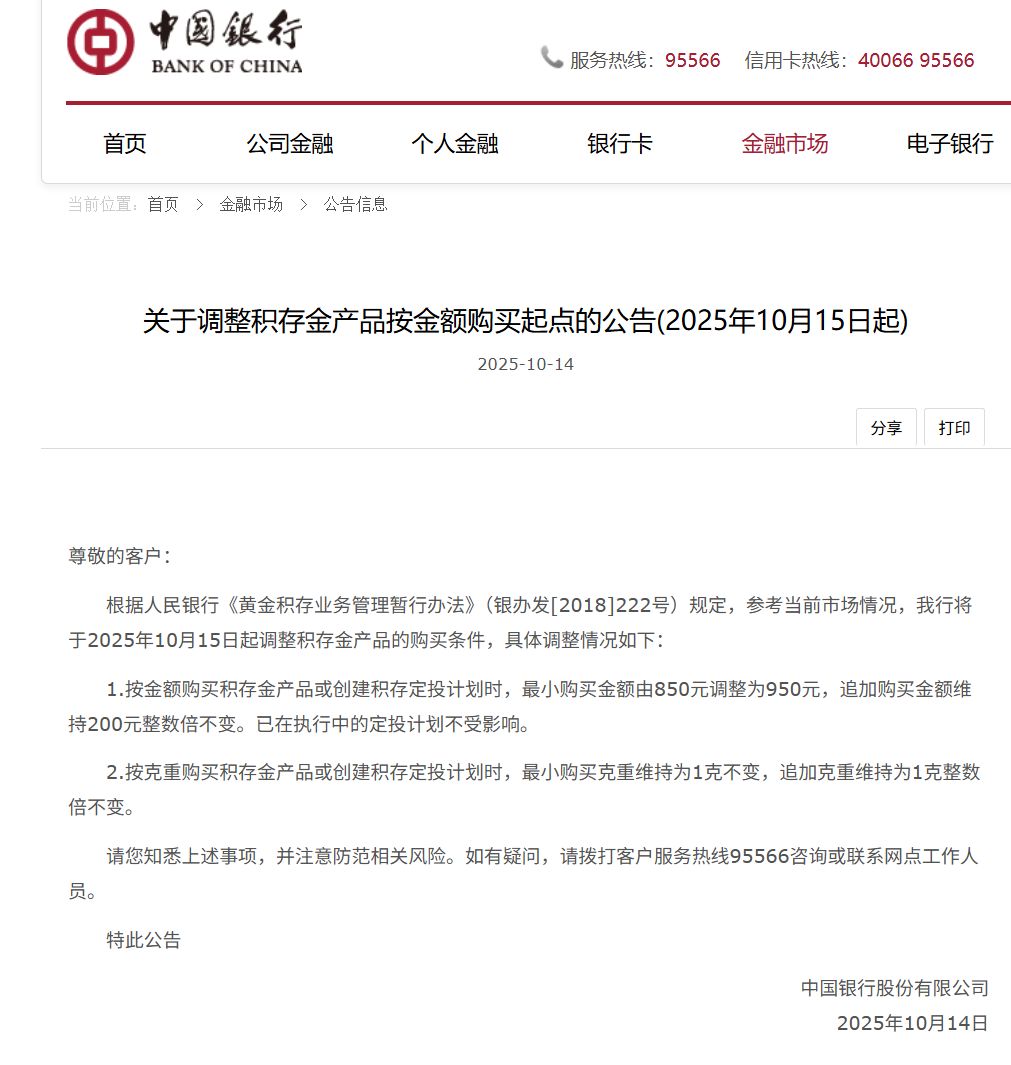
具体来看,按金额购买积存金产品或创建积存定投计划时,最小购买金额由850元调整为950元,追加购 买金额维持200元整数倍不变。已在执行中的定投计划不受影响。按克重购买积存金产品或创建积存定 投计划时,最小购买克重维持为1克不变,追加克重维持为1克整数倍不变。 北京商报讯(记者 宋亦桐)10月14日,中国银行发布《关于调整积存金产品按金额购买起点的公告》 指出,参考当前市场情况,该行将于2025年10月15日起调整积存金产品的购买条件。 ...
中国银行:上调积存金产品购买起点
Feng Huang Wang· 2025-10-14 08:16
中国银行发布关于调整积存金产品按金额购买起点的公告。将于2025年10月15日起调整积存金产品的购买条件,具体调整情况如下:1.按金额购买积存金 产品或创建积存定投计划时,最小购买金额由850元调整为950元,追加购买金额维持200元整数倍不变。已在执行中的定投计划不受影响。2.按克重购买 积存金产品或创建积存定投计划时,最小购买克重维持为1克不变,追加克重维持为1克整数倍不变。 支付宝工商银行积存金"暂不可开户" 记者发现,支付宝工商银行积存金目前不可开户,提示原因为系统维护暂不可开户。积存金是银行发行的黄金产品,目前只有工商银行积存金可以通过支 付宝买入,产品相关通知显示,自2025年8月28日起,蚂蚁财富工银积存金客户通过主动积存方式买入工银积存金可享受0手续费优惠,卖出交易手续费维 持不变为交易金额的0.5%(单笔最低手续费为0.01元),优惠活动截止日期为2025年11月8日。10月14日,现货黄金先涨后跌,截至发稿跌破4100美元/盎 司,现报4090美元/盎司。 ...
中国银行:上调积存金产品购买起点
财联社· 2025-10-14 08:02
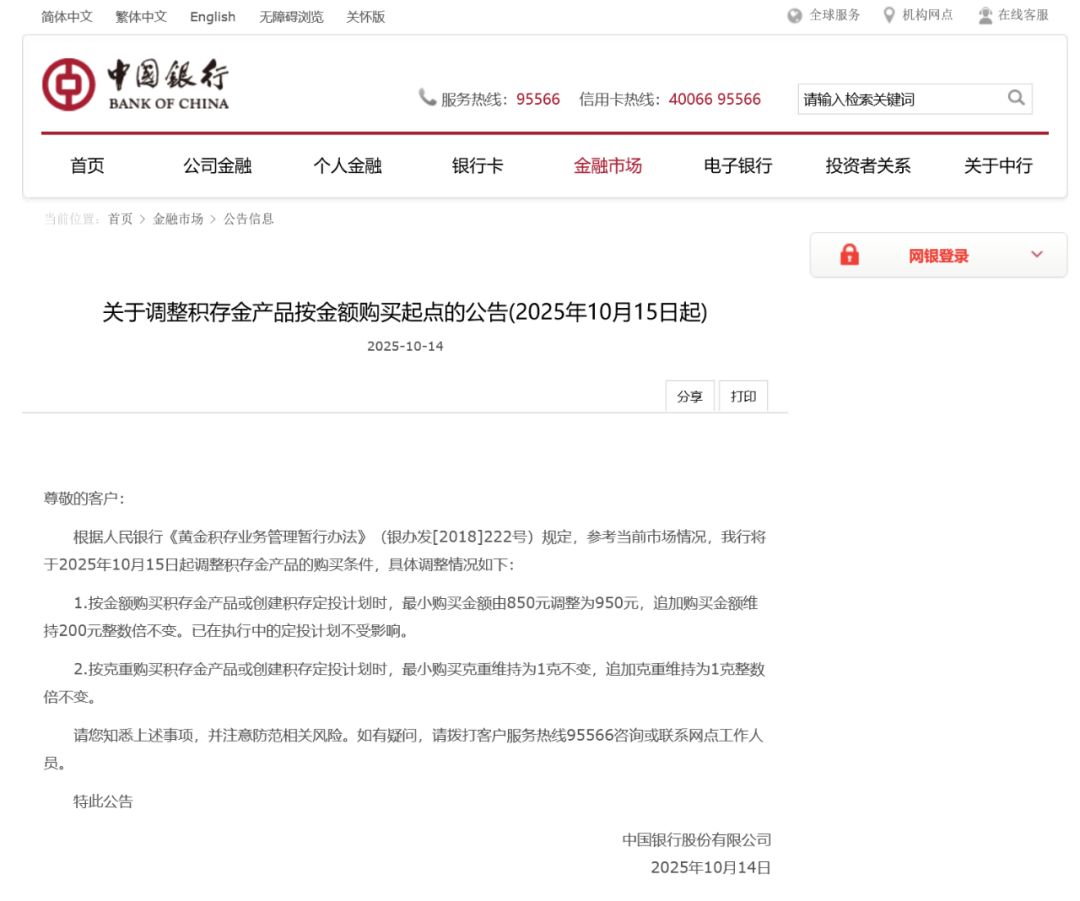
中国银行发布关于调整积存金产品按金额购买起点的公告。将于2025年10月15日起调整积存金产品的购买条件,具体调整情况如下:1.按金额购买积 存金产品或创建积存定投计划时,最小购买金额由850元调整为950元,追加购买金额维持200元整数倍不变。已在执行中的定投计划不受影响。2.按 克重购买积存金产品或创建积存定投计划时,最小购买克重维持为1克不变,追加克重维持为1克整数倍不变。 7x24h电报 头条新闻 VIP资讯 实时盯盘 支付宝工商银行积存金"暂不可开户" 记者发现,支付宝工商银行积存金目前不可开户,提示原因为系统维护暂不可开户。积存金是银行发行的黄金产品,目前只有工商银行积存金可以 通过支付宝买入,产品相关通知显示,自2025年8月28日起,蚂蚁财富工银积存金客户通过主动积存方式买入工银积存金可享受0手续费优惠,卖出 交易手续费维持不变为交易金额的0.5%(单笔最低手续费为0.01元),优惠活动截止日期为2025年11月8日。10月14日,现货黄金先涨后跌,截至发 稿跌破4100美元/盎司,现报4090美元/盎司。 下载财联社APP获取更多资讯 准确 快速 权威 专业 ...

常熟农商银行位列“中国银行业100强榜单”第75位
Jiang Nan Shi Bao· 2025-10-14 05:49
Core Insights - The China Banking Association released the "Top 100 Chinese Banks in 2025" list, with Changshu Rural Commercial Bank ranking 75th, an improvement of one position from the previous year, maintaining its status as the top county-level rural commercial bank for seven consecutive years [1] Financial Performance - As of June 30, 2025, Changshu Rural Commercial Bank reported total assets of 401.2 billion yuan, total deposits of 310.8 billion yuan, and total loans of 251.5 billion yuan, marking a significant scale of operations [1] - In the first half of the year, the bank achieved operating income of 6.062 billion yuan, a year-on-year increase of 10.10%, and net profit of 1.969 billion yuan, up 13.51% year-on-year, maintaining double-digit growth for 16 consecutive quarters [1] - The bank's non-performing loan ratio remained stable at 0.76%, indicating a balanced approach to quality and efficiency in its growth strategy [1] Business Strategy - The bank has implemented the "Changyin Microfinance" model to address financing challenges for small and micro enterprises, establishing a dual-track service network of "street running + data running" [1] - The balance of inclusive small and micro enterprise loans reached 104.3 billion yuan, while agricultural loans amounted to 139.2 billion yuan, demonstrating significant contributions to the real economy [1] Future Outlook - Looking ahead, Changshu Rural Commercial Bank plans to focus on five key areas: technology finance, green finance, inclusive finance, pension finance, and digital finance, aiming to create a distinctive financial service system [2] - The bank will concentrate on supporting small and micro enterprises and rural revitalization, fully committing to high-quality development in the new economic landscape [2]