STARBUCKS(04337)

Search documents
星巴克中国转身:用股权换取万家门店野心
Jin Tou Wang· 2025-11-04 13:48
Group 1 - Starbucks announced the sale of its China business control to Boyu Capital, with a transaction valuation of $4 billion, marking one of the largest divestitures by a global consumer goods company in recent years [1] - The investment from Boyu Capital is expected to accelerate Starbucks' expansion in China, where local competitors like Luckin Coffee offer significantly lower prices [1][3] - Starbucks aims to increase its market share in China, with plans to expand from the current 8,000 stores to over 20,000 [3] Group 2 - Boyu Capital will hold up to 60% of the new joint venture, while Starbucks retains 40% and will continue to license its brand and intellectual property [3] - Starbucks' market share in China has dropped from 34% in 2019 to 14% last year, indicating a significant decline in its competitive position [3] - Boyu Capital, established in 2010, has increased its investment in the consumer goods sector and has experience in enhancing operational efficiency for existing stores [5]



【西街观察】星巴克中国之变:资本化背后的本土化
Bei Jing Shang Bao· 2025-11-04 13:29
Core Viewpoint - Starbucks has announced the sale of its controlling stake in the Chinese market to Boyu Capital, marking a significant structural adjustment in its business model in China, driven by declining financial performance and increased competition [1][2]. Group 1: Business Strategy and Market Dynamics - The joint venture will see Boyu holding up to 60% of the equity, while Starbucks retains 40%, indicating a shift towards a more localized operational strategy [1]. - The rise of local competitors, particularly Luckin Coffee, has altered the market landscape, forcing Starbucks into price wars and diminishing its previous market dominance [1]. - New tea beverage brands have emerged rapidly, appealing to urban workers with lower operational costs and more flexible product offerings, further intensifying competition for Starbucks [1]. Group 2: Challenges and Transformation - The ongoing internal and external pressures have led to heightened performance anxiety for Starbucks, necessitating a change in strategy [2]. - Many foreign dining brands, including Starbucks, are re-evaluating their pricing strategies, expansion pace, and market strategies in response to changing market dynamics and consumer preferences [4]. - The core of the transformation focuses on better localization to stabilize their market position in China, adapting to the increasing online and delivery trends in the retail food industry [5].
博裕投资将控股星巴克中国
Mei Ri Jing Ji Xin Wen· 2025-11-04 13:20
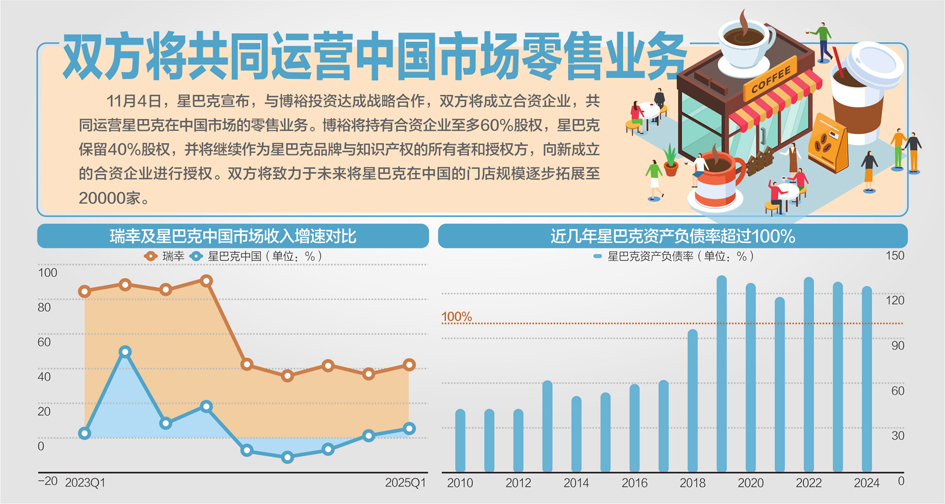
Core Viewpoint - Starbucks has entered a strategic partnership with Boyu Capital to establish a joint venture for its retail operations in China, marking a new chapter after 26 years in the market [1][3]. Group 1: Joint Venture Details - Boyu Capital will hold up to 60% equity in the joint venture, while Starbucks retains 40% and continues to own and license its brand and intellectual property [1]. - The enterprise value of the joint venture is approximately $4 billion, excluding cash and debt, which will determine Boyu Capital's corresponding equity [1]. Group 2: Market Potential and Growth Plans - Starbucks anticipates that the total value of its retail business in China will exceed $13 billion, comprising the equity transferred to Boyu Capital, retained equity, and future licensing revenue [3]. - The new joint venture will be headquartered in Shanghai and aims to expand Starbucks' store count in China from over 8,000 to 20,000 [4]. Group 3: Strategic Insights and Leadership - Starbucks' CEO Brian Niccol emphasized that Boyu Capital's local market expertise will accelerate Starbucks' expansion, particularly in smaller cities and emerging regions [4]. - Boyu Capital's partner Huang Yuzheng expressed a commitment to enhancing customer experiences through innovative and localized offerings [4]. Group 4: Historical Context and Comparisons - Boyu Capital, founded in 2011, has a diverse investment portfolio and has previously invested in notable projects such as Alibaba and NetEase Cloud Music [5][6]. - The partnership reflects a trend seen with other companies like Yum China and McDonald's, which have successfully accelerated growth in China by partnering with local investors [10][11].
星巴克怎么办
3 6 Ke· 2025-11-04 13:04
Core Insights - Starbucks has entered a new phase in China after 26 years, with Boyu Capital acquiring approximately 60% of Starbucks China for $4 billion, valuing the business at over $13 billion [1][2] - The acquisition is seen as a strong positive signal for the consumer market, with bidders offering valuations of 10 to 15 times the expected EBITDA for 2025 [2][3] - The competitive landscape has intensified, with new entrants like Luckin Coffee reshaping consumer preferences and market dynamics [9][13] Investment and Market Dynamics - Over 30 bidders participated in the acquisition process, including major private equity firms and tech companies, indicating strong interest in Starbucks China's potential [4][5] - The competitive bidding process reflects a broader trend of private equity and large corporations entering the Chinese consumer market [4][5] - Starbucks' previous market dominance is challenged by the rapid expansion of competitors like Luckin Coffee, which has surpassed Starbucks in store count [9][13] Operational Challenges - Starbucks faces increasing difficulties in expanding its store footprint, as landlords are now favoring emerging brands over established ones [13][14] - The company has closed several flagship stores in major cities, indicating a potential oversaturation in certain areas [14][15] - Expansion into lower-tier markets has not met expectations, with some stores struggling to break even [16][17] Strategic Recommendations - Investors have suggested that Starbucks should consider opening smaller stores and lowering prices to compete effectively [19][20] - However, Starbucks has rejected these suggestions, fearing that it would dilute its brand image [20][21] - The new partnership with Boyu Capital aims to expand the store count to 20,000, nearly doubling the current number of over 8,000 stores [21][22] Brand and Consumer Perception - Starbucks has historically been viewed as a premium brand, but changing consumer preferences and competition have eroded its market position [13][18] - The company is perceived as less innovative compared to competitors, with a slower pace of product development and marketing [27][28] - The need for a more localized approach to product offerings and marketing strategies is emphasized, similar to the successful model adopted by McDonald's in China [33][34] Future Outlook - The partnership with Boyu Capital is expected to enhance Starbucks' operational efficiency and market responsiveness [40][44] - The focus will be on improving customer experience, accelerating product innovation, and deepening localization efforts [44][45] - The success of this new joint venture will depend on effective resource integration and building trust between Starbucks and its new partner [45]

博裕投资40亿美元入主,星巴克中国换挡
Bei Jing Shang Bao· 2025-11-04 12:24
Core Viewpoint - Starbucks has announced a strategic partnership with Boyu Capital to establish a joint venture for its retail operations in China, aiming to expand its store count from 8,000 to 20,000 locations [1][5][6]. Group 1: Partnership Details - The joint venture will see Boyu Capital holding up to 60% equity, while Starbucks retains 40% [3][5]. - The enterprise value of the deal is approximately $4 billion, excluding cash and debt, with Starbucks' retail business in China valued at over $13 billion [3][5]. - The new joint venture will be headquartered in Shanghai and will manage the existing 8,000 Starbucks stores in China [3][5]. Group 2: Growth Strategy - The partnership aims to enhance customer experience, accelerate product and digital innovation, and expand into new cities and regions [3][5]. - Starbucks plans to focus on non-first-tier cities for its expansion, leveraging Boyu's local market expertise [5][7]. - The company is expected to innovate and possibly introduce sub-brands to penetrate deeper into the market [8]. Group 3: Market Context - The Chinese coffee market is highly competitive, with rivals like Luckin Coffee and Kudi Coffee rapidly expanding their store networks [7][8]. - Starbucks has been adapting its business model to local consumer preferences, emphasizing the need for a balance between speed of expansion and maintaining brand quality [6][8]. - The collaboration is seen as a way to enhance Starbucks' competitive edge by combining its brand strength with Boyu's local operational capabilities [6][7].
三大期指齐跌,科技股普跌;特斯拉跌2.5%,马斯克万亿美元薪酬被重要股东拒绝;星巴克40亿美元出售中国业务60%股权【美股盘前】
Mei Ri Jing Ji Xin Wen· 2025-11-04 12:17
Market Overview - Major U.S. stock index futures declined, with Dow futures down 0.98%, S&P 500 futures down 1.28%, and Nasdaq futures down 1.61% [1] Technology Sector - The technology sector saw a broad decline, with Palantir dropping nearly 8%, Oracle, Intel, and AMD falling over 2.5%, and Nvidia and Broadcom decreasing close to 2.5% [2] Chinese Stocks - Chinese stocks experienced a significant downturn, with Xpeng Motors down over 4%, Alibaba, JD.com, and NIO down over 3%, and Li Auto and Pinduoduo down approximately 2% and 1.5%, respectively [3] Tesla - Tesla's stock fell over 2.5% after the $1.9 trillion Norwegian sovereign wealth fund rejected CEO Elon Musk's proposed $1 trillion compensation plan, marking a significant investor decision [4] Supermicro - Supermicro, an AI server manufacturer, saw its stock decline nearly 3% ahead of its Q1 FY2026 earnings report, with market expectations for revenue at $5.83 billion, a 1.9% decrease year-over-year [4] Starbucks - Starbucks agreed to sell a 60% stake in its China business to private equity firm Boyu Capital for $4 billion to improve its operational performance in the Chinese market, resulting in a pre-market drop of over 0.5% [4] Denny's - Denny's stock surged nearly 50% in pre-market trading after announcing it would be acquired by a consortium, including TGI Fridays' owner TriArtisan Capital Advisors, for $620 million, including debt [4] Legal Issues - The new management team of the bankrupt American "First Brand" company filed a lawsuit against its founder and former CEO Patrick James, accusing him of fraudulently obtaining billions in financing and misappropriating funds [8] Government Shutdown - The U.S. federal government shutdown has reached its 35th day, tying the record for the longest shutdown in U.S. history, as bipartisan negotiations in the Senate have failed to pass a temporary funding bill [9] Economic Data - The final value of U.S. durable goods orders for September is set to be released at 23:00 Beijing time [10]


星巴克迎中国合伙人 能否撑起下沉市场的盈利预期?
Jing Ji Guan Cha Wang· 2025-11-04 11:53
Core Insights - Starbucks has entered a strategic partnership with Boyu Capital to form a joint venture for its retail operations in China, with Boyu holding up to 60% equity and Starbucks retaining 40% [2] - The estimated enterprise value of Starbucks' retail business in China exceeds $13 billion, which includes the value from the joint venture and ongoing brand licensing fees [2] - The partnership indicates a shift in control of Starbucks' operations in China to a local entity, reflecting a broader trend of foreign brands seeking local partnerships to enhance competitiveness [5][8] Financial Performance - In fiscal year 2024, Starbucks China reported revenues of $2.958 billion, a decline of 1.4% year-on-year, while fiscal year 2025 is expected to show a slight recovery with revenues projected at $3.105 billion, representing a 5% increase [3] Boyu Capital Overview - Boyu Capital is recognized as a top private equity firm in China, co-founded by former executives from China Ping An Group and TPG Capital, focusing on sectors like technology, consumer retail, and healthcare [4] - The firm has a diverse investment portfolio, including notable companies such as NetEase Cloud Music and Perfect Diary, and is known for its strategic investments in emerging markets [4] Market Dynamics - The Chinese consumer market is characterized by intense competition, with local brands employing aggressive pricing strategies to capture market share, posing challenges for foreign brands like Starbucks [5] - The partnership with Boyu Capital is seen as a necessary evolution for Starbucks to adapt to local market conditions and optimize its operations in lower-tier cities [6][7] Future Expansion Plans - The newly formed joint venture aims to expand Starbucks' store count in China from 8,000 to 20,000, indicating a significant growth strategy in the Chinese market [6] - The operational headquarters will remain in Shanghai, and the joint venture will focus on adapting to the unique challenges of the lower-tier market [6] Strategic Shift - Starbucks is transitioning from a direct operator to a brand licensor, which reduces operational risks and allows for a more flexible approach to market expansion [6][7] - This shift mirrors similar strategies employed by other foreign brands, such as McDonald's, which have sought local partnerships to enhance their market presence in China [8]

星巴克中国,卖了?
Xin Lang Cai Jing· 2025-11-04 11:37
Core Insights - Starbucks has announced a strategic partnership with Boyu Capital to establish a joint venture for operating its retail business in China [1][2] Group 1: Joint Venture Details - Boyu Capital will hold up to 60% equity in the joint venture, while Starbucks retains 40% and continues to own and license its brand and intellectual property [2] - The estimated total value of Starbucks' retail business in China exceeds $13 billion, comprising the equity transferred to Boyu, the retained equity value, and ongoing licensing revenue over the next decade [2] - The joint venture will be headquartered in Shanghai and manage approximately 8,000 Starbucks stores in China, with plans to expand to 20,000 stores in the future [2] Group 2: Market Potential and Strategy - Boyu Capital, founded in 2011, has a diversified investment management platform and aims to leverage its local market insights alongside Starbucks' global leadership in the coffee industry to accelerate growth [3] - Starbucks executives emphasize that this partnership will help unlock significant market potential, particularly in smaller cities and emerging regions in China [3] Group 3: Competitive Landscape - Starbucks China reported a revenue increase of 6% year-on-year to $831.6 million for the latest fiscal quarter ending September 28, 2025, and a projected annual revenue growth of 5% to $3.105 billion [4] - Despite positive growth, Starbucks faces intense competition from domestic brands like Luckin Coffee, which reported a 47% year-on-year revenue increase to $1.24 billion in Q2, along with a net profit growth of 44% [4] - Luckin Coffee continues to expand aggressively, with a total of 26,206 stores as of the end of Q2, reflecting a net increase of 2,109 stores [4]
星巴克中国易主,压力给到了瑞幸
3 6 Ke· 2025-11-04 11:24
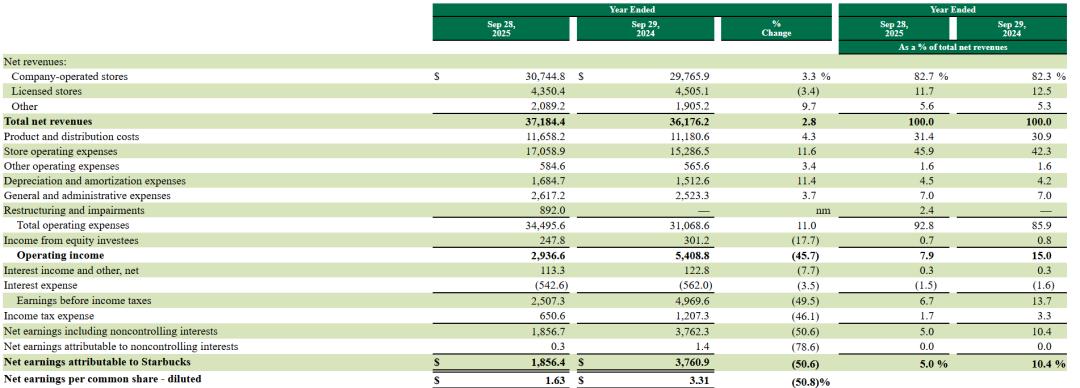
Core Viewpoint - Starbucks has officially announced a strategic partnership with Boyu Capital to establish a joint venture for operating its retail business in China, with Boyu holding up to 60% equity for approximately $4 billion, while Starbucks retains 40% [1][3]. Financial Performance - Starbucks reported a 5% year-over-year increase in global revenue for fiscal year 2025, with a notable 1% growth in same-store sales in Q4, marking the first positive growth in seven quarters [1][2]. - In fiscal year 2025, Starbucks' total revenue reached $37.18 billion, with net revenues from company-operated stores at $30.74 billion, reflecting a 3.3% increase [3]. - In China, Starbucks achieved total revenue of $3.105 billion for fiscal year 2025, a 5% increase year-over-year, with Q4 revenue at $831.6 million, up 6% [4][5]. Market Dynamics - The international segment of Starbucks performed well, with a 3% increase in same-store sales in Q4, driven by strong performances in markets like Japan, the UK, and Mexico [2]. - The Chinese market is seen as a crucial driver for overall growth, with significant contributions from product innovation, delivery service growth, and pricing optimization [4][6]. Competitive Landscape - Starbucks has engaged in aggressive pricing strategies, including a significant price reduction on several non-coffee products to compete in the "takeout war" among major delivery platforms [6][9]. - The company faces challenges from a competitive pricing environment, which may impact its premium brand positioning in China [8][9]. Operational Challenges - Despite the positive revenue growth, Starbucks' operating profit margin fell to 2.9% in Q4 from 14.4% a year earlier, primarily due to rising coffee bean prices [11]. - The company has been experiencing a decline in comparable store sales, with a 1% decrease attributed to a 5% drop in average transaction value [14]. Future Outlook - Starbucks aims to expand its store count in China to 20,000, focusing on lower-tier cities to capture a broader customer base [13]. - The company has entered 1,091 county-level markets in China, with a total of 8,011 stores, indicating a strategy to penetrate deeper into the market [14].
剑指20000家店,博裕资本控股星巴克中国,上半年“扫货”北京SKP、入股蜜雪冰城
3 6 Ke· 2025-11-04 11:19
Core Insights - Starbucks has established a strategic partnership with Boyu Capital to form a joint venture for its retail operations in China, marking a significant development in its 26-year history in the market [1][3][12] - Boyu Capital will hold up to 60% of the joint venture, while Starbucks retains 40% and continues to own the brand and intellectual property [1][3] - The total value of Starbucks' retail business in China is projected to exceed $13 billion, comprising the value from the joint venture, retained equity, and ongoing licensing revenue [1][3] Company Overview - The joint venture will be headquartered in Shanghai and aims to expand Starbucks' store count in China from 8,000 to 20,000 [3][12] - Starbucks' CEO Brian Niccol emphasized the importance of Boyu's local market expertise in accelerating growth, particularly in smaller cities and emerging regions [3][4] - Boyu Capital, founded in 2011, has a diverse investment portfolio and has previously invested in notable companies such as Alibaba and NetEase [5][9] Market Context - Starbucks reported a net revenue of 22 billion RMB in China for the fiscal year 2025, reflecting a nearly 5% growth, with same-store sales increasing by 2% and transaction volume by 9% in the fourth quarter [11][12] - The partnership is seen as a strategic move to enhance Starbucks' local market presence and adapt to the competitive coffee beverage landscape in China [12][13] - Historical precedents from other companies like Yum China and McDonald's China illustrate the potential benefits of local partnerships in accelerating market expansion [13]