咖啡零售

Search documents
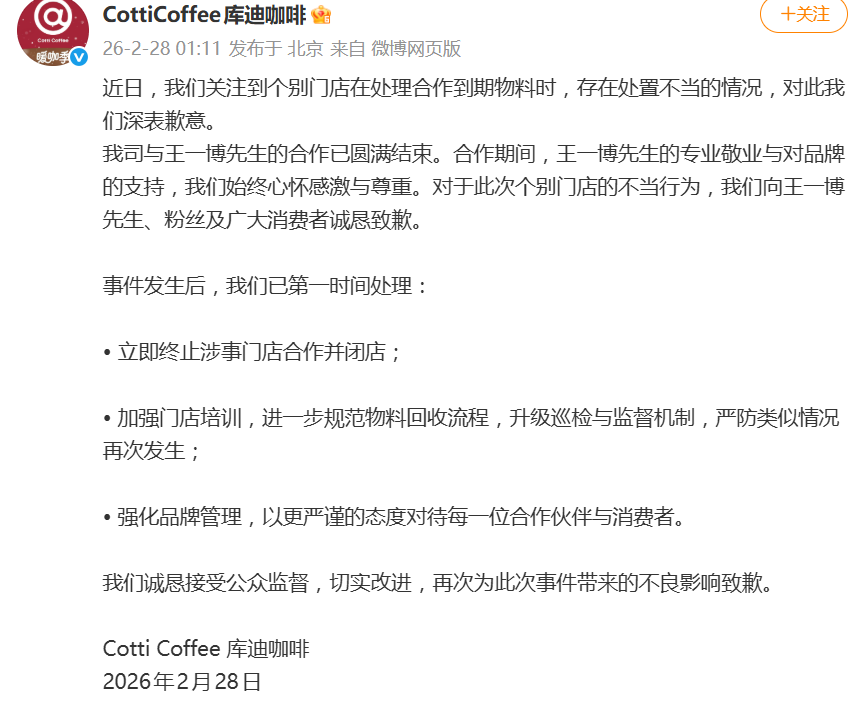
员工刻意剪碎王一博头像?库迪咖啡向王一博道歉:立即终止涉事门店合作并闭店,加强门店培训进一步规范物料回收流程
Jin Rong Jie· 2026-02-28 01:58
Core Viewpoint - Kudi Coffee issued an apology regarding the incident of maliciously destroying promotional materials featuring Wang Yibo's image, which sparked widespread outrage on social media [1][5]. Group 1: Incident Overview - The controversy began with a video circulating on social media showing staff at a Kudi Coffee store deliberately cutting and destroying promotional materials featuring Wang Yibo's image, which was perceived as disrespectful [3][4]. - The destruction of materials is a common practice in the fast-moving consumer goods and retail industry to avoid unauthorized use of an artist's image after contract expiration, but the manner of destruction and its public sharing were deemed inappropriate [3][4]. Group 2: Brand and Artist Relationship - Kudi Coffee and Wang Yibo have had a partnership since January 2024, with Wang Yibo becoming the global brand ambassador in January 2025, significantly boosting the brand's sales and international presence [4]. - The partnership ended on December 31, 2025, and the brand acknowledged the positive impact Wang Yibo had during their collaboration [4]. Group 3: Public Response and Brand Actions - Fans and the public demanded an apology from Kudi Coffee and called for serious consequences for those involved, as well as improved procedures for handling promotional materials [4][5]. - In response to the backlash, Kudi Coffee released a formal apology, admitting to improper handling of materials and outlining three key measures: terminating the partnership with the involved store, enhancing staff training, and improving material disposal processes [5][6]. Group 4: Legal and Ethical Implications - The incident highlights potential violations of the Civil Code of the People's Republic of China regarding the protection of an individual's portrait rights, as the actions taken by the store staff could be seen as infringing on Wang Yibo's rights [6]. - The situation serves as a reminder for brands to maintain respect and dignity in their partnerships, as a poorly handled separation can damage long-term brand trust [6].

2025年零售圈十大收购事件发布
Tai Mei Ti A P P· 2026-01-06 13:14
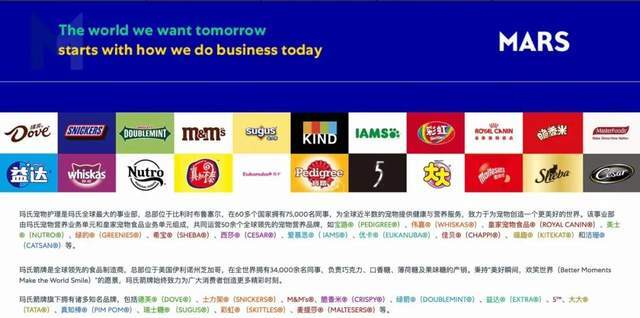
Core Insights - The retail industry experienced a significant wave of mergers and acquisitions in 2025, indicating a major capital reshuffle within the sector [1][27] - Major companies are either divesting non-core assets to focus on their main businesses or acquiring new brands to expand their portfolios [1][27] - Private equity firms are playing a crucial role in driving brand transformation and expansion in the retail sector [1][27] Group 1: Major Mergers and Acquisitions - Alibaba divested its stake in Suning and Intime Retail, marking a strategic shift to optimize resource allocation [3][26] - Mars, Incorporated completed the acquisition of Kellanova for approximately $35.9 billion, creating a global snack empire [5][7] - KKR acquired an 85% stake in Vista International, which is linked to the domestic beverage brand Da Yao, enhancing its control over the Chinese soda market [9][10] Group 2: Strategic Adjustments and Performance - After KKR's acquisition, Gao Xin Retail reported a revenue of 71.55 billion yuan, with a net profit of 386 million yuan, marking a turnaround from previous losses [4] - The acquisition of Kellanova by Mars is one of the largest in the packaged food sector in the last decade, highlighting the trend of consolidation among food giants [7][8] - CPE Yuanfeng's acquisition of Burger King China aims to accelerate local expansion with a commitment to invest $350 million [16][17] Group 3: Industry Trends and Future Outlook - The retail sector is shifting from scale expansion to lean operations, focusing on supply chain and brand value [2][27] - The relationship between brands and capital is evolving from mere financial support to active operational involvement, indicating a search for sustainable growth [27] - The ongoing mergers and acquisitions signal a re-evaluation of the value of physical retail, with supply chain and product strength becoming central to competition [27]


一边拼命开小店,一边砸钱做旗舰店,品牌到底在谋划什么?
Sou Hu Cai Jing· 2025-12-18 12:16
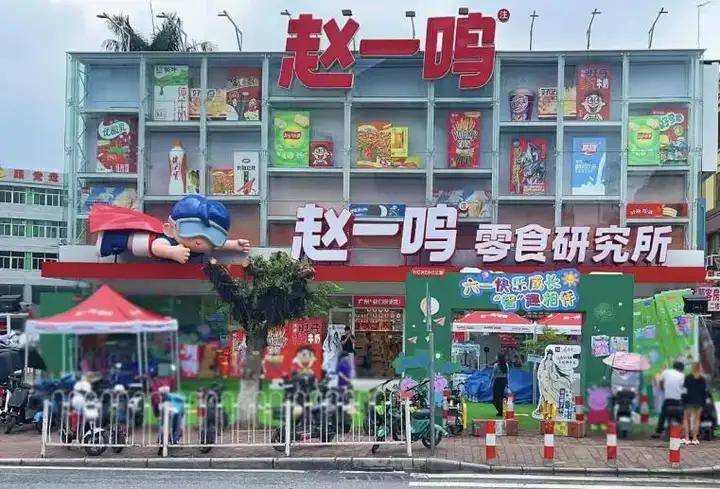
Core Insights - The commercial real estate sector is witnessing a dual strategy where brands are simultaneously opening small community stores and investing heavily in flagship stores in prime locations, indicating a shift in consumer habits and market trends [1][5] Group 1: Coexistence of Small and Large Stores - Small stores and flagship stores are growing together, with brands like Zhao Yiming Snacks utilizing a high-density layout strategy to cater to the convenience needs of urban consumers [2][4] - Flagship stores serve as immersive brand experiences, functioning as advertising platforms while also driving sales [2][5] Group 2: Transformation of Offline Store Functions - The evolution of brand perception has led to a redefined role for physical stores, which are now seen as specialized entities rather than mere sales channels [4][5] - Small stores benefit from lower rent and operational costs, allowing for efficient market penetration and immediate consumer engagement [4][5] Group 3: Consumer Behavior and Market Segmentation - The increasing stratification of consumer demand necessitates different operational models for small and flagship stores, with each fulfilling distinct roles within the brand ecosystem [5][6] - Small stores cater to high-frequency, immediate purchasing needs, while flagship stores provide unique social experiences and quality upgrades [5][6] Group 4: Challenges in the Dual-Store Model - The rise of online shopping has intensified competition for both small and flagship stores, as consumers increasingly prefer the convenience of e-commerce [9][11] - The high costs associated with creating and maintaining flagship stores pose significant challenges for brands, requiring careful management to ensure that enhanced experiences translate into sales [12][13] Group 5: Future Trends in Retail - The focus for small stores will shift towards improving operational quality and integrating into local communities, while flagship stores may evolve into multi-experience platforms that enhance brand identity [13][15] - Strong supply chains and digital capabilities will be essential for both small and flagship stores to meet consumer demands effectively and maintain competitive advantages [15][16]
京东旅行与尊茂酒店集团深化战略合作,七鲜咖啡在北京辰茂鸿翔酒店正式开业
Zhong Jin Zai Xian· 2025-12-03 07:59
Core Insights - The opening of Seven Fresh Coffee at Beijing Chenmao Hongxiang Hotel marks the first significant project following the strategic partnership between JD Travel and Zunmao Hotel Group, indicating a key step in innovating hotel formats and enhancing guest experiences [1][3] Group 1: Company Overview - Zunmao Hotel Group, a vice president unit of the China Tourism Hotel Association, focuses on creating deep integration of local culture and cuisine in its hospitality experiences, having received multiple awards including "China's Best Hotel Management Group" and "China Service Demonstration Enterprise" [3] - JD Travel, a subsidiary of JD Group, encompasses various sectors including hotel accommodation, transportation, tourism, and scenic parks, leveraging its supply chain capabilities to innovate and provide differentiated value in the hospitality industry [3] Group 2: Product and Service Innovation - Seven Fresh Coffee, a ready-to-drink beverage brand under JD Group, emphasizes using only fresh milk in its products, ensuring no creamers or plant-based fats are used, and employs low-temperature pasteurization and cold chain transportation for better taste and higher active protein content [3][5] - The launch of Seven Fresh Coffee in the hotel represents the first cross-industry integration between coffee and hotel services, aiming to create new consumption scenarios and explore additional business opportunities [5] Group 3: Future Plans and Collaboration - Both companies plan to establish a composite store in Shanghai Zunmao Hotel that integrates Seven Fresh Coffee and Seven Fresh Kitchen, indicating ongoing collaboration to explore diverse models of integrating hotel services with retail dining [5] - The partnership aims to enhance non-accommodation services in hotels, effectively converting idle spaces into value-added areas, while also attracting more online and offline traffic to the hotels [5]

商业秘密|咖啡豆涨价了咖啡店却不敢涨
Xin Lang Cai Jing· 2025-11-08 13:09
Core Insights - Coffee futures prices have surged significantly, with a peak of 437.95 cents per pound on October 23, marking a historical high and a year-on-year increase of 118.57% [1][2] - The rise in coffee prices is attributed to both market dynamics and unexpected weather impacts due to climate change, affecting global production [2] - The competitive landscape in the coffee retail sector is intense, with local brands outpacing international ones in store count and revenue, leading to pricing pressures [2][3] Price Trends - Coffee futures reached 336.4 cents per pound on December 10, 2022, up from 188.5 cents per pound on January 2, 2022, reflecting a cumulative increase of over 70% [1] - As of November 8, 2023, coffee futures were reported at 388.38 cents per pound, with a recent increase of 2.46% [1] - The ICE Arabica coffee futures saw a cumulative increase of 4.94% in the week ending November 7, 2023, contrasting with declines in sugar futures [1] Retail Challenges - Coffee retailers face a dilemma as rising raw material costs do not translate into higher retail prices due to fierce competition and consumer price sensitivity [3] - Many coffee shops are resorting to cost-cutting measures, such as reducing staff and store sizes, while increasing online sales to cope with high coffee bean prices [3] - The competitive pressure has led to a focus on new product offerings and lower prices, complicating the ability of retailers to pass on costs to consumers [3]
博裕投资将控股星巴克中国
Mei Ri Jing Ji Xin Wen· 2025-11-04 13:20
Core Viewpoint - Starbucks has entered a strategic partnership with Boyu Capital to establish a joint venture for its retail operations in China, marking a new chapter after 26 years in the market [1][3]. Group 1: Joint Venture Details - Boyu Capital will hold up to 60% equity in the joint venture, while Starbucks retains 40% and continues to own and license its brand and intellectual property [1]. - The enterprise value of the joint venture is approximately $4 billion, excluding cash and debt, which will determine Boyu Capital's corresponding equity [1]. Group 2: Market Potential and Growth Plans - Starbucks anticipates that the total value of its retail business in China will exceed $13 billion, comprising the equity transferred to Boyu Capital, retained equity, and future licensing revenue [3]. - The new joint venture will be headquartered in Shanghai and aims to expand Starbucks' store count in China from over 8,000 to 20,000 [4]. Group 3: Strategic Insights and Leadership - Starbucks' CEO Brian Niccol emphasized that Boyu Capital's local market expertise will accelerate Starbucks' expansion, particularly in smaller cities and emerging regions [4]. - Boyu Capital's partner Huang Yuzheng expressed a commitment to enhancing customer experiences through innovative and localized offerings [4]. Group 4: Historical Context and Comparisons - Boyu Capital, founded in 2011, has a diverse investment portfolio and has previously invested in notable projects such as Alibaba and NetEase Cloud Music [5][6]. - The partnership reflects a trend seen with other companies like Yum China and McDonald's, which have successfully accelerated growth in China by partnering with local investors [10][11].

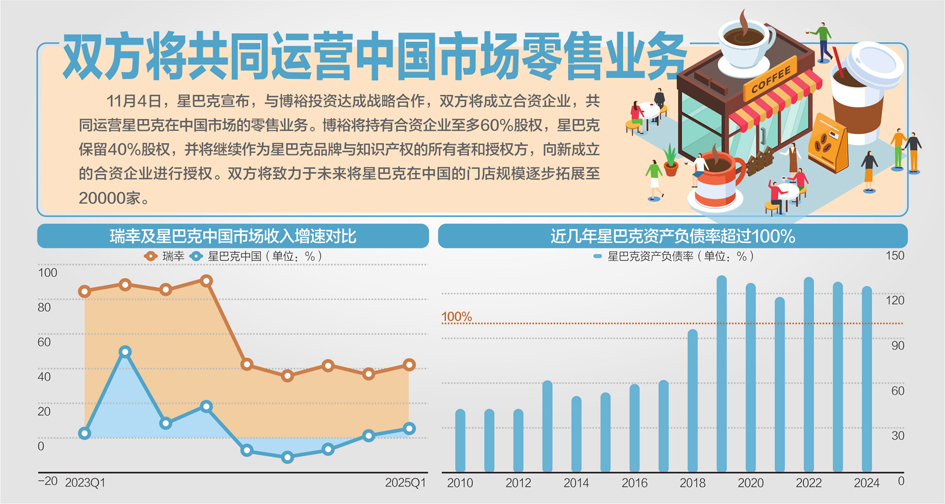
合资公司总部在上海,目标开店2万家!星巴克中国易主,新掌门大有来头:李嘉诚曾入股,买过北京SKP股权
Mei Ri Jing Ji Xin Wen· 2025-11-04 06:02
Core Insights - Starbucks has entered a strategic partnership with Boyu Capital to establish a joint venture for its retail operations in China, marking a significant shift in its business strategy in the region [1][3][9] - Boyu Capital will hold up to 60% of the joint venture, while Starbucks retains 40% and continues to own the brand and intellectual property rights [1][3] - The estimated enterprise value of the joint venture is approximately $4 billion, with Starbucks projecting its total retail business value in China to exceed $13 billion [1][3] Company Overview - The new joint venture will be headquartered in Shanghai and aims to expand Starbucks' store count in China from the current 8,000 to 20,000 [3][9] - Starbucks' CEO Brian Niccol emphasized that Boyu's local market expertise will accelerate growth, particularly in smaller cities and emerging regions [3][5] - Starbucks reported a net income of 22 billion RMB in China for the fiscal year 2025, reflecting a nearly 5% growth, with same-store sales increasing by 2% and transaction volume by 9% in the fourth quarter [9][10] Boyu Capital Profile - Boyu Capital, founded in 2011, is a leading alternative asset management firm in China, with a diverse investment portfolio exceeding 200 companies [6][7] - The firm has previously invested in high-profile companies such as Alibaba and has a strong presence in the consumer goods sector [6][9] - Boyu's recent acquisition of a 45% stake in Beijing SKP, valued at $4-5 billion, showcases its capability in large-scale mergers and acquisitions [6][7] Market Context - The partnership is seen as a strategic move for Starbucks to enhance its localization efforts in a competitive coffee market in China [10] - Historical precedents from other companies like Yum China and McDonald's indicate that partnerships with local investors can significantly accelerate market expansion [10]
剑指20000家店!博裕资本控股星巴克中国 上半年“扫货”北京SKP、入股蜜雪冰城
Mei Ri Jing Ji Xin Wen· 2025-11-04 03:38
Core Insights - Starbucks has established a strategic partnership with Boyu Capital to form a joint venture for its retail operations in China, with Boyu holding up to 60% equity and Starbucks retaining 40% [2][3] - The total value of Starbucks' retail business in China is expected to exceed $13 billion, comprising the equity transferred to Boyu, Starbucks' retained equity, and ongoing licensing revenue [2] - The joint venture will be headquartered in Shanghai and aims to expand the number of Starbucks stores in China from 8,000 to 20,000 [2] Company Overview - Starbucks' CEO Brian Niccol emphasized that Boyu's local market expertise will accelerate Starbucks' expansion, particularly in smaller cities and emerging regions [3] - Boyu Capital, founded by former executives from Ping An Group and TPG Capital, has a strong presence in the Chinese market and manages a portfolio of over 200 companies [4] - Boyu has been involved in significant investments in various sectors, including consumer goods and retail, showcasing its capability in large-scale acquisitions [6] Market Context - Starbucks reported a net income of 22 billion RMB in the Chinese market for the fiscal year 2025, reflecting a nearly 5% growth, with same-store sales increasing by 2% and transaction volume by 9% in Q4 [7] - The partnership aligns with Starbucks' strategy to enhance localization and adapt to the competitive coffee market in China [8] - Historical precedents from McDonald's and Yum China indicate that local partnerships can significantly accelerate store expansion in the Chinese market [9][10]
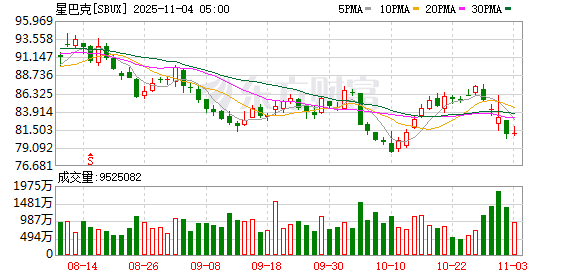
中石化易捷咖啡门店已突破千座,将持续深耕咖啡市场
Xin Lang Cai Jing· 2025-08-28 12:05
Core Insights - Sinopec Easy Joy Coffee has opened its 1000th store and first flagship store in Shanghai on August 28, marking a significant milestone in its expansion [1] - The coffee brand has established a presence in 23 provinces and 107 cities across China, leveraging over 8000 convenience store channels to sell freeze-dried and ready-to-drink coffee products [1] - The company aims to build a high-quality coffee service network nationwide, aspiring to become "China's largest travel coffee brand" [1] Company Overview - Easy Joy Coffee was founded in 2019 and benefits from Sinopec's extensive network of 31,000 gas stations and over 28,000 Easy Joy convenience stores [1] - The company has a significant membership base, utilizing private traffic to penetrate travel scenarios effectively [1] Future Strategy - The chairman of Sinopec Easy Joy Sales Co., Liu Zhihua, emphasized the commitment to deepening the coffee market and expanding the service network based on the "thousand-store" foundation [1]

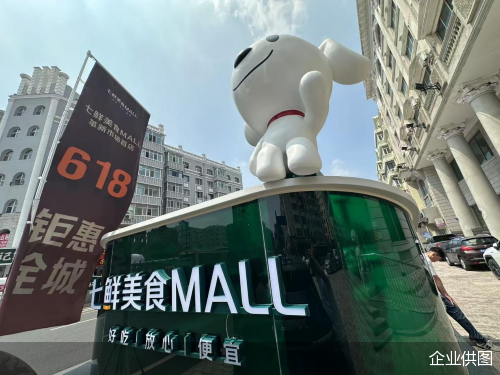
京东押宝供应链,七鲜美食MALL开业一个月,听听商家怎么说?
Bei Jing Shang Bao· 2025-08-08 11:32
Core Insights - JD.com has launched a new food delivery service, JD Takeout, which has gained significant traction since its inception on March 1, 2023, with a zero-commission model and employee benefits attracting many merchants [3][11] - The Seven Fresh Food MALL, a hybrid of offline dining and online delivery, opened on June 18, 2023, and has quickly become a popular destination, generating over 20,000 daily foot traffic and tripling its growth [3][8] - The integration of quality dining and delivery services at Seven Fresh Food MALL has established a new standard in the restaurant industry, focusing on supply chain innovation and cost reduction for merchants [4][13] Group 1: Business Model and Strategy - The Seven Fresh Food MALL combines over 30 dining brands, including traditional and trendy options, creating a unique culinary experience that appeals to both locals and tourists [3][4] - Merchants at the MALL benefit from JD's supply chain capabilities, which have significantly reduced their operational costs, allowing them to focus on quality and customer experience [11][12] - The MALL's model encourages cross-store ordering, enhancing customer convenience and increasing overall sales for participating brands [5][9] Group 2: Merchant Success Stories - Coffee Bear, a brand under the Microcosm Group, has successfully transitioned from B2B to B2C, achieving an average daily sales of 300 cups, which is double the sales of leading coffee chains [5][6] - Le Shou Yufang, a duck brand, reported a sales increase of 2-3 times after joining the MALL, selling 1,800 ducks in a week, equivalent to a month's sales at other locations [6][8] - The MALL has facilitated the launch of new products, such as the popular Erba Sauce Milk Tea, which has become a local sensation, driving additional sales for the brand [8][9] Group 3: Supply Chain and Operational Efficiency - JD's supply chain has enabled merchants to reduce their initial investment from 3 million to 200,000 yuan, allowing for a more agile business model [11][12] - The integration of real-time kitchen streaming and a dual evaluation system enhances transparency and quality control for both dine-in and delivery services [4][5] - The MALL's operational model has led to a significant increase in efficiency, with some brands reporting sales growth of 3-5 times after adopting a smaller footprint and streamlined processes [9][11]