MICROSOFT(04338)

Search documents
微软股价盘后大跌,支出创纪录新高且云业务增长放缓
Sou Hu Cai Jing· 2026-01-29 00:31
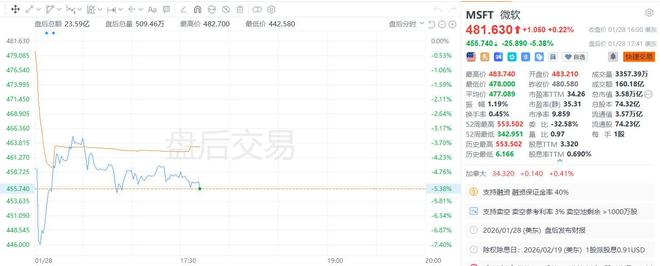
钛媒体App 1月29日消息, 微软股价大幅下跌,该公司支出飙升至历史新高,而云业务销售额增长放 缓,投资者担心其人工智能投资可能需要比预期更长的时间才能获得回报。第二财季资本支出达到375 亿美元,比上年同期增长66%,超过分析师预期的362亿美元。经汇率波动调整后,Azure云计算部门当 季营收增长38%,勉强符合分析师预期。但这一增速较上一季度放缓。该公司预计当前财季Azure销售 额将增长37%至38%。微软股价在盘后交易中下跌约7%,纽约常规交易时段收于481.63美元。(广角观 察) ...

微软(MSFT.US)财报亮眼却遭市场“用脚投票”:云业务增速微降 AI“狂烧钱”吓坏投资者
Zhi Tong Cai Jing· 2026-01-29 00:27
Core Viewpoint - Microsoft reported strong financial results for Q2 of FY2026, with revenue and profit exceeding Wall Street expectations. However, concerns over slowing growth in Azure cloud services and significant capital expenditures related to AI investments led to a sharp decline in its stock price post-announcement [1]. Financial Performance - For the second quarter ending December 31, Microsoft achieved revenue of $81.27 billion, a year-over-year increase of approximately 17%, surpassing the market expectation of $80.3 billion. Net profit reached $38.46 billion, translating to earnings per share of $5.16, significantly exceeding the expected $3.92. Adjusted earnings per share were $4.14, also above forecasts. Notably, the surge in net profit was partly due to changes in accounting treatment for investments in OpenAI, contributing an additional $1.02 to earnings per share [2]. Cloud Business Performance - Microsoft's "Intelligent Cloud" segment, including Azure, generated revenue of $32.91 billion, a nearly 29% year-over-year increase, slightly above expectations. However, the growth rate of Azure and other cloud services, which increased by 38% year-over-year at constant currency, showed a deceleration of one percentage point compared to the previous quarter. This slowdown raised concerns among investors betting on stronger cloud performance [3]. Capital Expenditures and AI Investment Concerns - Capital expenditures surged to $37.5 billion, a 66% year-over-year increase, exceeding analyst expectations of $36.2 billion. Approximately two-thirds of this expenditure was allocated to computing chips for data centers to meet AI demands. CEO Satya Nadella noted an increase of nearly 1 gigawatt in computing capacity during the quarter. Despite significant investments, the company faces challenges in rapidly expanding sufficient computing capacity to meet demand [4]. Remaining Performance Obligations (RPO) - The remaining performance obligations (RPO), representing future revenue under contract but not yet recognized, reached a record $625 billion, more than doubling year-over-year. This figure surpassed Oracle's reported $523 billion. However, 45% of Microsoft's RPO is tied to agreements with OpenAI, highlighting the company's deep reliance on this AI startup [4][5]. Other Business Segments - The Productivity and Business Processes segment, which includes Office, Dynamics, and LinkedIn, generated revenue of $34.12 billion, a 16% year-over-year increase, exceeding expectations. Microsoft also reported that its AI assistant, Microsoft 365 Copilot, has gained 15 million commercial user seats, indicating initial adoption momentum. Conversely, the More Personal Computing segment, which includes Windows, Xbox, Surface, and Bing, saw revenue decline by approximately 3% year-over-year to $14.25 billion, slightly below expectations, with gaming revenue down 9.5% [6]. Industry Competition and Stock Pressure - Microsoft is the first of the three major cloud service companies to report quarterly financial results, serving as a key indicator of the efficiency of AI investments among tech giants. Microsoft, Amazon, Google, and Meta are expected to collectively spend over $500 billion on AI this year. In contrast to Microsoft's post-earnings stock decline, Meta's stock surged following its announcement of increased AI spending, reflecting differing market expectations regarding AI strategies. Analysts noted that Microsoft's stock performance is closely tied to OpenAI's outcomes, particularly amid competition from Google's Gemini model and other emerging competitors [7].
科技巨头集体发榜:特斯拉Meta盘后跳涨 微软跳水
Di Yi Cai Jing· 2026-01-29 00:24
周三盘后,Meta、微软和特斯拉发布最新业绩。 新年以来,随着投资者试图判断人工智能的应用将如何颠覆此前龙头企业的商业模式,大盘科技股、软 件股与芯片股内部的分化态势正持续加剧。因此这些热门赛道公司的业绩,特别是资本开支状况受到了 广泛关注。 按照日程安排,苹果周四将披露最新业绩。 Meta公布利好营收预测,盘后涨逾7% 脸书母公司Meta盘后涨逾7%,超市场预期的销售额业绩指引提振市场情绪。公司第四财季营收598.9亿 美元,同比增长24%,市场预期 585.9 亿美元。调整后每股收益EPS 8.88 美元,预期8.23美元。 Meta预计一季度营收将在535亿至565亿美元区间,高于分析师514.1亿美元的预期值。 微软盘后股价跌近7%。微软智能云业务板块(含 Azure 云基础设施)营收达329.1亿美元,同比增长近 29%,略好于市场预期,不过Azure 云服务及其他云业务营收同比增长39%,而该业务在财年第一季度 的同比增速为40%。生产力和商业流程业务板块营收341.2亿美元,同比增长约16%,个人计算业务板块 营收142.5亿美元,同比下跌约3%。 截至本财年末,微软的商业剩余履约义务金额达62 ...


科技巨头集体发榜:特斯拉Meta盘后跳涨,微软跳水
Di Yi Cai Jing· 2026-01-29 00:15
苹果周四将发布业绩。 周三盘后,Meta、微软和特斯拉发布最新业绩。 微软发布第二财季财报显示,营收812.7亿美元,同比增长17%,市场预期802.7亿美元,净利润384.6亿 美元,合每股收益EPS 5.16 美元,较去年同期241.1 亿美元(合每股收益3.23 美元)大幅增长。 微软盘后股价跌近7%。微软智能云业务板块(含 Azure 云基础设施)营收达329.1亿美元,同比增长近 29%,略好于市场预期,不过Azure 云服务及其他云业务营收同比增长39%,而该业务在财年第一季度 的同比增速为40%。生产力和商业流程业务板块营收341.2亿美元,同比增长约16%,个人计算业务板块 营收142.5亿美元,同比下跌约3%。 新年以来,随着投资者试图判断人工智能的应用将如何颠覆此前龙头企业的商业模式,大盘科技股、软 件股与芯片股内部的分化态势正持续加剧。因此这些热门赛道公司的业绩,特别是资本开支状况受到了 广泛关注。 按照日程安排,苹果周四将披露最新业绩。 Meta公布利好营收预测,盘后涨逾7% 脸书母公司Meta盘后涨逾7%,超市场预期的销售额业绩指引提振市场情绪。公司第四财季营收598.9亿 美元,同 ...
微软(MESFT.US)财报亮眼却遭市场“用脚投票”:云业务增速微降 AI“狂烧钱”吓坏投资者
智通财经网· 2026-01-29 00:09
Core Viewpoint - Microsoft reported strong financial results for Q2 of FY2026, exceeding Wall Street expectations in both revenue and profit, but concerns over slowing Azure growth and record capital expenditures led to a significant drop in stock price after hours [1][2]. Financial Performance - For the second quarter ending December 31, Microsoft achieved revenue of $81.27 billion, a year-over-year increase of approximately 17%, surpassing the market expectation of $80.3 billion. Net profit reached $38.46 billion, with earnings per share (EPS) of $5.16, significantly exceeding the expected $3.92. Adjusted EPS was $4.14, also above expectations [2]. - The substantial increase in net profit was partly due to changes in accounting treatment for the investment in OpenAI, contributing an additional $1.02 to EPS [2]. Cloud Business Performance - Microsoft's "Intelligent Cloud" segment, including Azure, generated revenue of $32.91 billion, a nearly 29% year-over-year increase, slightly above expectations. However, the growth rate of Azure and other cloud services raised concerns [3]. - Azure and other cloud services revenue grew by 38% year-over-year at constant currency, matching analyst predictions but slowing by one percentage point from the previous quarter. This deceleration disappointed investors betting on stronger cloud performance [3]. Capital Expenditures and AI Investment Concerns - Microsoft reported a significant increase in capital expenditures, reaching $37.5 billion, a 66% year-over-year rise, exceeding analyst expectations of $36.2 billion. Approximately two-thirds of this expenditure was allocated to computing chips for data centers to meet AI demand [4]. - CEO Satya Nadella noted an increase of nearly 1 gigawatt in computing capacity during the quarter. Despite the substantial investment, the company faces challenges in rapidly expanding sufficient computing capacity to meet demand [4]. - The "remaining performance obligations" (RPO), indicating future revenue from signed contracts, reached a record $625 billion, more than doubling year-over-year. Notably, 45% of this figure is attributed to agreements with OpenAI, highlighting Microsoft's reliance on the AI startup [4][5]. Other Business Segments - The productivity and business processes segment, including Office, Dynamics, and LinkedIn, generated revenue of $34.12 billion, a 16% year-over-year increase, exceeding expectations. Microsoft also reported that its AI assistant, Microsoft 365 Copilot, has gained 15 million commercial user seats, indicating initial adoption momentum [5]. - The personal computing segment, which includes Windows, Xbox, Surface, and Bing, reported revenue of $14.25 billion, a slight year-over-year decline of about 3%, slightly below expectations. Game revenue decreased by 9.5% [6]. Industry Competition and Stock Pressure - Microsoft is the first of the three major cloud service companies to report quarterly financial results, serving as a key indicator of the efficiency of tech giants' AI investments. The total capital expenditure in AI by Microsoft, Amazon, Google, and Meta is expected to exceed $500 billion this year [7]. - In contrast to Microsoft's post-earnings stock decline, Meta's stock rose significantly after announcing increased AI spending, reflecting differing market expectations regarding AI strategies. Meta's projected annual capital expenditures are between $115 billion and $135 billion, above analyst estimates [7]. - Analysts noted that Google's strong performance with its latest Gemini model and the emergence of competitors like Anthropic are putting pressure on Microsoft's AI business and traditional software [7]. - Microsoft's stock closed at $481.63, experiencing a drop of over 7% in after-hours trading following the earnings report. Over the past three months, Microsoft's stock has declined approximately 11%, underperforming the S&P 500 index, which rose by 1% during the same period [7].
Meta第四季度营收同比增24%,盘后一度涨超11%;特斯拉Q4盈利高于预期,投资xAI 20亿美元;微软云业务增速放缓,资本支出创历史新高,盘后跌超7...
Mei Ri Jing Ji Xin Wen· 2026-01-29 00:08
当地时间1月28日,据媒体援引知情人士称,马斯克正计划将SpaceX的IPO时间安排在6月中旬——正值 罕见的行星连珠现象与他的生日期间。SpaceX计划融资规模高达500亿美元,估值约1.5万亿美元,将打 破沙特阿美2019年创下的290亿美元IPO纪录。有分析称,SpaceX公司将IPO日期放在6月份的原因之 一,或许就是马斯克的生日在6月28日,这在一定程度上凸显了马斯克对SpaceX公司的个人影响。另据 知情人士透露,该公司瞄准6月中旬上市,届时木星和金星将出现三年多来首次近距离相合。 点评:SpaceX拟于六月启动巨额IPO,潜在估值创历史新高,将引发全球资本市场高度关注。 NO.3Meta第四季度营收同比增24%,盘后一度涨超11% Meta周三盘后公布财报显示,公司第四季度营收598.9亿美元,同比增长24%,预估584.2亿美元;第四 季度广告收入581.4亿美元,同比增长24%,预估567.9亿美元;第四季度每股收益8.88美元,上年同期 8.02美元;第四季度经营利润247.5亿美元,同比增长5.9%。Meta称全年资本支出将达1150亿美元至 1350亿美元,超过分析师平均预期的1106 ...

微软股价盘后大跌 支出创纪录新高且云业务增长放缓
Xin Lang Cai Jing· 2026-01-28 23:56
微软股价大幅下跌,该公司支出飙升至历史新高,而云业务销售额增长放缓,投资者担心其人工智能投 资可能需要比预期更长的时间才能获得回报。 第二财季资本支出达到375亿美元,比上年同期增长66%,超过分析师预期的362亿美元。 经汇率波动调整后,Azure云计算部门当季营收增长38%,勉强符合分析师预期。但这一增速较上一季 度放缓。该公司预计当前财季Azure销售额将增长37%至38%。 微软股价在盘后交易中下跌约7%,纽约常规交易时段收于481.63美元。 该公司周三发布称,季度总销售额增长17%至813亿美元,每股收益为5.16美元。净利润增长主要得益 于微软对OpenAI的投资收益,该投资使每股收益增加了1.02美元。 分析师此前预计销售额为803亿美元,每股收益为3.92美元。 责任编辑:王永生 微软股价大幅下跌,该公司支出飙升至历史新高,而云业务销售额增长放缓,投资者担心其人工智能投 资可能需要比预期更长的时间才能获得回报。 第二财季资本支出达到375亿美元,比上年同期增长66%,超过分析师预期的362亿美元。 经汇率波动调整后,Azure云计算部门当季营收增长38%,勉强符合分析师预期。但这一增速较上一 ...
微软:按固定汇率计算,第三财季Azure及其他云服务收入增长预期为37%至38%。
Jin Rong Jie· 2026-01-28 23:17
本文源自:金融界AI电报 微软:按固定汇率计算,第三财季Azure及其他云服务收入增长预期为37%至38%。 ...
微软第二财季营收812.7亿美元
Xin Lang Cai Jing· 2026-01-28 23:06
Core Insights - Microsoft reported Q2 revenue of $81.27 billion, with a significant contribution from its cloud and productivity segments [1] - The intelligent cloud segment generated $32.91 billion, while the productivity and business processes segment brought in $34.12 billion [1] - Adjusted earnings per share for the second quarter were $4.14, but the stock fell over 7% in after-hours trading [1] Revenue Breakdown - Total revenue for the second fiscal quarter was $81.27 billion [1] - Intelligent cloud revenue accounted for $32.91 billion [1] - Productivity and business processes revenue reached $34.12 billion [1] Earnings Performance - Adjusted earnings per share for the quarter stood at $4.14 [1] - The market reacted negatively, with shares dropping more than 7% after the earnings announcement [1]
美股异动|微软云业务增长放缓 盘后一度下跌8%
Ge Long Hui A P P· 2026-01-28 22:55
格隆汇1月29日|微软(MSFT.US)的股价盘后一度下跌8%,尽管这家科技巨头公布了超出预期的第二财 季业绩。微软公布的调整后每股收益为4.14美元,营收为813亿美元。FactSet调查的分析师此前预计每 股收益为3.91美元,营收为803亿美元。投资者可能是在对该公司在Azure云服务方面的业绩做出反应。 该季度Azure的营收增长了39%。这一数据超过了华尔街预期的37.8%,但较第一财季40%的增速略有下 降。 ...