
MICROSOFT(04338)

Search documents
微软支出增加,云计算略超预期,引发人工智能回报担忧
Jin Rong Jie· 2026-01-28 21:54
Core Viewpoint - Microsoft's quarterly revenue slightly exceeded expectations, but the significant growth in its cloud computing business disappointed investors seeking higher returns, leading to a more than 7% drop in its stock price in after-hours trading [1] Group 1: Financial Performance - Microsoft's Azure cloud division reported a revenue growth of 39% in the second fiscal quarter, surpassing the market expectation of 38.8% [1] Group 2: Competitive Landscape - Microsoft has maintained a first-mover advantage in the AI race among major tech companies due to its early investment in OpenAI, which supports many of its products, including M365 Copilot [1] - The recent launch of Google's Gemini model and the release of autonomous agents like Anthropic's Claude Cowork pose risks to Microsoft's AI business and its long-standing software products [1] Group 3: Investor Sentiment - Ongoing investor skepticism regarding whether large tech companies can deliver sufficient returns to justify their investments in AI has put pressure on Microsoft's stock price [1]

微软第二季度营收812.7亿美元 云业务增速放缓 盘后跌超7%
Xin Lang Cai Jing· 2026-01-28 21:43
Core Insights - Microsoft reported a slowdown in cloud business growth, leading to an over 8% drop in stock price during after-hours trading, which later narrowed [2][10] - The adjusted earnings per share were $4.14, exceeding the expected $3.97, while total revenue reached $81.27 billion, above the anticipated $80.27 billion [10] - For the second quarter of fiscal year 2026, Microsoft announced a year-over-year revenue growth of 17% [10] Financial Performance - The net profit for the quarter was $38.46 billion, translating to an earnings per share of $5.16, up from $24.11 billion (or $3.23 per share) in the same quarter last year [10] - Azure and other cloud services revenue grew by 39%, slightly down from 40% in the previous quarter, with market expectations for this segment being 39.4% and 38.9% [10] - Other income for the quarter was $9.97 billion, a significant increase from an expense of $2.29 billion in the same quarter last year [10] Business Obligations - As of year-end, Microsoft's commercial remaining performance obligations reached $625 billion, a year-over-year increase of approximately 110%, largely due to a $250 billion cloud services agreement with OpenAI [11] - 45% of the commercial remaining performance obligations are related to OpenAI [11] Business Activity - The growth rate of commercial order volume surged from 112% in the first quarter to 230% [12] Segment Performance - Intelligent Cloud segment, which includes Azure, reported revenue of $32.91 billion, a nearly 29% year-over-year increase, surpassing analyst expectations of $32.40 billion [7] - Productivity and Business Processes segment, which includes Office software, Dynamics, and LinkedIn, generated revenue of $34.12 billion, a year-over-year growth of about 16%, exceeding the expected $33.48 billion [7] - More Personal Computing segment, covering Windows, Xbox, Surface, and Bing, reported revenue of $14.25 billion, a decline of about 3%, falling short of the expected $14.38 billion [7] Capital Expenditure and Strategic Moves - Microsoft is continuing to build data centers equipped with specialized chips to support generative AI models, and has also leased computing resources from CoreWeave and Nebius [8][14] - Capital expenditures and financing leases totaled $37.5 billion, a 66% year-over-year increase, exceeding analyst expectations of $34.31 billion [8][14] - Microsoft announced a price increase for commercial Office software subscriptions and secured a $30 billion cloud services deal with AI company Anthropic, which includes an additional agreement for up to 1 billion watts of computing power [8][14]


微软(MSFT.O)第二财季智能云营收329.1亿美元,机构预期为324.23亿美元。
Jin Rong Jie· 2026-01-28 21:21
本文源自:金融界AI电报 微软(MSFT.O)第二财季智能云营收329.1亿美元,机构预期为324.23亿美元。 ...
微软(MSFT.O)第二财季Azure和其他云服务收入增长38%。
Jin Rong Jie· 2026-01-28 21:21
本文源自:金融界AI电报 微软(MSFT.O)第二财季Azure和其他云服务收入增长38%。 ...
微软第二财季营收812.7亿美元,分析师预期803.1亿美元。智能云营收329.1亿美元,预期323.9亿美元
Hua Er Jie Jian Wen· 2026-01-28 21:02
Core Insights - Microsoft reported Q2 revenue of $81.27 billion, exceeding analyst expectations of $80.31 billion [1] - Intelligent Cloud revenue reached $32.91 billion, surpassing the forecast of $32.39 billion [1]
AI“烧钱竞赛”迎来关键检验!微软(MSFT.US)、Meta(META.US)财报成风向标
智通财经网· 2026-01-28 13:15
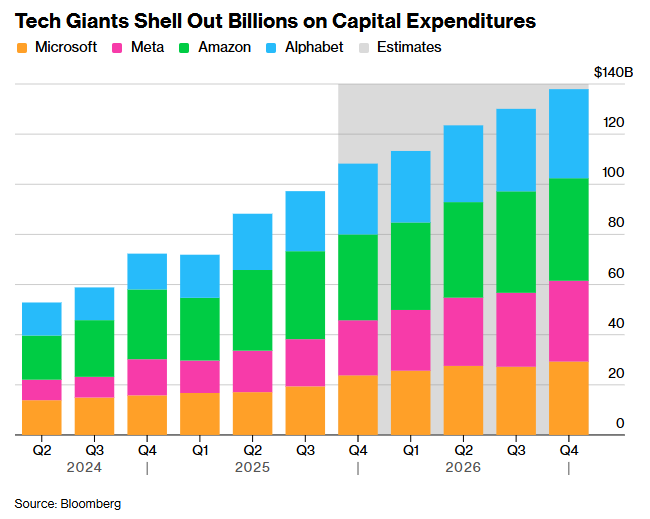
Core Viewpoint - Investors are concerned about the return on massive investments in artificial intelligence (AI) as Microsoft and Meta Platforms prepare to release their earnings reports, which may provide insights into the profitability of such expenditures [1][4]. Group 1: Company Earnings and Market Reactions - Microsoft and Meta are among the top four companies in the U.S. for AI spending, with a projected capital expenditure of approximately $505 billion in 2026, up from an estimated $366 billion in 2025 [1]. - Since the last earnings report on October 29, 2022, Microsoft's stock has dropped by 11%, while Meta's stock has decreased by about 10%, contrasting with a 1.3% increase in the S&P 500 index during the same period [1]. - Investors are closely monitoring the return on investment for these expenditures, with Jonathan Kofsky from Janus Henderson emphasizing that quarterly evaluations will be critical [1][4]. Group 2: AI Spending and Market Implications - Any indication that Microsoft and Meta plan to invest more than expected in AI could pressure their stock prices, while benefiting companies like Nvidia, Broadcom, and Micron that stand to gain from such spending [4]. - Seagate has reported strong demand for high-capacity hard drives, which is expected to continue at least until 2027, positively impacting the stock prices of related companies [4]. - Kofsky noted that investor expectations are that results will often meet or exceed the upper limits of projections, particularly for AI infrastructure companies like Nvidia and TSMC [4]. Group 3: Microsoft and Meta's Specific Challenges - For Microsoft, the focus will be on its Azure cloud computing business, which is experiencing strong demand for AI service development and operation [5]. - Azure's revenue is expected to grow by 38% year-over-year in the second quarter, following a 39% increase in the first quarter [5]. - Investors are also interested in the progress of Microsoft's Copilot product, which is a key AI software tool for office workers, although details on its contribution to overall sales growth remain limited [5]. Group 4: Meta's Growth Pressure - Unlike Microsoft, Meta lacks a cloud computing business and relies on AI to enhance advertising targeting and user engagement on its social media platforms [6]. - Meta faces significant pressure to demonstrate how its AI spending translates into growth, especially after a previous drop in stock price following its commitment to increased capital expenditures without clear return timelines [6]. - Market expectations for Meta's fourth-quarter revenue are optimistic, projecting a 21% increase to $58.4 billion, with earnings per share expected to rise by 2.1% to $8.19 [5].

微软、亚马逊财报:比起营收增速,投资者更担心被AI透支的订单积压
Hua Er Jie Jian Wen· 2026-01-28 13:14
Core Insights - The focus of Wall Street is shifting towards "remaining performance obligations," a metric indicating future sales backlog from long-term contracts in the cloud computing sector, as companies like Microsoft and Amazon report earnings [1][2] - The surge in long-term commitments from AI companies to cloud service providers is reshaping the competitive landscape of the cloud market, with Microsoft surpassing Amazon in new order backlog [1][3] - Concerns arise regarding the actual realization of these sales commitments, highlighted by Oracle's case where a significant increase in backlog did not translate to stock price gains due to doubts about profitability and execution [1][6] Group 1: Remaining Performance Obligations - "Remaining performance obligations" is gaining attention as a financial metric that reflects future sales from long-term contracts, particularly in the context of AI companies making substantial commitments to cloud providers [2] - Analysts note that when order backlog diverges from revenue growth, it becomes a critical indicator for investors to monitor [2] Group 2: Competitive Landscape - Amazon, while still holding the largest market share in cloud computing, has fallen behind Microsoft in terms of new order backlog since the launch of ChatGPT, with Google also emerging as a strong competitor [3] - Google's advancements in AI technology have allowed it to attract significant business from AI companies, altering the competitive dynamics in the cloud market [3] Group 3: Concerns Over Backlog Data - The data on order backlog has limitations, as different companies may have varying accounting methods, which can affect the comparability of the figures [4] - There are concerns about the reliability of these commitments, especially given past instances where companies renegotiated contracts to defer spending [4][5] Group 4: Oracle's Warning - Oracle's experience serves as a cautionary tale, where a massive increase in order backlog did not lead to positive market reactions due to skepticism about the profitability and realization of those contracts [6] - The market's response to the latest commitments from Microsoft, Amazon, and Google will be crucial in assessing investor sentiment regarding potential AI bubbles [6]

美股前瞻 | 三大股指期货齐涨 美联储利率决议来袭 微软、Meta、特斯拉盘后公布财报
智通财经网· 2026-01-28 12:12
盘前市场动向 1. 1月28日(周三)美股盘前,美股三大股指期货齐涨。截至发稿,道指期货涨0.04%,标普500指数期货涨0.37%,纳指期货涨 0.95%。 | = US 30 | 49,020.90 | 49,079.60 | 48,972.10 | +17.50 | +0.04% | | --- | --- | --- | --- | --- | --- | | = US 500 | 7,004.30 | 7.014.80 | 6,983.30 | +25.70 | +0.37% | | 트 US Tech 100 | 26,185.00 | 26,224.70 | 26,003.30 | +245.30 | +0.95% | 2. 截至发稿,德国DAX指数跌0.10%,英国富时100指数跌0.44%,法国CAC40指数跌0.96%,欧洲斯托克50指数涨0.03%。 | 德国DAX30 | 24,882.14 | 24,929.93 | 24,795.48 | -26.09 | -0.10% | | --- | --- | --- | --- | --- | --- | | 英国富时100 | 10,1 ...



微软“Maia 200”强化ASIC崛起叙事 高速铜缆、DCI与光互连站上自研AI芯片风口
智通财经网· 2026-01-28 07:23
Core Insights - The report from BNP Paribas highlights the launch of Microsoft's second-generation self-developed AI chip, "Maia 200," which is expected to trigger a new wave of investment in the AI computing power industry, particularly benefiting leaders in custom AI ASIC chips like Marvell and Broadcom [1][6] - Analysts predict that the market share of ASICs compared to NVIDIA's AI GPU clusters could significantly increase from the current ratio of 1:9/2:8 to nearly equal [1] - The ongoing AI infrastructure investment wave is projected to reach between $3 trillion and $4 trillion globally by 2030, driven by unprecedented demand for AI computing power [4] Group 1: AI Chip Market Dynamics - The trend of self-developed AI chips by cloud computing giants like Microsoft, Google, and Amazon is reshaping the AI ASIC and GPU landscape, with significant implications for data center interconnects and high-speed cabling [2][3] - Google’s TPU AI chip production is expected to surge, with projections of 5 million and 7 million units in 2027 and 2028, respectively, indicating a potential shift towards external sales of TPU chips [7] - The demand for AI ASICs is anticipated to triple by 2027, surpassing GPU shipments, driven by the expansion of Google’s TPU infrastructure and AWS Trainium clusters [7] Group 2: Infrastructure and Connectivity - The report identifies potential beneficiaries in the data center connectivity space, including Amphenol for high-speed copper cables and Lumentum for optical interconnects, as the demand for AI infrastructure grows [8] - The integration of high-performance networking solutions, such as NVIDIA's InfiniBand and Google's Optical Circuit Switching, is crucial for the efficiency of AI data centers, emphasizing the role of both copper and optical interconnects [9][10] - The Maia 200 AI infrastructure is expected to be deployed in a specific topology designed for AI inference workloads, with large-scale deployment anticipated to accelerate in the second half of 2026 [11]