
AKESO(09926)

Search documents
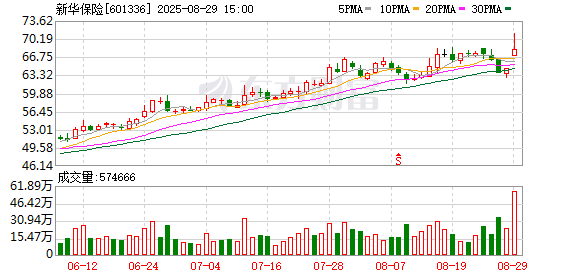
新华保险近一个月首次上榜港股通成交活跃榜
Zheng Quan Shi Bao Wang· 2025-08-29 12:57
Core Insights - On August 29, Xinhua Insurance made its first appearance on the Hong Kong Stock Connect active trading list in a month, with a trading volume of 2.241 billion HKD and a net sell of 335 million HKD [2][3] - The total trading volume of active stocks on the Hong Kong Stock Connect reached 51.102 billion HKD, accounting for 28.25% of the day's total trading amount, with a net buying amount of 2.774 billion HKD [2] - Among the most actively traded stocks, SMIC led with a trading volume of 7.859 billion HKD, followed by Guotai Junan International and Alibaba-W with trading volumes of 7.251 billion HKD and 6.741 billion HKD, respectively [2] Trading Activity Summary - Xinhua Insurance's trading activity on August 29 included a closing price of 48.14 HKD, reflecting a daily increase of 1.35% [3] - The stocks with the highest trading frequency over the past month included Alibaba-W and Tencent Holdings, each appearing 23 times on the active trading list [2] - Other notable stocks included Xiaomi Group with a trading volume of 4.731 billion HKD and Meituan-W with 4.410 billion HKD, both showing varying daily price changes [2]


南向资金今日净买入120.46亿港元,腾讯控股净买入15.84亿港元




Zheng Quan Shi Bao Wang· 2025-08-29 12:57
Market Overview - On August 29, the Hang Seng Index rose by 0.32%, with southbound trading totaling HKD 180.90 billion, comprising HKD 96.47 billion in buying and HKD 84.43 billion in selling, resulting in a net buying amount of HKD 12.04 billion [1] Southbound Trading Details - Southbound trading through the Stock Connect (Shenzhen) recorded a total transaction amount of HKD 69.63 billion, with buying at HKD 40.17 billion and selling at HKD 29.47 billion, leading to a net buying of HKD 10.70 billion [1] - Southbound trading through the Stock Connect (Shanghai) had a total transaction amount of HKD 111.27 billion, with buying at HKD 56.30 billion and selling at HKD 54.96 billion, resulting in a net buying of HKD 1.34 billion [1] Active Stocks - The most actively traded stock by southbound funds was SMIC, with a total transaction amount of HKD 78.59 billion [1] - Other notable stocks included Guotai Junan International and Alibaba-W, with transaction amounts of HKD 72.51 billion and HKD 67.41 billion, respectively [1] - Tencent Holdings had a net buying amount of HKD 15.84 billion, closing up by 0.42%, while Alibaba-W saw a net buying of HKD 11.49 billion [1][2] Continuous Net Buying - Three stocks experienced continuous net buying for more than three days, with Alibaba-W leading at six consecutive days, followed by Huahong Semiconductor at four days and Kangfang Biotech at three days [2] - The total net buying amounts during this period were HKD 59.75 billion for Alibaba-W, HKD 11.06 billion for Kangfang Biotech, and HKD 9.49 billion for Huahong Semiconductor [2]
智通港股通活跃成交|8月29日
智通财经网· 2025-08-29 11:03
Group 1 - On August 29, 2025, Guotai Junan International (01788), SMIC (00981), and Alibaba-W (09988) were the top three companies by trading volume in the Southbound Stock Connect, with trading amounts of 5.39 billion, 5.11 billion, and 3.14 billion respectively [1] - In the Southbound Stock Connect for Shenzhen-Hong Kong, Alibaba-W (09988), SMIC (00981), and Tencent Holdings (00700) led the trading volume, with amounts of 3.60 billion, 2.75 billion, and 2.16 billion respectively [1] Group 2 - The top ten active companies in the Southbound Stock Connect (Shanghai-Hong Kong) included Guotai Junan International (01788) with a net buy of 0.18 billion, SMIC (00981) with a net sell of 0.46 billion, and Alibaba-W (09988) with a net buy of 0.25 billion [2] - In the Southbound Stock Connect (Shenzhen-Hong Kong), Alibaba-W (09988) had a net buy of 0.90 billion, SMIC (00981) had a net buy of 0.39 billion, and Tencent Holdings (00700) had a net buy of 0.96 billion [2]
港股创新药ETF(159567)涨3.62%,成交额20.04亿元
Xin Lang Cai Jing· 2025-08-29 10:37
Group 1 - The Hong Kong Innovative Drug ETF (159567) closed with a gain of 3.62% on August 29, with a trading volume of 2.004 billion yuan [1] - The fund was established on January 3, 2024, with an annual management fee of 0.50% and a custody fee of 0.10% [1] - As of August 28, 2024, the fund's latest share count was 6.619 billion, with a total size of 6.126 billion yuan, reflecting an increase of 1574.08% in shares and 1521.35% in size year-to-date [1] Group 2 - The current fund manager is Ma Jun, who has managed the fund since its inception, achieving a return of 85.10% during the tenure [2] - The top holdings of the fund include Innovent Biologics, WuXi Biologics, BeiGene, and others, with significant weightings such as 9.52% for Innovent Biologics and 9.47% for WuXi Biologics [2] - The fund's recent trading activity shows a cumulative trading amount of 34.226 billion yuan over the last 20 trading days, averaging 1.711 billion yuan per day [1]


中银国际:升康方生物目标价至185港元 评级“买入”
Zhi Tong Cai Jing· 2025-08-29 09:52
Group 1 - The core viewpoint of the report is that Kangfang Biotech (09926) achieved a revenue of 1.41 billion RMB in the first half of the year, representing a year-on-year growth of 38% [1] - The sales of pharmaceuticals amounted to 1.4 billion RMB, with a year-on-year increase of 49%, primarily due to the inclusion of Cadonilimab and Ivosidenib in the national medical insurance catalog [1] - The target price for Kangfang Biotech has been raised to 185 HKD, with a reiterated "buy" rating [1] Group 2 - The report highlights the expansion of indications for AK104 and AK112, particularly AK112, which is currently being tested in five Phase III clinical trials for cold tumors [1] - The peak sales forecast for AK104 and AK112 in China has been increased to 4.5 billion RMB and 8 billion RMB, respectively [1] - The overseas risk-adjusted peak sales forecast for AK112 has been raised to 7 billion USD [1]
中银国际:升康方生物(09926)目标价至185港元 评级“买入”
智通财经网· 2025-08-29 09:38
Group 1 - The core viewpoint of the article highlights that CStone Pharmaceuticals (09926) reported a revenue of 1.41 billion RMB in the first half of the year, representing a year-on-year growth of 38% [1] - The sales of pharmaceuticals amounted to 1.4 billion RMB, with a year-on-year increase of 49%, primarily driven by the inclusion of Cadonilimab and Ivosidenib in the national medical insurance catalog [1] - The target price for CStone Pharmaceuticals has been raised to 185 HKD, with a reiterated "Buy" rating [1] Group 2 - The report indicates that the peak sales forecasts for AK104 and AK112 in China have been increased to 4.5 billion RMB and 8 billion RMB, respectively, due to the expansion of indications, particularly for AK112 into cold tumors [1] - Currently, there are five Phase III clinical trials for first-line treatments ongoing for AK112 [1] - The overseas risk-adjusted peak sales forecast for AK112 has been raised to 7 billion USD [1]
康方生物(09926.HK):业绩符合预期 HARMONI-AOS最终分析成功
Ge Long Hui· 2025-08-29 07:16
Core Viewpoint - The company reported 1H25 results that met expectations, with revenue of 1.412 billion yuan, a year-on-year increase of 37.75%, and a net loss attributable to shareholders of 588 million yuan [1] Group 1: Financial Performance - The company's core product revenue was in line with expectations, with product sales reaching 1.402 billion yuan, a year-on-year increase of 49.2% [1] - The gross margin for products was 79.25%, while the sales and marketing expense ratio decreased by 7.1 percentage points year-on-year to 47.80% [1] Group 2: Product Development and Clinical Trials - The company has established a commercialization team of over 1,000 sales personnel to maximize the domestic commercialization potential of its two core products, AK104 and AK112, which have been included in the national medical insurance directory [1] - The final analysis of the HARMONi-A trial showed statistically significant overall survival (OS) benefits for AK112 in treating 2L EGFRm NSCLC, with an OS hazard ratio of 0.80 [2] - AK112 has 13 ongoing registration/Phase III clinical trials globally, covering indications beyond lung cancer, with 8 trials specifically in the lung cancer field [2] Group 3: Profit Forecast and Valuation - The company maintains its profit forecasts for 2025 and 2026, with an upgraded target price of 225.00 HKD, reflecting an 87.5% increase and a 33.1% upside potential [3]
康方生物(09926):25H1:HARMONi-A 获统计学显著获益结果,建议关注 2025 WCLC 数据催化
Haitong Securities International· 2025-08-29 01:40
Investment Rating - The report maintains an "Outperform" rating for the company [2][10]. Core Insights - The HARMONi-A study achieved statistically significant benefits, and attention is recommended for the data catalyst at the 2025 WCLC [1][7]. - The company reported a revenue of RMB 1.41 billion in 25H1, reflecting a growth of 37.8%, with commercialization revenue at RMB 1.40 billion, up 49.2% [3][15]. - The gross profit reached RMB 1.12 billion, with a gross margin of 79.4%, down 12.6 percentage points [3][15]. - The company is expanding its product pipeline, with significant advancements in both oncology and immunology sectors [5][19]. Financial Performance - Revenue projections for 2025-2027 are RMB 3.10 billion, RMB 5.08 billion, and RMB 7.16 billion, representing year-on-year growth of 46%, 64%, and 41% respectively [10][22]. - The net loss for the period was RMB 0.59 billion, a decrease of 136% compared to the previous period [3][15]. - R&D expenses were RMB 0.73 billion, with an R&D ratio of 51.8% [3][15]. Product Development and Pipeline - The company has successfully launched new products, including ebronucimab (PCSK9) and ebdarokimab (IL-12/IL-23), contributing to revenue growth [4][16]. - The ADC pipeline includes bispecific ADCs, with ongoing phase I trials for AK145D1 and AK138D1 [5][17]. - The company is also advancing multiple bispecific T-cell engagers and trispecific IO antibodies, with several IND filings expected [20]. Upcoming Catalysts - Key upcoming catalysts include updates on HARMONi data and potential BLA submissions for ivonescimab and cadonilimab [21][22]. - The company anticipates potential approvals for AK111 (IL-17A) in psoriasis and AK120 (IL-4Rα) in atopic dermatitis [21][22].
智通港股通活跃成交|8月28日



智通财经网· 2025-08-28 11:02
Group 1 - On August 28, 2025, the top three companies by trading volume in the Hong Kong Stock Connect (southbound) were SMIC (00981) with a trading volume of 11.618 billion, Meituan-W (03690) with 9.659 billion, and the Tracker Fund of Hong Kong (02800) with 7.940 billion [1][2] - In the Shenzhen-Hong Kong Stock Connect (southbound), the top three companies were Meituan-W (03690) with a trading volume of 6.145 billion, SMIC (00981) with 5.565 billion, and Alibaba-W (09988) with 4.726 billion [1][2] Group 2 - In the Hong Kong Stock Connect (southbound), the net buying amounts for the top three companies were SMIC (00981) with +0.575 billion, Meituan-W (03690) with +0.630 billion, and Alibaba-W (09988) with +0.706 billion [2] - The Tracker Fund of Hong Kong (02800) had a significant net outflow of -7.885 billion, indicating a strong selling pressure [2] - In the Shenzhen-Hong Kong Stock Connect (southbound), Meituan-W (03690) experienced a net outflow of -0.297 billion, while SMIC (00981) had a net inflow of +0.318 billion [2]
港股创新药ETF(159567)跌1.26%,成交额22.27亿元
Xin Lang Cai Jing· 2025-08-28 10:18
Group 1 - The Hong Kong Innovative Drug ETF (159567) closed down 1.26% on August 28, with a trading volume of 2.227 billion yuan [1] - The fund was established on January 3, 2024, with a management fee of 0.50% per year and a custody fee of 0.10% per year [1] - As of August 27, 2024, the fund's latest share count was 6.506 billion shares, with a total size of 6.134 billion yuan, reflecting a year-to-date increase of 1545.50% in shares and 1523.46% in size compared to December 31, 2023 [1] Group 2 - The current fund manager is Ma Jun, who has managed the fund since its inception, achieving a return of 88.56% during the tenure [2] - The top holdings of the fund include Innovent Biologics (9.52%), WuXi Biologics (9.47%), BeiGene (8.73%), and others, with their respective market values and share counts detailed [2] - The fund's liquidity is strong, with a cumulative trading amount of 35.359 billion yuan over the last 20 trading days, averaging 1.768 billion yuan per day [1][2]