AKESO(09926)

Search documents
康方生物(09926) - 截至二零二五年十二月三十一日止月份股份发行人的证券变动月报表
2026-01-06 08:55
股份發行人及根據《上市規則》第十九B章上市的香港預託證券發行人的證券變動月報表 截至月份: 2025年12月31日 狀態: 新提交 致:香港交易及結算所有限公司 I. 法定/註冊股本變動 | 1. 股份分類 | 普通股 | 股份類別 | 不適用 | | | 於香港聯交所上市 (註1) | 是 | | | | --- | --- | --- | --- | --- | --- | --- | --- | --- | --- | | 證券代號 (如上市) | 09926 | 說明 | | | | | | | | | | | 法定/註冊股份數目 | | | 面值 | | | 法定/註冊股本 | | | 上月底結存 | | | 5,000,000,000 | USD | | 0.00001 | USD | | 50,000 | | 增加 / 減少 (-) | | | | | | | USD | | | | 本月底結存 | | | 5,000,000,000 | USD | | 0.00001 | USD | | 50,000 | 本月底法定/註冊股本總額: USD 50,000 FF301 第 1 頁 共 10 頁 ...

宝盈基金姚艺包揽去年12月股基与混基跌幅第一
Zhong Guo Jing Ji Wang· 2026-01-06 07:46
Group 1 - The core point of the article highlights that in December 2025, the worst-performing ordinary equity and mixed funds were both managed by Baoying Fund, specifically the Baoying Medical Health Hong Kong-Shenzhen Stock A and C, which reported returns of -13.20% and -13.26% respectively [1] - The Baoying Innovation Medical Mixed Initiation A and C funds also performed poorly, with returns of -14.14% and -14.19%, making them the worst in the mixed fund category [1] - All these funds are themed around the medical sector and are managed by the same fund manager, Yao Yi, who has a background in research and fund management [1] Group 2 - The latest quarterly report indicates that the top ten holdings of the Baoying Medical Health Hong Kong-Shenzhen Stock fund include major companies such as Innovent Biologics, Kelun Pharmaceutical, and others, while the Baoying Innovation Medical Mixed Initiation fund shares many of the same top holdings [1][2] - Notably, several of these top holdings experienced significant declines in December, with the largest holding, Innovent Biologics, dropping by 18.97%, and another major holding, 3SBio, declining by over 22% [2] - The performance metrics of the funds show that the Baoying Innovation Medical Mixed Initiation C has a cumulative net value of 0.8857 and a scale of 0.51 billion, while the A share has a cumulative net value of 0.8886 and a scale of 0.47 billion [3]




港股创新药ETF(159567)涨0.38%,成交额11.63亿元
Xin Lang Cai Jing· 2026-01-06 07:14
Core Viewpoint - The Hong Kong Innovative Drug ETF (159567) has shown a positive performance since its inception, with a slight increase in scale and significant trading activity in the early days of 2024 [1][2] Group 1: Fund Performance - The Hong Kong Innovative Drug ETF (159567) closed at a 0.38% increase on January 6, with a trading volume of 1.163 billion yuan [1] - As of January 5, the fund's latest share count was 10.479 billion shares, with a total scale of 8.331 billion yuan, reflecting a 5.50% increase in scale since December 31, 2025 [1] - The fund's management fee is set at 0.50% annually, and the custody fee is 0.10% annually [1] Group 2: Trading Activity - Over the past 20 trading days, the cumulative trading amount for the ETF reached 16.464 billion yuan, with an average daily trading amount of 0.823 billion yuan [1] - In the first two trading days of 2024, the ETF recorded a cumulative trading amount of 2.789 billion yuan, averaging 1.394 billion yuan per day [1] Group 3: Fund Holdings - The top holdings of the Hong Kong Innovative Drug ETF include companies such as BeiGene, CanSino Biologics, and Innovent Biologics, with significant percentages of the fund's total assets allocated to these stocks [2] - The largest holding is BeiGene, accounting for 10.62% of the portfolio, followed closely by CanSino Biologics at 10.55% and Innovent Biologics at 10.21% [2] - Other notable holdings include China National Pharmaceutical Group and Stone Group, with respective allocations of 9.62% and 7.56% [2]

大行评级|大和:今年中国生物医药板块首选是信达生物与恒瑞医药
Ge Long Hui· 2026-01-05 06:28
Group 1 - The core viewpoint of the report is that the Chinese biopharmaceutical sector experienced a comprehensive increase in 2025, and for 2026, a more selective stock-picking strategy is recommended, focusing on high-quality targets [1] Group 2 - Daiwa's top picks include Innovent Biologics and Hengrui Medicine, with Innovent's target price raised from HKD 95 to HKD 112, while Hengrui's target price remains at HKD 80 [1] - The rating for CanSino Biologics has been downgraded from "Buy" to "Hold," with its target price increased from HKD 100 to HKD 116 [1] - The rating for CSPC Pharmaceutical Group is maintained at "Sell," with a target price of HKD 6.6 [1]

康方生物(09926) - 根据上市规则第14A.60条的持续关连交易
2025-12-31 14:00
康 方 生 物 科 技( 開 曼 )有 限 公 司 (於 開 曼 群 島 註 冊 成 立 的 有 限 公 司) 香 港 交 易 及 結 算 所 有 限 公 司 及 香 港 聯 合 交 易 所 有 限 公 司 對 本 公 告 之 內 容 概 不 負 責,對其準確性或完整性亦不發表任何聲明,並明確表示,概不就因本公告全部 或任何部分內容而產生或因倚賴該等內容而引致的任何損失承擔任何責任。 Akeso, Inc. 茲 提 述 本 公 司 日 期 為 2020 年 4 月 14 日 的 招 股 章 程 , 內 容 有 關 中 山 康 方 與 正 大 天 晴簽訂合資協議成立合資企業,天晴康方。根據合資協議,( 其中包括 )單抗產 品的生產將由中山康方及正大天晴共同安排,並根據雙方生產設施各自的批准 時間表進行相應規劃。 於2021年12月21日,天晴康方與中山康方訂立委託生產協議,以載納委託生產 安排的條款及條件。根據委託生產協議,天晴康方同意(i)委託中山康方生產單 抗產品及(ii)就生產並交付的所有單抗產品支付相關生產成本。 (股 份 代 號:9926) 根據上市規則第14A .60條的持續關連交易 委託生產協議及 ...
中山全市研发经费投入连续三年超百亿,康方生物7个新药已上市
2 1 Shi Ji Jing Ji Bao Dao· 2025-12-31 12:38
Group 1 - The core achievement of Zhongshan during the "14th Five-Year Plan" period includes a continuous increase in GDP, surpassing 3500 billion and 4000 billion yuan, with an expected breakthrough of 4200 billion yuan by 2025 [2] - The total number of business entities in Zhongshan reached 740,000, marking a 60% growth over five years [2] - The number of provincial industrial parks increased from 3 to 11, and the total scale of the ten major industrial clusters exceeded 7000 billion yuan, with industrial investment expected to double by 2024 compared to 2021 [2] Group 2 - Zhongshan emphasizes innovation as the primary driving force for development, focusing on strengthening innovation supply, activating enterprise innovation, and improving financial support ecosystems [3] - The city invested nearly 5 billion yuan over five years to build high-level innovation platforms, collaborating with institutions like the Chinese Academy of Sciences and various universities [3] - R&D expenditure in Zhongshan has exceeded 10 billion yuan for three consecutive years, with a growth rate of over 20% for the last two years [3] - The biopharmaceutical industry in Zhongshan has established an ecosystem with a production value of 18 billion yuan, gathering over 650 related enterprises [3] - Special policies have been introduced to support innovative drug research and development, with funding support of up to 40% and a maximum of 65 million yuan per product [3] - R&D investment in the biopharmaceutical sector is expected to double from 2021 to 2024, with an average growth rate of over 30% in the last two years [3]
开启“中国双抗”之路:一家广东创新药企业的全球进击
Nan Fang Du Shi Bao· 2025-12-31 07:55
Core Insights - Chinese innovative pharmaceuticals are transforming from global followers to pioneers in new treatment paradigms, with local biopharmaceutical companies leading this change [1] - The pipeline of innovative drugs and newly launched drugs from China now accounts for one-third of the global total, showcasing the rapid growth of the industry [1] Company Overview - Kangfang Biopharma was founded in 2012 by Xia Yu and colleagues, focusing on the underexplored dual-antibody (bi-specific antibody) field in tumor immunotherapy [6] - The company invested heavily in developing comprehensive drug development platforms, including ACE and TETRABODY technologies, to support its innovative approach [6][7] - In 2022, Kangfang's dual-antibody drug, Cardunili (PD-1/CTLA-4), became the first of its kind approved globally, marking a significant milestone for dual-antibody drugs in China [6][10] Strategic Development - Kangfang's early licensing of CTLA-4 monoclonal antibodies for $200 million to Merck and subsequent commercialization of PD-1 monoclonal antibodies were strategic moves to build resources and credibility [7] - The company has successfully transitioned from single-target antibodies to dual-antibody innovations, demonstrating a commitment to long-term strategic vision [10] Production and Infrastructure - The establishment of a modern biopharmaceutical production base in Guangzhou took only 18 months, showcasing the efficiency of local support [11] - The rapid construction of the production facility allowed Kangfang to meet market demand effectively, particularly after the launch of Cardunili [12] Clinical Development and Global Impact - Kangfang has achieved a high success rate in clinical trials, with all drugs in clinical phase II successfully approved, contributing to China's position as a leader in innovative drug development [16] - The company licensed exclusive development and commercialization rights for its drug Yiwosi to Summit for $5 billion, reflecting its enhanced negotiation position and the global potential of its products [16] - Kangfang is building its global operational capabilities, with a research center in Shanghai and over 10 products undergoing early clinical trials in various countries [18] Industry Recognition - The success of Yiwosi in clinical trials against the global leader, Pembrolizumab, has garnered significant international media attention, positioning Chinese biopharmaceuticals alongside advancements in artificial intelligence [17]
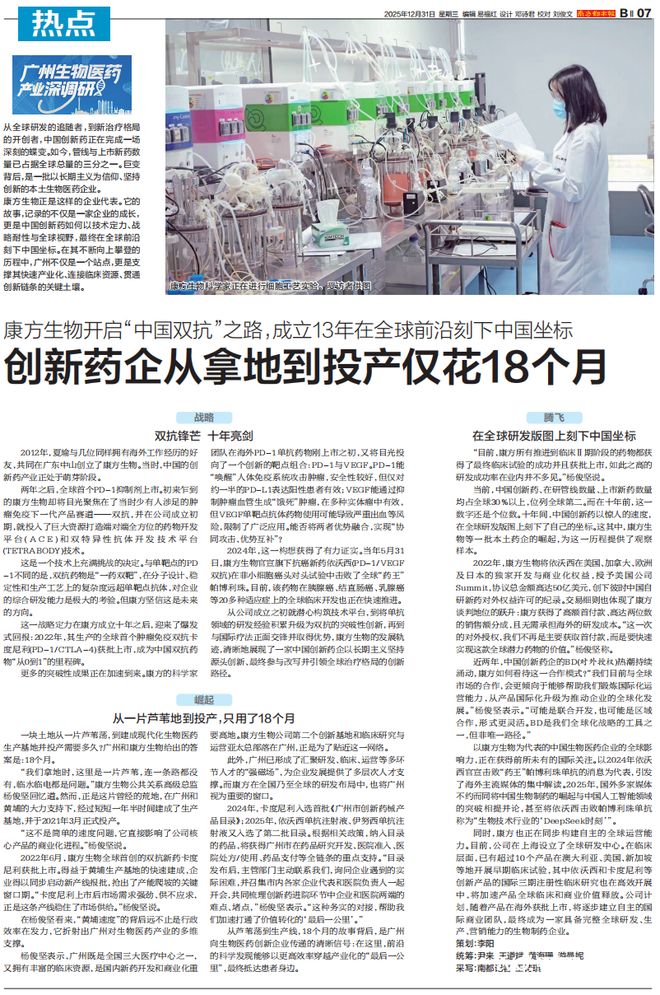
创新药企从拿地到投产仅花18个月
Nan Fang Du Shi Bao· 2025-12-30 23:17
Core Insights - Chinese innovative pharmaceuticals are undergoing a significant transformation, with local companies like Kangfang Biotech leading the way in developing new therapies and capturing a substantial share of the global market [3][10] Strategy - Kangfang Biotech was founded in 2012, focusing on the underexplored area of dual-target antibodies in tumor immunotherapy, investing heavily in developing comprehensive drug development platforms [5][6] - The company achieved a major milestone in 2022 with the approval of its dual-target antibody, Cardunili, marking a significant advancement in China's biopharmaceutical landscape [5][10] Technological Challenges - Developing dual-target antibodies presents greater complexity compared to single-target therapies, requiring advanced molecular design and production capabilities [4] Development and Production - Kangfang Biotech established a modern biopharmaceutical production base in Guangzhou within 18 months, significantly accelerating its product commercialization process [7][8] - The rapid establishment of the production facility allowed the company to meet strong market demand for Cardunili following its launch [8] Clinical Success - All drugs in clinical phase II have achieved successful trial outcomes and received market approval, showcasing a high success rate in research and development [10] Global Expansion - In 2022, Kangfang Biotech licensed exclusive development and commercialization rights for its drug, Iwosi, to a U.S. company for a total of $5 billion, reflecting its enhanced negotiation position in the global market [10] - The company is building its global operational capabilities, with a research center in Shanghai and ongoing clinical trials in multiple countries [12] Industry Impact - The rise of Kangfang Biotech and similar companies has positioned China as a significant player in the global pharmaceutical industry, with over 30% of new drug pipelines and approvals [10] - The success of Iwosi against the leading drug, Pembrolizumab, has garnered international media attention, likening the moment to breakthroughs in artificial intelligence [11]

港股生物医药股盘中走弱,金斯瑞生物科技跌近4%
Mei Ri Jing Ji Xin Wen· 2025-12-30 02:17
Group 1 - Hong Kong biopharmaceutical stocks weakened during trading on December 30, with Genscript Biotech falling nearly 4% [1] - Fuhong Hanlin declined by nearly 3%, while Kelun-Biotech dropped over 2% [1] - Other stocks such as CanSino Biologics, Rongchang Biologics, and Kanyin Biologics also experienced declines of over 1.5% [1]

从“借船出海”到“造船远航”:2025药企出海十大关键词
Xi Niu Cai Jing· 2025-12-29 09:34
Core Insights - The article discusses the transformation of Chinese pharmaceutical companies from merely selling products to actively participating in global value chains, with a significant increase in outbound licensing deals reaching over $100 billion by November 2025, a 75% increase year-on-year [3][4]. Group 1: Major Transactions - In 2024, major deals like Hengrui's $5 billion GLP-1 product and a $12.5 billion upfront payment from Pfizer to 3SBio for a dual antibody drug highlight the trend of billion-dollar collaborations becoming standard [4][6]. - Hengrui's partnership with GSK for $12.5 billion includes not only current products but also options for 11 early-stage projects, indicating a shift towards long-term strategic partnerships [4][10]. Group 2: Licensing Strategies - Chinese companies are moving from "one-off sales" to retaining rights in core markets while sharing rights in other regions, allowing them to benefit from both local and global markets [5][6]. - The new strategy involves keeping rights for the Greater China region while sharing development costs and rights for other markets, enhancing long-term revenue potential [6][10]. Group 3: Innovative Drug Categories - Antibody-drug conjugates (ADCs) and dual antibodies are emerging as key areas for Chinese companies, with significant deals reflecting their growing importance in the global market [6][7]. - The shift from traditional cancer drugs to innovative metabolic drugs like GLP-1 is notable, with companies like FOSUN and Hansoh making substantial deals in this area [14][15]. Group 4: Independent Global Expansion - Companies are increasingly opting for "self-driven" global expansion rather than simply licensing out, as seen with Kangfang Biopharma's approach to leading its own global clinical trials [8][9]. - This strategy, while riskier, offers higher potential returns compared to traditional licensing agreements [9]. Group 5: Platform-Based Collaborations - The trend is shifting from selling individual products to offering entire R&D platforms, as demonstrated by Hengrui's collaboration with GSK, which includes options for future projects [10][11]. - This model allows companies to monetize their ongoing research capabilities, enhancing their value proposition to partners [10][11]. Group 6: Regulatory and Pricing Developments - The introduction of a drug pricing registration system by China's National Healthcare Security Administration is expected to alleviate concerns about domestic pricing affecting global pricing strategies [12][13]. - This regulatory change has led to increased foreign investment in Chinese R&D, with a 28% year-on-year growth in 2025 [13]. Group 7: Market Valuation Changes - The market's evaluation criteria for Chinese innovative drug companies have shifted from focusing on generic drug revenues to assessing the value of outbound pipelines and global clinical progress [19][21]. - The average price-to-earnings ratio for innovative drug companies in China has risen significantly, reflecting a revaluation of their market potential [21].