AKESO(09926)

Search documents
大行评级|美银:首予康方生物“买入”评级及目标价162.8港元
Ge Long Hui· 2026-01-19 03:17
Core Viewpoint - Bank of America Securities initiates coverage of Kangfang Biopharma with a "Buy" rating and a target price of HKD 162.8, citing strong clinical trial data for the key drug ivonescimab in China as a solid reference for global trial results [1] Group 1 - The company is expected to reveal multiple global and China Phase III clinical trial data this year [1] - The inclusion in the national medical insurance directory, expansion of indications, and new drug approvals are accelerating the commercialization process in China, with expectations of reaching breakeven this year [1] - The company's rich R&D pipeline provides long-term growth momentum and new licensing opportunities [1]
向“领跑者”跨越! 中国双抗药物再迎高光时刻
Mei Ri Jing Ji Xin Wen· 2026-01-14 11:59
Core Insights - The announcement of a $5.6 billion licensing agreement between Rongchang Biopharma and AbbVie marks a significant milestone for Chinese innovative drugs entering the global market, indicating a shift from follower to leader in the dual antibody space [1][3] - Concurrently, Kangfang Biopharma's partner, Summit Therapeutics, submitted a Biologics License Application (BLA) for Ivoris monoclonal antibody to the FDA, further highlighting the progress of Chinese dual antibodies on the international stage [1][4] - However, the termination of a licensing agreement by Yiming Oncology with Instil Bio serves as a cautionary tale for the challenges faced by Chinese companies in global expansion [1][10] Group 1: Major Developments - Rongchang Biopharma's agreement with AbbVie includes an upfront payment of $650 million and potential milestone payments of up to $4.95 billion, along with double-digit royalties on net sales outside Greater China [3] - Kangfang Biopharma's Ivoris monoclonal antibody is positioned to address a significant unmet clinical need in treating EGFR-mutant non-small cell lung cancer, with the FDA expected to make a decision by Q4 2026 [4][5] - The competitive landscape for PD-1/VEGF dual antibodies is intensifying, with major pharmaceutical companies increasingly focusing on a few validated "winners" in the market [2][9] Group 2: Industry Trends - The recent high-value transactions in the dual antibody space reflect a growing recognition of the clinical and commercial potential of Chinese innovative drugs, with transaction amounts reaching new heights [9] - The competitive dynamics are shifting, as the number of potential international buyers decreases due to the concentration of capital and interest in a limited number of validated products [10][13] - The success of PD-1/VEGF dual antibodies is seen as pivotal for the future of cancer treatment, with ongoing clinical trials exploring their combination with other therapies to enhance efficacy [14]

港股通1月13日成交活跃股名单





Zheng Quan Shi Bao Wang· 2026-01-13 14:49
Market Overview - On January 13, the Hang Seng Index rose by 0.90%, with total southbound trading amounting to HKD 137.35 billion, including buy transactions of HKD 69.32 billion and sell transactions of HKD 68.03 billion, resulting in a net buying amount of HKD 1.30 billion [1] Southbound Trading Activity - The southbound trading through Stock Connect (Shenzhen) recorded a total trading amount of HKD 54.86 billion, with buy transactions of HKD 28.00 billion and sell transactions of HKD 26.85 billion, leading to a net buying amount of HKD 1.15 billion [1] - The southbound trading through Stock Connect (Shanghai) had a total trading amount of HKD 82.49 billion, with buy transactions of HKD 41.32 billion and sell transactions of HKD 41.17 billion, resulting in a net buying amount of HKD 0.15 billion [1] Active Stocks - Alibaba-W was the most actively traded stock with a total trading amount of HKD 139.06 billion and a net buying amount of HKD 10.71 billion, closing with a price increase of 3.63% [1][2] - Tencent Holdings followed with a total trading amount of HKD 52.93 billion and a net buying amount of HKD 7.56 billion, closing with a price increase of 0.72% [1][2] - Xiaomi Group-W had a total trading amount of HKD 49.62 billion and a net buying amount of HKD 6.07 billion, closing with a price decrease of 1.96% [1][2] Continuous Net Buying and Selling - Three stocks experienced continuous net buying for more than three days, with Xiaomi Group-W, Tencent Holdings, and Kuaishou-W having net buying days of 9, 5, and 3 respectively [2] - Tencent Holdings had the highest cumulative net buying amount of HKD 69.99 billion, followed closely by Xiaomi Group-W with HKD 69.33 billion [2] - Two stocks faced continuous net selling, with China Mobile and Meituan-W having net selling amounts of HKD 52.84 billion and HKD 11.67 billion respectively [2]
中国双抗再迎“高光”:荣昌收获56亿美元交易,康方闯关FDA
Mei Ri Jing Ji Xin Wen· 2026-01-13 12:33
Core Insights - The article highlights significant advancements in China's biopharmaceutical sector, particularly in the PD-1/VEGF dual antibody space, marked by major deals and regulatory submissions that indicate a shift from follower to leader status for Chinese companies in the global market [1][2][3]. Group 1: Major Developments - Rongchang Biopharma announced a $5.6 billion licensing agreement with AbbVie for its PD-1/VEGF dual antibody RC148, with an upfront payment of $650 million and potential milestone payments of up to $4.95 billion [2]. - Summit Therapeutics, a partner of Kangfang Biopharma, submitted a Biologics License Application (BLA) for Ivoris monoclonal antibody to the FDA, targeting EGFR-mutant non-small cell lung cancer, with a decision expected in Q4 2026 [3]. Group 2: Market Dynamics - The PD-1/VEGF dual antibody market is becoming increasingly competitive, with major pharmaceutical companies investing heavily, indicating the high commercial value of this therapeutic area [5][6]. - The termination of a collaboration between Yiming Biotech and Instil Bio serves as a cautionary tale, highlighting challenges faced by Chinese innovative drug companies in global markets, including the need for strong financial backing and execution capabilities [1][7]. Group 3: Future Outlook - The success of Kangfang's Ivoris monoclonal antibody in clinical trials could position it as a leading product in the market, potentially capturing significant market share if it demonstrates strong overall survival data [4][10]. - The increasing number of PD-1/VEGF products in clinical stages, with 14 products linked to Chinese companies, suggests a crowded competitive landscape, which may complicate future business development opportunities for companies like Yiming Biotech [8][9].
智通港股通活跃成交|1月13日

智通财经网· 2026-01-13 11:02
Core Insights - On January 13, 2026, Alibaba-W (09988), Tencent Holdings (00700), and Xiaomi Group-W (01810) were the top three companies by trading volume in the Southbound Stock Connect, with trading amounts of 81.05 billion, 29.45 billion, and 28.57 billion respectively [1] - The same companies also led in trading volume in the Shenzhen-Hong Kong Stock Connect, with trading amounts of 58.01 billion, 23.48 billion, and 21.05 billion respectively [1] Southbound Stock Connect (Shanghai-Hong Kong) - Alibaba-W (09988) had a trading amount of 81.05 billion and a net buy amount of -90.46 million [2] - Tencent Holdings (00700) recorded a trading amount of 29.45 billion with a net buy amount of +6.61 million [2] - Xiaomi Group-W (01810) achieved a trading amount of 28.57 billion and a net buy amount of +3.24 billion [2] - Other notable companies included Goldwind Technology (02208) with 23.07 billion and a net buy of +85.70 million, and SMIC (00981) with 22.72 billion and a net buy of -1.73 billion [2] Southbound Stock Connect (Shenzhen-Hong Kong) - Alibaba-W (09988) had a trading amount of 58.01 billion and a net buy amount of +1.16 billion [2] - Tencent Holdings (00700) recorded a trading amount of 23.48 billion with a net buy amount of +749 million [2] - Xiaomi Group-W (01810) achieved a trading amount of 21.05 billion and a net buy amount of +283 million [2] - Other significant companies included SMIC (00981) with 18.13 billion and a net buy of -661 million, and Kuaishou-W (01024) with 12.21 billion and a net buy of +114 million [2]
依沃西首个海外适应症BLA向FDA提交
Zheng Quan Shi Bao Wang· 2026-01-13 01:45
Core Viewpoint - Kangfang Biopharma's innovative PD-1/VEGF dual antibody, Ivosidenib, has submitted a Biologics License Application (BLA) to the FDA for treating EGFR mutation non-squamous non-small cell lung cancer (NSCLC) [1] Group 1: Company Developments - Ivosidenib's BLA submission is based on the overall results of the global Phase III HARMONi trial [1] - The application was submitted by Summit Therapeutics, the overseas partner of Kangfang Biopharma [1] Group 2: Regulatory Timeline - The FDA is expected to make a review decision on the BLA by the fourth quarter of 2026 [1] - The BLA aims to support the use of Ivosidenib in combination with chemotherapy for patients with EGFR mutation NSCLC who have progressed after third-generation EGFR-TKI treatment [1]
港股开盘:恒生科技指数涨1.93%,恒生指数涨1.32%
Jin Rong Jie· 2026-01-13 01:36
Group 1 - The Hang Seng Technology Index increased by 1.93% and the Hang Seng Index rose by 1.32% [1] - Notable stock performances include: Zhaoyi Innovation up by 45.06%, Dali Group Holdings up by 13.35%, and Rongchang Bio up by 8.84% [1] - Declining stocks include: Times Angel down by 4.96%, Master Kong Holdings down by 4.18%, and CIMC Enric down by 3.72% [1]


医药行业周报(26/1/5-26/1/9):小核酸领涨创新药,2026年还有哪些催化?-20260111
Hua Yuan Zheng Quan· 2026-01-11 15:08
Investment Rating - The report maintains a "Positive" investment rating for the pharmaceutical industry [4] Core Insights - The pharmaceutical index rose by 7.81% from January 5 to January 9, outperforming the CSI 300 index by 5.03%. The brain-machine interface and AI medical sectors are expected to remain active in Q1 2026, with a strong rebound in innovative drugs, particularly small nucleic acids [5][25] - The report highlights the potential for significant advancements in small nucleic acids in 2026, driven by breakthroughs in liver-targeted delivery technologies and a surge in clinical data readouts [8][22] - The report emphasizes the importance of selecting innovative drug stocks with strong fundamentals and suggests focusing on companies that have undergone sufficient adjustments [5][49] Summary by Sections Industry Performance - The pharmaceutical index saw 443 stocks rise and 25 fall during the week, with notable gainers including Innovative Medical (+61.04%) and Sanbo Brain Science (+56.15%). Conversely, Baohua Pharmaceutical saw a decline of -21.65% [5][26][27] Small Nucleic Acids - 2026 is projected to be a pivotal year for the small nucleic acid sector, with advancements in liver-targeted delivery technologies and a high frequency of clinical data readouts expected [8][22] - Arrowhead's delivery platform has shown promising results in clinical trials, validating the feasibility of RNAi therapies for obesity and other conditions [9][11] Investment Recommendations - The report suggests focusing on companies with leading platform capabilities and differentiated pipeline layouts, such as Rebio Biotech, Yuyuan Pharmaceutical, and Frontier Biotech [20][24] - It also recommends a diversified investment approach, including innovative drugs, brain-machine interfaces, and AI medical technologies [47][48] Market Trends - The report notes that the aging population and increasing healthcare demands are driving growth in the pharmaceutical sector, with a focus on chronic diseases and innovative medical technologies [47] - The report highlights the ongoing trend of domestic companies enhancing their capabilities in the global market, particularly in innovative drug development and medical devices [46][47] Key Companies to Watch - Recommended stocks include China National Pharmaceutical Group, Rebio Biotech, Shanghai Yizhong, and Yuyuan Medical [49]




香港交易所将于1月19日推出百济神州等六只新股票期权
智通财经网· 2026-01-09 06:01
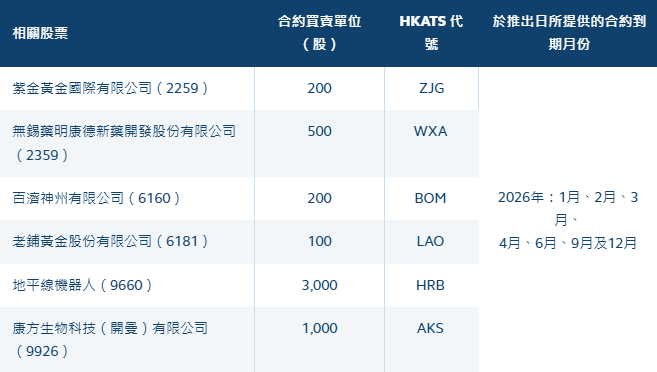
Group 1 - The Hong Kong Stock Exchange (HKEX) will launch six new stock options on January 19, 2026, expanding the stock options market and providing investors with more choices [2] - The new stock options will include Zijin Mining International (02259), WuXi AppTec (02359), BeiGene (06160), Lao Poo Gold (06181), Horizon Robotics (09660), and CanSino Biologics (09926) [2] - The average daily trading volume of the derivatives market at HKEX reached a record high of 1,662,751 contracts last year, representing a 7% year-on-year increase [2] Group 2 - Stock options, including monthly and weekly expiry contracts, were among the most actively traded products, with an average daily trading volume of 879,831 contracts, marking a 22% year-on-year increase [2] - The new stock options will have varying contract sizes, such as 200 shares for Zijin Mining International and BeiGene, and 500 shares for WuXi AppTec [3] - The launch will include contracts for multiple months in 2026, specifically January, February, March, April, June, September, and December for certain stocks [3]




香港交易所将于1月19日推出百济神州(06160)等六只新股票期权
智通财经网· 2026-01-09 05:50
Core Viewpoint - Hong Kong Stock Exchange (HKEX) will launch six new stock options on January 19, 2026, expanding the stock options market and providing investors with more choices [1] Group 1: New Stock Options - The new stock options will include Zijin Gold International (02259), WuXi AppTec (02359), BeiGene (06160), Lao Poo Gold (06181), Horizon Robotics (09660), and CanSino Biologics (09926) [1] - The contract sizes for the new options are as follows: Zijin Gold International (200 shares), WuXi AppTec (500 shares), BeiGene (200 shares), Lao Poo Gold (100 shares), Horizon Robotics (3,000 shares), and CanSino Biologics (1,000 shares) [2] Group 2: Market Performance - The average daily trading volume of HKEX's derivatives market reached 1,662,751 contracts last year, marking a 7% year-on-year increase and setting a new record [1] - Stock options, including monthly and weekly expiry contracts, were among the most actively traded products, with an average daily trading volume of 879,831 contracts, a 22% year-on-year increase and a new record high [1]