AKESO(09926)

Search documents
港股异动 | 医药股多数走高 歌礼制药-B(01672)涨超6% 康方生物(09926)涨超5%
智通财经网· 2026-02-20 07:08
Group 1 - The pharmaceutical stocks have shown a general upward trend, with notable increases in companies such as Genscript Biotech (up 6.33%), Kintor Pharmaceutical (up 5.23%), and Junshi Biosciences (up 4.39%) [1] - The Chinese innovative drug licensing market has continued its strong growth into 2026, with total transaction amounts exceeding $33.28 billion in the first quarter, surpassing the highest quarterly upfront payment levels of 2025 [1] - According to Open Source Securities, the innovative drug sector has experienced a correction over the past two quarters, but long-term prospects for quality stocks are favorable, suggesting an increase in sector allocation focusing on companies with established overseas opportunities and high clinical data performance [1] Group 2 - Donghai Securities previously indicated that the innovative drug sector is entering a phase of accelerated profit realization by 2025, with companies like Innovent Biologics and Rongchang Biopharmaceutical achieving profitability, while others like 3SBio and Shanghai Yizhong are expected to see significant performance increases [2] - The strong performance of the innovative drug sector validates the effectiveness of the domestic innovative drug business model, with core product volume growth supported by medical insurance becoming the foundation for performance growth, while external collaborations such as BD are crucial for enhancing earnings [2]

森瑞投资董事长林存:剑指全球,中国创新药2026再启新程
Xin Lang Cai Jing· 2026-02-15 03:07
Core Viewpoint - The Chinese innovative pharmaceutical sector is entering a golden development period, presenting a once-in-a-century investment opportunity due to unmet global medical needs and significant advancements in the industry [4][9]. Group 1: Market Growth and Trends - In 2025, the total value of out-licensing (BD) transactions for Chinese innovative drugs reached $135.7 billion, a significant increase from $51.9 billion in 2024, with upfront payments rising to $7 billion from $4.1 billion [4][9]. - In January 2026 alone, the transaction volume reached $30 billion, with upfront payments of $3 billion, indicating a strong start to the year [4][9]. - The proportion of external procurement pipelines from China for multinational pharmaceutical companies surged from 10% in 2020 to 42% in 2025, highlighting China's growing importance in the global pharmaceutical landscape [4][9]. Group 2: Clinical Milestones and Innovations - 2026 is identified as a critical year for validating major drugs, with several key clinical milestones expected to emerge, potentially leading to a re-evaluation of industry value [5][9]. - Notable clinical trials include Kangfang Biotech's AK112 for non-small cell lung cancer, which is anticipated to redefine first-line treatment standards [5][9]. - The ADC sector is also poised for significant developments, with Kelong Botai's SKB264 and Baili Tianheng's BL-B01D1 expected to release important phase III clinical data [5][9]. Group 3: Impact on Related Industries - The CXO (Contract Research Organization) sector, closely tied to innovative pharmaceuticals, is expected to benefit from the technological advancements in drug development, leading to a recovery in industry sentiment [5][10]. - Companies within the "WuXi" ecosystem, such as WuXi Biologics and WuXi AppTec, are experiencing a resurgence in orders and performance, reaching historical highs despite previous unfavorable U.S. policies [10].



智通港股通资金流向统计(T+2)|2月11日
智通财经网· 2026-02-10 23:38
Group 1 - Tencent Holdings (00700) had a net inflow of 4.316 billion, representing a 22.17% increase in net inflow ratio [2][3] - Alibaba-W (09988) experienced a net inflow of 1.658 billion, with a net inflow ratio of 13.70% [2][3] - Pop Mart (09992) saw a net inflow of 588 million, with a net inflow ratio of 17.52% [2][3] Group 2 - Kangfang Biotech (09926) faced a net outflow of -285 million, with a net outflow ratio of -33.89% [2][3] - Yingfu Fund (02800) had a net outflow of -248 million, with a net outflow ratio of -1.88% [2][3] - Yum China (09987) recorded a net outflow of -213 million, with a net outflow ratio of -30.90% [2][3] Group 3 - Huaxia Hang Seng Technology (03088) led in net inflow ratio at 89.30% with a net inflow of 54.532 million [2][3] - Southern East Selection (03441) followed with a net inflow ratio of 68.86% and a net inflow of 14.5209 million [2][3] - China Foods (00506) had a net inflow ratio of 59.26% with a net inflow of 4.9995 million [2][3] Group 4 - Jinyuan International (02232) had the highest net outflow ratio at -50.27% with a net outflow of -40.079 million [3] - iFlytek Medical Technology (02506) recorded a net outflow ratio of -49.63% with a net outflow of -15.2262 million [3] - Sinopec Crown (00934) had a net outflow ratio of -45.08% with a net outflow of -5.1472 million [3]



港股收评:Seedance2.0引爆!AI应用股大涨,影视股走强
Ge Long Hui· 2026-02-10 08:53
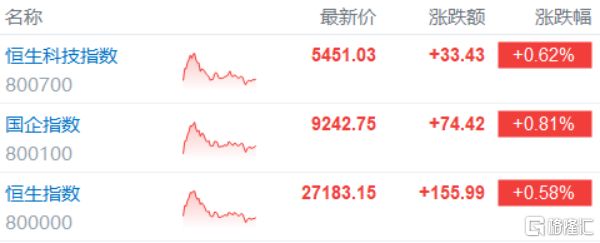
Market Overview - The Hong Kong stock market showed initial gains but narrowed its increase, with the Hang Seng Index closing up 0.58% above 27,000 points, while the Hang Seng China Enterprises Index and Hang Seng Tech Index rose by 0.81% and 0.62% respectively [1][2]. Sector Performance - Technology stocks rebounded, driven by AI application stocks, with the stock of Reading Group surging over 15%. The film and entertainment sector remained active, and the biopharmaceutical sector saw widespread gains, led by Fuhong Hanlin [3][4]. - New consumption concept stocks, paper industry stocks, home appliance stocks, shipping stocks, and automotive stocks mostly increased. Conversely, education stocks faced declines, with gaming stocks collectively sluggish, and real estate, gas, electric, and telecom stocks also underperformed [3][4]. Notable Stocks - AI application stocks saw significant gains, with Reading Group rising 15.41%, and Zhiyun up 14.81%, reaching a new historical high during the session. Other stocks like Fubo Group and Yidu Technology also experienced increases [6][8]. - In the film sector, Orange Sky Entertainment rose over 7%, with other companies like Damai Entertainment and Ningmeng Film also following suit [10]. - The biopharmaceutical sector was buoyed by Fuhong Hanlin's increase of over 7%, with other companies like WuXi Biologics and WuXi AppTec also seeing gains [12]. Industry Insights - The real estate sector faced pressure, with Shimao Group dropping over 6% amid ongoing sales challenges in the industry. Major real estate companies are reportedly initiating organizational restructuring [13][14]. - Education stocks struggled, with Guangzheng Education falling over 5%, alongside declines in New Oriental and other educational institutions [15]. Investment Outlook - According to Everbright Securities, the current liquidity environment in the Hong Kong stock market is entering an observation period, with limited space for further tightening. Positive catalysts could lead to a recovery in market sentiment and capital inflow [22].

恒生指数、恒生科技指数双双涨超1%
Xin Lang Cai Jing· 2026-02-10 07:01
Group 1 - The Hong Kong stock market is experiencing a rally, with both the Hang Seng Index and the Hang Seng Tech Index rising over 1% [1] - The AI application and innovative pharmaceutical sectors are leading the gains in the market [1] - Companies such as Yu Wen Group and Zhi Pu have seen their stock prices increase by over 6%, while Kangfang Biotech and Innovent Biologics have risen by over 3% [1]
驱动基因阴性NSCLC专题:下一代治疗范式:双抗、IO+ADC
Southwest Securities· 2026-02-10 03:06
Investment Rating - The report does not explicitly state an investment rating for the industry Core Insights - The proportion of driver gene-negative non-small cell lung cancer (NSCLC) patients is approximately 31% in both China and the United States, indicating a significant market opportunity for treatments targeting this demographic [2][15] - The estimated market size for immune drugs used in first-line treatment of driver gene-negative NSCLC is projected to be around 7.5 billion CNY (approximately 1.1 billion USD) in China and 18 billion CNY (approximately 2.7 billion USD) in the United States by 2030 [2] - The current first-line treatment for advanced driver gene-negative NSCLC primarily relies on PD(L)-1 inhibitors combined with chemotherapy, but there are limitations in long-term efficacy and options for patients intolerant to chemotherapy [3] Summary by Sections Section 1: NSCLC Global Overview - Lung cancer is the leading cancer type globally, with new cases accounting for approximately 12% of all cancer cases in 2022, translating to about 2.5 million new lung cancer cases [10] - In China, lung cancer represents about 22% of new cancer cases, with approximately 1.06 million new cases in 2022 [10] Section 2: Market Potential for Driver Gene-Negative NSCLC - The report highlights the significant market potential for immune therapies in treating driver gene-negative NSCLC, with a focus on the limitations of current treatment options [2][3] Section 3: Next-Generation Immunotherapy Approaches - The report discusses the advancements in dual (multi) antibody therapies and immune-oncology (IO) combined with antibody-drug conjugates (ADC), emphasizing their potential to improve treatment outcomes for patients with driver gene-negative NSCLC [5][8] - The clinical data supporting these new therapies is expected to catalyze further investment and development in this area [5] Section 4: Treatment Guidelines Comparison - The report compares treatment guidelines for driver gene-negative NSCLC between the United States and China, noting differences in treatment stratification and recommended therapies [32][34] - The U.S. guidelines emphasize PD-L1 expression levels, while Chinese guidelines focus more on performance status (PS) [32][34] Section 5: Future Catalysts - Key upcoming clinical data releases and studies are highlighted as potential catalysts for investment opportunities in the sector, particularly regarding dual antibodies and ADC therapies [5][8]

港股创新药ETF(159567)涨0.79%,成交额8.49亿元
Xin Lang Cai Jing· 2026-02-06 12:25
Core Viewpoint - The Hong Kong Innovative Drug ETF (159567) has shown a slight increase in performance, with a closing rise of 0.79% and a trading volume of 849 million yuan on February 6, 2024 [1]. Group 1: Fund Overview - The Hong Kong Innovative Drug ETF (159567) was established on January 3, 2024, with an annual management fee of 0.50% and a custody fee of 0.10% [1]. - As of February 5, 2024, the fund's total shares stood at 10.244 billion, with a total size of 7.906 billion yuan, reflecting a 2.36% decrease in shares and a 0.13% increase in size since December 31, 2023 [1]. Group 2: Liquidity and Trading Activity - Over the last 20 trading days, the cumulative trading amount for the ETF reached 21.573 billion yuan, with an average daily trading amount of 1.079 billion yuan [1]. - Since the beginning of the year, the ETF has recorded a cumulative trading amount of 29.237 billion yuan over 25 trading days, averaging 1.169 billion yuan per day [1]. Group 3: Fund Management - The current fund manager is Ma Jun, who has managed the fund since its inception, achieving a return of 56.50% during the management period [1]. Group 4: Top Holdings - The top holdings of the Hong Kong Innovative Drug ETF (159567) include: - CSPC Pharmaceutical Group (10.44% holding, 108 million shares, market value of 825 million yuan) [2] - BeiGene (9.91% holding, 4.8299 million shares, market value of 782 million yuan) [2] - CanSino Biologics (9.72% holding, 7.52 million shares, market value of 768 million yuan) [2] - China Biologic Products (9.66% holding, 13.7 million shares, market value of 763 million yuan) [2] - Innovent Biologics (9.53% holding, 10.9295 million shares, market value of 753 million yuan) [2] - Other notable holdings include 3SBio, Hansoh Pharmaceutical, and Kelun-Biotech [2].

美国医药调研反馈:肿瘤、代谢、自免、中枢神经系统赛道推荐更新
Haitong Securities International· 2026-02-06 11:33
Investment Rating - The report provides an "Outperform" rating for multiple companies in the healthcare sector, including BeiGene, JD Health, WuXi Biologics, and others, indicating a positive outlook for these stocks [1]. Core Insights - The macro and industry environment is improving due to the resolution of policy uncertainties, the release of significant clinical data, and a resurgence in global M&A activity, leading to a notable increase in investor sentiment towards innovative drugs for 2026 [4][11]. - In oncology, the PD-1/VEGF dual antibody approach is transitioning from "mechanism validation" to "clinical and industrial resonance," with multiple global Phase III trials underway, expected to catalyze approvals and data releases within the year [5][17]. - The metabolic sector is seeing growth in the cash-pay market for GLP-1 drugs, driven by limited insurance coverage and high out-of-pocket costs, prompting companies to enhance accessibility through direct sales and pricing adjustments [6][25]. - In the autoimmune space, there is a growing concentration risk among major products from multinational corporations (MNCs), with new antibody platforms expected to yield significant data in 2026, potentially leading to new business development opportunities [7]. - The central nervous system (CNS) investment focus remains on advancing Aβ monoclonal antibody treatments, with key data expected to open up early intervention market opportunities [9]. Summary by Sections Oncology - The PD-1/VEGF dual antibody's clinical and industrial certainty is strengthening, with major companies conducting multiple global Phase III trials across high-value indications [17]. - The Pan-RAS precision therapy is entering a realization phase, with key Phase III data expected in 2026 for pancreatic cancer and NSCLC [22]. Metabolic - The cash-pay market for GLP-1 drugs is expanding due to limited insurance coverage, with companies like Eli Lilly and Novo Nordisk adopting different direct-to-consumer strategies to enhance accessibility [25][26]. - Small nucleic acid therapies are expected to upgrade treatment paradigms, showing competitive data in weight loss and safety profiles when combined with GLP-1 [30]. Autoimmune - MNCs are increasingly reliant on a few blockbuster products, with structural opportunities arising from new antibody platforms expected to report data in 2026 [7]. - The trend towards oral formulations in autoimmune diseases is gaining traction, offering advantages in adherence and competitive differentiation [7]. CNS - The focus in CNS remains on Aβ monoclonal antibody treatments, with advancements expected to shift treatment towards earlier intervention populations [9]. - New delivery methods, such as systemic administration of small nucleic acids, are being explored as complementary approaches [9].


资金动向 | 北水持续抢筹腾讯、阿里,抛售康方生物3亿港元
Ge Long Hui· 2026-02-06 10:54
Group 1 - On February 6, southbound funds recorded a net purchase of HKD 14.859 billion, with Tencent Holdings and Alibaba receiving net buys of HKD 4.324 billion and HKD 1.656 billion respectively [1] - Kangfang Biotech and Changfei Optical Fiber Cable experienced net sales of HKD 306 million and HKD 79 million respectively [1] - Tencent Holdings closed at HKD 547.50, down 1.97%, while Alibaba closed at HKD 155.00, down 2.88% [2][3] Group 2 - Tencent and Alibaba faced further restrictions on their AI applications, impacting their competitive positioning in the consumer AI sector [4] - Bubble Mart announced London as its European headquarters and plans to open seven new stores in the UK, creating over 150 jobs [4] - China National Offshore Oil Corporation (CNOOC) is expected to see a rebound in oil and industrial metal prices by 2026, despite current commodity market volatility [4] Group 3 - China Mobile, along with other major telecom operators, launched Beidou SMS services, which may help mitigate profit pressures from increased VAT rates [5] - Morgan Stanley maintains a positive outlook on China Mobile due to its high profit margins and attractive dividend yield [5]


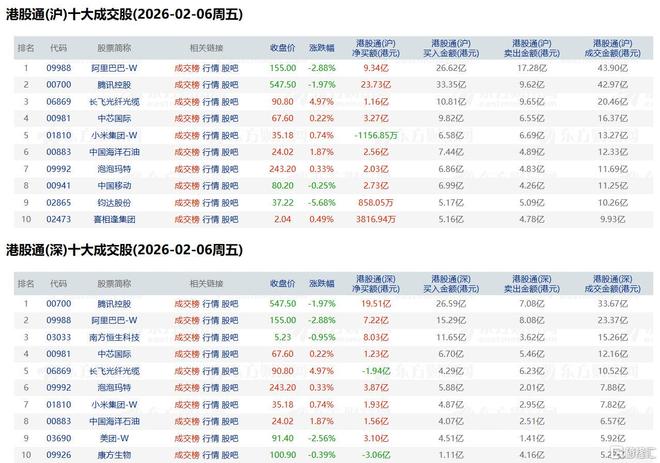
南向资金今日净买入148.59亿港元 腾讯控股获净买入居前
Xin Lang Cai Jing· 2026-02-06 10:00
Group 1 - Southbound funds recorded a net purchase of HKD 14.859 billion today [1] - Tencent Holdings received a net inflow of approximately HKD 4.324 billion [1] - Alibaba-W saw a net inflow of around HKD 1.656 billion [1] Group 2 - Kangfang Biopharmaceutical experienced a net outflow of HKD 306 million [1] - Changfei Optical Fiber (601869) faced a net outflow of HKD 79 million [1]