
Cambricon(688256)

Search documents
华创证券:大模型发展催化GPU需求 多家国产AI智算芯片加速追赶
智通财经网· 2025-12-24 06:16
Group 1 - The core viewpoint is that AI investment has achieved a closed loop, prompting overseas companies to increase their AI-related investments, with domestic GPU manufacturers catching up to international standards [1] - The demand for GPUs is catalyzed by the development of large models, as GPUs are more suitable for parallel computing tasks compared to CPUs, making them essential for AI training and inference [1] - The evolution of large language models follows the Scaling Law, indicating that their capabilities heavily rely on massive computing power, which will continue to drive AI applications [1] Group 2 - Major overseas companies, particularly in North America, are significantly increasing their AI investments, with Nvidia maintaining a dominant position in the global market [2] - Nvidia's GPU products have shown remarkable performance improvements, with the GB200 achieving training performance four times that of the H100 and inference performance thirty times that of the H100 [2] - The commercial viability of AI investments is being realized as large model users transition to paying customers, as evidenced by Google's token usage growth [2] Group 3 - The U.S. has expanded export restrictions on high-end GPUs, which has led to increased support for domestic computing power industries in China [3] - Several domestic companies, such as Cambricon and Haiguang Information, are launching AI computing chip products and are gradually catching up to international standards [3] - The profitability of domestic GPU companies varies, with Haiguang Information achieving profitability in 2021, while others like Moore Threads and Muxi are still in the early stages of commercialization [3]


半日主力资金丨加仓国防军工、电子股 抛售有色金属股


Di Yi Cai Jing· 2025-12-24 03:52
具体到个股来看,中国卫星、香农芯创、天际股份获净流入28.55亿元、12.85亿元、11.76亿元。 净流出方面,寒武纪-U、胜宏科技、摩尔线程-U遭抛售10.65亿元、9.86亿元、9.08亿元。 主力资金早间净流入国防军工、电子、电力设备、机械设备、计算机、汽车等板块,净流出有色金属、 银行、传媒、农林牧渔、食品饮料、煤炭等板块。 ...
榜单公布|2025 EDGE AWARDS年度上市公司价值榜正式揭晓
Sou Hu Cai Jing· 2025-12-24 02:38
Group 1 - The core viewpoint emphasizes that listed companies in China are not only the main force behind data growth but also serve as a stabilizing factor in the industry ecosystem, focusing on long-term value and comprehensive governance [2] - In 2025, the capital market aims for steady progress and quality improvement amidst multiple risks, enhancing market resilience and risk resistance, leading to reasonable quantitative growth and effective qualitative enhancement [2] - The market's expectations for listed companies have shifted from short-term performance to long-termism and comprehensive value, including governance structure, stable returns, strategic layout in frontier fields, and deep ESG practices [2] Group 2 - The 2025 T-EDGE Global Dialogue, organized by Titanium Media Group, NextFin.AI, and Barron’s China, highlights the importance of recognizing companies that redefine industry boundaries and emphasizes the core logic of "value investment" [3] - The EDGE AWARDS annual list includes categories such as Most Socially Responsible Company, Best Board Secretary, Most Investment Value Company, and Best Investor Relations Management Company, recognizing outstanding performance in governance, investment value, social responsibility, and investor relations [3][4] Group 3 - Aier Eye Hospital is recognized as a leader in ESG practices, integrating ESG into its core business and governance structure, while actively engaging in public welfare projects to enhance national eye health [5] - Betaini Group focuses on creating a skin health ecosystem and incorporates green development into its strategy, promoting biodiversity and sustainable practices [6] - Kweichow Moutai leads the liquor industry with a brand value of 468.718 billion, actively engaging in ecological protection and social responsibility initiatives [7] - JD Group has created significant employment opportunities and is committed to improving living conditions for its delivery personnel, with plans to invest 22 billion in housing projects [8] - Quantitative Group, listed on the Hong Kong Stock Exchange, leverages AI technology to reshape online consumption and has achieved a compound annual growth rate of 44.59% in revenue from 2022 to 2024 [9] - Seres focuses on new energy vehicles and has established a robust ESG governance framework, with significant growth in revenue and sales projected for 2024 [10] - Shui Jing Fang integrates social responsibility into its corporate strategy, setting clear environmental goals and contributing to community development [11] - China Baoan actively engages in social responsibility through its subsidiaries, contributing to community welfare and healthcare improvements [13] Group 4 - The Best Board Secretary category highlights the importance of effective communication between listed companies and the public, emphasizing the role of board secretaries in enhancing corporate governance [14] - Ren Shunying from Anfu Technology is recognized for her expertise in capital operations and corporate governance, significantly contributing to the company's compliance and investor relations [15] - Xia Ping from Jiahe Intelligent is noted for her effective investor relations management and participation in strategic planning [16] - Li Liangyu from Robotech is acknowledged for his role in maintaining corporate governance and enhancing market recognition [17] - Zhang Wenyu from Tianqi Lithium is recognized for his contributions to market value management and investor relations [18] Group 5 - The Most Investment Value Company category identifies companies with clear business models and significant breakthroughs in technology or policy, indicating strong growth potential [19][20] - Orbbec, a leader in 3D vision technology, has achieved over 70% market share in key sectors and continues to lead industry advancements [20] - BYD maintains its position as a global leader in new energy, with significant growth in overseas markets and a strong investment outlook [21] - Cambrian has entered a critical profitability phase, with substantial revenue growth and a strong market position in AI chips [22] - Hanlan Environment focuses on environmental services and has achieved consistent profit growth, attracting long-term investors [23] - Geely Auto has demonstrated strong financial performance and strategic integration, positioning itself for sustained growth [24] - Kanghong Pharmaceutical emphasizes innovation in drug development and has shown robust revenue growth, indicating long-term investment value [25] - Lens Technology maintains a strong market position with solid cash flow and growth potential in the automotive and consumer electronics sectors [26]




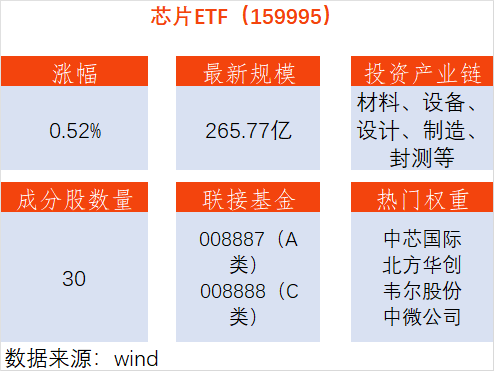
机构预计存储芯片价格将持续上涨,芯片ETF(159995.SZ)上涨0.52%,北京君正上涨6.23%
Mei Ri Jing Ji Xin Wen· 2025-12-24 02:35
Group 1 - The A-share market saw a collective rise in the three major indices, with the Shanghai Composite Index increasing by 0.08%, driven by strong performances in the environmental protection, electronics, and communication sectors, while agriculture, forestry, animal husbandry, and coal sectors experienced declines [1] - The chip technology stocks showed significant strength, with the chip ETF (159995.SZ) rising by 0.52%, and notable increases in component stocks such as Beijing Junzheng (up 6.23%), Shengbang Co. (up 5.15%), SMIC (up 2.95%), Zhaosheng Micro (up 2.79%), and Hu Silicon Industry (up 0.88%) [1] Group 2 - According to the CFM flash memory market report, there is expected to be a significant supply shortage for server eSSD and DDR5 RDIMM in Q1 2026, with DDR5 RDIMM prices projected to rise by over 40% and eSSD prices expected to increase by 20% to 30% [3] - Embedded storage prices are anticipated to see substantial increases, with embedded NAND and DRAM contract prices expected to rise by as much as 30% and 45% respectively by Q4 2025, with further significant increases projected for Q1 [3] - Dongguan Securities indicated that the continuous rise in storage prices reflects strong demand driven by AI, suggesting that companies within the storage industry chain are likely to benefit from these price increases [3] - The chip ETF (159995) tracks the National Chip Index, which includes 30 leading companies in the A-share chip industry across materials, equipment, design, manufacturing, packaging, and testing, including SMIC, Cambricon, Changdian Technology, and Northern Huachuang [3]




32股获杠杆资金净买入超亿元
Zheng Quan Shi Bao Wang· 2025-12-24 02:20
12月23日融资客净买入金额排名 | 代码 | 简称 | 12月23日涨跌幅 | 融资净买入额 | 最新融资余额 | 占流通市值比例 | 所属行 | | --- | --- | --- | --- | --- | --- | --- | | | | (%) | (万元) | (万元) | (%) | 业 | | 688256 | 寒武 纪-U | 3.99 | 87926.75 | 1553699.84 | 2.78 | 电子 | | 002837 | 英维克 | 10.00 | 72980.28 | 452962.02 | 5.13 | 机械设 备 | | 300476 | 胜宏科 技 | 3.44 | 52613.48 | 1756211.36 | 6.67 | 电子 | | 601899 | 紫金矿 业 | -1.35 | 48811.85 | 739590.45 | 1.12 | 有色金 属 | | 300502 | 新易盛 | -1.08 | 46564.77 | 2117870.13 | 5.22 | 通信 | | 300274 | 阳光电 | 0.26 | 38403.02 | 1445064. ...



寒武纪跌2.01%,成交额27.50亿元,主力资金净流出240.58万元
Xin Lang Zheng Quan· 2025-12-24 02:19
Core Viewpoint - The stock of Cambricon Technologies Co., Ltd. has experienced fluctuations, with a notable increase of 98.95% year-to-date, but a recent decline in trading performance over the past few days [1][2]. Group 1: Stock Performance - As of December 24, Cambricon's stock price was 1309.10 CNY per share, with a market capitalization of 5520.28 billion CNY [1]. - The stock has seen a trading volume of 27.50 billion CNY, with a turnover rate of 0.50% [1]. - Year-to-date, the stock has risen by 98.95%, but it has decreased by 0.49% over the last five trading days, 0.42% over the last twenty days, and 3.06% over the last sixty days [1]. Group 2: Financial Performance - For the period from January to September 2025, Cambricon reported a revenue of 46.07 billion CNY, reflecting a year-on-year growth of 2386.38% [2]. - The net profit attributable to shareholders for the same period was 16.05 billion CNY, showing a significant increase of 321.49% year-on-year [2]. Group 3: Shareholder Information - As of September 30, 2025, the number of shareholders for Cambricon was 62,000, which is an increase of 52.13% compared to the previous period [2]. - The average number of circulating shares per shareholder was 6748 shares, a decrease of 34.13% from the previous period [2]. - Major shareholders include Hong Kong Central Clearing Limited and various ETFs, with some experiencing a reduction in holdings [3].
两融余额三连升 杠杆资金大比例加仓16股
Zheng Quan Shi Bao Wang· 2025-12-24 02:01
Core Insights - The total margin balance in the market has reached 25,315.63 billion yuan, marking an increase of 149.23 billion yuan from the previous trading day, with a total increase of 321.98 billion yuan over three consecutive trading days [1][2] Industry Summary - Among the 31 industries categorized by Shenwan, 22 industries saw an increase in margin balance, with the communication industry leading with an increase of 5.37 billion yuan, followed by electronics and electric equipment [1][2] - The communication industry recorded the highest percentage increase in margin balance at 4.56%, followed by mechanical equipment and non-ferrous metals with increases of 2.56% and 2.55% respectively [1][2] Individual Stock Performance - During the period of increasing margin balances, 53.63% of the stocks saw growth in their margin balances, with 16 stocks experiencing an increase of over 50% [4] - The stock with the highest increase in margin balance was Kema Technology, which saw a growth of 103.96% to reach a margin balance of 933 million yuan [5] - Other notable stocks with significant increases include Runpu Food and Baolijie, with increases of 97.69% and 95.80% respectively [4][5] Margin Balance Increase Rankings - The top three stocks with the highest increase in margin balance were Zhongji Xuchuang, with an increase of 2.014 billion yuan (10.39% growth), followed by Hanwujing-U and Yangguang Power with increases of 973 million yuan and 926 million yuan respectively [7]


328只科创板股融资余额环比增加
Zheng Quan Shi Bao Wang· 2025-12-24 01:59
| 688135 | 利扬 | 22576.92 | 11.14 | 0.00 | | 0.96 | | --- | --- | --- | --- | --- | --- | --- | | | 芯片 | | | | | | | 688150 | 莱特 | 31931.18 | 11.08 | 157.65 | 29.33 | 0.83 | | | 光电 | | | | | | | 688629 | 华丰 | 112440.72 | 10.23 | 377.00 | 125.88 | 14.27 | | | 科技 | | | | | | | 688290 | 景业 智能 | 25501.99 | 10.14 | 26.00 | -11.64 | -7.80 | | | 德科 | | | | | | | 688205 | 立 | 112346.95 | 9.84 | 172.30 | 31.46 | 2.52 | | 688651 | 盛邦 安全 | 1 1136.94 | 9.38 | 0.00 | | -4.78 | | 68831 1 | 盟升 电子 | 19413.49 | 8.99 | 0.00 | ...



31只科创板股获融资净买入额超3000万元
Zheng Quan Shi Bao Wang· 2025-12-24 01:45
Wind统计显示,12月23日,科创板两融余额合计2673.32亿元,较上一交易日增加22.78亿元。其中,融 资余额合计2663.9亿元,较上一交易日增加22.67亿元;融券余额合计9.42亿元,较上一交易日增加0.11 亿元。 (文章来源:证券时报网) 从个股来看,12月23日,有328只科创板个股获融资净买入,净买入金额在3000万元以上的有31只。其 中,寒武纪-U获融资净买入额居首,净买入8.79亿元;融资净买入金额居前的还有鼎通科技、和林微 纳、华丰科技、德科立、东芯股份等股。 ...
集成电路ETF(159546)开盘涨0.06%,重仓股中芯国际涨2.17%,寒武纪跌0.08%
Xin Lang Cai Jing· 2025-12-24 01:42
Core Viewpoint - The Integrated Circuit ETF (159546) opened with a slight increase of 0.06%, priced at 1.791 yuan, indicating a stable market performance for the fund [1] Group 1: ETF Performance - The Integrated Circuit ETF (159546) has a performance benchmark based on the CSI All-Share Integrated Circuit Index return [1] - Since its establishment on October 11, 2023, the fund has achieved a return of 79.28% [1] - The fund's return over the past month is reported at 7.90% [1] Group 2: Major Holdings Performance - Major holdings within the ETF include: - SMIC (中芯国际) with an increase of 2.17% [1] - Cambrian (寒武纪) with a decrease of 0.08% [1] - Haiguang Information (海光信息) down by 0.24% [1] - Lattice Technology (澜起科技) down by 0.41% [1] - Zhaoyi Innovation (兆易创新) up by 1.21% [1] - Haowei Group (豪威集团) up by 0.10% [1] - Chipone (芯原股份) down by 0.32% [1] - Changdian Technology (长电科技) up by 0.57% [1] - Unisoc (紫光国微) down by 0.12% [1] - Tongfu Microelectronics (通富微电) up by 0.21% [1]

