
SPD BANK(600000)

Search documents
浦发银行及郑州银行同日披露吸收旗下村镇银行并改设分支机构
Zhong Guo Ji Jin Bao· 2025-11-11 05:10
Core Points - SPDB (Shanghai Pudong Development Bank) and Zhengzhou Bank have announced the acquisition and restructuring of their respective village banks into branch institutions, indicating a trend towards consolidation in the rural banking sector [2][3] - The National Financial Regulatory Administration has approved these acquisitions, emphasizing compliance with legal regulations during the process [2] - The restructuring aims to enhance service capabilities and risk management for the parent banks while expanding their operational scope in rural areas [3] Group 1: SPDB's Acquisition - SPDB has received approval to acquire Zhejiang Pingyang Pudong Village Bank and establish a new branch, SPDB Wenzhou Pingyang Branch, taking over its assets, liabilities, and operations [2] - This marks the second village bank restructuring initiative by SPDB in recent months, following a similar acquisition in Dalian [2] Group 2: Zhengzhou Bank's Acquisition - Zhengzhou Bank plans to acquire the remaining 49% of shares in Xun County Zhengyin Village Bank and will merge it into its operations, leading to the dissolution of the village bank [3] - Xun County Zhengyin Village Bank was established in November 2017 with a registered capital of 100 million yuan, and Zhengzhou Bank previously held a 51% stake [3] Group 3: Industry Trends - As of August 15, 2023, 100 village banks have completed mergers and restructurings, surpassing the total of 94 exits projected for the entire year of 2024 [3] - Analysts suggest that the consolidation of village banks into branch institutions will improve service capabilities and broaden the business scope for the parent banks, especially in areas lacking existing branches [3]



一日两家,“村改支”提速
Zhong Guo Ji Jin Bao· 2025-11-11 05:09
Core Insights - SPDB and Zhengzhou Bank announced the acquisition of their respective village banks and the establishment of branch institutions, indicating a trend towards consolidation in the rural banking sector [1][2] - The National Financial Regulatory Administration has approved these acquisitions, emphasizing compliance with legal regulations [1] - The reform of village banks is accelerating, with over 100 village banks having completed mergers and restructurings by mid-August, surpassing the total number of exits for the entire year of 2024 [2] SPDB Acquisition - SPDB has acquired Zhejiang Pingyang Pudong Village Bank and will establish the Wenzhou Pingyang Branch, taking over its assets, liabilities, and employees [1] - This is the second "village-to-branch" project initiated by SPDB this year, following the acquisition of Dalian Ganjingzi Pudong Village Bank [1] Zhengzhou Bank Acquisition - Zhengzhou Bank plans to acquire the remaining 49% of shares in Xun County Zhengyin Village Bank and will merge it into a branch institution [2] - The merger will result in the dissolution of Xun County Zhengyin Village Bank, with all rights and obligations transferred to Zhengzhou Bank [2] Industry Trends - The ongoing consolidation of village banks is aimed at enhancing service capabilities and risk resilience in rural areas [2] - The transformation of village banks into branches allows parent banks to expand their operational scope, particularly in regions lacking existing branches [2]
浦发银行等成立经济发展公司,含多项AI业务
Zheng Quan Shi Bao Wang· 2025-11-11 02:21
Core Insights - A new company named Shanghai Bund Jinke Economic Development Co., Ltd. has been established with a registered capital of 50 million yuan [1] - The company's business scope includes technology intermediary services, AI innovation and entrepreneurship service platforms, AI public data platforms, and AI industry application system integration services [1] - The company is jointly held by Shanghai International Trust Co., Ltd., a subsidiary of Pudong Development Bank [1]
金融科技助力进博会:从智能体验到交易撮合,金融力量贯穿“买与卖”
Di Yi Cai Jing· 2025-11-10 11:10
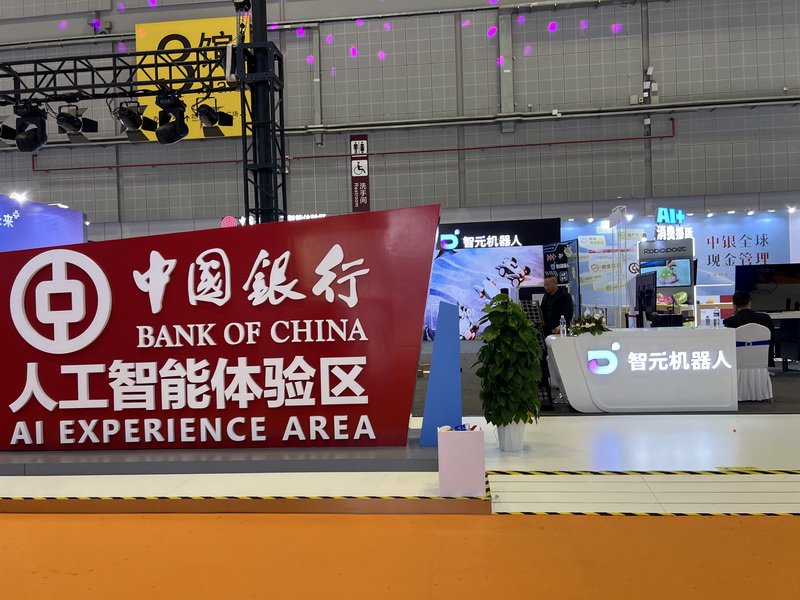
Core Insights - The eighth China International Import Expo (CIIE) concluded with an intended transaction amount of $83.49 billion, marking a record in both the number of participating companies and exhibition area, with 461 new global product launches [1] Group 1: Financial Institutions' Role - Financial institutions played a crucial role in enhancing the exhibition experience through technology and services, creating a seamless "transaction network" for buyers and sellers [1] - The integration of artificial intelligence (AI) and financial technology was highlighted, with various banks showcasing AI-driven experiences, such as China Bank's AI experience zone featuring robots and interactive displays [2][4] - The introduction of digital currency and upgraded payment systems facilitated smoother transactions, with the Industrial and Commercial Bank of China (ICBC) offering a commemorative digital currency wallet for the expo [6][9] Group 2: AI and Interactive Experiences - AI technology was prominently featured, with banks like China Construction Bank presenting humanoid robots capable of natural language interaction and full-service capabilities [5] - Interactive experiences, such as virtual racing and personalized AI portraits, attracted significant visitor engagement, demonstrating the blend of financial services with entertainment [5][6] - The use of AI in financial services was emphasized, with robots not only providing assistance but also marketing financial products effectively [4][5] Group 3: Payment Innovations - The payment system saw significant upgrades, with digital currency becoming a standard for transactions at the expo, allowing for quick and efficient cross-border payments [9][10] - The introduction of "instant buy and refund" services streamlined the tax refund process for international visitors, significantly reducing the time required for refunds [10] - The collaboration between China UnionPay and China Bank to offer integrated payment and tax refund services showcased the evolution of payment solutions at the expo [10] Group 4: Trade Facilitation and Collaboration - Financial institutions positioned themselves as resource hubs, facilitating connections between exhibitors and domestic buyers through various matchmaking activities [11] - The launch of upgraded banking apps by financial institutions aimed to enhance service integration, providing a comprehensive "finance + lifestyle" experience for exhibitors and consumers [13] - The role of financial institutions has evolved from merely providing loans to becoming key players in promoting global supply chain cooperation, as evidenced by the significant growth in cross-border settlement volumes [13]

浦发银行获批收购浙江平阳浦发村镇银行并设立分支机构
Bei Jing Shang Bao· 2025-11-10 10:12
Core Viewpoint - The National Financial Supervision Administration's Wenzhou Regulatory Bureau has approved Shanghai Pudong Development Bank's acquisition of Zhejiang Pingyang Pudong Village Bank and the establishment of a new branch in Wenzhou Pingyang [1] Group 1: Acquisition Details - Shanghai Pudong Development Bank will acquire the assets, liabilities, business, and employees of Zhejiang Pingyang Pudong Village Bank after the completion of asset verification [1] - The approval includes the establishment of Shanghai Pudong Development Bank Wenzhou Pingyang Branch [1] Group 2: Regulatory Compliance - The National Financial Supervision Administration emphasizes that Shanghai Pudong Development Bank must strictly adhere to relevant laws and regulations during the acquisition process [1] - Zhejiang Pingyang Pudong Village Bank is required to follow regulations for the dissolution of its legal entity [1]
股份制银行板块11月10日涨0.5%,中信银行领涨,主力资金净流入3.71亿元
Zheng Xing Xing Ye Ri Bao· 2025-11-10 08:48
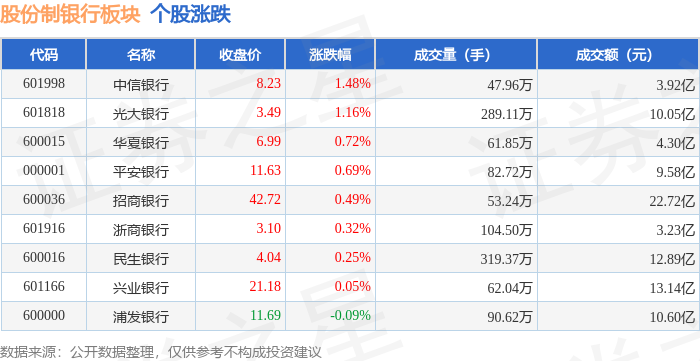
Core Insights - The banking sector saw a 0.5% increase on November 10, with CITIC Bank leading the gains [1] - The Shanghai Composite Index closed at 4018.6, up 0.53%, while the Shenzhen Component Index closed at 13427.61, up 0.18% [1] Banking Sector Performance - CITIC Bank (601998) closed at 8.23, up 1.48% with a trading volume of 479,600 shares and a transaction value of 392 million [1] - Other notable banks included: - Everbright Bank (601818) at 3.49, up 1.16%, with a transaction value of 1 billion [1] - Huaxia Bank (600015) at 6.99, up 0.72%, with a transaction value of 430 million [1] - Ping An Bank (000001) at 11.63, up 0.69%, with a transaction value of 958 million [1] - China Merchants Bank (600036) at 42.72, up 0.49%, with a transaction value of 2.27 billion [1] Capital Flow Analysis - The banking sector experienced a net inflow of 371 million from main funds, while retail and speculative funds saw net outflows of 131 million and 240 million, respectively [1] - Detailed capital flow for major banks included: - China Merchants Bank: Main funds net inflow of 29 million, speculative funds net outflow of 1.47 billion, retail funds net outflow of 1.43 billion [2] - Ping An Bank: Main funds net inflow of 92 million, speculative funds net outflow of 70 million, retail funds net outflow of 21 million [2] - CITIC Bank: Main funds net inflow of 73 million, speculative funds net outflow of 39 million, retail funds net outflow of 34 million [2]





本周在售最低持有期产品哪家强?
2 1 Shi Ji Jing Ji Bao Dao· 2025-11-10 08:44
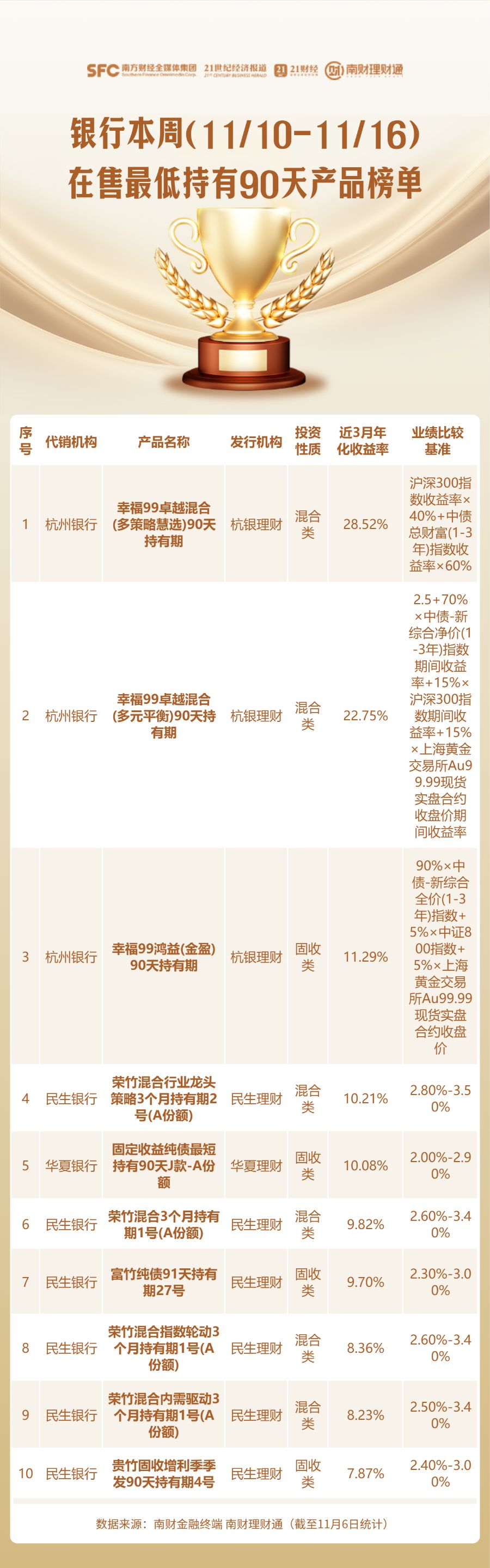
Core Insights - The article emphasizes the importance of distinguishing between various bank wealth management products, which often have similar names and vague characteristics, to help investors make informed choices [1] - The South Finance Wealth Management team compiles a weekly performance ranking of wealth management products available through different distribution channels, focusing on those with the best performance [1] Product Performance Summary - The report categorizes products based on minimum holding periods of 90 days, 180 days, and 365 days, calculating annualized returns for each category [1] - A total of 28 distribution institutions are involved in the ranking, including major banks such as Industrial and Commercial Bank of China, Bank of China, and Agricultural Bank of China [1] - The ranking is based on the assumption of the product's "on-sale" status, but actual availability may vary due to factors like sold-out quotas or differences in product listings for different customers [1] 90-Day Holding Period Products - The top-performing product for a 90-day holding period is from Hangzhou Bank, with an annualized return of 22.75% [4] - Other notable products include those from Minsheng Bank and Huaxia Bank, with returns of 10.21% and 10.08%, respectively [5] 180-Day Holding Period Products - For the 180-day holding period, Hangzhou Bank's product leads with a return of 14.04% [7] - Minsheng Bank also features prominently with products yielding 12.26% and 10.26% [7] 365-Day Holding Period Products - The report indicates that products with a 365-day holding period are also being evaluated, with specific performance data yet to be detailed in the provided excerpts [9]




从增量扩面到提质控险 银行业普惠金融迈向差异化精准服务
2 1 Shi Ji Jing Ji Bao Dao· 2025-11-10 04:21
Core Insights - The report highlights the significant growth and development of inclusive finance in China, particularly focusing on small and micro enterprises and rural areas, with a notable annual growth rate of over 20% in inclusive micro loans during the 14th Five-Year Plan period [1][2] - As of June 2025, the balance of inclusive micro loans reached 36 trillion yuan, which is 2.3 times that of the end of the 13th Five-Year Plan, with a decrease in interest rates by 2 percentage points [1][2] - The average interest rate for newly issued inclusive micro loans was 3.48% as of June 2025, reflecting a decrease of 66 basis points year-on-year [1][2] Group 1: Digital Empowerment - Digital technology has been a key driver for the development of inclusive finance, with banks utilizing big data and AI to enhance loan approval efficiency and reduce financing costs [2][7] - The market structure among banks is changing, with large commercial banks holding a 45.11% share of inclusive micro loans, while rural financial institutions have seen a decline in their market share [2][3] - The average growth rate of inclusive micro loans has been slowing down, with a decrease from 30.9% in 2020 to 12.3% by mid-2025 [2][3] Group 2: Performance of Listed Banks - Among listed banks, Agricultural Bank of China, Industrial and Commercial Bank of China, and Beijing Bank reported the highest growth rates in inclusive micro loans at 18.50%, 17.30%, and 17.27% respectively [3][4] - In contrast, some banks, including Shanghai Bank and Zhengzhou Bank, experienced negative growth rates of -3.97% and -2.06% [3][4] - The performance of different banks varies significantly, with state-owned banks generally showing stronger growth in inclusive micro loans compared to smaller banks [3][4] Group 3: Interest Rates and Risk Management - The interest rates for newly issued inclusive micro loans have decreased across various banks, with the highest rate at 4.20% and the lowest at 2.94% [7][8] - The gap in interest rates between large and small banks is narrowing, with some large banks' rates aligning closely with those of smaller banks [8][9] - The report emphasizes the importance of risk management in the inclusive finance sector, with several banks focusing on improving asset quality and managing non-performing loans [9][10]



打破业务壁垒 助力企业发展
Ren Min Wang· 2025-11-09 22:17
Core Insights - The core viewpoint of the article is the launch of the upgraded comprehensive financial service plan 8.0 by Shanghai Pudong Development Bank (SPDB) at the 8th China International Import Expo, emphasizing a full-ecosystem approach to cross-border financial services [1][2]. Group 1: Service Plan Features - The 8.0 version of the service plan integrates various financial sectors including green finance, technology finance, inclusive finance, supply chain finance, and personal cross-border finance, breaking down business barriers [1]. - The plan aims to provide a comprehensive solution encompassing settlement, financing, risk management, treasury management, and ecological services, with the goal of making these services a regular offering [1]. Group 2: Practical Implementation - SPDB has already implemented a full lifecycle cross-border service in its daily operations, exemplified by its support for Jie Sheng Group, a smart agriculture company, in navigating global business challenges [2]. - As of September 2023, SPDB reported a cross-border transaction settlement volume of 3.3 trillion yuan, a year-on-year increase of 47%, and a cross-border loan balance of 325.8 billion yuan, up 23% from the previous year [2].
搭建起全球资源联动的桥梁 从进博会看供应链上的金融“枢纽”
Shang Hai Zheng Quan Bao· 2025-11-09 17:28
Core Insights - The role of finance is evolving from merely supporting trade to becoming a key player in global supply chain value discovery and resource allocation [1][2] - The integration of advanced technologies such as artificial intelligence, big data, and blockchain is enhancing the efficiency of cross-border financial services [2][3] - Financial institutions are increasingly acting as bridges for global trade, facilitating cooperation between domestic and foreign entities [3][4] Financial Infrastructure Development - The launch of the "交银航贸通" platform by Bank of Communications integrates various digital functions to support small and micro foreign trade enterprises, addressing issues like financing difficulties and high hedging costs [1] - Shanghai Pudong Development Bank introduced a comprehensive financial service plan that includes ten digital cross-border financial products, achieving near-instantaneous cross-border settlement and financing [2] Cross-Border Financial Solutions - The emergence of credit reporting solutions for cross-border enterprises is providing small and medium-sized enterprises with a "credit passport," significantly reducing approval times for cross-border loans by 35% [2] - Standard Chartered Bank's participation in the expo highlights its commitment to providing comprehensive cross-border financial solutions, emphasizing the importance of China as a strategic market [3] Global Trade Financial Network - The financial institutions are depicted as a "highway" for data flow and a "dispatch center" for capital circulation, enhancing the support for cross-border trade [4] - The collaboration between various financial institutions during the expo aims to create a more seamless global trade financial network, reflecting the growing importance of multinational financial institutions in facilitating international economic exchanges [3][4]
