
HUA XIA BANK(600015)

Search documents
金工定期报告20251104:预期高股息组合跟踪
Soochow Securities· 2025-11-04 09:34
- The "Expected High Dividend Portfolio" model is constructed using a two-stage process: first, calculating the dividend yield based on annual report profit distribution data, and second, predicting and calculating the dividend yield using historical dividend data and fundamental indicators. Additionally, two short-term factors, the reversal factor and the profitability factor, are used to assist in stock selection. The portfolio is optimized within the CSI 300 constituents, holding 30 stocks per period and rebalancing monthly[3][8][13] - The stock selection process for the "Expected High Dividend Portfolio" involves: (1) excluding suspended and limit-up stocks from the CSI 300 constituents, (2) removing the top 20% of stocks with the highest short-term momentum (21-day cumulative returns), (3) excluding stocks with declining profitability (quarterly net profit growth rate < 0), and (4) ranking the remaining stocks by expected dividend yield and selecting the top 30 stocks to construct an equally weighted portfolio[9][13] - The backtesting results of the "Expected High Dividend Portfolio" from February 2, 2009, to August 31, 2017, show a cumulative return of 358.90% relative to the CSI 300 Total Return Index, with a cumulative excess return of 107.44%. The annualized excess return is 8.87%, the maximum rolling one-year drawdown of excess return is 12.26%, and the monthly excess win rate is 60.19%[11] - In October 2025, the "Expected High Dividend Portfolio" achieved an average return of 5.47%, outperforming the CSI 300 Index by 5.93% and the CSI Dividend Index by 2.50% during the same period[3][14][19]




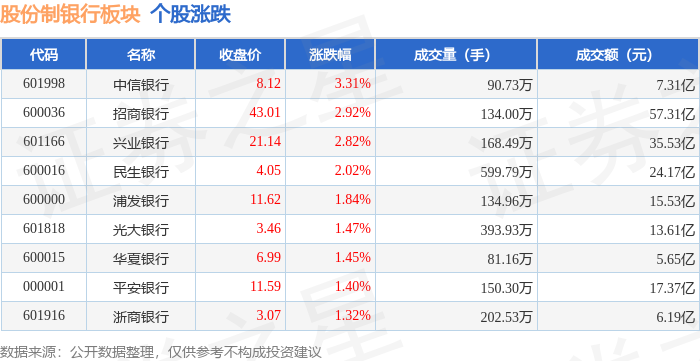
股份制银行板块11月4日涨2.44%,中信银行领涨,主力资金净流入17.63亿元
Zheng Xing Xing Ye Ri Bao· 2025-11-04 08:48
Core Viewpoint - The banking sector, particularly the joint-stock banks, experienced a notable increase of 2.44% on November 4, with CITIC Bank leading the gains, despite the overall decline in major stock indices [1] Group 1: Market Performance - The Shanghai Composite Index closed at 3960.19, down 0.41%, while the Shenzhen Component Index closed at 13175.22, down 1.71% [1] - CITIC Bank's stock price rose by 3.31% to 8.12, with a trading volume of 907,300 shares and a transaction value of 731 million [1] - Other notable performers included China Merchants Bank, which increased by 2.92% to 43.01, and Industrial Bank, which rose by 2.82% to 21.14 [1] Group 2: Capital Flow - The joint-stock banking sector saw a net inflow of 1.763 billion in main funds, while retail investors experienced a net outflow of 664 million [1] - Specific banks like Shanghai Pudong Development Bank had a main fund net inflow of 413 million, while retail investors saw a net outflow of 251 million [2] - Ping An Bank recorded a main fund net inflow of 294 million, with retail investors also experiencing a net outflow of 165 million [2]






42上市银行信披考评出炉:5家升级1家降级
2 1 Shi Ji Jing Ji Bao Dao· 2025-11-03 12:08
Core Viewpoint - The quality of information disclosure is a crucial indicator of the quality of listed companies and serves as an important basis for investors' decision-making. The Shanghai and Shenzhen Stock Exchanges have emphasized the importance of this quality and have set higher requirements for listed companies in their recent evaluation guidelines [1][3]. Summary by Sections Information Disclosure Evaluation - In 2024-2025, 42 A-share listed banks received ratings of B or above for their information disclosure, with 22 banks rated A. The ratings remained consistent with the previous year for most banks, with only six experiencing changes [1][2][6]. Evaluation Criteria - The evaluation of information disclosure quality includes eight main aspects: compliance, effectiveness, investor relations management, return to investors, social responsibility disclosure, penalties and regulatory measures, support for exchange operations, and other factors recognized by the exchange [3][5]. Impact on Financing and Mergers - The evaluation results are considered in the review of refinancing and mergers and acquisitions. Companies rated A will receive various supports, such as exemptions from post-review for certain disclosures and prioritized training opportunities [6][7]. Bank Responses and Commitments - Several banks, including Hangzhou Bank and Citic Bank, have publicly committed to enhancing their information disclosure quality following their A ratings. They emphasize transparency, effective communication, and adherence to regulations as key components of their strategies [9][10][11].



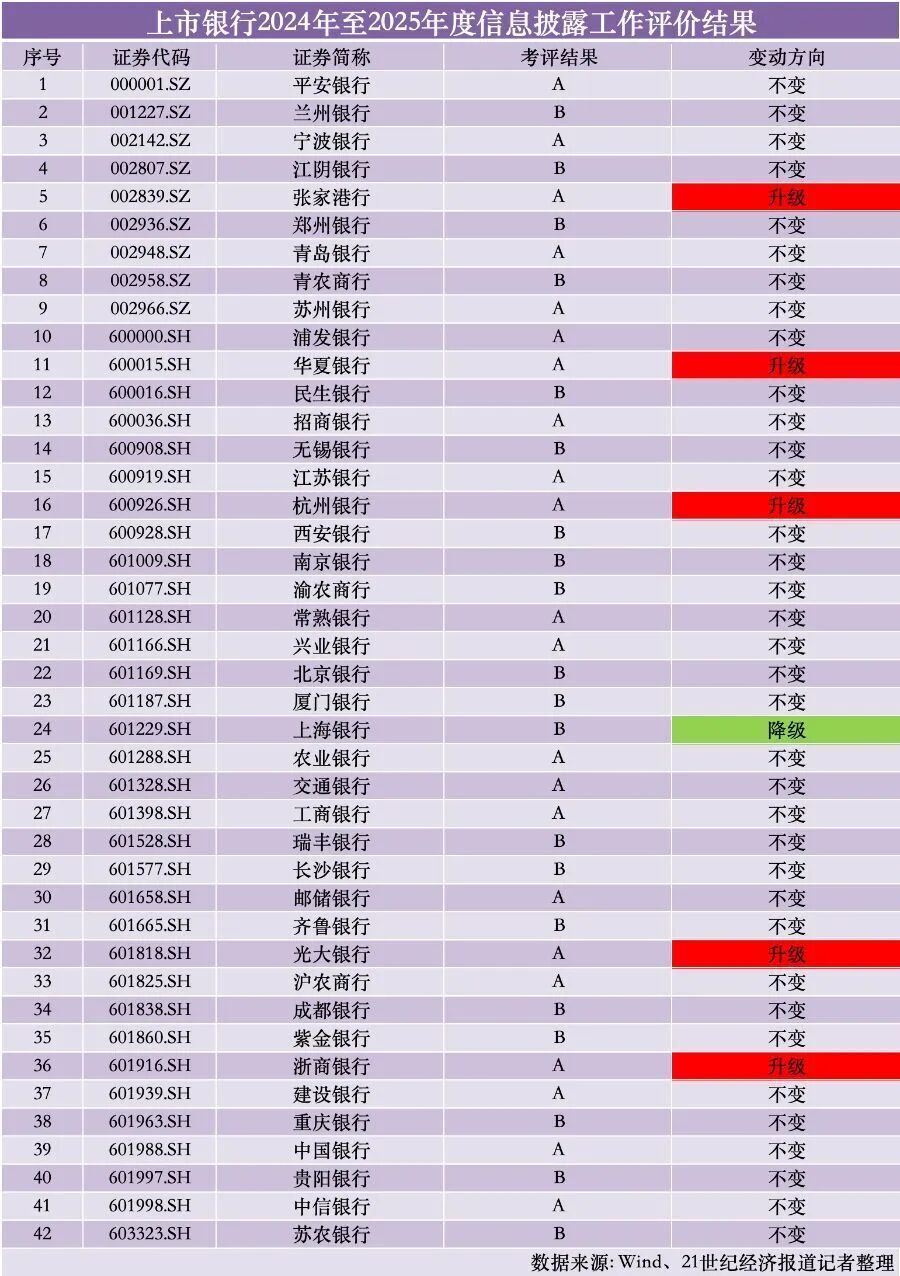
上市银行信披考评出炉:光大、华夏、浙商提级,上海银行降级
2 1 Shi Ji Jing Ji Bao Dao· 2025-11-03 10:57
Core Viewpoint - The quality of information disclosure is a crucial indicator of the quality of listed companies and serves as an important basis for investors' decision-making. The Shanghai and Shenzhen Stock Exchanges have emphasized the importance of information disclosure quality and have implemented comprehensive evaluations of listed companies' disclosure practices [1][3]. Group 1: Regulatory Framework - In March, the Shanghai and Shenzhen Stock Exchanges released guidelines focusing on enhancing information disclosure regulation, punishing financial fraud, strengthening cash dividend supervision, and promoting the enhancement of investment value for listed companies [1][3]. - The evaluation criteria for information disclosure quality include eight aspects: normative disclosure, effective disclosure, investor relations management, return to investors, social responsibility disclosure, penalties and regulatory measures, support for exchange work, and other factors recognized by the exchange [3][5]. Group 2: Evaluation Results - Among the 42 A-share listed banks, all received ratings of B or above, with 22 banks rated A. Most banks maintained their ratings from the previous year, with only six experiencing changes [3][6]. - The banks rated A include major state-owned banks such as Industrial and Commercial Bank of China, Agricultural Bank of China, and China Bank, as well as several joint-stock and city commercial banks [6][7]. Group 3: Impact on Capital Activities - The evaluation results of information disclosure will influence the review of refinancing and mergers and acquisitions for listed banks, establishing a strong market incentive and constraint mechanism [5][8]. - Both the Shanghai and Shenzhen Stock Exchanges provide various supports and conveniences for companies rated A, such as exemptions from post-review for temporary reports and reduced inquiry rounds for restructuring audits [8][9]. Group 4: Commitment to Improvement - Several banks, including Hangzhou Bank and China CITIC Bank, have publicly committed to further enhancing their information disclosure quality following their A ratings, emphasizing transparency, effective communication, and governance [10][11]. - China CITIC Bank has highlighted its commitment to investor rights protection, having distributed over RMB 170 billion in cash dividends and planning to increase its mid-term dividend payout ratio [11].


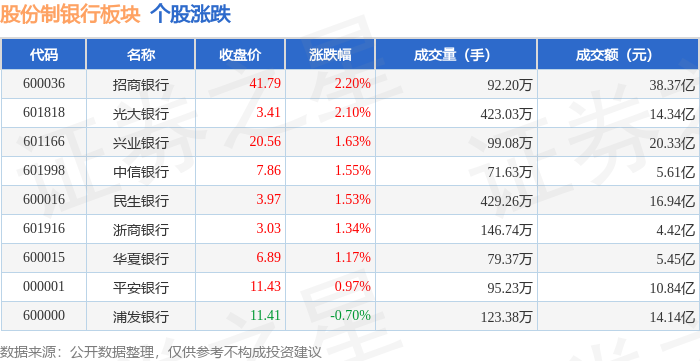
股份制银行板块11月3日涨1.41%,招商银行领涨,主力资金净流入6.63亿元
Zheng Xing Xing Ye Ri Bao· 2025-11-03 08:43
Group 1 - The banking sector saw an increase of 1.41% on November 3, with China Merchants Bank leading the gains [1] - The Shanghai Composite Index closed at 3976.52, up 0.55%, while the Shenzhen Component Index closed at 13404.06, up 0.19% [1] - Major banks such as China Merchants Bank and Everbright Bank reported significant price increases of 2.20% and 2.10% respectively [1] Group 2 - The banking sector experienced a net inflow of 663 million yuan from institutional investors, while retail investors saw a net outflow of 222 million yuan [1] - China Merchants Bank had a net inflow of 2.41 billion yuan from institutional investors, indicating strong institutional interest [1] - Everbright Bank and Minsheng Bank also attracted significant institutional inflows of 1.47 billion yuan and 1.10 billion yuan respectively [1]
关于国泰惠信三年定期开放债券型 证券投资基金开放申购、赎回 及转换业务的提示性公告
Sou Hu Cai Jing· 2025-11-02 23:11
Core Points - The announcement details the opening period for subscription, redemption, and conversion of the Guotai Huixin Three-Year Regular Open Bond Fund, which will accept applications from November 3, 2025, to November 28, 2025, after which it will enter a closed period until November 28, 2028 [1][2] - A communication-based meeting for fund shareholders will be held to discuss amendments to the fund contract, with voting from November 3, 2025, to December 3, 2025 [3][5] - The meeting requires at least half of the fund shares to be represented for valid resolutions, and amendments to the fund contract must be approved by two-thirds of the voting rights present [15][29] Fund Management - Guotai Fund Management Co., Ltd. is responsible for managing the fund and has collaborated with the custodian, Huaxia Bank Co., Ltd., to organize the shareholder meeting [3][17] - The fund's contract was established on October 31, 2019, and the proposed amendments aim to better protect the interests of shareholders in response to market changes [20][25] Voting Process - Shareholders can submit their votes via a designated ballot, which can be downloaded from the fund management's website [6][23] - Specific requirements for voting include providing identification and, for institutional investors, necessary documentation such as business licenses [7][8] Contract Amendments - Proposed changes to the fund contract include adjustments to termination clauses and the removal of certain investment restrictions, which will be discussed at the shareholder meeting [20][26] - If the proposed amendments are approved, the fund management will implement the changes and notify the relevant regulatory authorities within five days [28][30]
债市波动 挤压银行投资收益空间
Shang Hai Zheng Quan Bao· 2025-11-02 17:54
Core Viewpoint - The volatility in the bond market and the narrowing net interest margin have pressured the revenue of several listed banks in the first three quarters of this year, leading to a gradual decline in the benefits from the "bond bull" market [1][2] Group 1: Revenue Impact - Many listed banks have faced revenue pressure due to bond market fluctuations and a slowdown in credit expansion, with investment income becoming a crucial support for profits [2][3] - As of the end of Q3 2025, 24 out of 42 listed banks reported a year-on-year decline in non-interest income, and 8 banks saw a drop in net investment income [2] - Notably, China Merchants Bank reported a significant loss of 8.827 billion yuan in fair value changes, with a quarterly loss of 4.008 billion yuan in Q3 alone [2][3] Group 2: Strategies to Mitigate Losses - Some banks have managed to achieve year-on-year growth in investment income by actively selling bonds to lock in floating profits during high market conditions [4] - For instance, China Construction Bank's investment net income increased by 150.55%, while several other banks reported over 70% growth in investment income [4] - The strategy of "selling bonds to realize floating profits" is based on the classification of financial assets, where certain assets can confirm investment income upon sale [4] Group 3: Future Outlook and Adjustments - Analysts suggest that the sustainability of the "selling bonds to supplement profits" strategy will decline as previously accumulated floating profits are exhausted [5] - The People's Bank of China has signaled a return to government bond trading operations, which is expected to enhance monetary policy flexibility and stabilize market expectations [6] - As the bond market enters a low-volatility phase, banks are shifting their investment strategies from relying solely on interest margin gains to enhancing active trading and risk management capabilities [7]
债市波动挤压银行投资收益空间
Shang Hai Zheng Quan Bao· 2025-11-02 17:53
Core Viewpoint - The volatility in the bond market and the narrowing net interest margin have pressured the revenue of several listed banks in the first three quarters of the year, leading to a gradual decline in the benefits from the "bond bull" market [1][2]. Group 1: Revenue Impact - Many listed banks have faced revenue pressure due to bond market fluctuations and a slowdown in credit expansion, with investment income becoming a crucial support for profits [2][3]. - As of the end of Q3 2025, 24 out of 42 listed banks reported a year-on-year decline in non-interest income, and 8 banks saw a drop in net investment income [2]. - Notably, China Merchants Bank reported a loss of 8.827 billion yuan in fair value changes, with a quarterly loss of 4.008 billion yuan in Q3 alone [2][3]. Group 2: Strategies to Mitigate Losses - Some banks have managed to achieve year-on-year growth in investment income by actively selling bonds to lock in profits during high market conditions [4]. - For instance, China Construction Bank's investment net income increased by 150.55%, while several other banks also reported over 70% growth in investment income [4]. - The strategy of "selling bonds to realize floating profits" is based on the classification of financial assets, where certain assets can confirm investment income upon sale [4]. Group 3: Future Outlook and Adjustments - Analysts suggest that the sustainability of the "selling bonds to supplement profits" strategy will decline as previously accumulated floating profits are exhausted [5]. - The People's Bank of China has signaled a return to government bond trading operations, which is expected to enhance monetary policy flexibility and stabilize market expectations [6]. - As the bond market enters a low-volatility phase, banks are shifting their investment strategies from relying solely on interest margin gains to enhancing active trading and risk management capabilities [7].
面对城商行突袭,华夏银行打起业绩「防御战」
Hua Er Jie Jian Wen· 2025-11-02 10:45
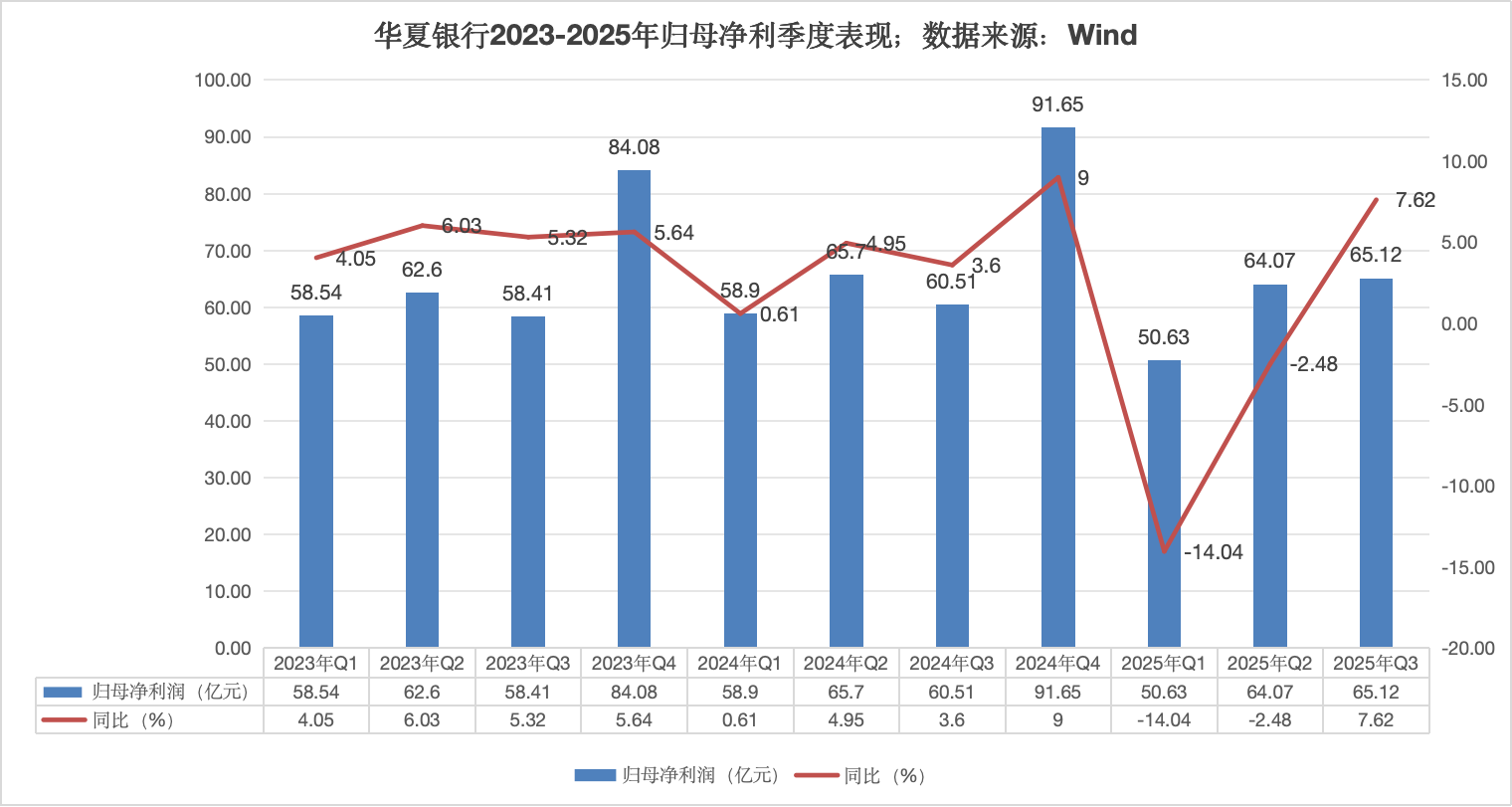
Core Viewpoint - Under the reshuffling of commercial banks, city commercial banks are gaining momentum, increasing growth anxiety for lagging joint-stock banks like Huaxia Bank [1][2]. Group 1: Financial Performance - Huaxia Bank reported a revenue of 64.881 billion and a net profit of 17.982 billion for the first three quarters, representing declines of 8.79% and 2.86% year-on-year, respectively [1][6]. - Among 42 listed banks in A-shares, Huaxia Bank ranked 40th and 37th in revenue and net profit growth rates, indicating a significant lag behind most banks [2]. - In the third quarter, Huaxia Bank experienced a revenue decline of 15.02% but a net profit increase of 7.62%, marking a V-shaped reversal in profit growth [7][9]. Group 2: Asset Quality and Risk Management - As of the end of the third quarter, Huaxia Bank's non-performing loan ratio stood at 1.58%, the worst among A-share joint-stock banks [4][14]. - The bank faces a dilemma between sacrificing risk control for growth or tightening risk management and potentially losing market share to aggressive city commercial banks [5][16]. - The bank's management has undergone significant changes, including the appointment of a new chairman and several key executives, aimed at addressing long-standing governance and risk management issues [18][19]. Group 3: Strategic Adjustments - Huaxia Bank is implementing a "cutting inward" strategy to optimize its organizational structure and improve operational efficiency [20][21]. - The bank's focus is shifting towards retail transformation and digital risk control, with an emphasis on supporting technological innovation and green finance [29]. - The bank's capital adequacy ratio is at 12.63%, which, while above the regulatory requirement, is still at the lower end compared to peers, indicating a weak capacity to absorb risks [14][23]. Group 4: Competitive Landscape - Huaxia Bank's profits have been surpassed by five city commercial banks, which are experiencing higher growth rates, intensifying competitive pressure [25][26]. - The bank's main markets, the Beijing-Tianjin-Hebei and Yangtze River Delta regions, are also the battlegrounds for these aggressive city commercial banks [28].
首单落地,光谷推出“科创金融小银团”,助力解决成长期科技企业“融资困境”
Sou Hu Cai Jing· 2025-11-02 07:19
Core Viewpoint - The successful implementation of the "Science and Innovation Financial Small Syndicate" mechanism in the East Lake High-tech Zone is marked by the first credit loan of 5 million yuan from Hankou Bank, indicating a new approach to financing for growth-oriented technology enterprises [1][2]. Group 1 - The first "Small Syndicate" involves a joint investment of 35 million yuan from five banks, including Industrial and Commercial Bank of China, Wuhan Rural Commercial Bank, Hankou Bank, Shanghai Pudong Development Bank, and Huaxia Bank, tailored for the enterprise Hanning Rail [1]. - The "Science and Innovation Financial Small Syndicate" model innovates on traditional syndicate loans by allowing banks to independently approve loans while sharing information and discussing credit limits, enhancing transparency and trust in financing [1][2]. - This financing model targets growth-stage technology enterprises with financing needs ranging from 20 million yuan to 500 million yuan, addressing common challenges such as insufficient credit limits from single banks and high communication costs among multiple banks [1]. Group 2 - Hubei Province Science and Technology Guarantee Company acts as the operational body, coordinating among banks based on their risk preferences and processes to ensure efficient operation of the mechanism [2]. - In case of operational disruptions for funded enterprises, the Hubei Province Science and Technology Guarantee Company will lead discussions among cooperating banks to stabilize loans, renew loans, or develop orderly exit plans, preventing risks associated with single bank withdrawals [2]. - The initial success of the "Science and Innovation Financial Small Syndicate" has attracted nine banks, with ten enterprise projects accelerating, and nearly 400 enterprises in the reserve pool, indicating strong future growth potential [2].