
HUA XIA BANK(600015)

Search documents
不再“规模至上”,银行行长纷纷表态“反内卷”
2 1 Shi Ji Jing Ji Bao Dao· 2025-09-01 11:04
Core Viewpoint - The banking industry is undergoing a transformation focused on "anti-involution," emphasizing high-quality development and avoiding excessive competition, as highlighted by recent statements from bank executives and regulatory bodies [1][2][6]. Group 1: Industry Trends - The term "anti-involution" has been officially recognized in the banking sector, with the People's Bank of China addressing it in their monetary policy report, indicating a shift in focus from external shocks to internal structural adjustments [1][2]. - Bank executives are increasingly using terms like "high-quality development," "stability," and "reasonable scale control," reflecting a consensus on moving away from scale-driven growth [1][6]. Group 2: Strategic Responses - Banks are adopting differentiated strategies to combat involution, such as optimizing asset structures and implementing rational pricing mechanisms. For instance, Minsheng Bank emphasizes deepening customer relationships and sustainable development [3][4]. - Industrial and Commercial Bank of China (ICBC) has implemented a "balanced pricing" strategy to stabilize net interest margins while supporting market operations [4]. Group 3: Non-Interest Income Focus - Non-interest income is becoming a critical area for banks to enhance revenue structures and reduce reliance on traditional lending. For example, ICBC reported a non-interest income of 95.5 billion yuan, with significant contributions from wealth management and other services [9][10]. - Agricultural Bank of China is innovating in the non-interest sector by developing comprehensive services for the elderly, showcasing a shift towards diversified revenue streams [11][12]. Group 4: Quality Over Quantity - The consensus among banks is shifting from a focus on scale to prioritizing quality and efficiency in growth. This is evident in the performance metrics shared by various banks, indicating a commitment to sustainable and quality-driven growth [6][7]. - The concept of "uniform speed balance" proposed by ICBC's president highlights the importance of stable growth over aggressive expansion, aiming to enhance the efficiency of capital allocation [8].





14家银行信用卡余额半年“缩水”2000亿,有卡民7张信用卡销掉6张
Di Yi Cai Jing· 2025-09-01 10:29
Core Insights - The credit card market is experiencing a significant decline, with various metrics showing a downward trend, including credit card loan balances, transaction volumes, and the number of active cards [1][2][3] Credit Card Loan Balances - The total credit card loan balance of 14 major banks reached 7.52 trillion yuan, a decrease of 197.57 billion yuan or 2.56% compared to the beginning of the year [1][2] - China Bank reported the largest decline in credit card loans, down 13.88% to 522.50 billion yuan, while other banks like Ping An Bank and Industrial Bank saw reductions of 9.23% and 8.07%, respectively [2] Credit Card Transaction Volumes - The total credit card transaction amount for 12 banks was 11.47 trillion yuan, reflecting a year-on-year decrease of 11.05%, equating to a loss of 1.42 trillion yuan [2] - The highest decline was observed in China Bank and Everbright Bank, with transaction volumes dropping over 18% [2] Credit Card Circulation - The total number of circulating credit cards among 10 banks was 890 million, a decrease of 3.91 million cards compared to the previous year [3] - Ping An Bank saw a net reduction of 6.26 million cards, while Citic Bank experienced an increase of 6.37 million cards [3] Credit Card Business Revenue - Credit card business revenue is also on a downward trend, with only four banks disclosing figures. For instance, China Merchants Bank reported a 4.96% decline in interest income to 30.61 billion yuan [4][5] - Other banks like Citic Bank and Everbright Bank reported declines of 14.61% and 21.3%, respectively, in their credit card business revenue [5] Credit Card Non-Performing Loans - The non-performing loan (NPL) ratio for credit cards is rising, with the highest NPL ratio reported by China Merchants Bank at 1.75% [6] - Agricultural Bank and Postal Savings Bank reported the lowest NPL ratios at around 1.5% [6] Changing Consumer Behavior - There is a noticeable shift in consumer attitudes towards credit cards, with many users opting to cancel multiple cards, citing that they only need one or two [7] - The trend of "decluttering" credit cards is evident, as consumers express dissatisfaction with the reduced benefits associated with credit cards [7] Industry Outlook - Despite the overall contraction in the credit card market, there is potential for quality improvement and differentiation in competition [8] - Future strategies for banks include focusing on high-end customer needs and basic customer demands, with various banks launching targeted promotional activities [8][9]

个人消费贷款贴息今日开闸!多家银行提前预热,五大热点全解析
Mei Ri Jing Ji Xin Wen· 2025-08-31 14:52
Core Viewpoint - The implementation of the personal consumption loan interest subsidy policy will officially start on September 1, 2025, allowing residents to benefit from interest subsidies on eligible personal consumption loans issued by various banks [1][2]. Summary by Sections Policy Details - The subsidy will apply to personal consumption loans used for specific categories such as household vehicles, education, healthcare, and more, with a maximum subsidy of 1% per year, capped at 50% of the loan contract interest rate [2]. - Each borrower can receive a total subsidy of up to 3,000 yuan, corresponding to a cumulative consumption amount of 300,000 yuan, with a specific cap of 1,000 yuan for loans under 50,000 yuan [2]. Bank Promotions - Multiple banks, including Bank of China, China Construction Bank, and others, have begun promotional activities for their consumption loan products, utilizing social media and mobile banking platforms to inform customers about the upcoming subsidy [3][4]. - Banks are actively advertising specific loan products that qualify for the subsidy, such as "E-loan" and "Quick Loan" from Bank of China, and "i Car Loan" from Shanghai Pudong Development Bank [3]. Application Process - The application process for the subsidy will be similar to that of regular loans, with banks implementing systems to automatically identify eligible transactions for subsidy calculations [8]. - Customers will need to sign a supplementary agreement to authorize banks to access their transaction information for subsidy eligibility [8]. Customer Queries - Banks have addressed common customer questions regarding the subsidy, clarifying that both new and existing customers can benefit from the policy if their loans meet the criteria [9]. - The subsidy will be applied directly to the interest owed, simplifying the process for customers [10]. Channels for Application - Banks have emphasized that customers should apply for the subsidy through official channels, such as bank branches and mobile banking apps, and will not use third-party platforms for processing [11]. - No fees will be charged for processing the personal consumption loan subsidy [13].

超17家银行将派发2375亿“红包”,国有大行成绝对主力
Bei Jing Shang Bao· 2025-08-31 14:05
Core Viewpoint - The mid-term profit distribution plans of listed banks in A-shares for 2025 show a significant increase in total dividends, reaching 237.54 billion yuan, with state-owned banks being the primary contributors [2][3][4]. Group 1: Dividend Distribution Overview - Among 42 listed banks, 17 have announced their mid-term dividend plans for 2025, with a total dividend amount of 237.54 billion yuan [2][3]. - The six major state-owned banks contributed 204.66 billion yuan, accounting for 86% of the total dividends announced by the 17 banks [3][4]. - Industrial and Commercial Bank of China leads with a dividend of 50.40 billion yuan, followed by China Construction Bank and Agricultural Bank of China with 48.61 billion yuan and 41.82 billion yuan respectively [3][4]. Group 2: Factors Influencing Dividend Decisions - The ability of state-owned banks to distribute dividends is supported by their strong capital strength, stable profitability, and ample cash flow, allowing them to maintain high dividend payouts [4][9]. - The decision to distribute dividends is influenced by a balance of capital adequacy, business expansion needs, regulatory requirements, and shareholder return expectations [4][9][10]. - Some banks, such as Zhengzhou Bank and Qingdao Rural Commercial Bank, have explicitly stated they will not distribute dividends for the first half of 2025, citing performance pressures and capital replenishment needs [8][9]. Group 3: Trends in Dividend Distribution - The trend of increasing mid-term and quarterly dividends among listed banks has been noted since the introduction of the new "National Nine Articles" policy, which encourages multiple dividend distributions within a year [2][4]. - Several joint-stock banks, including CITIC Bank and Minsheng Bank, have announced their mid-term dividend plans, with CITIC Bank aiming for a dividend payout ratio of 30.7% [4][6]. - The distribution landscape shows a clear differentiation, with some banks actively pursuing dividends while others pause due to various operational challenges [8][9].




个人消费贷贴息明日开闸,贷30万元最多可享贴息3000元
Mei Ri Jing Ji Xin Wen· 2025-08-31 08:23
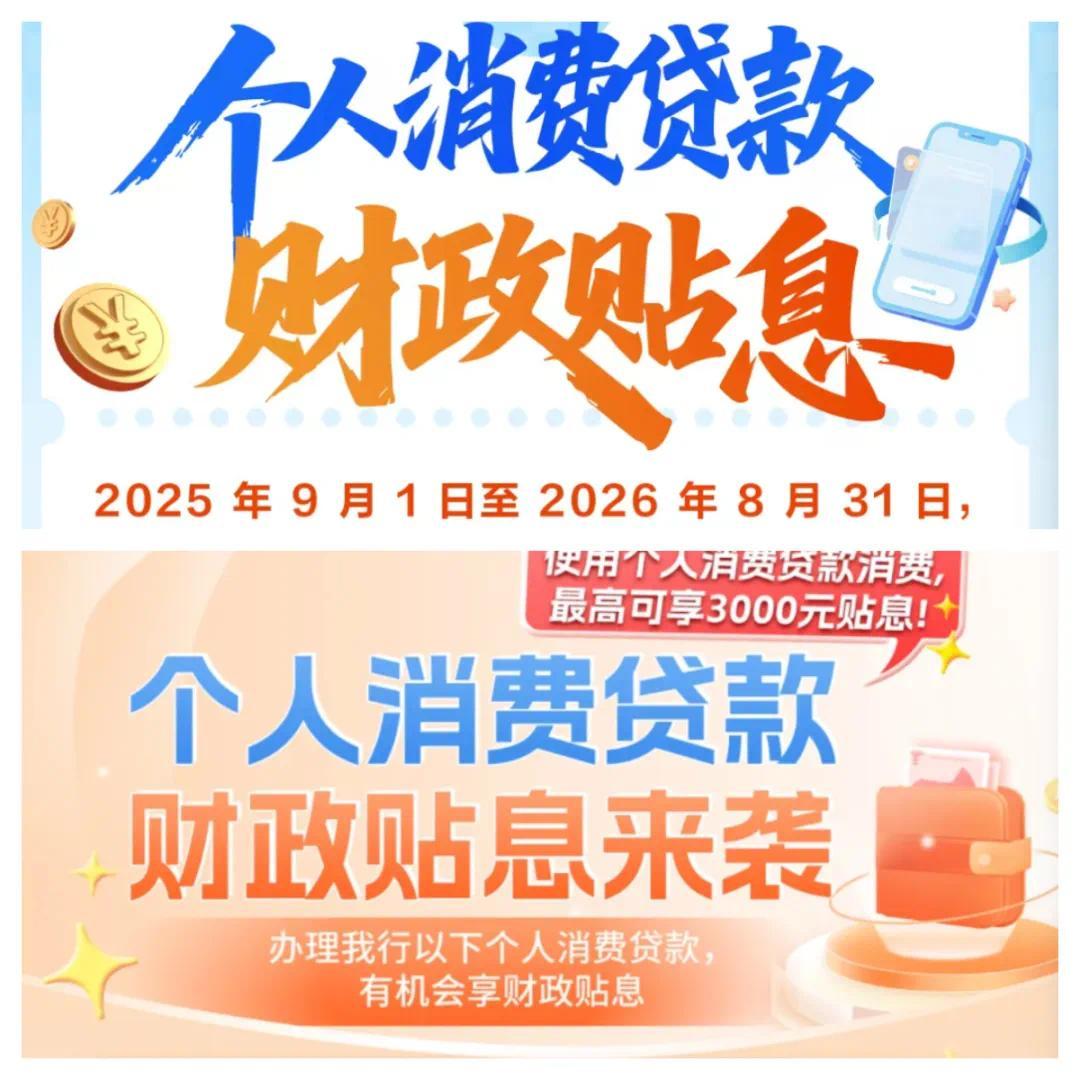
Core Viewpoint - The personal consumption loan interest subsidy policy will officially start on September 1, 2025, allowing residents to benefit from interest subsidies on eligible loans used for consumption [1][2]. Group 1: Policy Implementation - The subsidy period is from September 1, 2025, to August 31, 2026, covering personal consumption loans issued by various financial institutions [1]. - The subsidy applies to loans used for specific consumption categories, including household vehicles, education, cultural tourism, and health care, with a maximum subsidy of 3,000 yuan for eligible loans [2][5]. Group 2: Subsidy Standards - The annual subsidy rate is set at 1% of the actual loan principal used for consumption, with a cap of 50% of the loan contract interest rate [2]. - Each borrower can receive a total subsidy of up to 3,000 yuan, corresponding to a cumulative consumption amount of 300,000 yuan, with a specific limit of 1,000 yuan for loans under 50,000 yuan [2]. Group 3: Bank Promotions and Preparations - Multiple banks, including Bank of China, China Construction Bank, and others, have begun promotional activities for their consumption loan products, utilizing social media and mobile banking platforms [3][5][6]. - Banks are optimizing their customer service channels to provide information about the subsidy, including dedicated sections in mobile banking apps and enhanced intelligent customer service responses [7][8]. Group 4: Application Process - The application process for the subsidy will be similar to standard loan applications, with banks able to automatically identify eligible transactions for subsidy processing [10]. - Customers must sign a supplementary agreement to authorize banks to access their transaction information for subsidy eligibility [10]. Group 5: Customer Eligibility and Funding - The subsidy is available to both new and existing customers, provided their loans meet the eligibility criteria during the subsidy period [11]. - Subsidy funds will be deducted directly from the interest charged on the loans, simplifying the process for customers [12].
个人消费贷贴息明日开闸!多家银行启动预热,五大热点答疑
Mei Ri Jing Ji Xin Wen· 2025-08-31 05:45
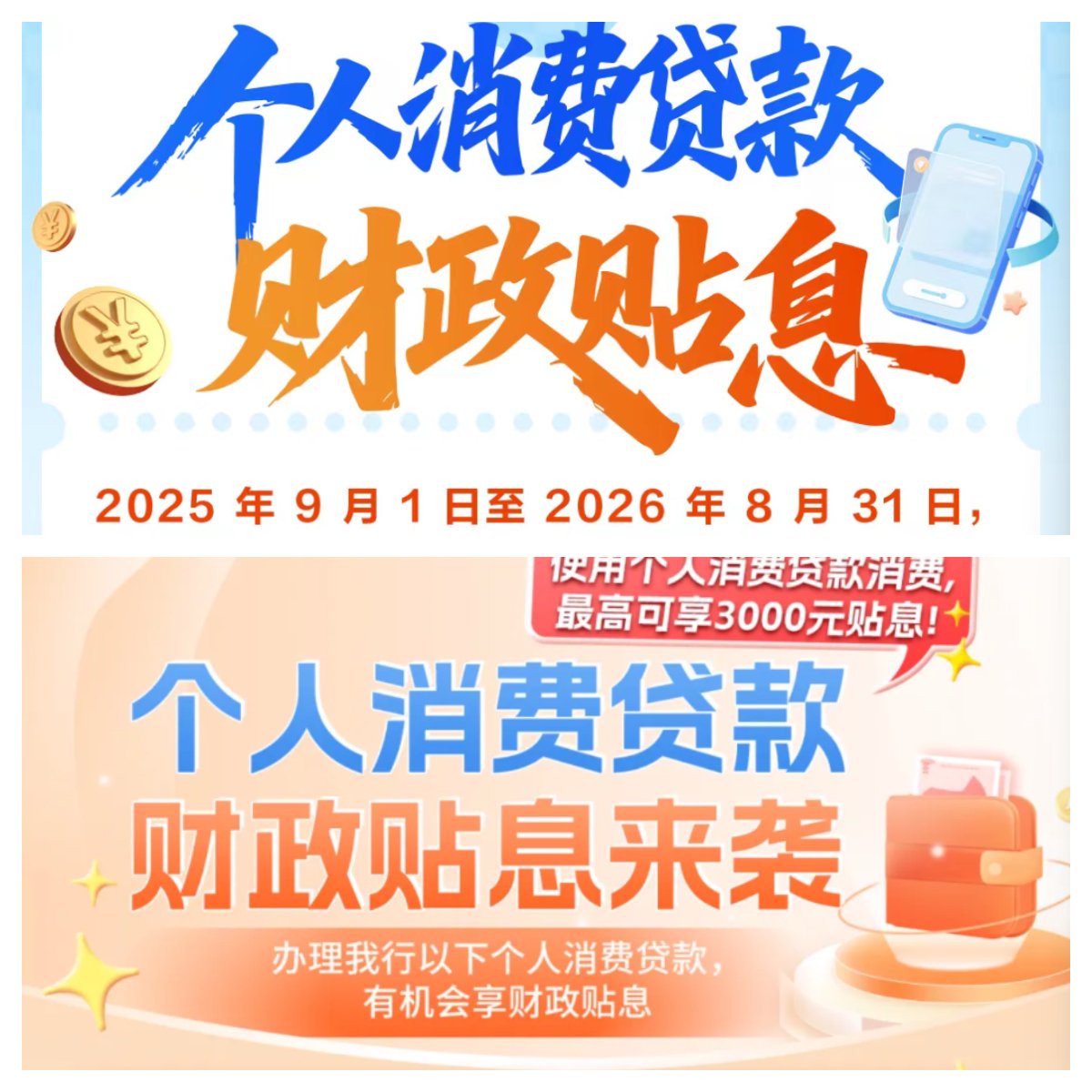
Core Viewpoint - The personal consumption loan interest subsidy policy will officially start on September 1, 2025, allowing residents to benefit from interest subsidies on eligible loans used for consumption [1][2]. Summary by Sections Policy Implementation - The subsidy policy will be in effect from September 1, 2025, to August 31, 2026, covering personal consumption loans issued by various banks, excluding credit card transactions [1][2]. - The subsidy applies to loans used for specific consumption categories, including household vehicles, education, healthcare, and electronics, with a maximum subsidy of 3,000 yuan for eligible loans [2][5]. Subsidy Standards - The annual subsidy rate is set at 1% of the eligible loan principal, capped at 50% of the loan contract interest rate [2]. - Each borrower can receive a total subsidy of up to 3,000 yuan, corresponding to a total consumption amount of 300,000 yuan, with a specific cap of 1,000 yuan for loans under 50,000 yuan [2]. Bank Promotions - Multiple banks, including China Bank, Construction Bank, and others, have begun promotional activities for their consumption loan products, utilizing social media and mobile banking platforms for outreach [2][5][6]. - Banks are offering various loan products that qualify for the subsidy, such as "E-loan" and "Quick Loan" from China Bank, and "iCar Loan" from Shanghai Pudong Development Bank [5][6][7]. Application Process - The application process for the subsidy is designed to be straightforward, with banks automatically identifying eligible transactions through their systems [9]. - Customers may need to sign a supplementary agreement to authorize banks to access their transaction information for subsidy eligibility [9]. Customer Eligibility - The subsidy is available to both new and existing customers, including those who applied for loans before the policy's implementation date, provided they meet the eligibility criteria [10]. - The subsidy will be applied directly to the interest payments, reducing the amount owed by the borrower [11]. Channels for Application - Customers are encouraged to apply for the subsidy through official channels such as bank branches and mobile banking apps, with no third-party intermediaries involved [12]. - No fees will be charged for processing the subsidy applications [12].
银行高管思辨“反内卷”: 在规范市场中提高客服硬实力
Zheng Quan Shi Bao· 2025-08-30 16:46
Core Viewpoint - The banking industry is shifting towards a "de-involution" approach to combat irrational price competition, which is seen as detrimental to long-term growth and stability [1][2][4]. Group 1: Industry Perspectives - The 2024 Central Economic Work Conference and the 2025 Government Work Report emphasize the need to address "involutionary" competition in the banking sector [1]. - The Central Financial Committee's recent meeting highlighted the importance of regulating low-price, disorderly competition among enterprises [1]. - Bank executives, including Ping An Bank's president, have warned that prolonged unprofitable competition poses a significant risk to the industry [1]. Group 2: Impact on Banking Operations - The "de-involution" policy is expected to stabilize net interest margins in the banking sector, as indicated by multiple bank leaders [2]. - There has been a noticeable reduction in malicious competition in loan pricing over the past two months, which helps alleviate downward pressure on asset yields [2]. - Banks are encouraged to enhance their service capabilities and customer experience as competition shifts from price to meeting customer needs [2]. Group 3: Strategic Shifts - Banks like Huaxia Bank and Zhejiang Commercial Bank are focusing on transitioning from price-based competition to differentiated, comprehensive services [4]. - The emphasis is on providing value-driven services centered around customer needs, rather than engaging in price wars [4]. - The industry consensus on "de-involution" is becoming a practical action rather than just a slogan, as discussed in recent earnings presentations [3].



上海大消息!20多家银行宣布:调整
Zhong Guo Ji Jin Bao· 2025-08-30 01:53
Core Viewpoint - Shanghai's new housing policy has led to a reduction in mortgage rates for existing loans and a minimum rate of 3.09% for new second-home loans, aligning them with first-home rates [1][3]. Group 1: New Mortgage Rates - The new policy eliminates the distinction between first and second home mortgage rates in Shanghai, with the specific rate determined by the market rate pricing mechanism and individual bank conditions [2][10]. - The minimum mortgage rate for new second-home loans in Shanghai is set at 3.09%, which is consistent with the first-home loan rate [3][2]. Group 2: Existing Mortgage Adjustments - Existing mortgage rates can be adjusted for eligible borrowers, particularly if their current rate exceeds the national average by more than 30 basis points [4][11]. - For example, a second-home loan with a current rate of 3.45% could potentially be reduced to 3.36% [6][4]. - The adjustment process will not incur any fees and will begin on September 1, 2025 [7][14]. Group 3: Implementation and Communication - Banks in Shanghai, including major institutions like ICBC and Bank of China, have issued announcements regarding the new mortgage rate adjustments [1][9]. - Borrowers can check their eligibility for rate adjustments through their respective banks starting September 1, 2025 [12][13].



银行高管思辨“反内卷”:在规范市场中提高客服硬实力
Zheng Quan Shi Bao· 2025-08-29 19:49
Core Viewpoint - The banking industry has reached a consensus on "anti-involution," transitioning from a slogan to actionable measures, as highlighted in recent semi-annual performance briefings [1]. Group 1: Industry Consensus and Policy - The 2024 Central Economic Work Conference and the 2025 Government Work Report have called for a "comprehensive rectification of 'involutionary' competition" [1]. - The sixth meeting of the Central Financial Committee emphasized the need to "legally and reasonably govern low-price and disorderly competition" [1]. Group 2: Impact on Banking Operations - Ping An Bank's president, Ji Guangheng, stated that competition that does not cover costs is detrimental and poses a potentially disruptive risk to the industry [1]. - Hangzhou Bank's vice president, Zhang Jianfu, noted that irrational price wars negatively affect normal banking development, leading to situations where business growth does not translate into revenue or profit [1]. - The long-term impact of such competition could weaken banks' ability to serve the real economy and accumulate risks that affect macroeconomic development [1]. Group 3: Benefits of "Anti-Involution" - Ping An Bank's vice president, Xiang Youzhi, believes that "anti-involution" will create a fairer and more vibrant market, enhance the effective allocation of financial resources, and maximize the interests of financial entities and society [1]. - The policy is expected to promote long-term, high-quality development in the financial industry and protect the legitimate rights of financial customers [1]. Group 4: Stabilization of Net Interest Margin - Citic Bank's president, Lu Wei, indicated that "anti-involution" policies and neutral monetary policies will help stabilize the banking industry's net interest margin [2]. - Zhang Jianfu echoed this sentiment, suggesting that combating irrational pricing will contribute to stabilizing bank interest margins [2]. Group 5: Addressing Malicious Competition - Industrial Bank's financial planning department general manager, Lin Shu, noted that "anti-involution" helps regulate malicious and disorderly competition in loan pricing, alleviating downward pressure on bank asset returns [2]. - However, Lin also pointed out potential inconsistencies in the implementation of "anti-involution" policies across different regions and banks [2]. Group 6: Focus on Customer Needs - As price competition diminishes, banks will need to compete based on their ability to meet customer needs, emphasizing the importance of enhancing professional service capabilities and optimizing business processes [2]. - Huaxia Bank's president, Qu Gang, stated the importance of adhering to regulatory and self-discipline requirements, shifting focus from price competition to value-based services centered around customer needs [2]. - Zhejiang Merchants Bank's president, Chen Haiqiang, mentioned the shift from price-based competition to differentiated comprehensive services, focusing on the entire customer lifecycle [2].
华夏银行: 华夏银行2025年中期利润分配方案公告
Zheng Quan Zhi Xing· 2025-08-29 17:25
Summary of Key Points Core Viewpoint - The company plans to distribute a cash dividend of RMB 0.10 per share, pending approval from the shareholders' meeting [1]. Profit Distribution Plan - The company's net profit for the parent company is RMB 10.52 billion, with retained earnings from previous years amounting to RMB 122.87 billion, leading to a total distributable profit of RMB 133.40 billion [1]. - The proposed distribution plan suggests a cash dividend of RMB 1.00 for every 10 shares held, based on the total share capital as of the record date [1]. - The cash dividend represents a certain percentage of the net profit attributable to the shareholders of the listed company [1]. Decision-Making Process - The ninth board meeting of the company held on August 27, 2025, approved the profit distribution plan and submitted it for shareholder approval [2]. - Independent directors believe the plan complies with relevant regulations and adequately considers shareholder returns and regulatory capital requirements [2]. - The supervisory board also supports the plan, stating it balances capital regulation, shareholder returns, and future development needs [2].