
CMBC(600016)

Search documents
民生银行临沂沂水支行:反诈宣传进企业,守护经济安全线
Qi Lu Wan Bao· 2025-08-28 02:24
Core Viewpoint - The article highlights the efforts of Minsheng Bank's Linyi Yishui branch in promoting financial knowledge among employees through a specialized educational campaign aimed at enhancing financial literacy and risk awareness [1][2] Group 1: Educational Activities - The campaign included various educational methods such as on-site explanations, distribution of illustrated brochures, video presentations of real cases, and situational simulations [1] - Key topics covered in the activities included prevention of telecom and online fraud, identification of illegal fundraising traps, credit card safety tips, and personal information protection methods [1] - An interactive Q&A session was held to engage employees, with prizes for correct answers, fostering a lively atmosphere and encouraging participation [1] Group 2: Target Audience and Impact - The educational outreach reached over 200 employees, primarily targeting young and middle-aged workers who are at critical stages of career development and family building [2] - The content was tailored to address practical financial issues relevant to their daily lives, such as salary card security, online shopping payments, and investment management [2] - The initiative not only improved employees' financial literacy but also heightened their awareness of financial risks, contributing to a safer and healthier financial environment [2] Group 3: Future Plans - Minsheng Bank's Linyi Yishui branch plans to continue enhancing its "Minsheng Consumer Protection in Action" brand by conducting more targeted financial knowledge dissemination activities [2] - The bank aims to fulfill its social responsibility as a financial institution and contribute to the establishment of a harmonious financial environment [2]

多家金融机构发布2025年中期业绩报告;人民币对美元汇率走强 | 金融早参
Mei Ri Jing Ji Xin Wen· 2025-08-27 23:33
Group 1: Financial Institutions Performance - Multiple financial institutions reported their mid-year performance for 2025, showing net profit growth: China Life achieved a net profit of 40.931 billion yuan, up 6.9% year-on-year; CITIC Bank reported a net profit of 36.478 billion yuan, a 2.78% increase; China Pacific Insurance recorded a net profit of 26.53 billion yuan, growing 16.9% year-on-year [1] Group 2: Currency Exchange Rate - The central parity rate of the RMB against the USD was raised by 80 basis points to 7.1108, the highest since November 6, 2024. The previous day's rate was 7.1188, and the onshore RMB closed at 7.1621 [2] - The RMB has appreciated by a total of 479 basis points against the USD since the beginning of 2025, driven by a decline in the USD index of over 10% [2] Group 3: A-share Banking Sector - The A-share banking sector experienced a continuous decline, with Postal Savings Bank dropping over 4%, and other banks like Everbright Bank, Minsheng Bank, Agricultural Bank, and Bank of Communications falling over 2% [3] Group 4: Life Insurance Industry Insights - China Ping An's co-CEO Guo Xiaotao stated that the life insurance sector has entered a golden development period, serving as a cornerstone for wealth management among the middle-income group. Life insurance offers threefold value: wealth preservation and appreciation, protection for clients and their families, and added services for healthcare and retirement [4]



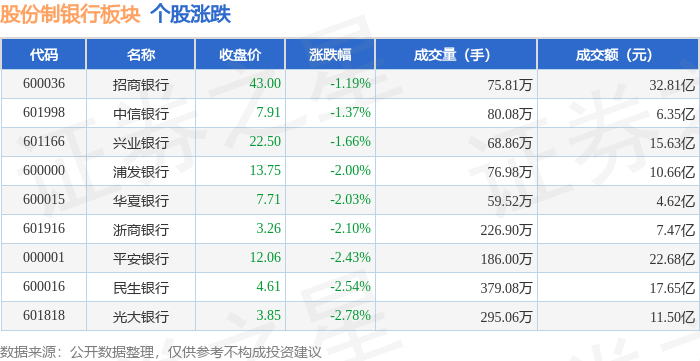
股份制银行板块8月27日跌1.74%,光大银行领跌,主力资金净流出12.69亿元
Zheng Xing Xing Ye Ri Bao· 2025-08-27 08:46
Market Performance - The banking sector saw a decline of 1.74% on August 27, with Everbright Bank leading the drop [1] - The Shanghai Composite Index closed at 3800.35, down 1.76%, while the Shenzhen Component Index closed at 12295.07, down 1.43% [1] Individual Bank Performance - China Merchants Bank closed at 43.00, down 1.19% with a trading volume of 758,100 shares and a transaction value of 3.281 billion [1] - CITIC Bank closed at 7.91, down 1.37% with a trading volume of 800,800 shares and a transaction value of 635 million [1] - Industrial Bank closed at 22.50, down 1.66% with a trading volume of 688,600 shares and a transaction value of 1.563 billion [1] - Shanghai Pudong Development Bank closed at 13.75, down 2.00% with a trading volume of 769,800 shares and a transaction value of 1.066 billion [1] - Huaxia Bank closed at 7.71, down 2.03% with a trading volume of 595,200 shares and a transaction value of 462 million [1] - Zhejiang Commercial Bank closed at 3.26, down 2.10% with a trading volume of 2,269,000 shares and a transaction value of 747.1 million [1] - Ping An Bank closed at 12.06, down 2.43% with a trading volume of 1,860,000 shares and a transaction value of 2.268 billion [1] - Minsheng Bank closed at 4.61, down 2.54% with a trading volume of 3,790,800 shares and a transaction value of 1.765 billion [1] - Everbright Bank closed at 3.85, down 2.78% with a trading volume of 2,950,600 shares and a transaction value of 1.150 billion [1] Capital Flow Analysis - The banking sector experienced a net outflow of 1.269 billion from main funds, while retail investors saw a net inflow of 821 million [1] - The table indicates varying net inflows and outflows for individual banks, with Shanghai Pudong Development Bank showing a main fund net inflow of 20.815 million [2] - Minsheng Bank had a significant main fund net outflow of 253 million, while retail investors contributed a net inflow of 40.322 million [2]





民生银行临沂兰山支行开展反诈教育宣传活动
Qi Lu Wan Bao· 2025-08-27 07:25
民生银行临沂兰山支行将营业网点打造为反诈宣传的"主课堂",通过场景化、互动化、多样化的宣传方 式,让客户在办理业务的同时,潜移默化地接受反诈教育,切实提升金融消费者的防骗意识和能力。在 网点内,专门设立了"公众教育专区",通过图文并茂的案例展板、互动问答等形式,生动展示"冒充电 商客服、虚假投资理财、校园贷"等高发诈骗类型,帮助客户直观了解诈骗手段和防范要点。同时,利 用LED电子屏循环播放反诈短视频,以通俗易懂、生动形象的方式吸引客户关注,增强宣传的感染力和 传播力。在业务办理过程中,柜员结合客户身份和业务类型,开展有针对性的"靶向提醒"。例如,对老 年客户重点讲解"冒充子女借钱、保健品诈骗"等常见骗局,提醒他们不轻信陌生来电、不随意透露个人 信息;对年轻客户则着重强调"刷单返利、网络兼职"等新型诈骗手段,引导他们理性对待网络信息;对 企业财务人员,则重点提示"冒充老板指令转账、虚假发票"等企业财务诈骗风险,增强其风险识别和应 对能力。此外,该行还通过发放反诈宣传折页、举办反诈知识讲座、开展"反诈小课堂"等形式,进一步 扩大教育宣传覆盖面。截至目前,已累计触达金融消费者300余人次,发放各类宣传物料120余 ...
民生银行临沂费县支行:金融知识进医院 共筑安全“防火墙”
Qi Lu Wan Bao· 2025-08-27 07:25
Core Viewpoint - The article highlights a financial education campaign conducted by Minsheng Bank to enhance financial literacy and risk awareness among healthcare workers and patients, focusing on preventing illegal agency rights protection and illegal fundraising [1][2] Group 1: Financial Education Campaign - The campaign took place on August 13 at a hospital in Feixian, organized by Minsheng Bank's branch in Linyi, aiming to help participants identify financial risks and strengthen self-protection capabilities [1] - Various methods were employed during the event, including setting up consultation booths, distributing informational brochures, and face-to-face explanations to educate attendees about financial knowledge [1] Group 2: Focus on Illegal Activities - The staff emphasized common scams related to illegal agency rights protection, such as "agent insurance refunds" and "agent handling of credit card debts," which often involve high fees and potential personal information leaks [1] - In discussing illegal fundraising, the staff provided a systematic overview of its characteristics, common tactics, and methods for identification and prevention, citing examples like "pension projects" and "high-interest returns" [1] Group 3: Participant Engagement and Future Plans - Approximately 200 healthcare workers and patients participated in the event, with positive feedback indicating a clearer understanding of illegal agency rights protection and fundraising [2] - Minsheng Bank plans to continue promoting financial knowledge by reaching out to more communities, enterprises, and schools to contribute to safeguarding the public's financial security and fostering a stable financial environment [2]
民生银行临沂临沭步行街社区支行:珍惜一生血汗 远离非法集资
Qi Lu Wan Bao· 2025-08-27 07:25
Core Viewpoint - The article emphasizes the importance of raising public awareness and understanding of the dangers of illegal fundraising, aiming to create a healthy and stable financial environment through educational activities [1][2]. Group 1: Educational Activities - The event held by Minsheng Bank aimed at educating the community about illegal fundraising, featuring the theme "Cherish Hard-Earned Money, Stay Away from Illegal Fundraising" [1]. - The activity combined on-site promotion with consultation services, targeting community residents, merchants, and students [2]. - Staff distributed promotional materials and explained common forms of illegal fundraising, identification methods, and prevention measures, while also answering questions from the public [2]. Group 2: Outreach and Training - The bank organized specialized training for its employees to enhance their financial knowledge and promotional skills, ensuring the accuracy and professionalism of the information shared [2]. - The outreach strategy included both in-branch promotions and regular visits to business districts, enterprises, schools, and communities to discuss various financial risks, including illegal fundraising and telecom fraud [2]. - The event successfully reached approximately 120 individuals, answered over 10 questions, and distributed more than 60 informational materials, effectively improving the public's ability to recognize and prevent illegal fundraising [2]. Group 3: Future Initiatives - Minsheng Bank plans to further advance its illegal fundraising prevention efforts by integrating online and offline channels to expand the reach and effectiveness of its educational campaigns [2]. - The goal is to foster a community-wide participation and prevention atmosphere, ultimately protecting the public's financial interests [2].
民生银行临沂兰山支行走进企业开展消保宣传,传递金融正能量
Qi Lu Wan Bao· 2025-08-27 07:25
Group 1 - The core viewpoint of the articles is the importance of financial knowledge dissemination and consumer rights protection in the banking sector, particularly through educational activities organized by Minsheng Bank [1][2] - Minsheng Bank's Linyi Lanshan branch conducted a financial education campaign aimed at enhancing employees' awareness of financial risk prevention, focusing on practical financial scenarios encountered by employees [1] - The campaign included discussions on personal information protection, prevention of telecom and internet fraud, and safe use of bank cards, utilizing real-life case studies to illustrate the tactics used by fraudsters [1][2] Group 2 - The event also addressed the actual credit product needs of employees, promoting responsible borrowing and credit maintenance while warning against illegal financial activities such as "trap loans" and "high-interest loans" [2] - An interactive Q&A session allowed employees to ask questions about credit card usage and investment products, making complex financial concepts more accessible and practical [2] - Participants reported gaining valuable skills in identifying financial fraud and a clearer understanding of their legal rights, indicating the effectiveness of the educational initiative [2]
民生银行济南槐荫支行走进幼儿园开展金融知识启蒙活动
Qi Lu Wan Bao· 2025-08-27 07:25
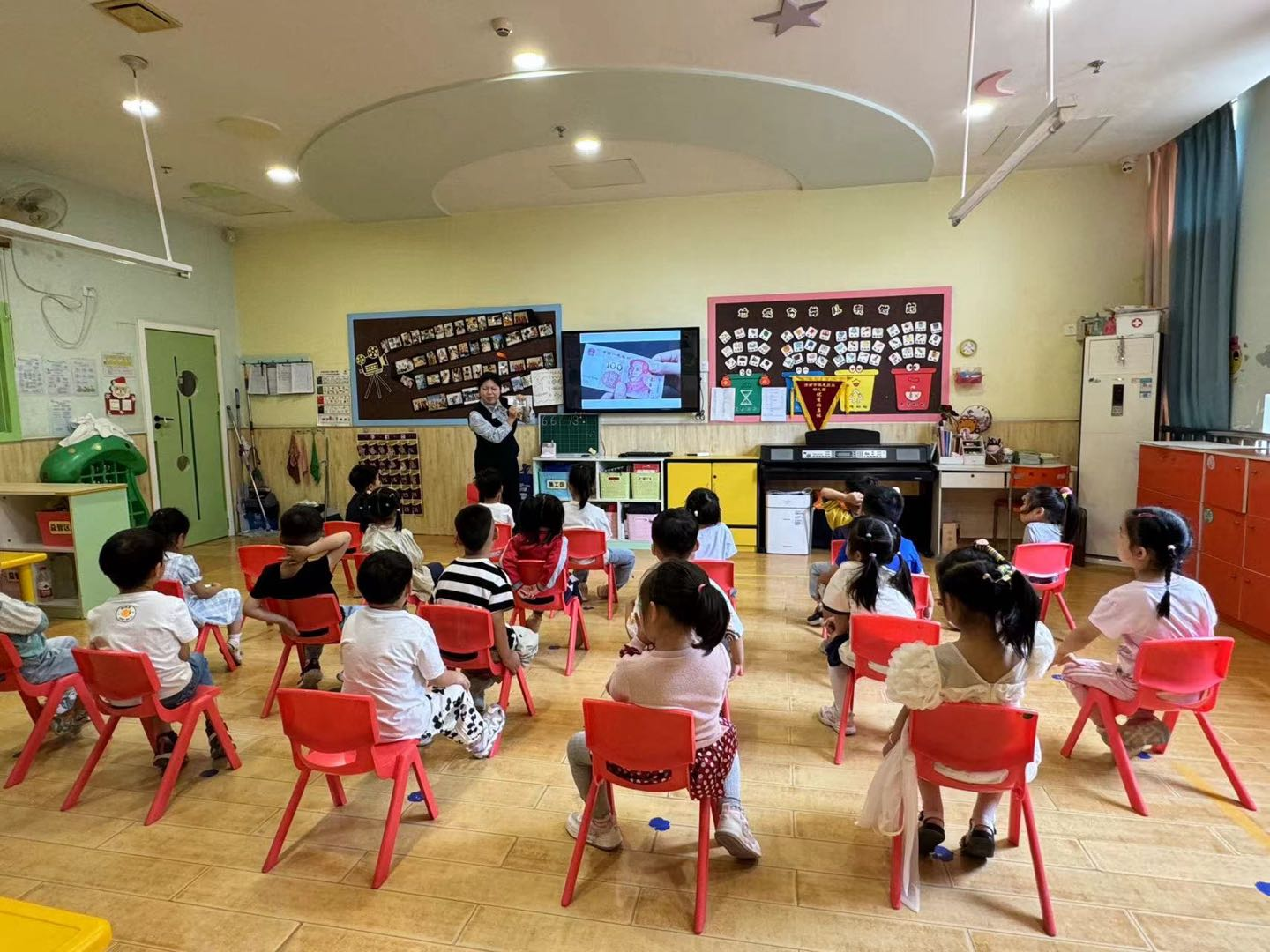
Core Viewpoint - The article highlights the initiative by Minsheng Bank's Jinan Huaiyin Branch to educate young children about financial knowledge and consumer rights protection through engaging activities in kindergartens [1] Group 1: Financial Education Initiative - Minsheng Bank's Jinan Huaiyin Branch conducted a financial knowledge enlightenment activity in a kindergarten to enhance children's awareness of financial risk prevention [1] - The "Little Banker" fun classroom designed by the bank staff effectively captured the children's attention, introducing them to concepts like the secrets of currency and the origins of money [1] - Interactive games, such as the "Counting Money Expert" competition and the "True or False" identification activity, served as effective tools for children to understand financial knowledge [1] Group 2: Impact and Future Plans - The activities not only ignited enthusiasm among children but also instilled a sense of responsibility towards money management, as noted by a teacher's positive feedback on the usefulness of the financial education [1] - Minsheng Bank plans to continue exploring new paths and forms for consumer rights protection, aiming to strengthen the financial safety net for the community [1]
民生银行济宁邹城支行:金融知识进社区 筑牢居民“钱袋子”
Qi Lu Wan Bao· 2025-08-27 07:25
Core Viewpoint - The article highlights a community event organized by Minsheng Bank to enhance residents' understanding of the Renminbi and to raise awareness about counterfeit currency [1][2] Group 1: Event Details - Minsheng Bank's Jining Zoucheng branch conducted a practical Renminbi knowledge promotion event in Miaohu Community [1] - The event featured informative displays about the evolution of the Renminbi and its key anti-counterfeiting features, attracting many residents [1] - Bank staff provided detailed explanations of anti-counterfeiting techniques using everyday language, making complex financial knowledge accessible [1] Group 2: Community Engagement - Special attention was given to elderly residents, with staff patiently demonstrating identification methods to ensure understanding [1] - An interactive session allowed residents to practice distinguishing between real and counterfeit currency, fostering a lively atmosphere [1] - The staff shared local counterfeit fraud cases to raise awareness and encourage vigilance during transactions [1] Group 3: Future Plans - The event received positive feedback from the community, with plans for Minsheng Bank to continue similar promotional activities [2] - The bank aims to expand the reach of these initiatives and incorporate more engaging formats to deliver financial knowledge [2] - The ongoing efforts are expected to empower more residents with the skills to identify counterfeit currency and protect their finances [2]
民生银行济南章丘支行开展“理性借贷,守护信用”金融知识普及活动
Qi Lu Wan Bao· 2025-08-27 07:25
Core Viewpoint - The article emphasizes the importance of consumer rights protection in financial services and highlights the proactive measures taken by Minsheng Bank's Jinan Zhangqiao branch to promote rational borrowing and risk awareness among the public [1][2] Group 1: Event Overview - Minsheng Bank's Jinan Zhangqiao branch organized a promotional event themed "Rational Borrowing, Protecting Credit" to educate the public on borrowing concepts and risk prevention [1] - The event involved outreach to communities, business districts, and markets, aiming to deliver professional financial knowledge directly to the public [1] Group 2: Educational Activities - The bank dispatched a team of professionals to engage in face-to-face communication with the public, utilizing banners, brochures, and interactive Q&A sessions to explain rational borrowing [1] - Key topics covered included applicable scenarios for loans, application conditions, and interest rate calculations, helping attendees gain a comprehensive understanding of borrowing [1] Group 3: Public Feedback and Impact - Participants expressed surprise at the various factors to consider when taking out loans, indicating a positive reception to the educational efforts [1] - The bank staff highlighted the importance of personal credit and responsible borrowing, advising against impulsive debt accumulation [1] Group 4: Addressing Illegal Lending - The bank educated attendees on identifying illegal lending practices and emphasized the necessity of choosing legitimate financial institutions [1] - Many attendees reported a clearer understanding of borrowing risks and a commitment to more rational borrowing behaviors in the future [1] Group 5: Commitment to Social Responsibility - Minsheng Bank's Jinan Zhangqiao branch reiterated its commitment to social responsibility and efforts to strengthen financial safety for the community [2]