CITIC Securities Co., Ltd.(600030)

Search documents
东南亚和印度经济增长和钢材需求预测
Zhong Xin Qi Huo· 2026-02-11 10:18
1. Report Industry Investment Rating No relevant content provided. 2. Core Viewpoints of the Report - The ASEAN - 5 and India are in a stage of rapid development, and steel demand is highly concentrated in construction and infrastructure sectors. By 2030, their apparent steel consumption is expected to grow, with India having higher demand elasticity and greater incremental potential [2][3][121]. - The combined apparent steel consumption of the ASEAN - 5 and India may reach approximately 270 million tons in 2030, with a CAGR of about 5.8%, and an additional demand of approximately 116 million tons of iron ore. India is the main source of this increment [9][121]. - In a pessimistic scenario in 2026, China's steel demand will decline by about 10 million tons, while the ASEAN - 5 and India will drive an annual demand increment of about 14 million tons. The demand increment from emerging markets can offset the reduction in domestic demand in China, promoting the bottom - out and stabilization of ferrous metal prices [10][122][119]. 3. Summary According to Relevant Catalogs 3.1 Overview - Steel consumption in the ASEAN - 5 and India is highly concentrated in construction and infrastructure. Fluctuations in steel demand depend on infrastructure investment and urban construction. Per capita GDP, urbanization rate, and steel usage intensity can describe the development stage of each economy and have guiding significance for incremental projection [7]. - Each country has its own steel - demand characteristics. Malaysia and Thailand's steel - demand growth is stabilizing, Vietnam has high demand elasticity, Indonesia and the Philippines have an infrastructure - led demand structure, and India has prominent steel - demand growth potential [8][121]. 3.2 The Basic Situation of the ASEAN - 5 and India 3.2.1 Vietnam - In 2024, Vietnam's per capita GDP was approximately $4,717, and the urbanization rate was 40.2%, with manufacturing value - added accounting for about 23.4% of GDP. Its steel consumption in 2023 was about 21.17 million tons, with construction accounting for about 89%. Steel demand has medium - term elasticity and sustainability [12][13][124]. - Vietnam coordinates industrial upgrading and investment expansion by prioritizing manufacturing and infrastructure construction, such as the North - South high - speed railway and industrial park expansion [14][125]. 3.2.2 Malaysia - As of 2024, Malaysia's per capita GDP was approximately $11,867, and the urbanization rate was 80.12%, with manufacturing accounting for 24.1% of GDP. In 2023, its apparent steel consumption was about 6.7 million tons, with construction accounting for 63.2% [17][18][130]. - Malaysia uses "Ekonomi MADANI (2023)" as a reform framework and promotes infrastructure construction. The "New Industrial Master Plan 2030" focuses on advanced manufacturing [19][131]. 3.2.3 Thailand - By 2024, Thailand's per capita GDP was approximately $7,345, and the urbanization rate was 54.32%, with manufacturing added value accounting for about 24.3% of GDP. In 2023, its apparent steel consumption was about 16.08 million tons, with construction and infrastructure accounting for nearly 80% [22][23][134]. - Thailand uses the "20 - Year National Strategy 2018–2037" as a framework, promotes manufacturing transformation, and focuses on the construction of the Eastern Economic Corridor and the China - Thailand Railway [24][25][135]. 3.2.4 Indonesia - As of 2024, Indonesia's per capita GDP was approximately $4,925, and the urbanization rate was 59.2%, with manufacturing value - added accounting for about 19% of GDP. In 2023, its apparent steel consumption was about 176.5 million tons, with infrastructure and non - infrastructure buildings accounting for nearly 80% [30][31][138]. - Indonesia focuses on the construction of the new capital Nusantara and "Making Indonesia 4.0" to promote infrastructure investment and manufacturing transformation [32][139]. 3.2.5 Philippines - As of 2024, the Philippines' per capita GDP was approximately $3,985, and the urbanization rate was 48.6%, with manufacturing output accounting for about 15.7% of GDP. In 2023, its apparent steel consumption was about 9.45 million tons, with the construction sector accounting for 81% [39][40][143]. - The Philippines uses the "Philippine Development Plan (PDP) 2023–2028" as a framework, promotes infrastructure construction, and takes infrastructure investment as the main line [41][144]. 3.2.6 India - As of 2024, India's per capita GDP was approximately $2,697, and the urbanization rate was 36.9%, with manufacturing added value accounting for about 12.6% of GDP. In 2023, its apparent steel consumption was about 133 million tons, with construction, infrastructure, and engineering/packaging accounting for the vast majority [46][47][147]. - India promotes manufacturing revitalization and infrastructure construction through policies such as "Make in India" and the "PM Gati Shakti National Infrastructure Construction Plan". In the Union Budget 2025–26, a large amount of capital is allocated to infrastructure [48][50][148]. 3.3 The Core Driver of Steel Demand - Steel consumption in the ASEAN and India is highly concentrated in construction and infrastructure, with a proportion of 55% - 90%. Steel demand mainly depends on construction and infrastructure investment [66][68][156]. - The relationship between steel intensity of use (I - U) and per capita GDP typically shows an inverted U - shaped pattern. Low - income countries have higher steel - usage intensity elasticity, and this elasticity converges as per capita GDP increases [70][71][158]. - Per capita GDP and urbanization rate are key exogenous variables for studying steel demand in the ASEAN and India. The urbanization process is an important driving mechanism for steel demand [76][164]. 3.4 Steel Demand Forecasting in Southeast Asia and India - A Three - Model Approach - The ASEAN - 5's development path is closer to South Korea and Taiwan, while India is more like mainland China. When the per capita GDP reaches around $12,000 - 20,000, the growth of steel demand slows down [77][79][165]. - The IMF predicts that the per capita GDP of the six countries will grow, with India's growth rate exceeding 9%. The UNCTAD predicts that the urbanization rate increase of the six countries is limited. The population growth rate of India, the Philippines, and Indonesia is relatively fast [89][92][93]. - Three complementary forecasting models are constructed: elastic net regression, per capita steel consumption regression, and historical path trend benchmarking. The final projection value is obtained by a dynamic weighted average of the three models [101][102][185]. - By 2030, the total steel consumption of the ASEAN - 5 and India is expected to increase from 203.9 million tons in 2023 to 269.8 million tons, with a CAGR of about 4.1%. India is the main source of demand growth, with an expected increase of about 51 million tons [111][113][191]. - The increase in steel demand will lead to an increase in iron ore demand. By 2030, the combined iron ore demand of the ASEAN - 5 and India is approximately 4.73 billion tons, an increase of over 116 million tons compared to 2023 [116][193]. - In 2026, China's steel demand may decline by about 10 million tons in a pessimistic scenario, while the ASEAN - 5 and India will drive an annual demand increment of about 14 million tons. The emerging - market demand can offset the decline in China's demand [10][119][195].

从通道到枢纽:中资券商的港股大航海时代
市值风云· 2026-02-11 10:12
Core Viewpoint - The Hong Kong stock market has become the most comprehensive market for foreign capital to allocate Chinese assets, providing a "one-stop" opportunity for international investors to access China's growth [3][4]. Group 1: Market Dynamics - In 2024, the Hong Kong stock market raised approximately HKD 87.6 billion, a year-on-year increase of 89% [4]. - In 2025, the market saw a significant surge in IPO fundraising, reaching HKD 2,856.93 billion, a year-on-year increase of 224%, reclaiming the top position globally for IPO fundraising [4]. - The number of companies waiting for IPOs in Hong Kong has exceeded 350, indicating sustained capital vitality in the market [4]. Group 2: Sectoral Trends - In 2025, 117 companies successfully listed on the Hong Kong stock market, with new economy sectors like hard technology (27%), healthcare (23%), and new consumption (25%) becoming the main contributors [5][7]. - The traditional sectors such as infrastructure and real estate are gradually declining in proportion [5]. Group 3: Role of Chinese Securities Firms - The A+H listing model became a powerful engine for the Hong Kong IPO market in 2025, with 19 A-share companies raising nearly HKD 1.4 billion, contributing to nearly half of the total fundraising [8]. - Chinese securities firms have transitioned from participants to dominant players in the market, with a market share of approximately 56% among the top ten IPO underwriters [8][10]. - The number of licensed Chinese securities firms in Hong Kong has increased from 8 in 2007 to 111 by 2024, indicating significant growth in the sector [10]. Group 4: Competitive Advantages - Chinese securities firms leverage their "home advantage" and offer comprehensive end-to-end solutions, from identifying new economy companies for listing to providing seamless A+H share services [10]. - The case of CATL's secondary listing in Hong Kong exemplifies the shift of Chinese firms from "supporting roles" to "pricing leaders" in major IPOs [11][13]. - The independent service capability of Chinese securities firms is highlighted by the successful IPO of Sanhua Intelligent Controls, which did not hire foreign underwriters [13]. Group 5: Financial Performance - The brokerage industry is expected to see significant profit increases in 2026, with CITIC Securities projected to earn HKD 30.051 billion, a year-on-year increase of 38.46% [18]. - Other firms like Guotai Junan and GF Securities are also expected to report substantial profit growth [18]. Group 6: Strategic Transformation - A trend of capital increase among Chinese securities firms is evident, with at least five firms announcing capital increases totaling nearly HKD 20 billion, marking a new high [20][21]. - This capital influx indicates a strategic shift towards higher-yield capital business, moving from a low-risk, low-return model to a more integrated service provider role [21][22]. - The Hong Kong market serves as a strategic training ground for Chinese securities firms to enhance their capabilities in pricing, market-making, and risk management [22][23].




【财经分析】利率周期下的稳健突围 2026年各类投资工具价值凸显
Zhong Guo Jin Rong Xin Xi Wang· 2026-02-11 01:54
Group 1 - The article emphasizes the increasing importance of various investment tools such as ETFs, quantitative investments, and Systematic Active Equity (SAE) in the context of rising market uncertainty and interest rate fluctuations [2][4] - ETFs are highlighted for their unique value propositions, including providing liquidity, serving as effective price discovery tools, and enhancing market resilience during volatility [2][3] - The demand for bond ETFs is growing as investors seek to diversify risks and stabilize returns, with a notable increase in allocation from long-term funds like insurance and pensions [4][5] Group 2 - The current market for bond ETFs in China is still underdeveloped, with a penetration rate of approximately 0.4% compared to over 4% in mature markets, indicating significant growth potential [4][5] - Challenges facing the domestic bond ETF market include insufficient funding stability and uneven liquidity distribution, which hinder broader investor participation [5] - The article predicts that by 2026, institutional investors will increase their allocation to bond ETFs, driven by the need for effective risk management in uncertain economic conditions [6][8] Group 3 - The article discusses the localization of overseas systematic investment models to better fit the Chinese market, with adjustments made to product timelines and structures based on local investor needs [7] - It is suggested that the flexibility of ETFs will allow investors to capture structural opportunities in the A-share market in 2026, while systematic investments will provide comprehensive solutions to meet diverse investor demands [8] - The overall outlook emphasizes the importance of understanding the core values of various investment tools and aligning them with individual investment goals for stable wealth growth [8]

中信证券:三大交易所同步优化再融资 头部投行有望受益
智通财经网· 2026-02-11 01:21
登录新浪财经APP 搜索【信披】查看更多考评等级 炒股就看金麒麟分析师研报,权威,专业,及时,全面,助您挖掘潜力主题机会! 中信证券发布研报称,本次再融资措施的优化,其政策覆盖面与市场协同性实现了大幅提升。与以往改 革多聚焦于科创板等特定板块不同,此次北交所、上交所、深交所同步推出一揽子举措,形成了多层 次、全市场协同推进的改革格局。 在具体导向上,措施精准聚焦于两类核心群体:一是具有市场代表性与规范治理的优质上市公司,通过 优化审核支持其发展"第二增长曲线";二是处于不同发展阶段的科技创新企业,通过包容性安排满足其 合理融资需求。这种既支持成熟优质企业做大做强,又兼顾尚在成长中的创新型中小企业的设计,充分 体现了"扶优"与"扶科"并重、大小企业均有所兼顾的系统性思维,是健全资本市场投融资功能、促进投 融资协调发展的重要实践。 投资主线方面,"十五五"期间,我国经济结构转型升级与金融体系深化改革同频共振,为证券公司投行 业务开辟了广阔的战略纵深。中信证券建议关注投行业务实力强、储备项目丰富的证券公司。 中信证券主要观点如下: 事项: 2026年2月9日,沪深北交易所宣布优化再融资一揽子措施。我们对此点评如下: ...
中信证券:光伏电池组件行业“反内卷”有望迎来加速 推荐电池组件、浆料和设备龙头厂商
智通财经网· 2026-02-11 01:13
Core Viewpoint - The surge in silver prices is expected to accelerate the adoption of low-cost metal pastes in the photovoltaic (PV) battery module industry, leading to increased cost differentiation among manufacturers and the potential elimination of outdated production capacity [1][6] Group 1: Silver Price Impact - The price of silver has risen significantly, from approximately 8,000 RMB/kg in mid-2025 to around 19,000 RMB/kg currently, with expectations for continued strength [2] - For TOPCon batteries, a 1,000 RMB/kg increase in silver price corresponds to a cost increase of about 0.01 RMB/W, with current silver paste costs nearing 0.20 RMB/W [2] - HJT manufacturers are expected to reduce silver usage to below 4 mg/W, achieving a cost advantage over TOPCon batteries by more than 0.10 RMB/W [2][3] Group 2: Competitive Landscape - The introduction of low-cost metal pastes is anticipated to accelerate among leading manufacturers, with a critical mass application expected in the second half of 2026 [3] - Second and third-tier manufacturers may face challenges in adopting low-cost metal pastes due to funding and technical limitations, potentially widening the cost gap to over 0.10 RMB/W compared to leading firms [3] Group 3: Intellectual Property Developments - Aiko Solar has signed a patent licensing agreement with Maxeon, paying 1.65 billion RMB over five years for access to BC battery patents, marking a significant step in addressing intellectual property issues in the PV industry [4] - This collaboration is expected to enhance Aiko's competitive position and set a precedent for resolving patent disputes within the industry [4] Group 4: Investment Recommendations - The PV battery module industry is projected to experience accelerated "anti-involution," with recommendations to invest in leading battery module manufacturers, core paste suppliers, and HJT equipment suppliers with sustained competitive advantages [6]

中信证券:看好26Q1大众品板块开门红 推荐三条主线
智通财经网· 2026-02-11 01:05
Core Viewpoint - The report from CITIC Securities indicates that the consumer goods sector is expected to weaken in Q4 2025 due to the adverse effects of the Spring Festival timing, although there are signs of demand stabilization when excluding seasonal factors from September to November [1] Group 1: Consumer Goods Sector - The consumer goods industry is anticipated to see a sequential decline in fundamentals in Q4 2025, primarily influenced by the Spring Festival timing [1] - Despite the expected weakness in Q4 2025, there is optimism for a strong start in Q1 2026, driven by favorable factors such as the staggered Spring Festival inventory buildup and stabilizing demand [1] - The report highlights three main investment themes: 1) pro-cyclical logic focusing on the catering and dairy sectors, 2) independent growth logic targeting high-demand beverage and snack sectors, and 3) high-dividend defensive strategies [1] Group 2: Dairy Sector - In Q4 2025, dairy companies are expected to experience a sequential decline in revenue, but demand is showing signs of stabilization, particularly in low-temperature milk [2] - The profitability of dairy companies may face uncertainty due to reduced cost advantages from raw milk prices and potential impairment issues in Q4 [2] - The dairy sector is projected to benefit from the staggered Spring Festival inventory buildup in Q1 2026, leading to a potential return to positive revenue growth [2] Group 3: Catering Supply Chain - The overall demand in the catering supply chain is expected to be flat in Q4 2025, but certain segments, such as hot pot, may see improvements due to seasonal effects [3] - The prices of most raw materials, including pork, flour, and sugar, are expected to remain low, while some prices, like oils and imported dairy products, are on the rise [3] - The industry consensus indicates a gradual easing of competitive pressures as price wars become less prevalent [3] Group 4: Snack Sector - The snack sector is projected to experience a sequential decline in fundamentals in Q4 2025 due to adverse effects from the Spring Festival timing and high raw material costs [4] - Anticipated inventory buildup for snack gift boxes during the Spring Festival in Q1 2026 is expected to drive a recovery in the sector [4] - Leading snack companies are accelerating store openings and improving same-store performance, indicating a positive outlook for profitability [4] Group 5: Beverage Sector - The beverage industry is facing intense competition, with companies actively investing to expand market share, leading to varied performance among listed companies [5] - Companies in high-demand segments with strong market positions and effective cost control are expected to perform better [5] - The cost advantages observed in 2025 are expected to diminish slightly in 2026 due to rising PET prices and declining sugar prices [5]
回调后建议积极配置,持续关注板块绩优个股
Changjiang Securities· 2026-02-11 01:05
Investment Rating - The report maintains a "Positive" investment rating for the non-bank financial sector [11] Core Insights - The non-bank sector has shown weak overall performance this week, with a recommendation to seize allocation opportunities in the brokerage sector despite a market trading decline. The insurance sector is expected to see improved long-term return on equity (ROE) and valuation recovery, suggesting a positive allocation strategy [2][4] - The report continues to recommend companies with stable profit growth and dividend rates, including Jiangsu Jinzhong, China Ping An, and China Pacific Insurance, highlighting their strong market positions [4] - Additional recommendations include New China Life, China Life, Hong Kong Stock Exchange, CITIC Securities, Dongfang Caifu, Tonghuashun, and Jiufang Zhitu Holdings based on performance elasticity and valuation [4] Industry Performance - The non-bank financial index decreased by 0.6% this week, with a year-to-date decline of 1.1%, ranking 29th out of 31 sectors. The market's trading activity has decreased, with an average daily turnover of 24,066.54 billion yuan, down 21.43% week-on-week [5][15] - The insurance sector saw a year-on-year premium income increase of 7.43% in December 2025, with property insurance and life insurance revenues growing by 3.92% and 8.91%, respectively [18][19] - The report notes a recovery in the stock financing scale in January 2026, with equity financing reaching 134.86 billion yuan, up 103.4% month-on-month, while bond financing decreased by 15.6% [46] Key Industry News - The Hong Kong Monetary Authority released the "Management Measures for Bank Insurance Institution Licenses" to enhance regulatory compliance [59] - The People's Bank of China and other departments issued a notice to further prevent and manage risks related to virtual currencies [60] Company Announcements - CITIC Securities announced a cash dividend distribution of 0.29 yuan per share, totaling 4.298 billion yuan [63] - Red Tower Securities reported a share buyback of 16.03 million shares, accounting for 0.34% of total shares, with a total expenditure of 140 million yuan [62] - Huatai Securities plans to issue H-share convertible bonds totaling 10 billion HKD, with an initial conversion price of 19.7 HKD per share [68]

中信证券:未来人民币国际化进程或有望提速
Sou Hu Cai Jing· 2026-02-11 00:41
中信证券研报指出,相较2021年的"十四五"规划建议"稳慎推进人民币国际化",2025年的"十五五"规划 建议强调"推进人民币国际化",表述更加积极,未来人民币国际化进程或有望提速。站在当前时点评估 人民币国际化程度,可以看到人民币在支付领域的国际化进程相对领先,预计"十五五"期间高质量共 建" 一带一路"或为人民币支付带来更多场景和需求。同时受益于相对较低的融资成本,人民币的融资 属性也持续凸显。但人民币的储备功能和投资功能仍有较大提升空间,尤其2025年我国贸易顺差规模突 破万亿美元,转化为扩大对外直接投资和对外证券投资的需求高增。基于债市对外开放的经验,支持各 类型机构在境外市场发行人民币债券以丰富可投品种、持续优化拓展内地与香港金融市场互联互通机制 等,有望培育更为大规模的人民币离岸市场,形成"经常账户顺差-对外实体/金融投资"的资金良性循 环,助力人民币国际化更进一步。 ...
中信证券:本轮人民币升值不同于历史上的任何一轮
Xin Lang Cai Jing· 2026-02-11 00:40
Core Viewpoint - The current appreciation of the RMB is fundamentally different from previous cycles, driven by factors such as improved overseas earning capabilities of Chinese companies, global distrust in the US dollar, and policy shifts aimed at supporting domestic demand through "taxation" on foreign trade [2][3][14]. Group 1: Factors Driving RMB Appreciation - Chinese companies' ability to earn overseas has increased, leading to a significant demand for currency conversion, with a record trade surplus of $118.89 billion in 2025, up 19.78% year-on-year [6]. - Global speculative funds are increasingly seeking physical assets, reflecting concerns over the credibility of the US dollar, with rising interest in tangible assets like gold and shipping vessels [10]. - China's trade policy is shifting from merely expanding scale to stabilizing supply chains and controlling risks, enhancing the profitability of outbound enterprises and increasing the real demand for RMB [12]. Group 2: Market Dynamics and Historical Context - The current RMB appreciation cycle, starting in Q2 2025, shows unique signs such as underperformance in Hong Kong stocks and a lack of strong expectations for the US-China economic dynamics, which historically correlated with RMB appreciation [3]. - Historical analysis indicates that the exchange rate is not the decisive factor in industry allocation, as various industries benefit differently from RMB appreciation based on their cost structures and market conditions [25]. Group 3: Industry Impact and Profitability - Approximately 19% of industries are expected to benefit from RMB appreciation, particularly those with high import dependency for raw materials and low export dependency for finished goods, such as steel, petrochemicals, and consumer goods [28][29]. - Industries like aviation, gas, and paper are likely to experience significant stock price elasticity due to their historical performance during RMB appreciation phases, driven by cost savings [39]. Group 4: Policy Responses and Future Outlook - To mitigate rapid appreciation, potential policy responses may include monetary easing and relaxing restrictions on foreign financial investments, which could enhance the growth prospects for sectors like brokerage and insurance [34][39]. - The ongoing trend of Chinese manufacturing companies expanding production overseas indicates that these firms are less negatively impacted by RMB appreciation, as they have established competitive advantages [36].

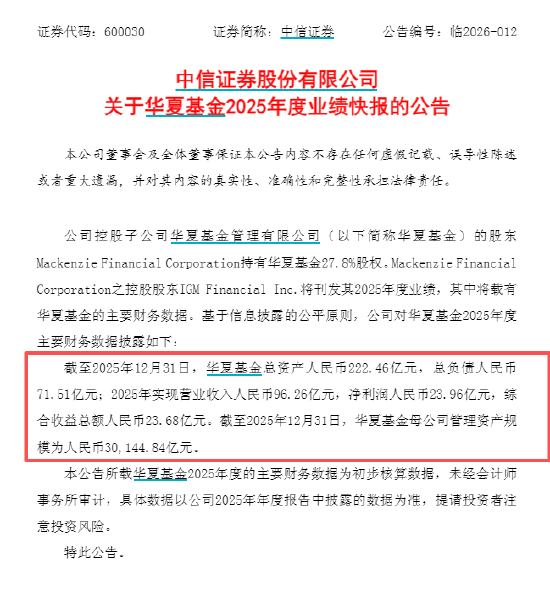
中信证券:华夏基金2025年净利润23.96亿元 较上一年同期增长11.02%
Xin Lang Cai Jing· 2026-02-11 00:24
Core Viewpoint - The financial performance of Huaxia Fund for the year 2025 shows significant growth in both revenue and net profit compared to the previous year, indicating a strong operational performance and asset management capability. Financial Performance - As of December 31, 2025, Huaxia Fund reported total assets of RMB 222.46 billion and total liabilities of RMB 71.51 billion [6] - The company achieved an operating income of RMB 96.26 billion and a net profit of RMB 23.96 billion for the year 2025 [6] - Comprehensive income totaled RMB 23.68 billion for the same period [6] Year-on-Year Growth - The operating income for 2025 increased by 19.86% compared to the same period in 2024 [8] - Net profit for 2025 rose to RMB 21.58 billion, reflecting an increase of 11.02% year-on-year [8] Asset Management - By the end of Q4 2025, Huaxia Fund's asset scale reached RMB 22,797.8 billion, which is an increase of RMB 4,917.3 billion compared to the same period in 2024 [8] - The number of products offered by Huaxia Fund increased by 72 during the year [8] Asset Management Scale - As of December 31, 2025, the parent company of Huaxia Fund managed assets totaling RMB 30,144.84 billion [6]