CM BANK(600036)

Search documents
招商银行(600036) - 招商银行股份有限公司关于董事任职资格核准的公告
2025-11-04 09:00
A 股简称:招商银行 A 股代码:600036 公告编号:2025-056 招商银行股份有限公司(简称本公司或招商银行)收到《国家金融 监督管理总局关于邓仁杰招商银行董事任职资格的批复》(金复〔2025〕 623号)。根据上述批复,邓仁杰先生招商银行董事的任职资格已获得核 准。 邓仁杰先生担任本公司股东董事(非执行董事)的任期自核准日2025 年10月30日起生效,至本公司第十三届董事会届满之日止。邓仁杰先生 的简历及相关信息请参阅刊登在上海证券交易所网站(www.sse.com.cn) 和本公司网站(www.cmbchina.com)的本公司2024年度股东大会文件。 特此公告。 招商银行股份有限公司董事会 2025 年 11 月 4 日 招商银行股份有限公司 关于董事任职资格核准的公告 本公司董事会及全体董事保证本公告内容不存在任何虚假记载、误导性陈述或者 重大遗漏,并对其内容的真实性、准确性和完整性承担法律责任。 ...
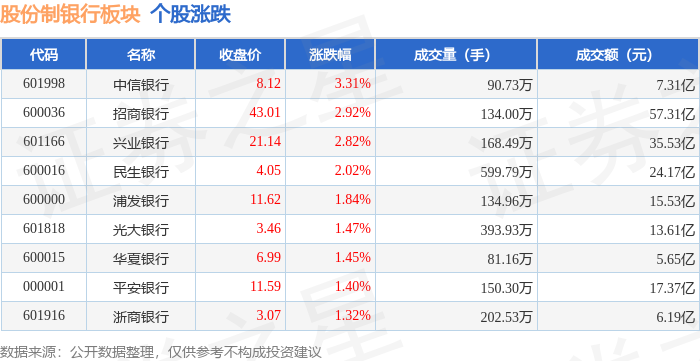
股份制银行板块11月4日涨2.44%,中信银行领涨,主力资金净流入17.63亿元
Zheng Xing Xing Ye Ri Bao· 2025-11-04 08:48
Core Viewpoint - The banking sector, particularly the joint-stock banks, experienced a notable increase of 2.44% on November 4, with CITIC Bank leading the gains, despite the overall decline in major stock indices [1] Group 1: Market Performance - The Shanghai Composite Index closed at 3960.19, down 0.41%, while the Shenzhen Component Index closed at 13175.22, down 1.71% [1] - CITIC Bank's stock price rose by 3.31% to 8.12, with a trading volume of 907,300 shares and a transaction value of 731 million [1] - Other notable performers included China Merchants Bank, which increased by 2.92% to 43.01, and Industrial Bank, which rose by 2.82% to 21.14 [1] Group 2: Capital Flow - The joint-stock banking sector saw a net inflow of 1.763 billion in main funds, while retail investors experienced a net outflow of 664 million [1] - Specific banks like Shanghai Pudong Development Bank had a main fund net inflow of 413 million, while retail investors saw a net outflow of 251 million [2] - Ping An Bank recorded a main fund net inflow of 294 million, with retail investors also experiencing a net outflow of 165 million [2]






25Q3银行持仓点评:主动基金降配不改中长期资金增持趋势
Ping An Securities· 2025-11-04 07:43
Investment Rating - The report maintains an "Outperform" rating for the banking sector [1] Core Insights - The banking sector has seen a decline in active fund holdings, reaching the lowest level since 2021, with a decrease of 1.58 percentage points to 1.03% in the third quarter of 2025 [3][4] - Passive funds have increased significantly, with a total scale of 5.23 trillion, up approximately 992.5 billion from the second quarter, making them the main source of incremental funds for the banking sector [3][10] - Despite the overall decline in holdings, certain banks like Minsheng Bank and Ningbo Bank have seen an increase in their holdings [3][12] Summary by Sections Fund Holdings Situation - Active fund holdings in the banking sector have decreased to a low of 1.03%, down 1.58 percentage points from the previous quarter, indicating a significant underweight compared to the sector's market capitalization [4][5] - Passive funds have grown to 5.23 trillion, with a 1.1 percentage point increase in their share to 56%, highlighting their role as a key source of new capital for the sector [4][10] Stock Performance of Major Banks - Major state-owned banks have experienced a decline in holdings, with specific reductions noted in Industrial and Commercial Bank, Agricultural Bank, and others, reflecting a broader trend of reduced preference for bank stocks [7][12] - Smaller banks have also seen notable declines, with banks like China Merchants Bank and Jiangsu Bank showing significant reductions in their holdings [7][12] Shareholder Dynamics - Insurance companies have continued to increase their stakes in banks, indicating a sustained interest from long-term investors in the banking sector's dividend attributes [16][18] - The report notes that several banks have seen new entries into their top ten shareholders, further emphasizing the interest from institutional investors [16][17] Market Trends and Recommendations - The report suggests that the changing structure of fund flows is a critical factor in the valuation recovery of the banking sector, with passive index expansion providing stable inflows [3][10] - It recommends focusing on banks with high dividend yields and potential for long-term capital inflows, particularly in the A-share and Hong Kong markets [3][10]


大行积存金业务暂停又恢复,已有银行金条价格含税上调
第一财经· 2025-11-04 07:04
Core Viewpoint - The recent changes in gold tax policies have led to multiple banks, including Industrial and Commercial Bank of China (ICBC), China Construction Bank, and Agricultural Bank of China, temporarily suspending their gold accumulation and physical exchange services, with some banks adjusting their product offerings and pricing in response to the new regulations [3][5][12]. Group 1: Impact of New Tax Policies - The new gold tax policy has prompted banks to pause gold accumulation services and adjust their product offerings, with ICBC and China Construction Bank announcing suspensions on November 3, 2025 [5][6]. - ICBC quickly resumed its gold accumulation services on the evening of the same day, indicating a rapid response to the regulatory changes [7][8]. - The adjustments made by banks are primarily due to system upgrades and the need to comply with the new tax regulations, rather than a significant impact on their gold business [12][14]. Group 2: Changes in Product Offerings - Banks like China Merchants Bank have shifted some of their self-operated gold products to a consignment model, reducing the range of physical gold products available for exchange [8][15]. - The new tax policy has led to an increase in the prices of physical gold products, with banks adjusting their pricing structures accordingly [12][15]. - The changes in tax regulations mean that banks will now face different invoicing rules, which could affect their cost structures and pricing strategies for gold products [13][14]. Group 3: Market Reactions and Future Outlook - The market for gold products has seen a tightening of inventory, with certain gold bars becoming unavailable for purchase [9][12]. - Industry experts suggest that while the immediate impact on banks' gold businesses may be limited, the overall product and operational structures will undergo adjustments in response to the new tax policies [14].



银行板块逆势走强,银行ETF易方达(516310)助力低成本布局板块龙头
Mei Ri Jing Ji Xin Wen· 2025-11-04 06:52
Core Viewpoint - The A-share market is experiencing an overall adjustment, while the banking sector is showing strength, with the China Securities Banking Index rising by 1.7% as of 14:28. This indicates a shift from high-volatility growth stocks to undervalued, high-dividend value sectors, with banks positioned to benefit from this trend [1]. Summary by Category Market Performance - The China Securities Banking Index has increased by 1.7%, with notable gains from stocks such as Xiamen Bank (over 5%) and Jiangyin Bank (over 3%). Major banks like CITIC Bank, Industrial Bank, and China Merchants Bank have also seen increases of over 2% [1]. Investment Trends - Analysts suggest that after an extreme performance of small-cap growth stocks in the third quarter, the excess returns of small-cap growth relative to large-cap value have reached historical highs. This has led to a market shift towards low-valuation, high-dividend value sectors [1]. Valuation Metrics - The current price-to-book ratio of the China Securities Banking Index is approximately 0.7 times, which is at the 34th percentile since the index was launched in 2013. The current dividend yield is around 4%, with the spread over government bonds at a historically high level, indicating significant investment value [1].

大行积存金业务暂停又恢复,已有银行金条价格含税上调
Di Yi Cai Jing· 2025-11-04 06:08
Core Viewpoint - The recent changes in gold tax policies have led multiple major banks, including Industrial and Commercial Bank of China (ICBC), China Construction Bank, and Agricultural Bank of China, to suspend gold accumulation and physical exchange services, with some banks making significant adjustments to their offerings [1][2][3]. Group 1: Bank Responses - ICBC announced the suspension of its gold accumulation services effective November 3, 2025, due to macroeconomic policy impacts, but existing customers' plans remain unaffected [2]. - China Construction Bank also suspended its gold accumulation services, including real-time purchases and physical gold exchanges, while allowing existing plans to continue [2][3]. - Agricultural Bank of China halted its gold accumulation services and physical gold exchanges, citing the new tax policy as the reason for the suspension [3]. Group 2: Adjustments in Gold Products - China Merchants Bank has shifted some of its self-operated gold products to a consignment model and temporarily removed certain products from sale, with the current prices reflecting the new tax-inclusive rates [1][4]. - The availability of physical gold products has decreased, with some banks reporting limited inventory, particularly for investment gold bars [4][5]. Group 3: Tax Policy Implications - The new tax policy, effective from November 1, 2023, clarifies the VAT rules for gold transactions, impacting how banks and their partners handle gold sales and pricing [5][6]. - The policy change means that banks may face increased costs when selling gold bars due to the shift from VAT exemptions to standard VAT rates for certain transactions [6][7]. - The overall impact on banks' gold business is expected to be limited, but adjustments in product offerings and pricing strategies are anticipated as banks adapt to the new regulations [5][7][8].
公募重仓股25年进化史!穿越牛熊“主心骨”未变!
天天基金网· 2025-11-04 05:32
Core Viewpoint - The article discusses the evolution of public fund holdings over the past 25 years, highlighting the shift from cyclical industries to consumer sectors, and now to technology and high-end manufacturing, reflecting China's economic transformation and investment trends [3][10]. Group 1: Historical Evolution of Heavyweight Stocks - From 2000 to 2010, public funds primarily invested in cyclical stocks like steel and finance, mirroring the industrialization and urbanization era [4]. - Key stocks included China Unicom and China Merchants Bank, with the latter being the top holding for nine consecutive years, showcasing the banking sector's profitability during credit expansion [4]. - In 2007, Baosteel's market value reached 39.39 billion yuan, despite a slight profit decline, indicating the "cyclical dominance" market logic [4]. Group 2: Transition to Consumer Sector - Between 2010 and 2020, the consumer sector took over as the main focus, with Kweichow Moutai becoming a benchmark stock, reflecting the consumption upgrade trend [5]. - During this decade, leading consumer stocks like Yili and Gree Electric also saw significant holdings, with net profit growth rates exceeding 20% [5]. Group 3: Rise of Technology and High-End Manufacturing - From 2020 onwards, technology and high-end manufacturing emerged as the new mainline, aligning with innovation-driven development and the "dual carbon" strategy [6]. - By the end of 2024, CATL's holding value surpassed 178.69 billion yuan, with a net profit growth of 15.01% and a stock price increase of 66.92% [6]. - The trend continued into the third quarter of 2025, with CATL's holding value reaching 207.10 billion yuan and a net profit growth of 36.2% [6]. Group 4: Stock Selection Logic - There is a strong correlation between net profit growth and stock price increases among the top holdings, indicating the importance of fundamentals [7]. - For instance, New East Wisdom's net profit growth of 284.38% led to a stock price surge of 318.74% in 2025 [7]. - Historical examples show that high profit growth is a core support for stocks to navigate through cycles [7]. Group 5: Valuation Dynamics - The evolution of price-to-earnings ratios and total market values reflects the market's dynamic re-evaluation of company values [8]. - For example, Kweichow Moutai's P/E ratio rose from 21.37 in 2005 to 56.3 in 2020, indicating a consensus on its brand strength and demand resilience [8]. - In contrast, tech stocks like Cambrian's P/E ratio approached 500 by the third quarter of 2025, reflecting a willingness to pay a premium for growth potential [8]. Group 6: Concentration and Diversification of Holdings - The concentration of holdings has evolved, with a notable shift from a focus on financial and steel sectors in 2007 to a more diversified approach by 2025 [9]. - The top ten holdings now cover various sectors, including electrical equipment and communications, indicating a strategy shift towards diversification to manage risks [9]. Group 7: Future Outlook - The future landscape of heavyweight stocks will continue to evolve with technological advancements and national strategic directions [12]. - The strong performance of technology stocks like CATL and New East Wisdom suggests that the trend of technology-driven industrial upgrades will persist [12]. - Traditional sectors like Kweichow Moutai, despite adjustments, still demonstrate value resilience, indicating a balanced approach in future investments [12].





上市公司三季报的几点债市信号:A股上市公司三季报分析
Hua Yuan Zheng Quan· 2025-11-04 05:17
Report Industry Investment Rating - The report is bullish on the bond market, predicting that the yield of the 10Y Treasury bond will return to around 1.65% this year, the 30Y Treasury bond to 1.9%, and the 5Y Tier 2 capital bonds of large banks to 1.9% (for bonds without VAT) [74]. Core Viewpoints - The revenue growth rate of the entire A-share market and the net profit growth rate of the parent company are at a low level, indicating that the economic growth rate may have stabilized at a low level but still faces downward pressure. The yield of the 10-year Treasury bond is more closely related to the revenue growth rate of the entire A-share market than the nominal GDP growth rate [1][4]. - The loan growth rate has been declining, and the proportion of loans in the bank's asset side is decreasing. The demand for personal and corporate loans may be weak in the long term, while the scale of government bonds may significantly expand. The asset structure of the banking system may face long-term changes, with the proportion of loans likely to decline significantly [21][24]. - Since the beginning of 2023, the proportion of financial investments of large banks has rebounded, and the growth rate of bond investments has increased. The cost rate of interest-bearing liabilities of listed banks has been decreasing quarter by quarter, and it is expected to further decline in the future [1][49]. - The decline in bank liability costs will support the downward oscillation of bond yields. Given the current economic situation, the rapid decline in bank liability costs, and the loose capital situation, the report is bullish on the bond market [70][74]. Summary by Directory 1. Analyzing Economic and Bank Operating Pressures from the Q3 Reports of the Entire A-share Market - **Economic Insights from the Entire A-share Performance**: The revenue growth rate of the entire A-share market can reflect the nominal GDP growth rate to some extent. The revenue growth rate of the entire A-share market and the 10-year Treasury bond yield have a similar trend. The performance growth rate of the entire A-share market is still under pressure, and the growth rate of the real economy also faces significant pressure [5][6][9]. - **Economic Insights from the Bank Sector Performance**: The performance of the banking sector is closely related to the economy. In recent years, the performance growth of the banking sector has been under significant pressure, and the net interest margin of commercial banks has been continuously declining [11][12][15]. - **Financing Demand from the Entire A-share Liabilities**: Since Q1 2024, the long-term borrowing growth of the entire A-share market (excluding finance, petroleum, and petrochemicals) has almost stagnated, reflecting the weak financing demand of market-oriented enterprises. The social financing growth rate generally leads the nominal GDP growth rate by 1 - 2 quarters, but its guiding role may decline in the future [18][20]. 2. Changes in Bank Asset and Liability Situations - **Declining Loan Growth Rates of Large and Small Banks**: The loan growth rate has significantly declined. The growth of personal housing loans is facing negative growth pressure, which significantly drags down the growth rate of personal loans. The loan growth rates of both large and small banks have declined, and the proportion of loans is also decreasing. In the long term, the asset structure of the banking system may change, with the proportion of loans likely to decline and the proportion of bond investments likely to increase [21][25][36]. - **Decreasing Deposit Proportion on the Liability Side of Large Banks and Stable Deposit Proportion of Small Banks**: The growth of corporate deposits of large banks has slowed down. In recent years, the proportion of deposits on the liability side of large banks has decreased, while the average deposit proportion of listed joint-stock banks has increased [37][48]. 3. Banks with Significant Financial Investment Growth in Q3 2025 - Since the beginning of 2023, the proportion of financial investments of large banks has rebounded. In Q3 2025, the financial investments of some banks, such as ICBC and CCB, increased significantly, while those of a few banks decreased. The financial investment increments of large banks, joint-stock banks, and city and rural commercial banks were all significant, and the bond investment growth rates of the Big Four banks and small and medium-sized banks were also relatively high [49][56][59]. 4. Decrease in Bank Interest-Bearing Liability Costs - In 2025, the decline of the current deposit proportion slowed down. Since the beginning of 2024, the deposit interest payment rate has significantly decreased, and the interest-bearing liability cost rate has been decreasing quarter by quarter. It is expected to further decline in the future [60][63][66]. 5. Investment Recommendations - The decline in bank liability costs will support the downward oscillation of bond yields. In the future, the liability costs of commercial banks are expected to decline year by year, which will drive the yield of the 10-year Treasury bond to decline. Given the current economic situation and the value of government bond allocation, it is recommended that commercial bank self-operated departments increase the allocation of government bonds. The report is bullish on the bond market [70][73][74].


刚刚,直线拉升!大反转来了
Zhong Guo Ji Jin Bao· 2025-11-04 05:00
Market Overview - The A-share market experienced a decline in the morning session, with the Shanghai Composite Index down 0.19%, Shenzhen Component Index down 1.27%, and ChiNext Index down 1.51% [2][3] - The total trading volume in the Shanghai and Shenzhen markets was 1.22 trillion yuan, a decrease of 164.8 billion yuan compared to the previous trading day [3] Banking Sector Performance - The banking sector showed strong performance, with all A-share bank stocks rising. Notable increases included China Merchants Bank up 2.92% and Industrial Bank up over 3% [4][5] - Key bank stock performances included: - Agricultural Bank of China: 8.17 yuan, up 2.00%, market cap 2779.2 billion yuan, YTD change 59.87% - Industrial and Commercial Bank of China: 8.10 yuan, up 2.53%, market cap 2679.2 billion yuan, YTD change 21.97% [5] - Hong Kong-listed bank stocks also saw gains, with China Merchants Bank up over 3% [4][6] Insurance Sector Performance - The insurance sector also performed well, with major A-share insurers like China Life and New China Life rising over 1% [7] - The five major A-share listed insurance companies reported a combined operating income of 23,739.81 billion yuan, a year-on-year increase of 13.6%, and a net profit of 4,260.39 billion yuan, up 33.5% [8] Gold Sector Performance - The gold sector faced a collective decline, with stocks like Shengda Resources down over 5% and several others down more than 3% [11][12] - Specific stock performances included: - Shengda Resources: 22.04 yuan, down 5.00%, market cap 15.2 billion yuan, YTD change 85.01% - Zhongjin Gold: 21.05 yuan, down 3.57%, market cap 102 billion yuan, YTD change 79.70% [12] Innovative Drug Sector Performance - The innovative drug sector saw significant declines, with stocks like Hengrui Medicine down over 1.15% [13] - Notable declines included: - Changshan Pharmaceutical: 57.87 yuan, down 17.09%, market cap 53.2 billion yuan, YTD change 189.49% - Haicheng Pharmaceutical: 56.11 yuan, down 8.14%, market cap 6.7 billion yuan, YTD change 179.14% [14] - The recent national medical insurance negotiations introduced a "commercial insurance innovative drug directory" mechanism, indicating a shift towards multi-tiered healthcare coverage [16]


刚刚,直线拉升!大反转来了
中国基金报· 2025-11-04 04:51
Market Overview - A-shares experienced a decline in the morning session, with the Shanghai Composite Index down by 0.19%, Shenzhen Component down by 1.27%, and ChiNext down by 1.51% [2][4] - The total trading volume in the Shanghai and Shenzhen markets was 1.22 trillion yuan, a decrease of 164.8 billion yuan compared to the previous trading day [4] Sector Performance - The banking sector showed strong performance, with all bank stocks rising. Notable increases included China Merchants Bank up by 2.92% and Industrial Bank up by over 3% [7][8] - The insurance sector also saw gains, with major companies like China Life and New China Life rising over 1% [11][12] - Conversely, the gold sector faced a collective downturn, with stocks like Shengda Resources dropping over 5% and several others declining by more than 3% [19][21] - The innovative drug sector experienced significant declines, with stocks like Changshan Pharmaceutical falling by 17.09% [24][27] Banking Sector Details - Major banks such as Agricultural Bank of China and Industrial and Commercial Bank of China saw their stock prices increase, with market capitalizations of 27,792 billion yuan and 26,792 billion yuan respectively [8] - The overall performance of the banking sector reflects a positive sentiment in the market, contrasting with other sectors [6][7] Insurance Sector Insights - The five major A-share listed insurance companies reported a total revenue of 23,739.81 billion yuan for the first three quarters of 2025, marking a year-on-year growth of 13.6% [13] - The net profit attributable to shareholders reached 4,260.39 billion yuan, representing a 33.5% increase year-on-year, indicating a strong operational performance [13] Gold Sector Analysis - The gold sector is experiencing a downturn, with several companies reporting significant declines in stock prices. For instance, Zhongjin Gold fell by 3.57% and Shandong Gold by 3.28% [20][21] - Despite the drop in stock prices, some gold jewelry brands have reported an increase in domestic gold jewelry prices, with prices reaching 1,265 yuan per gram [23] Innovative Drug Sector Developments - The innovative drug sector is facing challenges, with several companies reporting substantial stock price declines. For example, Heng Rui Medicine fell by over 1.15% [25][26] - The recent national medical insurance negotiations introduced a new mechanism for commercial insurance innovative drug directories, which may alleviate some financial pressures on high-value innovative drugs [31]