Rnm(600259)

Search documents
稀土板块大涨!概念股盘点来了(名单)
Zheng Quan Zhi Xing· 2025-08-08 02:03
Industry Overview - The rare earth sector has seen a significant increase, with companies like Zhenghai Magnetic Materials and Aishichuang hitting the daily limit up, indicating strong market performance [1] - Rare earth elements are classified into light and heavy rare earths, with China being the sole source of heavy rare earth separation globally [1] - The rare earth industry is entering a traditional consumption peak season in August, leading to increased demand and procurement [1] Supply and Demand Dynamics - The demand for rare earth materials is expected to rise due to increased orders from major manufacturers, with some orders scheduled until mid-September [1] - The import volume of domestic rare earth products has significantly decreased due to factors like US-China tariff conflicts and political issues in Myanmar [1] - Recent price increases in rare earth materials are a key catalyst for the sector's heightened interest, with expectations of continued upward price momentum driven by strong demand [1][2] Applications of Rare Earth Materials - Rare earth permanent materials are crucial in the electric vehicle sector, with approximately 2 kilograms of rare earth used per vehicle [2] - The consumer electronics sector also shows stable growth in demand for high-performance permanent materials, used in devices like smartphones and computers [2] - Emerging industries, such as humanoid robotics, are projected to create substantial demand for rare earth materials, with estimates suggesting a potential market of $800 billion [2] Key Companies in the Rare Earth Sector - Northern Rare Earth: One of the largest suppliers of light rare earth products globally, with a target utilization rate of 90% for praseodymium and neodymium by 2025 [3] - Zhongke Magnetic Materials: A significant domestic producer of permanent magnetic materials, focusing on sintered neodymium-iron-boron and ferrite magnets [3] - China Rare Earth: The only listed platform for China Minmetals, specializing in ion-type rare earth separation and processing [3] - Galaxy Magnet: Engaged in the development and production of bonded neodymium-iron-boron magnets and samarium-cobalt magnets [3] - Inlohua: Produces neodymium-iron-boron permanent materials and serves major clients like Apple and Samsung [3] - Baotou Steel: Supplies rare earth concentrates and is known for its rich mineral resources [3] - Guangxi Rare Earth: A key player in the Guangdong rare earth industry, holding significant mining rights [4] - Xiamen Tungsten: Involved in rare earth permanent magnets with an annual production capacity of 4,000 tons [4]




研判2025!中国氧化铽行业产业链、价格及进出口分析:出口管制与资源战略双轮驱动,中国氧化铽市场成全球市场风向标[图]
Chan Ye Xin Xi Wang· 2025-08-08 01:29
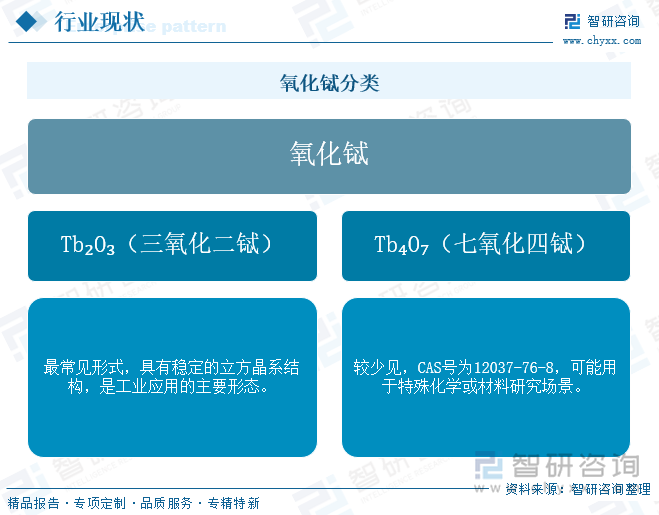
Core Viewpoint - China, as the world's richest country in rare earth resources, is leading in the terbium oxide industry in terms of resource reserves, production capacity, and technological development. The country is reshaping the global rare earth supply chain through policy regulation and market mechanisms, with terbium oxide being a key strategic resource whose price fluctuations are critical indicators of international geopolitical and industrial trends [1][8][17]. Industry Overview - Terbium oxide (Tb₂O₃) is a black-brown powder with unique optical and magnetic properties, relatively stable chemical characteristics, and is insoluble in water but soluble in acid [2]. - China's rare earth reserves are approximately 44 million tons, accounting for nearly half of the global proven reserves, with production reaching 270,000 tons in 2024, a year-on-year increase of 12.50% [6][8]. Industry Chain - The upstream of the terbium oxide industry includes rare earth mineral resources and various production equipment. The midstream involves the manufacturing of terbium oxide, while the downstream applications include fluorescent materials, magneto-optical materials, catalysts, electronic ceramics, and new energy materials [4]. Current Industry Status - In April 2025, China implemented export controls on seven types of medium and heavy rare earths, causing international market panic and leading to a spike in European terbium oxide prices to $3,000 per kilogram (approximately 2.181 million RMB per ton). By June 2025, the domestic price of terbium oxide reached 7.09 million RMB per ton, a year-on-year increase of 31.30% [1][10][12]. Key Enterprises' Performance - The Chinese terbium oxide industry is characterized by a competitive landscape dominated by state-owned enterprises, with significant advantages in production and market position. For instance, China Northern Rare Earth Group has a net profit increase of 727.3% in Q1 2025, while China Rare Earth Group has a production volume of 7,785.27 tons in 2024, a year-on-year increase of 107.27% [12][15]. Industry Development Trends 1. **Policy Regulation and Export Control**: The export control policy is expected to be a long-term strategic tool, significantly altering the global rare earth supply-demand structure. The average approval cycle for export licenses has been shortened by 30% [17]. 2. **Technological Innovation**: The industry is focusing on green transformation and high value-added production, with companies like Northern Rare Earth investing in zero wastewater discharge systems and achieving a 30% reduction in energy consumption per unit of output [19]. 3. **Market Demand Evolution**: The demand for terbium and dysprosium is expected to grow significantly due to high-end markets like robotics and new energy vehicles, although there are potential risks from alternative materials and geopolitical tensions [20].


研判2025!中国氧化镝行业产业链、价格及进出口分析:政策及技术革新重构市场,行业完成价格理性回归[图]
Chan Ye Xin Xi Wang· 2025-08-08 01:29
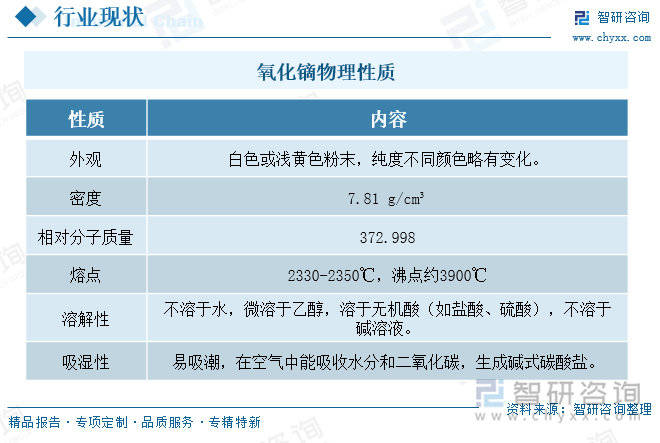
Industry Overview - The price of dysprosium oxide in China remained above 2 million yuan per ton from 2021 to 2023, driven by explosive growth in the global electric vehicle industry leading to supply-demand imbalances [1][7] - As a key additive in neodymium-iron-boron permanent magnets, the demand for dysprosium surged with the increase in electric vehicle production, while supply chain responses lagged, causing temporary supply shortages and irrational price increases [1][7] - By mid-2025, dysprosium prices fell to 1.615 million yuan per ton, a year-on-year decrease of 11.26%, due to multiple factors including increased global rare earth mining capacity and technological advancements reducing production costs [1][7] Industry Chain - The upstream of the dysprosium industry chain includes raw materials and production equipment, with raw materials primarily being rare earth mineral resources [4] - The midstream involves the production and manufacturing of dysprosium, while the downstream applications include magnetic materials, laser technology, electronics, new energy batteries, aerospace, and medical devices [4] Market Dynamics - Global rare earth reserves are approximately 90 million tons, with China holding 44 million tons, accounting for 48.9% of the total [6][7] - In 2024, China produced 270,000 tons of rare earths, representing 69.2% of global production, ensuring a stable supply for dysprosium production [6][7] Key Companies - China Rare Earth Group has an annual dysprosium production capacity of about 300 tons, with a product purity of 99.99% [11] - Guangsheng Nonferrous Metals, the only rare earth mining rights holder in Guangdong, produced 900 tons of dysprosium in 2023, expected to increase to 1,100 tons by 2025 [11] - Northern Rare Earth is a leading producer with a dysprosium output of 1,000 tons in 2023, projected to rise to 1,200 tons by 2025 [11] Industry Trends - The Chinese government is enhancing regulation of the rare earth industry, promoting integration and green transformation, with new policies aimed at protecting and rationally utilizing rare earth resources [17] - Technological innovations, such as the successful trial of the "physical vapor deposition combined with grain boundary diffusion method," have reduced dysprosium usage by 70% while improving magnetic properties [18][19] - The rapid development of global electric vehicles, wind power, and humanoid robots is creating new growth points for the dysprosium industry, with electric vehicles being a major demand driver [20]
广晟有色(600259)8月4日主力资金净流入7052.97万元
Sou Hu Cai Jing· 2025-08-04 07:45
Core Viewpoint - Guangsheng Nonferrous Metals Co., Ltd. has shown a mixed financial performance with a significant increase in net profit despite a decline in total revenue, indicating potential resilience in profitability [1][2]. Financial Performance - As of the first quarter of 2025, the company reported total revenue of 1.506 billion yuan, a year-on-year decrease of 14.05% [1]. - The net profit attributable to shareholders reached 472.712 million yuan, reflecting a year-on-year increase of 115.55% [1]. - The non-recurring net profit was 450.621 million yuan, up 114.78% year-on-year [1]. - The current ratio stood at 1.264, while the quick ratio was 0.523, and the debt-to-asset ratio was 52.77% [1]. Market Activity - On August 4, 2025, the stock price closed at 61.68 yuan, with an increase of 1.95% [1]. - The trading volume was 105,700 lots, with a total transaction value of 650 million yuan [1]. - The net inflow of main funds was 70.5297 million yuan, accounting for 10.85% of the transaction value [1]. Company Overview - Guangsheng Nonferrous Metals Co., Ltd. was established in 1993 and is located in Haikou City, primarily engaged in nonferrous metal smelting and rolling processing [2]. - The company has a registered capital of 3.3643591 billion yuan and a paid-in capital of 1.29372517 billion yuan [1][2]. - The legal representative of the company is Yang Jie [1]. Investment and Innovation - The company has made investments in 27 enterprises and participated in 32 bidding projects [2]. - It holds 16 patents and has obtained 6 administrative licenses [2].
稀土ETF嘉实(516150)红盘蓄势,机构:稀土产品价格合理,有望进一步上涨
Sou Hu Cai Jing· 2025-08-04 03:34
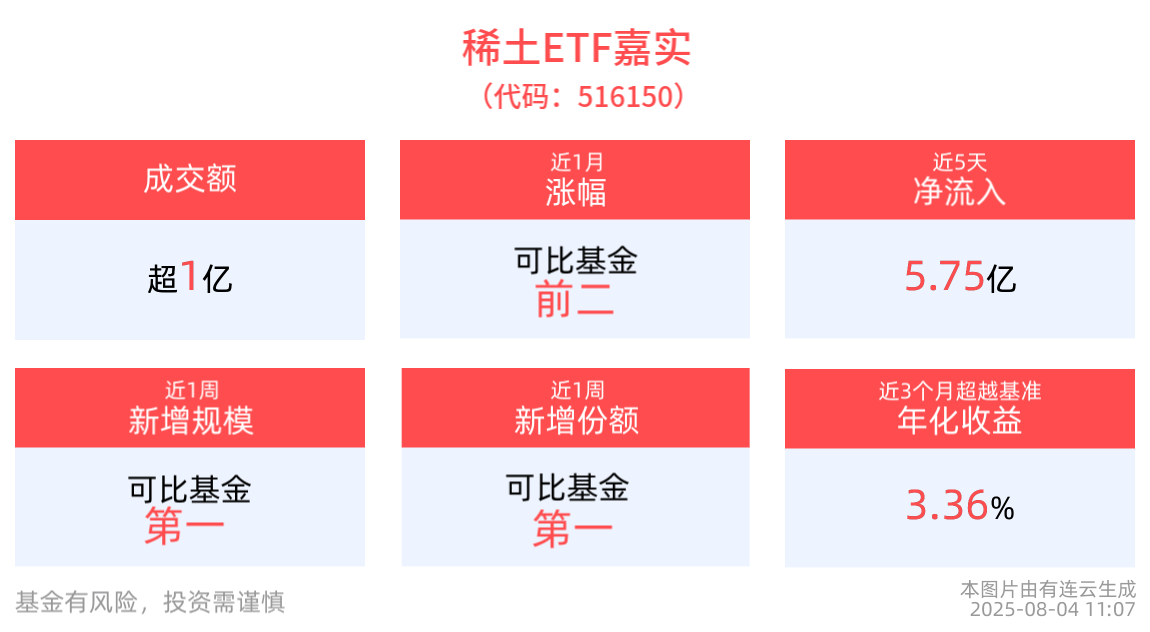
流动性方面,稀土ETF嘉实盘中换手2.78%,成交1.15亿元。拉长时间看,截至8月1日,稀土ETF嘉实近1周日均成交3.57亿元,居可比基金第一。 规模方面,稀土ETF嘉实近1周规模增长1.38亿元,实现显著增长,新增规模位居可比基金第一。份额方面,稀土ETF嘉实近1周份额增长2.94亿份,实现显 著增长,新增份额位居可比基金第一。 资金流入方面,拉长时间看,稀土ETF嘉实近5个交易日内有4日资金净流入,合计"吸金"5.75亿元。 截至8月1日,稀土ETF嘉实近1年净值上涨62.04%,指数股票型基金排名153/2944,居于前5.20%。从收益能力看,截至2025年8月1日,稀土ETF嘉实自成立 以来,最高单月回报为41.25%,最长连涨月数为4个月,最长连涨涨幅为83.89%,上涨月份平均收益率为10.02%。 数据显示,截至2025年7月31日,中证稀土产业指数前十大权重股分别为北方稀土、包钢股份、中国稀土、盛和资源、卧龙电驱、中国铝业、领益智造、格 林美、厦门钨业、金风科技,前十大权重股合计占比59.32%。 截至2025年8月4日 11:07,中证稀土产业指数上涨0.01%,成分股湘电股份上涨3. ...



广晟有色(600259)8月1日主力资金净流出1991.16万元
Sou Hu Cai Jing· 2025-08-03 04:21
Group 1 - The core viewpoint of the news is that Guangsheng Nonferrous Metals Co., Ltd. has reported a decline in total revenue while showing significant growth in net profit for the first quarter of 2025 [1] - As of August 1, 2025, Guangsheng Nonferrous Metals' stock closed at 60.5 yuan, down 1.37%, with a turnover rate of 3.61% and a trading volume of 121,500 lots, amounting to 735 million yuan [1] - The company's latest financial results indicate total operating revenue of 1.506 billion yuan, a year-on-year decrease of 14.05%, while net profit attributable to shareholders reached 47.2712 million yuan, a year-on-year increase of 115.55% [1] Group 2 - The company has a current ratio of 1.264, a quick ratio of 0.523, and a debt-to-asset ratio of 52.77% [1] - Guangsheng Nonferrous Metals has made investments in 27 enterprises and participated in 31 bidding projects, along with holding 16 patents and 6 administrative licenses [2] - Established in 1993 and located in Haikou, Guangsheng Nonferrous Metals primarily engages in the smelting and rolling processing of nonferrous metals [1]
有色金属周报:稀土、钼价继续看多,锑价或迎拐点-20250803
SINOLINK SECURITIES· 2025-08-03 02:58
Investment Rating - The report does not explicitly provide an investment rating for the industry Core Insights - The copper market shows a steady upward trend in demand, with a focus on observing global inventory levels and U.S. demand recovery [13] - The aluminum sector is stabilizing at the bottom, facing seasonal pressures and production adjustments [15] - Precious metals, particularly gold, are gaining attractiveness as a safe haven due to geopolitical tensions and economic uncertainties [16] - The rare earth sector is expected to see price increases due to supply constraints and policy changes, benefiting leading state-owned enterprises [32] - The antimony market is stabilizing with expectations of price recovery driven by export improvements and domestic production cuts [34] - Molybdenum prices are on the rise due to supply disruptions and increasing demand from the steel industry [35] - Tin prices are under slight pressure but supported by strong inventory levels and demand recovery in related sectors [36] Summary by Sections 1. Base and Precious Metals Market Overview - Copper prices decreased by 1.66% to $9,633.00 per ton on LME, with domestic inventory down 0.1 thousand tons to 11.93 thousand tons [1] - Aluminum prices fell by 2.26% to $2,571.50 per ton on LME, with domestic electrolytic aluminum inventory increasing [2] - Gold prices increased by 3.08% to $3,416.00 per ounce, driven by geopolitical tensions and economic concerns [3] 2. Base and Precious Metals Fundamental Updates 2.1 Copper - The copper processing fee index rose to -$42.09 per ton, with downstream demand showing weakness [1] 2.2 Aluminum - Domestic aluminum processing rates slightly decreased, with expectations of continued weak performance [2] 2.3 Precious Metals - Gold's appeal as a safe haven is increasing amid global trade tensions and geopolitical conflicts [3] 3. Minor Metals and Rare Earth Market Overview - Rare earth prices are expected to rise due to supply constraints and policy changes, with strategic resources needing re-evaluation [32] - Antimony prices are anticipated to recover due to improved export expectations and domestic production cuts [34] - Molybdenum prices are increasing due to supply disruptions and strong demand from the steel sector [35] 4. Minor Metals and Rare Earth Fundamental Updates 4.1 Rare Earth - Prices for praseodymium-neodymium oxide rose by 7.23% to 513,200 yuan per ton, with supply tightening expected [33] 4.2 Antimony - Antimony ingot prices remain stable, with expectations of recovery driven by export improvements [34] 4.3 Molybdenum - Molybdenum prices increased by 8.02% to 4,310 yuan per ton, with supply disruptions impacting the market [35] 4.4 Tin - Tin prices decreased by 2.69% to 264,100 yuan per ton, but strong inventory levels provide support [36]

稀土产业链,优势在我
Tai Ping Yang Zheng Quan· 2025-08-01 06:03
Investment Rating - The report maintains a positive outlook on the rare earth industry, highlighting investment opportunities driven by demand growth and price increases [4]. Core Insights - China holds the largest rare earth reserves globally, with 44 million tons, accounting for 38% of the world's total [4][16]. - The demand for high-performance rare earth permanent magnets is expected to grow significantly, particularly in the automotive and consumer electronics sectors [4]. - The report emphasizes the leading position of Chinese companies in the rare earth permanent magnet industry, with a focus on companies like Northern Rare Earth, China Rare Earth, and Shenghe Resources [4]. Summary by Sections 1. Global Supply of Rare Earth Resources - China is the largest supplier of rare earths, with a well-established separation industry and significant technological advantages [27]. - The report outlines the increasing production and export quotas for rare earths in China, with a total quota of 270,000 tons for 2024, including 250,000 tons of light rare earths [27]. 2. Definition and Global Distribution of Rare Earths - Rare earths consist of 17 elements, including 15 lanthanides, yttrium, and scandium, with significant reserves found in China, Brazil, and the USA [16][20]. 3. Production and Export of Rare Earths in China - Major companies in China include Northern Rare Earth and Shenghe Resources, with production figures for 2024 indicating substantial output in various rare earth products [30][37]. - China exported 123,000 tons of rare earth products in 2024, with a total export value of 25.6 billion yuan, reflecting a 7.7% year-on-year increase [37]. 4. Overseas Supply of Rare Earths - The report discusses the increasing production of rare earths in the USA and Australia, with significant developments in the Mountain Pass mine and Lynas Corporation's operations [40][48]. 5. Rare Earth Prices - Current prices for key rare earth products are reported to be reasonable, with potential for further increases, particularly for praseodymium-neodymium oxide and dysprosium oxide [64]. 6. Rare Earth Permanent Magnet Industry - The report highlights the growing demand for rare earth permanent magnets in various applications, including electric vehicles and consumer electronics, with production expected to exceed 250,000 tons in 2024 [88]. 7. Key Companies in the Rare Earth Sector - Northern Rare Earth is identified as a leading player with significant production capacity and a focus on high-end magnetic materials [123]. - China Rare Earth is noted for its comprehensive industry chain, covering resource development to deep processing [127]. - Shenghe Resources is recognized for its overseas resource layout and strategic partnerships [138].
稀土指数盘中跌超2%
Mei Ri Jing Ji Xin Wen· 2025-08-01 02:13
8月1日,稀土指数盘中跌幅超2%,包钢股份、盛和资源、北方稀土、中国稀土、广晟有色跌幅靠前。 (文章来源:每日经济新闻) ...
钨、钴、稀土价格上涨 小金属相关公司上半年“成绩单”亮眼
Cai Jing Wang· 2025-07-30 06:11
本报记者 丁蓉 小金属价格上涨与供需两端共振密切相关。 年初至今,钨、钴、稀土价格纷纷上涨。Wind数据显示,截至7月29日,钴报价263000元/吨,相比2024 年末的170000元/吨,涨幅为54.71%;钨精矿报价192500元/吨,相比2024年末的142500元/吨,涨幅为 35.09%。截至7月29日,中国稀土行业协会公布的稀土价格指数报202.70,相比2024年末的163.80,涨 幅为23.75%。 在市场回暖背景下,小金属行业相关上市公司业绩显著提升。截至目前,中国北方稀土(集团)高科技 股份有限公司(以下简称"北方稀土")、广晟有色金属股份有限公司(以下简称"广晟有色")、浙江华 友钴业股份有限公司(以下简称"华友钴业")、广东翔鹭钨业股份有限公司(以下简称"翔鹭钨业")等 上市公司上半年"成绩单"均颇为亮眼。 苏商银行特约研究员付一夫在接受《证券日报》记者采访时表示:"供给方面,小金属普遍存在资源储 量有限、开采难度大等特点,短期内难以快速扩大产能;需求方面,新能源车、风电、半导体等新兴产 业快速发展,带动了对钨、钴、稀土等关键材料的需求激增,这种供需错配导致价格持续上涨。此外, 受 ...