Nisco(600282)

Search documents
2025年中国生铁产量为8.4亿吨 累计下降3%
Chan Ye Xin Xi Wang· 2026-01-28 03:35
上市企业:宝钢股份(600019),马钢股份(600808),鞍钢股份(000898),首钢股份(000959),河钢股 份(000709),凌钢股份(600231),重庆钢铁(601005),安阳钢铁(600569),八一钢铁(600581),南 钢股份(600282) 相关报告:智研咨询发布的《2026-2032年中国高纯生铁行业市场产销状况及投资战略研判报告》 根据国家统计局数据显示:2025年12月中国生铁产量为0.6亿吨,同比下降9.9%;2025年中国生铁累计 产量为8.4亿吨,累计下降3%。 2020-2025年中国生铁产量统计图 数据来源:国家统计局,智研咨询整理 知前沿,问智研。智研咨询是中国一流产业咨询机构,十数年持续深耕产业研究领域,提供深度产业研 究报告、商业计划书、可行性研究报告及定制服务等一站式产业咨询服务。专业的角度、品质化的服 务、敏锐的市场洞察力,专注于提供完善的产业解决方案,为您的投资决策赋能。 ...





2025年中国钢材产量为14.5亿吨 累计增长3.1%
Chan Ye Xin Xi Wang· 2026-01-28 03:28
Core Viewpoint - The report highlights a projected decline in China's steel production in December 2025, with a year-on-year decrease of 3.8%, while the cumulative production for the year is expected to grow by 3.1% to 1.45 billion tons [1]. Group 1: Industry Overview - According to the National Bureau of Statistics, China's steel production is forecasted to be 120 million tons in December 2025, reflecting a year-on-year decline of 3.8% [1]. - The cumulative steel production in China for the year 2025 is projected to reach 1.45 billion tons, indicating a cumulative growth of 3.1% [1]. Group 2: Companies Mentioned - Listed companies in the steel sector include Baosteel Co., Ltd. (600019), Ansteel Co., Ltd. (000898), Maanshan Iron & Steel Co., Ltd. (600808), Shagang Group (002075), Shougang Group (000959), Baotou Steel (600010), Taiyuan Iron & Steel (000825), Hunan Valin Steel (000932), Hebei Iron & Steel (000709), and Nanjing Steel (600282) [1]. Group 3: Research Report - The report titled "Analysis of Competitive Landscape and Investment Development Research on China's Steel Deep Processing Industry from 2026 to 2032" was published by Zhiyan Consulting, a leading industry consulting firm in China [1]. - Zhiyan Consulting has been dedicated to industry research for over a decade, providing in-depth industry reports, business plans, feasibility studies, and customized services [1].


南京钢铁股份有限公司2026年第一次临时股东会决议公告
Shang Hai Zheng Quan Bao· 2026-01-26 20:54
证券代码:600282 证券简称:南钢股份 公告编号:临2026-009 南京钢铁股份有限公司 2026年第一次临时股东会决议公告 (五)公司董事和董事会秘书的列席情况 本公司董事会及全体董事保证本公告内容不存在任何虚假记载、误导性陈述或者重大遗漏,并对其内容 的真实性、准确性和完整性承担法律责任。 重要内容提示: ● 本次会议是否有否决议案:无 一、会议召开和出席情况 (一)股东会召开的时间:2026年1月26日 (二)股东会召开的地点:南京市六合区卸甲甸幸福路8号南钢办公楼203会议室 (三)出席会议的普通股股东和恢复表决权的优先股股东及其持有股份情况: ■ (四)表决方式是否符合《公司法》及《公司章程》的规定,会议主持情况等。 本次股东会由公司董事会召集,采用现场投票和网络投票相结合的方式表决。本次会议由公司董事长黄 一新主持。会议的召集、召开及表决方式符合《公司法》等法律、法规、规范性文件及《南京钢铁股份 有限公司章程》《南京钢铁股份有限公司股东会议事规则》的规定。 1、公司在任董事9人,列席9人,其中副董事长杨峰,董事郭家骅、王海勇、肖玲,独立董事施设通过 腾讯会议系统参会; 2、董事会秘书唐睿出席 ...

南钢股份(600282) - 江苏泰和律师事务所关于南京钢铁股份有限公司2026年第一次临时股东会的法律意见书
2026-01-26 09:30
江苏泰和律师事务所 关于南京钢铁股份有限公司 2026 年第一次临时股东会的 法律意见书 根据《中华人民共和国证券法》《中华人民共和国公司法》(以下简称"《公 司法》")、中国证券监督管理委员会《上市公司股东会规则》(以下简称"《股 东会规则》")、《上海证券交易所上市公司自律监管指引第 1 号——规范运作》 (以下简称"《自律监管指引第 1 号》")等法律、法规、规范性文件和《南京 钢铁股份有限公司章程》(以下简称"《公司章程》")的有关规定,江苏泰和 律师事务所(以下简称"本所")接受南京钢铁股份有限公司(以下简称"公司") 的委托,指派律师(以下简称"本所律师")出席公司 2026 年第一次临时股东 会(以下简称"本次股东会"、"会议"),并出具本法律意见书。 法律意见书 江苏泰和律师事务所 关于南京钢铁股份有限公司 2026 年第一次临时股东会的 法律意见书 泰和津师事务所 JC MASTER LAW OFFICES 中国 · 南京 · 清江南路70号国家水资源大厦9层 电话: 025 84503333 传真: 025 84505533 网址: http: //www.jcmaster.com 致:南 ...
南钢股份(600282) - 南京钢铁股份有限公司2026年第一次临时股东会决议公告
2026-01-26 09:30
证券代码:600282 证券简称:南钢股份 公告编号:临 2026-009 (二) 股东会召开的地点:南京市六合区卸甲甸幸福路 8 号南钢办公楼 203 会议室 南京钢铁股份有限公司 2026年第一次临时股东会决议公告 本公司董事会及全体董事保证本公告内容不存在任何虚假记载、误导性陈述 或者重大遗漏,并对其内容的真实性、准确性和完整性承担法律责任。 重要内容提示: 本次会议是否有否决议案:无 一、会议召开和出席情况 (一) 股东会召开的时间:2026 年 1 月 26 日 (三) 出席会议的普通股股东和恢复表决权的优先股股东及其持有股份情况: | 1、出席会议的股东和代理人人数 | 478 | | --- | --- | | 2、出席会议的股东所持有表决权的股份总数(股) | 4,560,640,641 | | 3、出席会议的股东所持有表决权股份数占公司有表决权股份总数的比例(%) | 73.9752 | (四) 表决方式是否符合《公司法》及《公司章程》的规定,会议主持情况 等。 本次股东会由公司董事会召集,采用现场投票和网络投票相结合的方式表决。 本次会议由公司董事长黄一新主持。会议的召集、召开及表决方式符 ...
国盛证券:新能源周报:2023年8月-20260125
GOLDEN SUN SECURITIES· 2026-01-25 08:18
Investment Rating - The report maintains a "Buy" rating for the steel sector, indicating a positive outlook for selected companies within the industry [4][11]. Core Insights - The steel industry is experiencing a slight increase in daily molten iron production, with an average of 228.2 thousand tons, reflecting a 0.2 thousand ton increase [14]. - Total steel inventory has shifted from a decrease to an increase, with a week-on-week rise of 0.8%, indicating a change in market dynamics [26]. - Apparent steel consumption has weakened on a week-on-week basis, with a notable decline in rebar demand, which decreased by 15.3% [40]. - The report highlights a decrease in steel prices and immediate profit margins, suggesting a challenging pricing environment for steel products [71]. Summary by Sections Supply - Daily molten iron production has slightly increased, with long-process production rising [14]. - The capacity utilization rate of 247 steel mills is at 85.5%, showing a 0.1 percentage point increase [20]. Inventory - Total steel inventory has increased, with social inventory at 8.685 million tons, up 0.2% week-on-week [28]. - Steel mill inventory has also risen significantly, indicating a potential oversupply situation [26]. Demand - Apparent consumption of five major steel products has decreased by 2.0% week-on-week, with rebar consumption down by 2.5% [50]. - The average weekly transaction volume for construction steel has dropped to 78 thousand tons [42]. Raw Materials - Iron ore prices have weakened, with a decrease in shipments from Australia and Brazil, leading to a rise in port inventories [49]. - The report notes that the current "anti-involution" policy may influence future production rhythms and pricing [49]. Prices and Profits - The comprehensive steel price index has decreased by 0.7% week-on-week, with specific prices for rebar and hot-rolled sheets also declining [71]. - Immediate profit margins for long-process steel products have decreased, indicating pressure on profitability [71]. Key Companies - The report recommends several companies for investment, including Hualing Steel, Nanjing Steel, and Baosteel, highlighting their potential benefits from the current market conditions [7].


钢铁周报20260125:安保预期趋严,关注原料补库节奏-20260125
Guolian Minsheng Securities· 2026-01-25 07:41
Investment Rating - The report maintains a "Buy" rating for several key companies in the steel industry, including Hualing Steel, Baosteel, Nanjing Steel, and others, indicating a positive outlook for their performance [2][3]. Core Insights - The report highlights a tightening security expectation in the steel industry following a serious safety incident at Baogang Steel, which has led to increased scrutiny and potential impacts on production [9]. - It notes that while steel prices have decreased recently, the overall demand-supply dynamics are showing signs of marginal improvement, with steel mills expected to recover profits in the near term [9]. - The report emphasizes the shift towards high-end product exports, suggesting that leading companies will benefit from a transition from scale expansion to quality and efficiency improvements [9]. Summary by Sections Domestic Steel Market - As of January 23, 2026, steel prices have declined, with rebar priced at 3,260 CNY/ton, down 60 CNY from the previous week [15][16]. - The report indicates an increase in production, with total output for major steel products reaching 8.2 million tons, a slight increase from the previous week [9][12]. International Steel Market - The U.S. steel market shows stable prices, with hot-rolled coil prices at 1,050 USD/ton, unchanged from the previous week [27][29]. - European steel prices have seen slight increases, with hot-rolled prices rising to 745 USD/ton [27][29]. Raw Materials and Shipping Market - Domestic iron ore prices are fluctuating, with local prices for iron concentrate around 750 CNY/ton, while imported iron ore prices are showing a downward trend [31][34]. - The report notes that the shipping market has seen an increase, indicating potential cost pressures for raw material imports [31]. Production and Inventory - The report states that as of January 23, 2026, total steel inventory has increased, with social inventory rising by 21,400 tons to 8.6746 million tons [9][12]. - The production of rebar has increased to 1.9955 million tons, reflecting a recovery in output levels [9][12]. Profitability Analysis - The report provides a profitability outlook, indicating that the average gross margins for rebar and hot-rolled steel have shown fluctuations, with rebar margins decreasing by 8 CNY/ton [9][12]. - It suggests that the profitability of steel mills is expected to improve as demand conditions stabilize [9].


中欧红利精选混合发起A:2025年第四季度利润151.13万元 净值增长率2.8%
Sou Hu Cai Jing· 2026-01-23 09:56
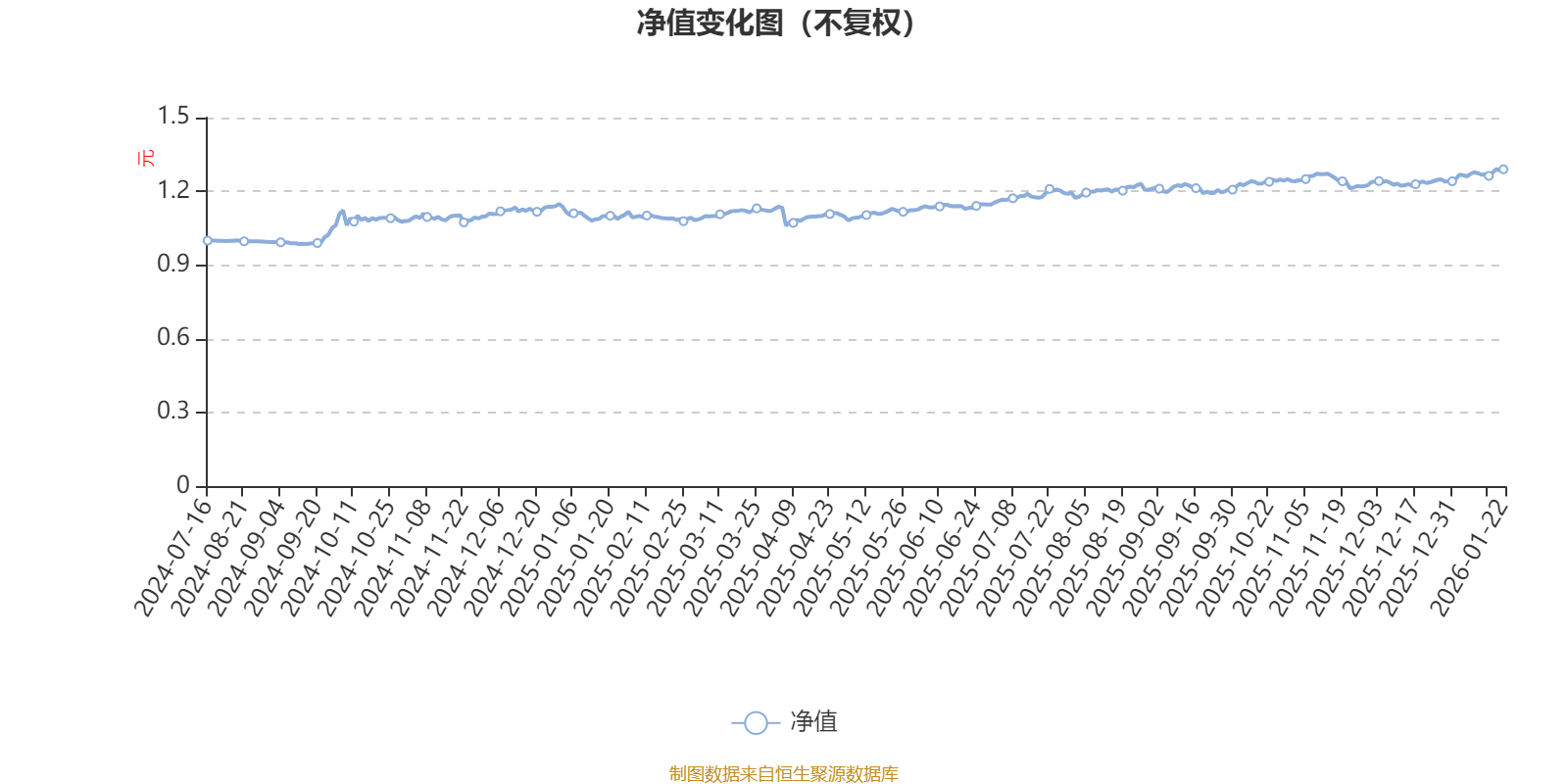
Group 1 - The core viewpoint of the report indicates that the fund, AI Fund China Europe Dividend Select Mixed Initiation A, has shown a profit of 1.5113 million yuan in Q4 2025, with a weighted average profit per fund share of 0.032 yuan. The fund's net value growth rate for the reporting period was 2.8%, and the fund size reached 61.4973 million yuan by the end of Q4 [3][15] - The fund is categorized as a mixed equity fund, with a unit net value of 1.29 yuan as of January 22. The fund managers are Liu Yong and Zhang Xue Ming [3] - The fund management expresses optimism about the future of dividend investment in China, suggesting there is still room for further development and deeper exploration. They plan to enhance research in this area and refine existing dividend strategies [3] Group 2 - As of January 22, the fund's three-month cumulative net value growth rate is 4.09%, ranking 514 out of 689 comparable funds. The six-month growth rate is 6.58%, ranking 603 out of 689, and the one-year growth rate is 18.55%, ranking 581 out of 673 [3] - The fund's Sharpe ratio since inception is 1.3735, indicating a favorable risk-adjusted return [8] - The maximum drawdown since inception is 6.78%, occurring in Q2 2025, which is the highest quarterly drawdown recorded [11] Group 3 - The average stock position since inception is 86.6%, compared to the peer average of 84.04%. The fund reached its highest stock position of 92.16% at the end of Q3 2025 and its lowest of 67.43% at the end of Q3 2024 [14] - As of the end of Q4 2025, the fund's top ten holdings include Guangzhou Development, Nanjing High-Tech, Weifu High-Tech, Huadian International, Ordos, Nanjing Steel, Wuxi Bank, Shandong Publishing, Guiyang Bank, and Zhongchuang Zhiling [18]




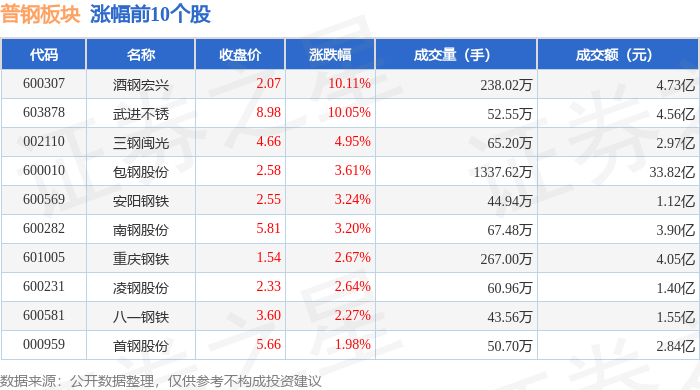
普钢板块1月23日涨1.53%,酒钢宏兴领涨,主力资金净流入3.97亿元
Zheng Xing Xing Ye Ri Bao· 2026-01-23 09:04
Market Performance - The steel sector saw an increase of 1.53% on January 23, with Jiugang Hongxing leading the gains [1] - The Shanghai Composite Index closed at 4136.16, up 0.33%, while the Shenzhen Component Index closed at 14439.66, up 0.79% [1] Individual Stock Performance - Jiugang Hongxing (600307) closed at 2.07, with a rise of 10.11% and a trading volume of 2.38 million shares, amounting to a transaction value of 473 million yuan [1] - Wujin Stainless Steel (603878) also saw a significant increase of 10.05%, closing at 8.98 with a trading volume of 525,500 shares [1] - Other notable performers included Sangang Min Guang (002110) with a 4.95% increase, Baogang Co. (600010) up 3.61%, and Anyang Steel (600569) up 3.24% [1] Capital Flow Analysis - The steel sector experienced a net inflow of 397 million yuan from main funds, while retail funds saw a net outflow of 169 million yuan [2] - Main funds showed significant net inflows in stocks like Baogang Co. (600010) with 194 million yuan and Jiugang Hongxing (600307) with 145 million yuan [3] - Conversely, retail investors had notable outflows from Jiugang Hongxing and Baogang Co., indicating a shift in investor sentiment [3]


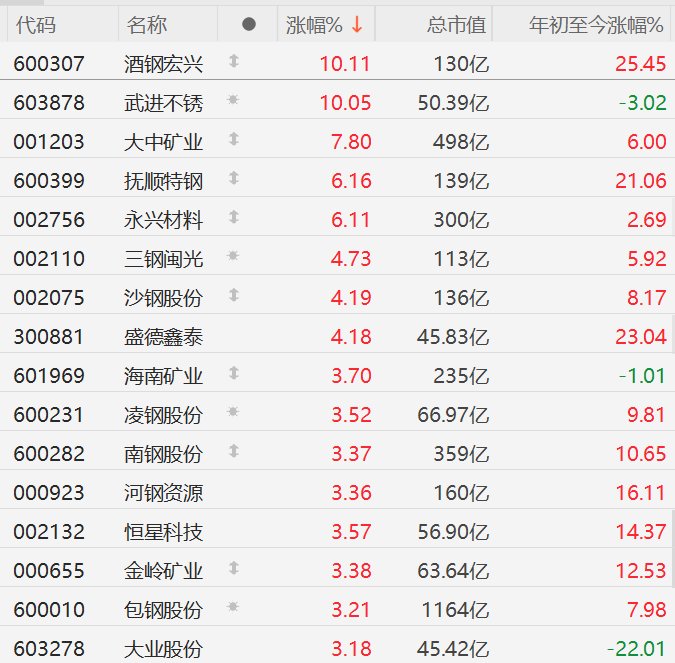
钢铁股拉升,酒钢宏兴、武进不锈涨停
Ge Long Hui· 2026-01-23 06:05
Core Viewpoint - The A-share market saw significant gains in the steel sector on January 23, with several stocks reaching their daily limit up, indicating strong investor interest and potential bullish sentiment in the industry [1]. Group 1: Stock Performance - Jiugang Hongxing (600307) experienced a rise of 10.11%, with a total market value of 13 billion and a year-to-date increase of 25.45% [1]. - Wujin Stainless Steel (603878) increased by 10.05%, with a market capitalization of 5.04 billion, but has seen a year-to-date decline of 3.02% [1]. - Dazhong Mining (001203) rose by 7.80%, with a market value of 49.8 billion and a year-to-date increase of 6.00% [1]. - Fushun Special Steel (600399) saw a gain of 6.16%, with a market capitalization of 13.9 billion and a year-to-date increase of 21.06% [1]. - Yongxing Materials (002756) increased by 6.11%, with a market value of 30 billion and a year-to-date rise of 2.69% [1]. - Sansteel Minguang (002110) rose by 4.73%, with a market capitalization of 11.3 billion and a year-to-date increase of 5.92% [1]. - Shagang Co. (002075) increased by 4.19%, with a market value of 13.6 billion and a year-to-date rise of 8.17% [1]. - Shengde Xintai (300881) saw a gain of 4.18%, with a market capitalization of 4.583 billion and a year-to-date increase of 23.04% [1]. Group 2: Additional Stock Movements - Yizhou Guoshi (601969) increased by 3.70%, with a market value of 23.5 billion but a year-to-date decline of 1.01% [1]. - Linggang Co. (600231) rose by 3.52%, with a market capitalization of 6.697 billion and a year-to-date increase of 9.81% [1]. - Nanjing Steel (600282) increased by 3.37%, with a market value of 35.9 billion and a year-to-date rise of 10.65% [1]. - Hebei Steel Resources (000923) saw a gain of 3.36%, with a market capitalization of 16 billion and a year-to-date increase of 16.11% [1]. - Hengxing Technology (002132) rose by 3.57%, with a market value of 5.69 billion and a year-to-date increase of 14.37% [1]. - Baogang Co. (600010) increased by 3.21%, with a market capitalization of 116.4 billion and a year-to-date rise of 7.98% [1].