
GXED(600617)

Search documents
2026年中国新能源汽车融资租赁行业政策、产业链、市场规模、重点企业及趋势研判:新能源汽车产销持续高速增长,带动融资租赁市场规模跃升至千亿元[图]
Chan Ye Xin Xi Wang· 2026-01-28 01:25
内容概况:新能源汽车的普及对促进环境保护、优化能源结构及带动经济发展具有深远意义,但其相对 高昂的初始购置成本与部分技术瓶颈,一度成为市场广泛接纳的关键障碍。在此背景下,融资租赁作为 一种能够有效降低用户拥有门槛、分散技术迭代风险的金融解决方案,其重要性日益凸显。新能源汽车 融资租赁市场,即由租赁公司或金融机构向消费者或企业提供以新能源汽车为标的物的租赁服务,当前 正步入高速发展的快车道。这一进程得到了政策与技术的双重驱动:在政策层面,国家将新能源汽车购 置税减免政策延续至2025年,并积极探索车电分离等创新模式;部分地方政府还推出针对性的融资租赁 贴息,直接激励采购与消费。这些政策不仅降低了消费者购买新能源汽车的成本,也促进了新能源汽车 融资租赁业务的发展。在市场层面,新能源汽车技术的持续进步与性能的显著提升,正不断改善用户体 验并提高市场接受度。尤其值得关注的是,以Z世代为代表的年轻消费群体,其"以租代购"的消费理念 更为普及,对环保、智能且具备网联功能的新能源汽车表现出强烈偏好。多方利好因素的叠加,共同推 动市场规模实现跨越式增长。数据显示,中国新能源汽车融资租赁行业市场规模从2015年的4.49亿元增 ...


国新能源:公司目前尚未建设财务共享中心
Zheng Quan Ri Bao Wang· 2026-01-27 13:16
证券日报网讯 1月27日,国新能源(600617)在互动平台回答投资者提问时表示,公司目前尚未建设财 务共享中心。随着公司不断的发展,公司将继续提高财务数字化、智能化的水平。 ...
国新能源(600617.SH):我公司目前尚未建设财务共享中心
Ge Long Hui· 2026-01-27 10:35
Group 1 - The company, Guo Xin Energy (600617.SH), has stated that it has not yet established a financial shared service center [1]
研判2026!中国新能源汽车高压部件行业进入壁垒、政策汇总、产业链图谱、市场规模、竞争格局及发展趋势分析:市场格局较为分散[图]
Chan Ye Xin Xi Wang· 2026-01-27 01:29
Core Viewpoint - The Chinese electric vehicle (EV) high-voltage component industry has transitioned from policy-driven to market-driven growth, with increasing consumer acceptance of pure electric and hybrid models, leading to a significant expansion in production and sales, and a surge in demand for high-voltage components [1][10]. Industry Overview - The high-voltage system in EVs is crucial for energy storage, conversion, transmission, and usage, operating at hundreds of volts, which distinguishes EVs from traditional fuel vehicles [2]. - High-voltage components are essential for the efficient operation of EVs, enabling energy management and enhancing overall performance [4]. Market Size and Growth - By 2025, the market size of China's high-voltage component industry is projected to reach 311.66 billion yuan, representing a year-on-year growth of 26.5%, capturing 49.32% of the global market share [1][10]. - In the first nine months of 2025, China's production and sales of new energy vehicles reached 11.24 million and 11.23 million units, respectively, with a year-on-year growth of 35.2% and 34.9% [8]. Industry Barriers - The high-voltage component industry faces significant technical barriers, requiring precise design, programming skills, and a deep understanding of system logic to ensure performance, reliability, and safety [5][6]. Market Policies - The Chinese government has implemented various policies to support the development of the automotive parts industry, including high-voltage components, creating a favorable environment for growth [6]. Industry Chain - The upstream of the high-voltage component industry includes suppliers of raw materials like copper, aluminum, and rare earths, while the downstream consists of EV manufacturers and the aftermarket, which is seeing increased demand as early EVs enter replacement cycles [7][8]. Competitive Landscape - The industry is characterized by a fragmented market with numerous players focusing on specific segments. Key companies include Xinrui Technology, Zhonghang Optoelectronics, BYD Semiconductor, and Futec Technology [10][11]. Development Trends - The industry is expected to see a shift towards higher voltage and efficiency, with wide bandgap semiconductor materials playing a crucial role in enhancing energy conversion efficiency [14]. - There will be a trend towards system integration and modularization, aiming for lightweight designs and cost control [14]. - Collaboration within the supply chain will deepen, with a focus on localizing key materials and components to build a self-sufficient supply chain [15].




2026年中国新能源汽车PTC控制器行业市场政策汇总、产业链图谱、市场规模、竞争格局及发展趋势分析:CR5市场占有率达59.6%[图]
Chan Ye Xin Xi Wang· 2026-01-27 01:22
Core Viewpoint - The PTC controller market in China is expected to grow rapidly, reaching a market size of 2.137 billion yuan by 2025, with a year-on-year growth of 15.3%, accounting for 48.08% of the global market [1][4]. Overview - PTC controllers are essential components in PTC heaters, which are crucial for the thermal management systems of electric vehicles [1][4]. - The high-voltage components of electric vehicles include various systems such as electric drive, power supply, battery, thermal management, range extender, and charging infrastructure [1]. Market Policies - The Chinese government has implemented several policies to support the development of the automotive parts industry, including PTC controllers, creating a favorable environment for growth [5][6]. Industry Chain - The upstream of the PTC controller industry includes suppliers of power devices, chips, capacitors, PCBs, and sensors, while the downstream consists of electric vehicle manufacturers and the aftermarket [6][7]. - Major electric vehicle manufacturers like BYD, Tesla, and NIO are the core demand drivers for PTC controllers [6]. Development Status - The PTC controller market in China is projected to expand significantly, driven by the rapid growth of the electric vehicle market and continuous upgrades in thermal management systems [1][4]. Competitive Landscape - The market for PTC controllers is characterized by significant customer barriers, with major manufacturers like Fudi Technology, Shanghai Jinmai, and Dongfang Electric showing strong competitive advantages [9]. - By 2024, the combined market share of the top five companies in the PTC controller sector is expected to reach 59.6%, with Fudi Technology holding the largest share at 20.12% [9]. Development Trends - The industry is moving towards high-voltage and integrated solutions, with ceramic PTCs becoming the mainstream technology due to their advantages in high voltage and thermal efficiency [11]. - The market is expected to see a shift towards third-party control suppliers, leading to increased market concentration and the need for differentiation among smaller firms [12]. - The dual carbon goals and energy efficiency standards are driving the demand for low-energy and high-reliability PTC controllers, with new growth opportunities emerging in commercial electric vehicles and international markets [13].

截至2025年底全国新能源汽车保有量达4397万辆 占汽车总量的12.01%
Xin Lang Cai Jing· 2026-01-26 08:51
Core Insights - The Ministry of Public Security reported that by the end of 2025, the total number of new energy vehicles (NEVs) in China is expected to reach 43.97 million, accounting for 12.01% of the total number of vehicles [1] - Among these, the number of pure electric vehicles (EVs) is projected to be 30.22 million, representing 68.74% of the NEV total [1] - In 2025, new registrations of NEVs are anticipated to be 12.93 million, making up 49.38% of all new vehicle registrations, which is an increase of 1.68 million or 14.93% compared to 2024 [1]
乘联分会崔东树:2025年中国新能源汽车出口量343万辆,同比增长70%
Huan Qiu Wang Zi Xun· 2026-01-26 08:20
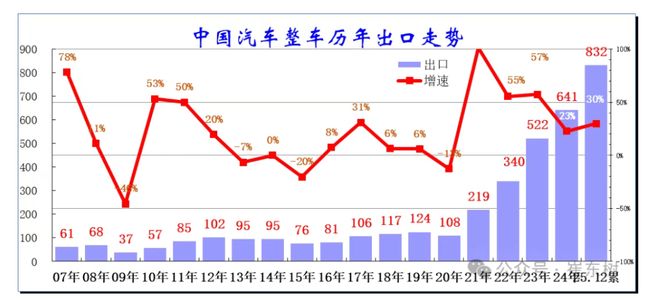
崔东树公布的数据显示,2025年12月中国汽车实现出口99万辆,同比增73%,环比增23%,同比和环比 走势总体较强;全年中国汽车实现出口832万辆,同比2024年全年增速30%。 数据显示,2025年12月中国汽车出口中纯电动占比25%(同比+4%),插混占比17%(同比+11%),混 动占比7%(同比+2%),纯燃油车占比40%(同比-18%)。2025年全年中国汽车出口中纯电动占比 28%(同比+2%),插混占比13%(同比+8%),混动占比6%(同比+2%),纯燃油车占比43%(同 比-11%)。 崔东树表示,中国新能源车2025年全年出口表现好于预期,主要是插混和混动替代纯电动成为出口增长 的新增长点,尤其是插混的皮卡出口表现较强,成为商用车新能源车出口亮点。中国新能源车出口向中 东和发达国家市场呈现高质量发展的局面,主要是出口西欧和亚洲市场。(思瀚) 来源:环球网 【环球网科技综合报道】1月26日消息,乘联分会秘书长崔东树发文称,2025年12月中国新能源汽车出 口42万辆,同比增长174%,表现很好;2025年全年新能源汽车出口量343万辆,同比增长70%,增速高 于2024年全年的16%较多。 ...
公安部:截至2025年底全国新能源汽车保有量达4397万辆
Zhong Zheng Wang· 2026-01-26 05:04
中证报中证网讯(记者 李嫒嫒)1月26日,公安部交通管理局微信公众号发布数据显示,据公安部统 计,2025年全国机动车保有量达4.69亿辆,其中汽车3.66亿辆;机动车驾驶人达5.59亿人,其中汽车驾 驶人5.25亿人。 截至2025年年底,全国新能源汽车保有量达4397万辆,占汽车总量的12.01%;其中纯电动汽车保有量 3022万辆,占新能源汽车保有量的68.74%。2025年新注册登记新能源汽车1293万辆,占新注册登记汽 车数量的49.38%,与2024年相比增加168万辆,增长14.93%。 ...
全国新能源充电设施突破2000万个,大功率快充与乡村布局仍不足
Jing Ji Guan Cha Wang· 2026-01-24 06:20
Core Viewpoint - The National Energy Administration of China has reported significant growth in electric vehicle (EV) charging infrastructure, projecting a total of 20.092 million charging points by 2025, representing a year-on-year increase of 49.7% [2] Group 1: Charging Infrastructure Growth - By 2025, the number of private charging facilities is expected to reach 15.375 million, up 82% year-on-year, while public charging facilities will total 4.717 million, reflecting a 31.9% increase [2] - The growth in charging infrastructure has accelerated, with the time taken to increase from 1 million to 10 million charging points reduced from 13 years to just 18 months [2][3] - The average charging power of public charging stations has increased to 46.5 kW, with a 33% improvement in charging efficiency [2][3] Group 2: Coverage and Accessibility - Charging stations have been established in 98% of highway service areas, with 71,500 charging points built, and 19 provinces achieving full coverage of charging facilities in rural areas [3] - The current charging infrastructure is concentrated in economically developed regions, with the top 10 regions accounting for 65.7% of public charging facilities by 2025 [4] Group 3: Market Dynamics and Competition - The market share of the top five charging operators is projected to decline from 65.4% in 2024 to 61.1% in 2025, indicating increased competition [5] - The total number of battery swap stations is expected to reach 5,155 by 2025, marking a 16% increase from the previous year [5] Group 4: Future Projections - The "Three-Year Doubling" action plan aims to establish 28 million charging facilities by the end of 2027, catering to over 80 million electric vehicles [3][4] - Predictions indicate that by 2026, there will be an addition of 7.419 million private charging facilities and 1.448 million public charging facilities [5]
2025年山西省能源生产情况:山西省发电量4405.8亿千瓦时,同比下滑0.8%
Chan Ye Xin Xi Wang· 2026-01-24 02:47
Core Insights - The report highlights a decline in electricity generation in Shanxi Province, with a total generation of 440.58 billion kWh in 2025, representing a year-on-year decrease of 0.8% [1] - The breakdown of electricity generation by type shows that thermal power accounts for 80.5% of the total, with a generation of 354.58 billion kWh, down 3.6% year-on-year [1] - Renewable energy sources are showing growth, with wind power generation increasing by 13.8% to 55.58 billion kWh and solar power generation rising by 13.2% to 25.875 billion kWh [1] Electricity Generation Overview - In December 2025, Shanxi Province's electricity generation was 42.26 billion kWh, reflecting a year-on-year decline of 3% [1] - The total electricity generation in Shanxi Province is primarily driven by thermal power, followed by wind and solar energy, indicating a shift towards renewable sources despite the overall decline [1] Industry Context - The report is part of a broader analysis by Zhiyan Consulting, which focuses on the energy sector in China from 2026 to 2032, assessing market trends and investment opportunities [1] - The data is sourced from the National Bureau of Statistics and is organized to ensure comparability with previous years, reflecting the evolving landscape of industrial enterprises in the region [2]


