
GXED(600617)

Search documents
在太阳能展会感知中国新能源产业点亮非洲
Xin Hua She· 2026-02-05 03:39
Group 1 - The 2026 Africa International Solar Energy Exhibition was held in Nairobi, Kenya, showcasing clean energy products like photovoltaic modules and energy storage devices, highlighting the impact of Chinese renewable energy companies in Africa [1] - Cynthia Muhati, acting CEO of the Kenya Renewable Energy Association, noted that Chinese renewable energy products significantly improve local living standards, enabling better education and income opportunities for families [1] - Many African households face challenges such as frequent power outages and high electricity costs, making renewable energy a practical and affordable solution [1] Group 2 - Chinese companies showcased products designed for the African environment, emphasizing features like high-temperature resistance and dust-proof capabilities [2] - Longi Green Energy's sales manager mentioned that their bifacial solar panels enhance efficiency and stability while also addressing fire, dust, and bird droppings [2] - Collaboration with local universities and training initiatives has sparked interest among young people in renewable energy, fostering local talent in installation, design, and entrepreneurship [2] Group 3 - Discussions among exhibitors focused on practical issues such as implementation, cost reduction, and expanding coverage, reflecting the real challenges faced in Africa's energy transition [3] - Ayo Ademilua, CEO of the Nigerian Renewable Energy Association, emphasized the crucial role of Chinese companies in Africa's renewable energy development, predicting more factories and training initiatives in the coming years [3] - The presence of stable and clean electricity is transforming lives in Africa, moving the energy transition from concept to reality, with Chinese renewable energy industries playing a pivotal role in this process [3]

2025我国新能源装机占比超80%,绿色电力ETF嘉实(159625)一键布局绿电相关产业投资机遇
Xin Lang Cai Jing· 2026-02-05 03:02
Group 1 - The core viewpoint of the news highlights the performance of the National Green Power Index, which fell by 1.36% as of February 5, 2026, with mixed results among constituent stocks [1] - In 2025, China's new energy installed capacity reached a historical high, with a total of 434.4 GW added, accounting for 80.2% of all new power generation installations; solar power capacity reached 1.2 billion kW, a year-on-year increase of 35.4%, while wind power capacity reached 640 million kW, a year-on-year increase of 22.9% [1] - Zhongyuan Securities suggests a "barbell strategy" for power asset allocation, focusing on cutting-edge areas like virtual power plants and controllable nuclear fusion for offensive investments, while defensive investments should target large hydropower and high-dividend thermal power companies with stable profitability [1] - Galaxy Securities notes the introduction of a capacity price mechanism for coal, gas, pumped storage, and new energy storage, marking a significant upgrade for storage from an auxiliary service role to a core function of the power system, which is expected to enhance profitability stability and construction enthusiasm [1] Group 2 - As of January 30, 2026, the top ten weighted stocks in the National Green Power Index include China Nuclear Power, Yangtze Power, Three Gorges Energy, and others, collectively accounting for 52.75% of the index [2] - The Green Power ETF by Harvest (159625) closely tracks the National Green Power Index, serving as a convenient tool for investing in the overall performance of listed companies related to green power [2] Group 3 - Investors can seize investment opportunities through the corresponding Green Power ETF linked fund (017057) [3]
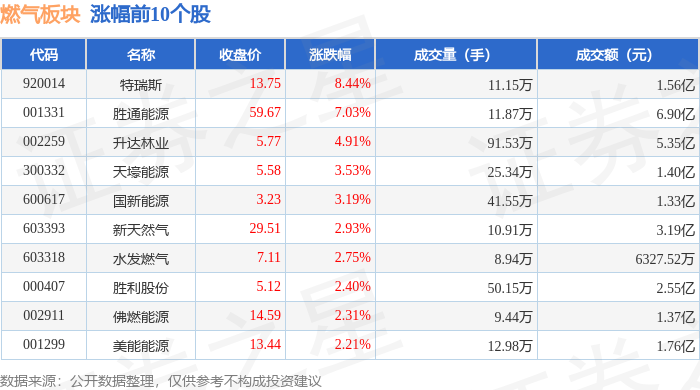
燃气板块2月4日涨1.4%,特瑞斯领涨,主力资金净流出1695.62万元
Zheng Xing Xing Ye Ri Bao· 2026-02-04 08:56
Market Performance - The gas sector increased by 1.4% compared to the previous trading day, with Teris leading the gains [1] - The Shanghai Composite Index closed at 4102.2, up 0.85%, while the Shenzhen Component Index closed at 14156.27, up 0.21% [1] Individual Stock Performance - Teris (code: 920014) closed at 13.75, up 8.44%, with a trading volume of 111,500 shares and a transaction value of 156 million yuan [1] - Shengtong Energy (code: 001331) closed at 59.67, up 7.03%, with a trading volume of 118,700 shares and a transaction value of 690 million yuan [1] - Shengdalin Forestry (code: 002259) closed at 5.77, up 4.91%, with a trading volume of 915,300 shares and a transaction value of 535 million yuan [1] - Tianhao Energy (code: 300332) closed at 5.58, up 3.53%, with a trading volume of 125,340 shares and a transaction value of 14 million yuan [1] - New Energy (code: 600617) closed at 3.23, up 3.19%, with a trading volume of 415,500 shares and a transaction value of 13.3 million yuan [1] Capital Flow Analysis - The gas sector experienced a net outflow of 16.96 million yuan from institutional funds and a net outflow of 90.12 million yuan from speculative funds, while retail investors saw a net inflow of 107 million yuan [2] - New Natural Gas (code: 603393) had a net outflow of 37.81 million yuan from institutional funds, while Shengtong Energy (code: 001331) saw a net inflow of 29.42 million yuan [3] - The overall capital flow indicates a mixed sentiment among different investor types within the gas sector [2][3]


【回望2025】聚焦风险链,穿透安全场:C-EVES中国新能源汽车安全专项的“创新”实践
Zhong Guo Qi Che Bao Wang· 2026-02-04 06:22
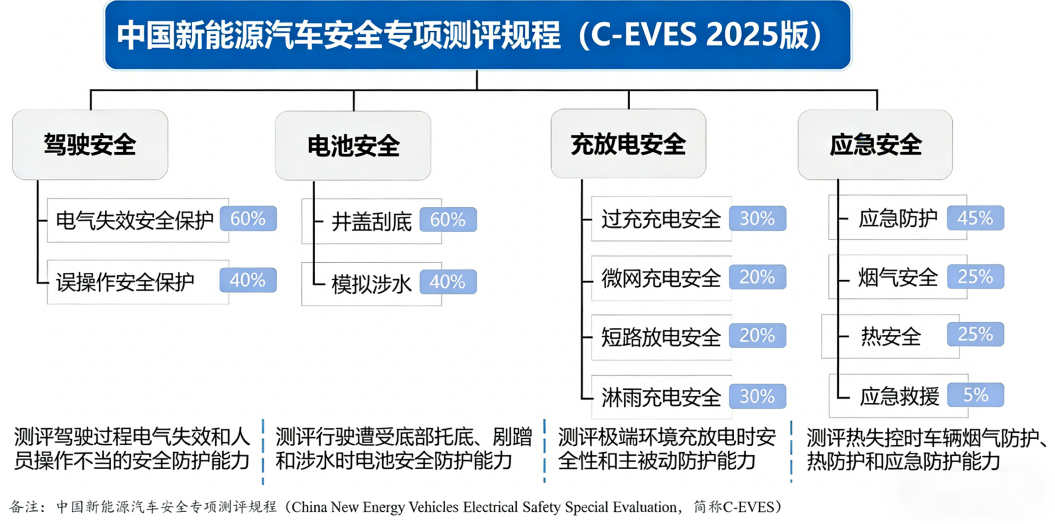
Core Viewpoint - The introduction of the C-EVES (China Electric Vehicle Evaluation System) represents a significant innovation in safety assessment for electric vehicles, aligning with national strategies for high-quality development and emphasizing the importance of safety in gaining consumer trust [1][10]. Group 1: Innovation in Assessment - C-EVES introduces a "scene correlation" assessment logic that addresses the disconnect between traditional testing methods and real-world driving scenarios, focusing on a continuous evaluation of driving safety, battery safety, charging and discharging safety, and emergency safety [2][4]. - The assessment method aims for "full-chain risk penetration," transitioning from validating single risks to evaluating interconnected risks within user behavior [2][7]. Group 2: Focus on Key Risk Areas - The assessment framework targets four critical scenarios: - **Driving Safety**: Evaluates the vehicle's proactive protection against operational errors, revealing that many models only provide alerts without taking necessary safety measures [4][6]. - **Battery Safety**: Tests the battery's resilience under extreme conditions, with findings indicating variability in structural integrity among different models [4][6]. - **Charging and Discharging Safety**: Assesses vehicle performance under abnormal electrical conditions, highlighting areas for improvement in safety features during complex charging scenarios [4][6]. - **Emergency Safety**: Integrates fire research to evaluate escape routes and survival chances during thermal runaway incidents, identifying common shortcomings in emergency response features [5][6]. Group 3: Industry Collaboration - The C-EVES framework was developed through collaboration with over 20 organizations, including global NCAP institutions and major automotive companies, reflecting a consensus on enhancing safety standards in the industry [8]. - The process of creating C-EVES involved extensive discussions and expert reviews, showcasing an open and rigorous collaborative innovation mechanism [8]. Group 4: Future Implications - The launch of C-EVES is not only a technical innovation but also a profound response to the industry's safety development philosophy, aiming to build a robust safety framework for the future of the electric vehicle sector [10]. - This initiative is expected to contribute to the global discourse on automotive safety governance, positioning China as a leader in innovative safety solutions [10].
中国新能源汽车在西班牙销量快速增长
Xin Hua She· 2026-02-03 03:49
Core Insights - In 2025, BYD, a leading Chinese electric vehicle manufacturer, registered 25,500 new vehicles in Spain, marking a year-on-year increase of 410% [2] Industry Summary - The significant growth in BYD's new vehicle registrations in Spain highlights the robust development momentum of the Chinese electric vehicle industry [2]

对话英国访华团成员:中国新能源非常惊人,英企还可以做这些
Guan Cha Zhe Wang· 2026-02-03 02:42
Group 1: Core Insights - The visit of UK Prime Minister Keir Starmer to China marks a significant effort to enhance cooperation, particularly in the energy sector, with a large delegation of over 60 UK business leaders [1] - Greg Jackson, CEO of Octopus Energy, emphasizes the potential for collaboration in renewable energy, highlighting China's leadership in solar, battery, and wind technologies [3][4] - Jackson notes that the cost of batteries has decreased by 20 times over the past 15 years due to China's investment in R&D, which has transformed the global energy landscape [3][4] Group 2: Energy Cooperation - Octopus Energy is already collaborating with Chinese companies like BYD and Chery to introduce electric vehicles to Europe, showcasing a commitment to innovation [4][5] - The establishment of joint ventures in the electricity trading sector is a goal for Octopus Energy, leveraging experiences from other regions to help reduce electricity prices in China [5][6] - Jackson highlights the importance of a customer-centric approach and data-driven optimization software as unique advantages for Octopus Energy in the competitive energy market [6][7][9] Group 3: Policy and Market Dynamics - Jackson expresses hope for maintaining low tariffs on Chinese renewable energy products, which he believes is crucial for fostering business collaboration [12] - He discusses the need for mutual respect and understanding in the partnership between the EU and China, particularly in the electric vehicle sector [12][13] - The transition from fossil fuels to electric power is seen as a significant opportunity for both the UK and EU, with a focus on increasing local energy supply and reducing dependence on imports [13][16] Group 4: China's Green Energy Ecosystem - Jackson praises China's effective focus on electrifying energy consumption, particularly through the promotion of electric vehicles, contributing to a cleaner environment [15][16] - He notes that three-quarters of global clean energy construction is taking place in China, indicating a strong momentum in the renewable energy sector [16][17] - The enthusiasm for investment opportunities from both UK and Chinese businesses is highlighted as a key takeaway from the visit, reflecting a shared vision for a sustainable future [18]

我国新能源新增发电量占全社会新增用电量97.1%
Xin Lang Cai Jing· 2026-02-02 08:25
Core Insights - The China Electricity Council has reported that by 2025, the country will add 550 million kilowatts of new power generation capacity, with wind and solar energy accounting for 440 million kilowatts, representing 80.2% of the total new capacity [1] Group 1 - The new power generation capacity will predominantly come from renewable sources, with wind, solar, and biomass contributing to 97.1% of the total new electricity generation, indicating a significant shift towards green energy [1] - The continuous enhancement of green electricity supply capabilities reflects China's ongoing efforts in energy and power green and low-carbon transformation [1]
2025年中国新能源客车出口市场现状分析 出口市场新能源渗透率超过18%【组图】
Qian Zhan Wang· 2026-01-30 09:08
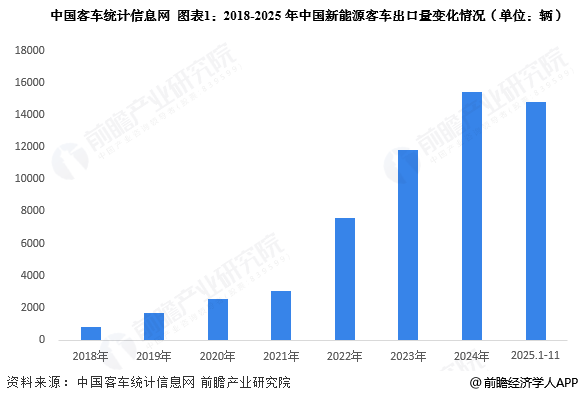
转自:前瞻产业研究院 以下数据及分析来自于前瞻产业研究院新能源客车研究小组发布的《中国新能源行业发展前景与投资战 略规划分析报告》 从中国新能源客车出口量来看,参考中国客车统计信息网披露的数据,2018-2024年呈现快速增长态 势,2024年中国新能源客车出口量超过1.5万辆,2025年上半年出口量达到7629辆,超过2023年全年, 截至11月,中国新能源客车出口量达到1.48万辆。 本文核心数据:新能源客车出口量;新能源客车出口结构 近几年新能源客车出口量快速增长 新能源客车出口市场渗透率超过18% 从新能源客车出口量占客车出口总量的比重来看,变化趋势与新能源客车出口量趋势一致,2018-2024 年逐年递增,2024年超过18%,在全球节能减排、低碳环保趋势的带动下,该占比有望进一步提升。 比亚迪出口量排名第一 行业主要上市公司:宇通客车(600066.SH)、中通客车(000957.SZ)、中国中车(601766.SH)、安凯客车 (000868.SZ)、福田汽车(600166.SH)、金龙汽车(600686.SH)、比亚迪(002594.SH)、东风股份 (600006.SH)、长安汽车(0006 ...
中国新能源汽车持续领跑全球
Ren Min Ri Bao· 2026-01-29 00:29
Core Insights - The article highlights the significant advancements in China's electric vehicle (EV) industry, showcasing the achievements of companies like Seris Group and the government's commitment to developing high-quality manufacturing and core technologies in the automotive sector [1][2]. Group 1: Industry Growth and Government Support - The Chinese EV market is experiencing robust growth, with production and sales expected to reach 16.626 million and 16.49 million units respectively in 2025, marking year-on-year increases of 29% and 28.2% [1]. - The government's emphasis on developing new energy vehicles is seen as essential for transitioning from a major automotive nation to a strong automotive power, focusing on self-reliance in key technologies and components [1]. Group 2: Technological Advancements - The integration of artificial intelligence in the EV sector is enhancing competitiveness, with companies like Xpeng and Geely making strides in autonomous driving and AI applications [3]. - Geely's Starry Smart Computing Center, with a computing power of 23.5 quintillion operations per second, is accelerating the implementation of "full-domain AI" in the automotive industry [3]. Group 3: Market Dynamics and Competition - Measures to combat "involution" in the automotive industry, such as product consistency checks and anti-unfair competition enforcement, are beginning to yield results, correcting issues like chaotic price wars [4]. - The shift from resource-intensive, low-price competition to technology innovation and value enhancement is evident, with mainstream automakers focusing on high-quality supply and brand elevation [4]. Group 4: Safety Standards and Innovations - New safety standards are being established to enhance the safety baseline for EVs, with rigorous testing protocols being implemented to ensure vehicle safety in various scenarios [5][6]. - As of October 2025, the installation rate of automatic emergency braking systems in new passenger EVs reached 72.1%, reflecting a growing focus on safety innovations [6].
加强研发 加快转型 加力拓展市场 中国新能源汽车持续领跑全球(向新向优的中国产业)
Ren Min Ri Bao· 2026-01-28 23:05
Core Viewpoint - The advancements in China's electric vehicle (EV) industry, highlighted by technological breakthroughs and strong market performance, reflect the country's transition from a major automotive player to a leader in high-quality automotive manufacturing [1][2]. Group 1: Industry Growth and Market Performance - In 2025, China's EV production and sales are projected to reach 16.626 million and 16.49 million units, respectively, marking year-on-year growth of 29% and 28.2%, with EV sales accounting for 47.9% of total new car sales [1]. - The demand for EVs continues to grow, driven by policies such as trade-in programs and rural initiatives, showcasing the resilience and dynamic potential of the Chinese economy [2]. Group 2: Technological Advancements - The introduction of high-efficiency integrated powertrains and intelligent flexible manufacturing stations supports the production of both steel and aluminum vehicle bodies, demonstrating significant technological progress in the EV sector [1]. - Companies like Xpeng and Geely are leveraging artificial intelligence to enhance vehicle capabilities, with Xpeng's second-generation VLA model entering mass production and Geely's smart manufacturing initiatives aimed at reducing development cycles [3]. Group 3: Industry Standards and Safety Enhancements - New national standards for battery safety, driving assistance, and vehicle safety technologies are being developed to enhance the safety of EVs, with a reported installation rate of 72.1% for automatic emergency braking systems in new passenger EVs from January to October 2025 [6]. - The automotive industry is shifting from low-cost competition to a focus on technological innovation and value enhancement, with measures in place to combat disordered price wars and promote brand quality [4]. Group 4: Safety Testing and Innovations - Advanced safety testing protocols are being implemented, including crash tests that simulate real-world scenarios, ensuring that vehicles meet stringent safety requirements [5]. - The establishment of comprehensive safety centers allows for extensive testing of various safety features, contributing to the overall improvement of vehicle safety standards in the EV market [5].